
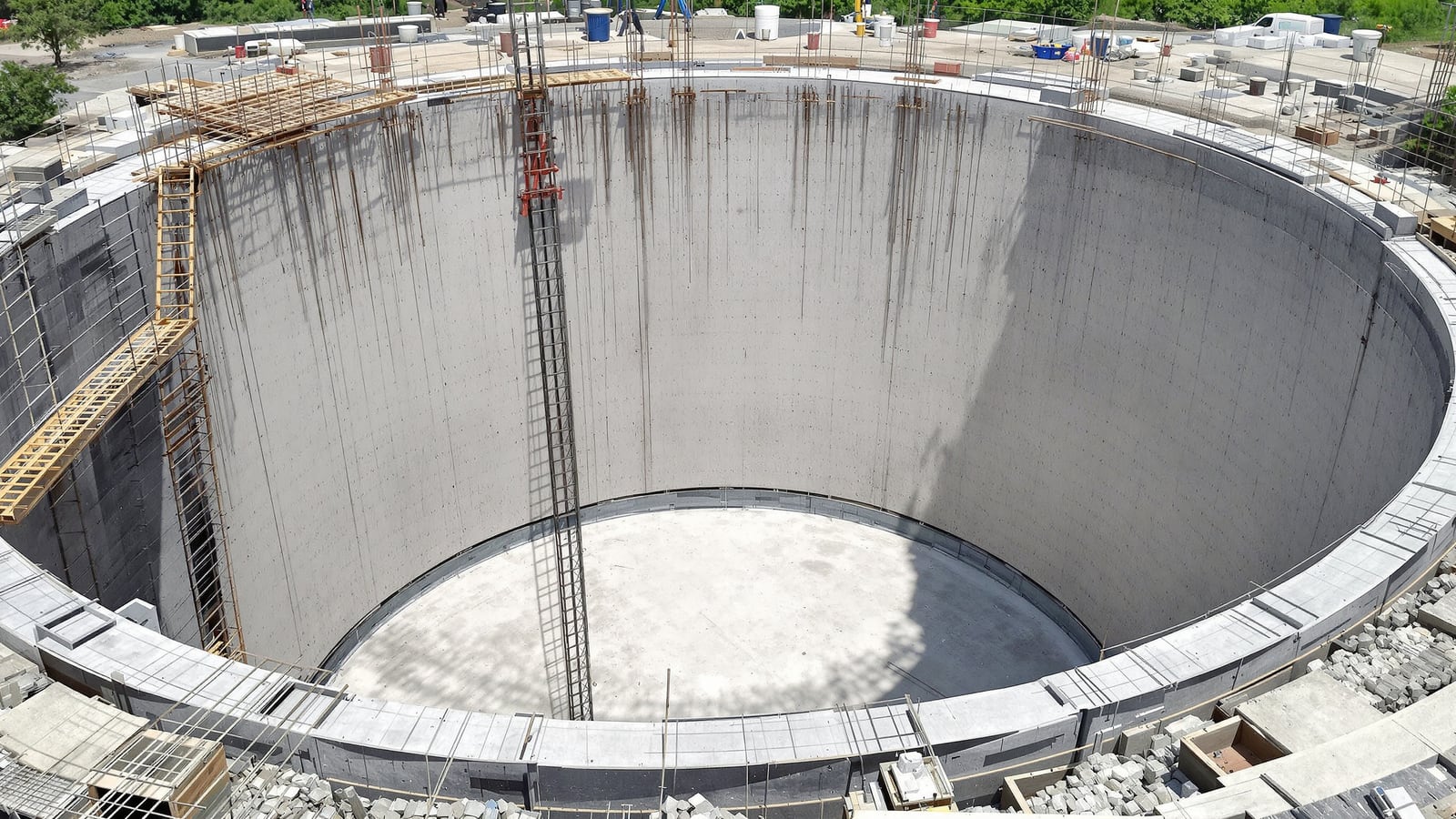
RCC Water Tank in India: Cast-in-Place Concrete Sumps & Overhead Tanks, Waterproofing, Cost & IS 3370
The reinforced cement concrete water tank — cast in place for large underground sumps and big overhead terrace tanks — how it is built to M25 watertight concrete, why waterproofing and IS 3370 detailing decide whether it leaks, food-grade lining, cleaning access and ventilation, life, indicative cost and where it beats plastic.
A reinforced cement concrete (RCC) water tank is a liquid-retaining structure cast in place from steel-reinforced concrete, and it is still the default in India wherever storage is large, buried, or has to carry structural load. The building's underground sump, the big overhead tank serving an apartment block, and the fire-water reserve are almost always RCC rather than moulded plastic. This guide is for designers, contractors and site engineers who have to specify and build one so that it holds water for decades without leaking.
It sits under the Studio Matrx water storage tanks guide and is a companion to the guides on underground sump tanks and plastic water tanks. For the auto-fill fitting see float valves; for how the tank fits the sump-to-pump-to-overhead supply chain see the domestic water distribution guide. For sizing, do not reinvent it here — use the bathroom water tank calculator with roughly 135 litres per person per day as the design demand.
Where RCC tanks are used
RCC earns its place where plastic cannot practically or economically go:
- Underground sumps. Below-ground storage takes soil and, where the water table is high, groundwater pressure on the outside. A monolithic RCC box handles both; a plastic tank buried in soil does not, and needs an RCC surround anyway. This is the most common RCC application in Indian homes and apartments.
- Large overhead tanks. Above roughly 5,000 litres, and certainly for apartment overhead reservoirs of tens of thousands of litres, RCC (or a staging with an RCC tank) is cast because a single moulded tank that size does not exist and multiple plastic tanks are clumsy to plumb and clean.
- Big buildings and campuses. Domestic, flushing and fire reserves for high-rises, hospitals, schools and industry are RCC, often compartmented so one cell can be isolated and cleaned while the other stays in service.
- Fire-water tanks, where a guaranteed static reserve is a statutory requirement.
Rule of thumb: below ~2,000 litres and above ground, plastic almost always wins on cost and hygiene. Buried, or above ~5,000 litres, RCC is usually the honest answer.
Role in the supply system
The sump stores incoming municipal or borewell water at ground level; a pump lifts it to the overhead tank; the building then feeds off the overhead tank by gravity. RCC can serve at either end, and in most projects both the sump and the large overhead reservoir are RCC.
How an RCC water tank is built
The tank is a liquid-retaining structure, which is a stricter design case than an ordinary RCC slab or beam. The governing standard is IS 3370 (Code of Practice for Concrete Structures for the Storage of Liquids), whose whole purpose is to limit cracking so the concrete stays watertight in service.
Concrete grade. IS 3370 practice is a minimum of M25 for water-retaining work (some designers hold M20 as an absolute floor for small tanks, but M25 is the sensible norm and is what most consultants specify). A low water-cement ratio, good compaction and proper curing matter more here than almost anywhere else, because it is the density of the concrete itself that resists water passing through it.
Reinforcement. Steel is detailed to keep crack widths small — closely spaced bars in both faces, generous cover to protect against corrosion in a permanently damp environment, and careful attention to wall-to-base and wall-to-wall junctions where restraint cracks form. Continuous construction, or properly detailed water-stops at any construction joint, keeps those joints from becoming leak paths.
Watertight concrete. The first line of defence against leakage is the concrete mix, not the coating over it. Dense, well-cured, low-permeability concrete — often with an integral waterproofing admixture batched in — is what a good RCC tank relies on. Coatings are the second line, not the first.
The waterproofing requirement
This is the part that decides whether an RCC tank is a success or a recurring headache. Concrete is not inherently waterproof, and a tank that cracks or seeps ruins the structure below and wastes stored water. Serious RCC tanks use a belt-and-braces approach:
1. Integral waterproofing — a crystalline or plasticising admixture dosed into the concrete so the body of the wall itself resists water.
2. A surface coating / membrane — a cementitious polymer-modified coating or an approved lining applied to the inside (the water face) after curing, and often to the outside of a buried tank against ground water.
- Cracks and leaks are the classic failure mode. They come from shrinkage, thermal movement, poor compaction (honeycombing), cold joints without water-stops, or overstressed steel. Design to IS 3370, cure properly, and detail joints — retrofitting waterproofing into a cracked tank is far more expensive than getting it right once.
- Test before use. Fill the tank and hold it for the specified period (a water-tightness / ponding test) and inspect for damp patches or drops on the outside before you finish and hand over.
The same logic that governs wet areas applies here; the bathroom waterproofing guide covers integral-plus-coating thinking in more depth.
Food-grade lining and hygiene
If the tank stores potable water, the internal coating must be food-grade / potable-water safe — a lining that does not leach into or taint the water. Bare cement can raise pH and shed fines early in a tank's life, so a certified internal coating both waterproofs and makes the surface hygienic and easy to clean. Insist on a product declared safe for drinking-water contact, not a generic waterproofing paint.
Cleaning access, ventilation and connections
An RCC tank is fixed and buried or overhead, so access has to be designed in:
- Access / manhole cover. A lockable, mosquito-proof, watertight cover large enough for a person to enter and clean the tank. Compartmenting a large tank lets one cell stay in service while the other is cleaned.
- Ventilation. A screened vent or air pipe so the tank breathes as the level rises and falls without drawing in dust or insects — important for both hygiene and to avoid pressure locking on a sealed tank.
- Inlet, outlet, overflow and washout. Inlet with a float valve to stop overfilling; outlet raised slightly off the floor so settled silt is not drawn into supply; an overflow pipe sized to pass the full inlet flow; and a washout / scour at the lowest point so the tank drains fully for cleaning. A gentle floor slope toward the washout helps.
- Detailed tank cleaning and disinfection schedules belong to a forthcoming maintenance guide; the takeaway here is to build the access that makes cleaning possible.
RCC versus plastic tanks
| Factor | RCC (cast-in-place) | Plastic (moulded PE) |
|---|---|---|
| Best use | Large, buried, structural, fire reserve | Small–medium, above ground |
| Typical capacity | 5,000 L to lakhs of litres | 200 L to ~10,000 L |
| Underground | Excellent (takes soil / water load) | Needs an RCC surround |
| Waterproofing | Critical, can crack and leak | Inherently watertight |
| Hygiene | Good with food-grade lining | Good; opaque tanks resist algae |
| Life | Decades (30+ years) | ~10–20 years |
| Cost & build time | High; weeks to cast and cure | Low; delivered and fitted in a day |
| Repair | Specialist crack injection / re-coat | Usually replace |
Indicative capacity, cost and life
Figures below are indicative for planning only — RCC cost swings widely with size, depth, soil, water table and finishing, so price it locally.
| Application | Typical capacity | Indicative build cost | Life |
|---|---|---|---|
| Small house sump | 5,000–10,000 L | ₹60,000–₹1,50,000 | 30+ years |
| Apartment underground sump | 20,000–50,000 L | ₹2,50,000–₹8,00,000+ | 30+ years |
| Large overhead RCC tank | 10,000–30,000 L | ₹2,00,000–₹6,00,000+ | 30+ years |
| Fire-water reserve | As per statute | Project-specific | 30+ years |
Pros: very long life, large and custom sizes, structurally strong, suits underground and fire-reserve duty, can be compartmented.
Cons: high cost and long build time, waterproofing is unforgiving and leaks are expensive to fix, needs a food-grade lining for potable use, and repairs are specialist work.
References
- IS 3370 — Code of Practice for Concrete Structures for the Storage of Liquids (design of liquid-retaining RCC structures, including crack-width control).
- IS 456 — Plain and Reinforced Concrete, Code of Practice (general RCC design).
- Studio Matrx: water storage tanks guide, underground sump tanks, plastic water tanks, float valves, and the bathroom water tank calculator.
Confirm grade, cover and waterproofing details with your structural consultant and IS 3370 for any tank you build.
Export this guide
Related Guides — Deep-dive reading
Underground Water Sump Tanks in India: Sizing, Waterproofing and Safe Placement
The below-ground reservoir that catches municipal and borewell water at ground level before a pump lifts it to your overhead tank — how it fits the supply chain, why waterproofing is make-or-break, how big to build it, where to keep it away from the sewer, and how to keep the pump from running dry.
PlumbingWater Storage Tanks Guide for India: Sump, Overhead, Sizing, Materials & Fittings
The master overview of how an Indian home stores water — why storage exists at all, the sump to pump to overhead-tank to gravity chain, how much to hold, underground versus overhead placement, plastic versus RCC versus steel, food-grade and hygiene, the inlet-outlet-overflow-vent-washout fittings, and cleaning at a glance.
PlumbingBathroom Planning for New Homes in India: Get It Right Before You Build
The bathroom decisions you cannot undo once the slab is cast — location and stacking, sunken vs non-sunken slabs, waterproofing, and the plumbing, electrical and ventilation you must coordinate with the civil work, stage by stage.
BathroomsRelated Tools — Try Free
Rainwater Tank Sizer
How big should your rainwater tank be? Computes annual harvest, recommended tank capacity in litres, water-bill savings, and payback — for 10 Indian cities.
RWH CalculatorBathroom Waterproofing Calculator
Work out waterproofing material (kg/L) and cost for a bathroom by area, wall band, system type and coats — cementitious, acrylic, PU or SBR.
Bathroom CalculatorBathroom Water Tank Calculator
Size the overhead storage tank and sump a home needs for its bathrooms and daily use, by people, bathrooms and reserve days.
Bathroom Calculator