
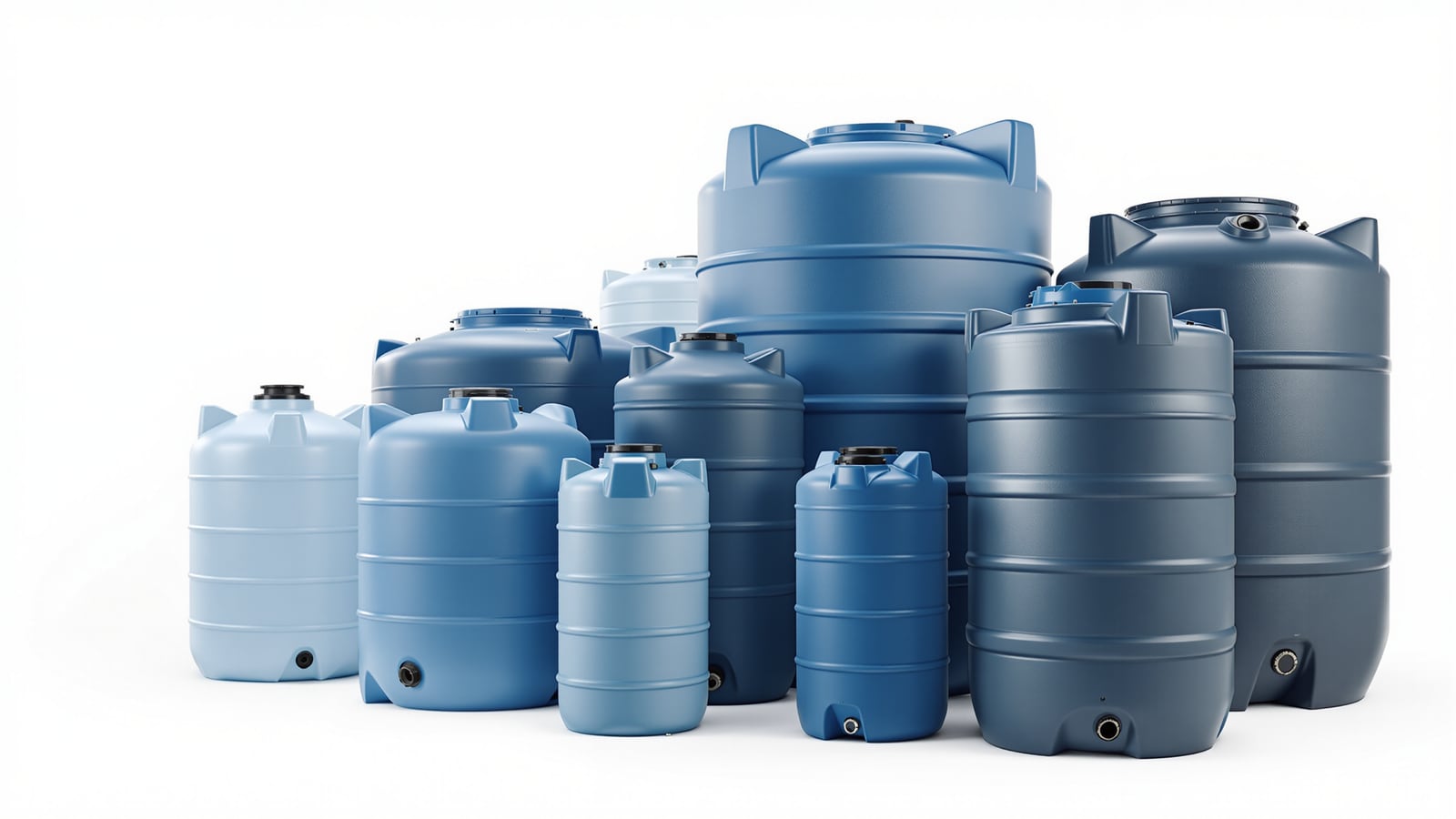
Plastic (Polyethylene) Water Tanks in India: Layers, Food-Grade, Sizes, Lifespan & Cost
The black or blue rotomoulded PE tank on almost every Indian roof — how rotational moulding works, single versus triple and four or five layer construction, food-grade FDA and BIS material, black anti-algae versus white and coloured bodies, common 500, 1000, 2000 and 5000 litre sizes, UV degradation and lifespan, cleaning, fittings, pros and cons against RCC and steel, and indicative prices.
The plastic water tank — technically a rotomoulded polyethylene (PE) tank — is the default way an Indian home stores water. Look across any city rooftop and the rows of black, blue and green drums you see are almost all PE tanks. They are light, seamless, rust-proof, cheap and quick to install, which is why they have largely replaced site-built masonry tanks for household overhead storage. This guide explains how they are made, what the "layers" on the label actually mean, how to read food-grade claims, which capacity suits your home, and how a plastic tank compares with RCC and steel.
This guide sits under the Studio Matrx water storage tanks guide and is a companion to the guides on overhead water tanks, RCC water tanks and steel water tanks. For picking a size in litres by household and bathrooms, use the bathroom water tank calculator rather than guessing, and for the automatic filling valve on top see float valves.
Where the plastic tank sits in the water system
In a typical Indian home water travels along a simple chain: the municipal or borewell supply fills an underground sump, a pump lifts that water to an overhead tank, and gravity from the overhead tank feeds every tap, cistern and geyser below. The plastic tank you see on the roof is usually the overhead tank in that chain; a larger PE tank can also serve as the underground or ground-level storage. Understanding this flow — covered in the water supply guide — matters because the tank's height sets your tap pressure and its volume sets how long you can ride out a supply cut.
How a rotomoulded PE tank is made
Rotational moulding, or rotomoulding, is what gives these tanks their seamless one-piece body. Powdered polyethylene is loaded into a hollow metal mould, the mould is closed and then slowly rotated about two axes inside an oven. As it turns, the powder melts and coats the entire inner surface evenly; the mould is then cooled and opened, and a jointless tank is lifted out.
Because there is no seam, weld or joint anywhere in the wall, a rotomoulded tank has no natural weak line to crack or leak — a key reason PE tanks are so durable for the price.
The number of times the operator adds a fresh charge of powder during the cycle decides how many layers the finished wall has, and that is the single most important thing on the label.
Reading the layers: single, triple and four or five layer
The layer count is a rotomoulding term for how many distinct plies make up the wall, each added for a reason. More layers mean better protection and a longer life, at a higher price.
- Single-layer: one plain PE wall. Cheapest, but sunlight and heat reach the water directly, so algae grows faster and the water heats up more. Fine for a cheap sump or non-drinking storage; not the best choice for exposed rooftop drinking water.
- Triple-layer (3-layer): the mainstream household choice. A black inner layer resists algae, a middle layer adds strength, and a UV-stabilised outer layer resists sun and colour fade. Most branded 3-layer tanks carry a long warranty.
- Four and five-layer: premium bodies that add a food-grade / anti-microbial inner layer and, in some, a foam insulation layer that keeps stored water noticeably cooler in summer. Worth it where the tank is fully sun-exposed or the water sits for long periods.
| Construction | Typical layers | Key benefit | Best for |
|---|---|---|---|
| Single-layer | 1 | Lowest cost | Sump, non-potable, budget builds |
| Triple-layer | 3 | Anti-algae inner + UV outer + strength | Most homes, exposed overhead tanks |
| Four-layer | 4 | Adds food-grade / anti-microbial inner | Drinking water, hot climates |
| Five-layer | 5 | Adds foam insulation, cooler water | Fully sun-exposed roofs, long storage |
Food-grade material and hygiene
For a tank that holds drinking water, the inner layer should be made from food-grade polyethylene — a virgin PE compound certified safe for potable water contact, often described against FDA food-contact norms and Indian BIS standards. Reputable brands mould the potable inner layer from virgin (not recycled) resin; cheap tanks sometimes use recycled scrap, which can taint taste and leach. Ask specifically for a food-grade, virgin-material inner layer, and prefer tanks that state compliance with the relevant BIS standard for rotational-moulded PE water tanks.
- Multi-layer premium tanks add an anti-microbial inner surface that suppresses bacterial growth on the wall.
- A well-fitting, lockable lid matters as much as the material — it keeps out dust, insects, birds and sunlight, all of which drive algae and contamination.
Black anti-algae versus white and coloured tanks
The colour is not just cosmetic. A black (or dark) body is nearly opaque, so almost no sunlight passes through the wall to feed algae inside — which is why black remains the most popular and the safest low-maintenance choice. White and light-coloured tanks let more light through and can encourage algae unless the inner layer is a dark, light-blocking ply; good multi-layer white tanks solve this with a black inner layer under the white skin. Light tanks do keep the water slightly cooler in the sun. The rule of thumb: for a plain single-layer tank pick black; for a multi-layer tank with a proper black inner layer the outer colour is your choice.
Common capacities and choosing a size
Household PE tanks come in standard steps — 500, 1000, 2000 and 5000 litres are the everyday sizes, with 300, 750 and 3000 litre options in between and larger 5000-litre-plus tanks for buildings. Indian planning norms assume roughly 135 litres per person per day (lpcd) for a fully plumbed home, so a family of four needs well over 500 litres a day before any buffer for supply cuts.
As indicative guidance only: a small flat might manage on 500–1000 L, a typical family home on 1000–2000 L of overhead storage, and larger homes on 2000–5000 L. Do not size by feel — use the bathroom water tank calculator to work out litres from people and bathrooms.
Placement, structural load and fittings
A full tank is heavy: water alone weighs about 1 kg per litre, so a 1000 L tank puts over a tonne on the roof, and a 2000 L tank over two tonnes, concentrated on its footprint. Because a PE tank has a flexible floor, it must sit on a full, flat, continuous base — a masonry platform, an RCC slab or a proper steel/PVC stand — never on a few loose bricks, which lets the floor sag and stress. On an existing roof, confirm the slab and beams can carry the load before placing a large tank.
Standard connections are simple to plumb:
- Inlet at the top, usually with a float valve so the tank stops filling automatically when full.
- Overflow near the top, piped to a safe drain so an overfill is visible and does not soak the roof.
- Outlet a little above the floor, so settled sediment stays below the draw-off point.
- Washout / drain at the very bottom for emptying and cleaning.
- A vent and a secure, well-fitting lid for air movement and access.
Fittings are threaded PP or brass tank connectors (nut, gasket and flange) fitted through drilled holes; a moulded tank makes drilling and sealing easy but every penetration must be gasketed well to avoid weeps.
Lifespan, UV degradation and cleaning
A good branded rotomoulded tank lasts around 10 to 15 years in Indian conditions, and often longer if it is shaded and well maintained. The main enemy is ultraviolet (UV) light: sustained sun slowly makes plain PE brittle, chalky and faded, and eventually prone to cracking. UV-stabilised outer layers on 3-layer and higher tanks resist this for years, which is exactly what the warranty is buying you. A tank baking on a fully exposed roof ages faster than one under a shade or on a lower floor.
For hygiene the tank should be cleaned every six months or so — drained, scrubbed to remove sediment and any biofilm, and refilled. A full cleaning schedule belongs to the Studio Matrx maintenance section (forthcoming); for now, keep the lid closed, keep the tank out of direct sun where you can, and inspect the outer surface yearly for chalking or hairline cracks.
Pros and cons versus RCC and steel
| Factor | Plastic (PE) | RCC (concrete) | Stainless steel |
|---|---|---|---|
| Weight (empty) | Very light | Very heavy | Light |
| Corrosion / rust | None | None (can crack, leak) | Excellent, food-safe |
| Installation | Drop-in, fast | Site-built, slow | Fabricated / modular |
| UV / weather life | 10–15 yrs, UV-limited | Very long if built well | Very long |
| Cost | Lowest | High (labour) | Highest |
| Repairability | Hard to repair; replace | Patchable | Weldable |
Plastic wins on price, weight and speed and never rusts, which is why it dominates household overhead storage. Its weaknesses are UV ageing and a shorter life than a well-built RCC or a quality stainless tank, and it is essentially non-repairable — a cracked tank is replaced, not patched.
Indicative cost
Prices vary by brand, layer count and capacity, but as a rough guide a branded triple-layer 1000 L overhead tank runs in the region of ₹6,000 to ₹10,000, a 500 L around ₹3,000 to ₹5,000, and a 2000 L roughly ₹12,000 to ₹18,000, with single-layer tanks cheaper and four or five-layer insulated tanks dearer. Treat these as indicative figures for planning and confirm current rates locally, since they move with resin prices.
References
- IS 12701 — Rotational moulded polyethylene water storage tanks (Bureau of Indian Standards), the Indian standard commonly referenced for rotomoulded PE tanks. Confirm the current edition before specifying.
- Studio Matrx: water storage tanks guide, overhead water tanks, RCC water tanks, steel water tanks.
Export this guide
Related Guides — Deep-dive reading
Water Storage Tanks Guide for India: Sump, Overhead, Sizing, Materials & Fittings
The master overview of how an Indian home stores water — why storage exists at all, the sump to pump to overhead-tank to gravity chain, how much to hold, underground versus overhead placement, plastic versus RCC versus steel, food-grade and hygiene, the inlet-outlet-overflow-vent-washout fittings, and cleaning at a glance.
PlumbingOverhead Water Tank on the Roof (India): Why It's Up There, Sizing, Structural Load, Fittings & Care
The rooftop tank is what gives your taps and showers their pressure. Why height creates head, how to size it, what a full tank weighs and how to support it on the slab, materials, staging height, overflow and vent, sun and algae, cleaning access, and when to run more than one tank.
PlumbingUnderground Water Sump Tanks in India: Sizing, Waterproofing and Safe Placement
The below-ground reservoir that catches municipal and borewell water at ground level before a pump lifts it to your overhead tank — how it fits the supply chain, why waterproofing is make-or-break, how big to build it, where to keep it away from the sewer, and how to keep the pump from running dry.
PlumbingRelated Tools — Try Free
Rainwater Tank Sizer
How big should your rainwater tank be? Computes annual harvest, recommended tank capacity in litres, water-bill savings, and payback — for 10 Indian cities.
RWH CalculatorWater Storage Days Calculator
Find how many days your water storage lasts in a supply cut from total capacity, occupants and per-person use.
Plumbing CalculatorMaterial Schedule Generator
Generate a room-wise finish schedule — walls, floors, ceilings, trim, and joinery by location.
Material Schedule