

Radiant & Underfloor Heating: Even, Comfortable Warmth from the Floor Up
The quiet, draft-free way to heat — how radiant and underfloor heating warm surfaces and people rather than blowing hot air, hydronic vs electric systems, where they suit Indian hill homes and bathrooms, and the comfort and efficiency case.
Most heaters blow hot air, which rises, dries the air and leaves your feet cold. Radiant and underfloor heating do the opposite: they warm the surfaces — the floor, and through it the objects and people in the room — for an even, gentle, draft-free warmth that feels comfortable at a lower air temperature. It's the same idea as radiant cooling, run the other way. In India it's a niche but genuinely lovely solution for hill homes and cold bathroom floors. This guide explains how it works and where it fits.
It builds on the Home Heating Guide, part of the HVAC Knowledge Hub.
Scope. A guide to inform choice and specification. Radiant/underfloor design and installation (embedded pipes or heating mats, controls, floor build-up) are qualified professional work.
How radiant heating works
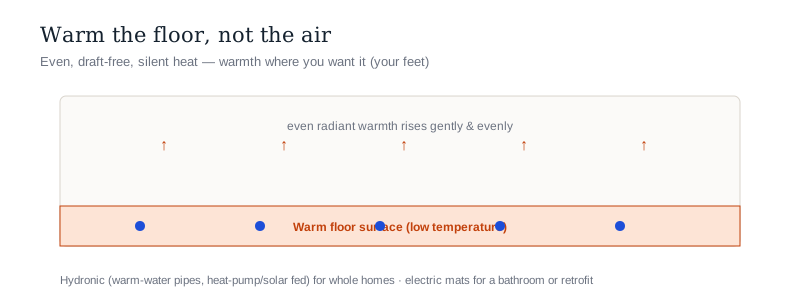
Radiant heating warms by radiation and surface contact, not by heating the air:
- A gently warm floor (or wall/panel) radiates infrared heat to everything in the room, including you — the same way the sun warms you across cold air.
- Because the whole floor is the emitter, it works at a low, comfortable surface temperature (a warm floor, not a hot one).
- There's no blown air, so no drafts, no dust stirred up, no dried-out air, and near silence.
- Heat starts at floor level — where you want it — so your feet are warm and the room is even top to bottom, unlike hot air that pools at the ceiling.
This is the opposite of a room heater or fan-based system, and the reason radiant heat feels so comfortable.
Hydronic vs electric
Two ways to warm the floor:
- Hydronic (warm-water) underfloor — pipes embedded in the floor screed carry warm water from a heat pump, solar thermal or a boiler. Efficient to run (especially heat-pump-fed, since it needs only mildly warm water), ideal for whole-home or large-area heating, but a bigger install best suited to new construction.
- Electric underfloor — thin heating mats/cables under the floor finish, warmed directly by electricity. Simpler and cheaper to install (good for a single room or a retrofit, like a bathroom), but resistance heating means higher running cost for large areas.
- Rule of thumb — electric mats for a small area or retrofit (a bathroom, a dressing area); hydronic for whole-home heating in a new hill house, ideally paired with a heat pump for efficiency.
Where it suits India
- Hill homes — Himachal, Uttarakhand, the North-East, hill stations: cold winters where whole-home comfort matters make hydronic underfloor a genuinely good fit, especially with a heat pump.
- Cold bathroom floors — a small electric mat under bathroom tiles is a modest, popular comfort upgrade anywhere winters bite, banishing the shock of a cold floor.
- Towel warmers & radiant panels — small radiant touches for comfort.
- Not for most of India — in warm and hot-humid regions there's simply no heating need; the design problem is cooling. Underfloor heating is a cold-climate comfort, not a national default.
The comfort and efficiency case
- Comfort — even, gentle warmth at a lower air temperature, no drafts or noise; widely rated the most comfortable form of heating.
- Efficiency — because it heats at a low water/surface temperature, hydronic underfloor pairs beautifully with a heat pump (high COP at low output temperature) or solar thermal, making it efficient if the heat source is efficient.
- The catch — slow to respond (the floor mass takes time to warm and cool), so it suits steady, all-day heating rather than quick bursts; and it's a construction-integrated system, not a plug-in.
- Design it in — best planned into a new floor build-up; retrofitting hydronic into an existing slab is disruptive (electric mats are the practical retrofit).
The one-line answer
Radiant and underfloor heating warm the surfaces and people in a room rather than blowing hot air — a gently warm floor radiates even, draft-free, silent heat that feels comfortable at a lower air temperature, with warmth where you want it (your feet) instead of pooled at the ceiling. It comes in two forms: hydronic (warm water in embedded floor pipes, efficient especially when fed by a heat pump or solar, ideal for whole-home new builds) and electric (heating mats under the finish, cheap to install and great for a bathroom or retrofit, but costlier to run over large areas). In India it's a cold-climate comfort, not a default — a genuinely good fit for hill homes (hydronic + heat pump) and a popular small upgrade for cold bathroom floors (electric mats), but pointless where the real problem is cooling. It's the most comfortable heating there is and efficient when paired with an efficient low-temperature heat source — with the trade-offs that it responds slowly and is best designed into the floor from the start.
Where to go next
- The heating overview: Home Heating Guide.
- The efficient heat source: Heat Pump Guide · Solar Water Heating Guide.
- The cooling twin: Radiant Cooling Guide.
- Quick alternative: Room Heater Guide.
References
- ASHRAE Handbook — HVAC Systems & Equipment (Panel Heating & Cooling); ISHRAE — radiant systems guidance.
- Bureau of Energy Efficiency (BEE) — efficient low-temperature heating & heat-pump pairing: https://beeindia.gov.in/
- National Building Code of India, SP 7 (Part 8 — Building Services; verify current edition), Bureau of Indian Standards.
A guide to inform choice. Radiant/underfloor design and installation are qualified professional work. Verify any standard's current status via the BIS catalogue before relying on it.
Export this guide
Related Guides — Deep-dive reading
Underfloor Heating in India: Electric vs Hydronic Warm Floors for Hill Stations and North Indian Winters
The two systems explained, which floor finishes actually conduct the heat, the build-up layers under your tile, real install and running costs in rupees, and the handful of cold Indian regions where underfloor heating genuinely earns its place.
Flooring & SurfacesFlooring Thermal Comfort in India: How Your Floor Affects Heat, Cold and Energy Bills
The physics of why stone and tile feel cool while wood, cork and carpet feel warm, and how to match the floor to your climate zone so the surface under your feet works with the weather instead of against it.
Flooring & SurfacesRadiant Cooling: Comfort From Cool Surfaces, Not Cold Blasts
The quiet, efficient alternative to blowing cold air — how radiant cooling chills floors, ceilings or panels with water to absorb heat directly from a room, why it's more comfortable and efficient, its big caveat (condensation in humid India), and where it fits.
HVAC & CoolingRelated Tools — Try Free
Heated Towel Rail Calculator
Size an electric heated towel rail (wattage and bars) and work out its running cost per month and year at your tariff.
Bathroom CalculatorFalse Ceiling Cost Estimator
Live ₹/sqft across 8 ceiling types — POP, gypsum, designer, metal, PVC, wooden — with cove and spot lighting for 20 Indian cities.
Cost CalculatorGeyser Running Cost Calculator
Work out a water heater's electricity use and running cost per day, month and year — and compare electric, gas, heat-pump and solar.
Bathroom Calculator