
R32 vs R410A vs R290: Which AC Refrigerant Is Better?
The gas inside your AC matters more than you think — how R32, R410A and R290 compare on efficiency, global-warming impact and safety, why the industry is moving to lower-GWP refrigerants, and what it means when you buy an air conditioner today.
The refrigerant is the working fluid that lets your AC move heat — and which one is inside matters more than most buyers realise, for both efficiency and the planet. Older refrigerants like R410A have a high global-warming potential (GWP); the industry is transitioning to lower-GWP options like R32 and the natural R290 under global climate agreements. This guide compares the three so you understand what's in your AC, what to prefer when buying, and why it matters.
It builds on Air Conditioning Basics, part of the HVAC Knowledge Hub.
The safety line & scope. Refrigerant is only handled by trained technicians — it must be charged and recovered properly, never vented (and R290 is flammable, needing special handling). This guide is to inform your buying choice, not for any DIY.
What GWP means — and why it matters
The key concept behind the whole comparison:
- GWP (Global Warming Potential) — how much a gas warms the planet compared to CO₂, if released. A high-GWP refrigerant leaking to the atmosphere does far more climate damage than a low-GWP one.
- The Kigali Amendment to the Montreal Protocol commits the world (including India) to phasing down high-GWP refrigerants — driving the shift to lower-GWP options.
- So a refrigerant is judged on cooling efficiency, its GWP (climate impact if it leaks), and safety (toxicity/flammability). The trade-offs among these define the choices.
The three compared
| R410A | R32 | R290 (propane) | |
|---|---|---|---|
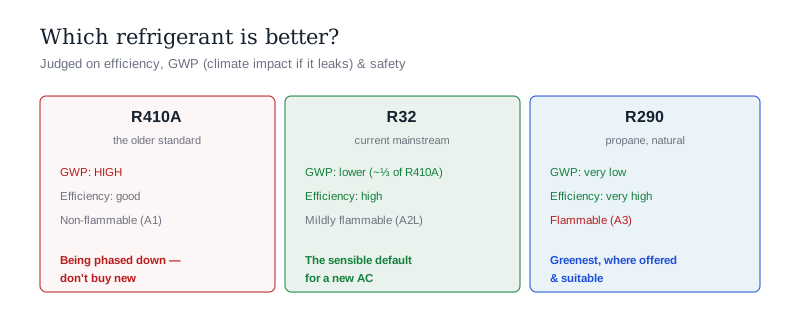
| GWP (climate impact) | High | Lower (~⅓ of R410A) | Very low |
| Efficiency | Good | High | Very high |
| Flammability | Non-flammable (A1) | Mildly flammable (A2L) | Flammable (A3) |
| Status | Being phased down | Current mainstream | Growing, natural |
R410A — the older standard
- Widely used in older/existing ACs; efficient and non-flammable.
- High GWP — its big drawback, so it's being phased down under Kigali.
- Fine in units you already own; not what to choose new if a lower-GWP option is available.
R32 — the current mainstream
- The mainstream refrigerant in new Indian ACs today.
- Lower GWP (roughly a third of R410A) and efficient — often more efficient than R410A.
- Mildly flammable (A2L classification) — handled safely with proper design and by trained technicians.
- The sensible default when buying a new AC now.
R290 (propane) — the low-GWP frontier
- A natural refrigerant with very low GWP and very high efficiency — excellent environmentally.
- Flammable (A3) — needs careful design, charge limits and trained handling, so it's used in select (often smaller) units.
- Growing as the industry decarbonises; a strong green choice where available and appropriately applied.
What it means when you buy
The practical guidance:
- Prefer a new AC with a low-GWP refrigerant — R32 is the mainstream, sensible choice today; R290 is greener still where offered and suitable.
- Avoid buying new R410A units when R32 is available — you're locking in a higher-GWP gas.
- For an AC you already own, don't worry — keep it well-maintained and fix any leaks promptly (a leak is both a performance and a climate problem), and let a technician handle the refrigerant.
- Efficiency and refrigerant go together — R32 units are often both greener and more efficient, so it's not a trade-off.
- Always a technician's job — charging, recovery and leak repair, never DIY, especially with flammable R32/R290.
The one-line answer
The refrigerant inside an AC matters for both efficiency and the climate, judged on cooling performance, GWP (how much it warms the planet if it leaks), and safety. R410A is the older standard — efficient and non-flammable but high-GWP, so being phased down under the Kigali Amendment; R32 is today's mainstream choice — lower GWP (about a third of R410A) and often more efficient, mildly flammable (A2L) but safely handled — the sensible default for a new AC; and R290 (propane) is the low-GWP frontier — very low GWP and very efficient, but flammable (A3), so used in select units with careful design. So when buying, prefer R32 (or R290 where suitable) and avoid new R410A; for an AC you own, keep it maintained and fix leaks promptly — and leave all refrigerant handling to a trained technician.
Where to go next
- The fundamentals: Air Conditioning Basics Guide.
- Buy with this in mind: How to Choose an Air Conditioner Guide.
- The green picture: Sustainable HVAC Guide.
- Fix leaks (a climate + performance issue): AC Not Cooling Guide.
References
- Kigali Amendment to the Montreal Protocol — HFC (high-GWP refrigerant) phase-down; Ozone Cell, Ministry of Environment, Forest & Climate Change (MoEFCC): https://ozonecell.nic.in/
- IS 1391 (Parts 1 & 2 : 2023) Room Air Conditioners, Bureau of Indian Standards; refrigerant safety classification per international standards (e.g. IEC 60335-2-40 for flammable-refrigerant appliances).
- Bureau of Energy Efficiency (BEE) — efficiency & Star Labelling: https://beeindia.gov.in/
Refrigerant regulations and availability evolve; verify current phase-down status. All refrigerant handling — especially flammable R32/R290 — must be done by a trained technician. Verify any standard's status via the BIS catalogue before relying on it.
Export this guide
Related Guides — Deep-dive reading
HVAC Refrigerants: What's Inside Your AC and Why It's Changing
The working fluid that makes cooling possible — what a refrigerant is, the properties that matter (GWP, ODP, efficiency, flammability), the generations from R22 to R32 and R290, the safety classes, and why the whole industry is transitioning to low-global-warming gases.
HVAC & CoolingThe Refrigerant Phase-Down: Montreal, Kigali and What to Buy Now
Why the gas in your AC keeps changing — the global agreements retiring ozone-damaging and high-warming refrigerants (the Montreal Protocol and Kigali Amendment), India's commitments and timeline, and how to future-proof an air-conditioner purchase.
HVAC & CoolingSplit AC Guide: The Indian Home's Default Air Conditioner
Everything on the split AC — how the indoor and outdoor units work together, why it's quieter and more efficient than a window unit, how to choose tonnage, stars and features, where to place both units, and what installation and upkeep it needs.
HVAC & CoolingRelated Tools — Try Free
Refrigerant GWP Impact Calculator
The CO₂-equivalent released if an AC's refrigerant leaks — by gas (R32, R410A, R22, R290) and charge — compared and put in relatable terms to show why low-GWP refrigerants matter.
HVACConcept Generator
Get 3 AI-generated design concepts for any room with style, materials, and cost estimate.
DesignAIRenovation vs New Build Calculator
Compare renovating vs building new interiors city-wise across 13 work scopes with GST and per-sqft rates.
Cost Comparison