
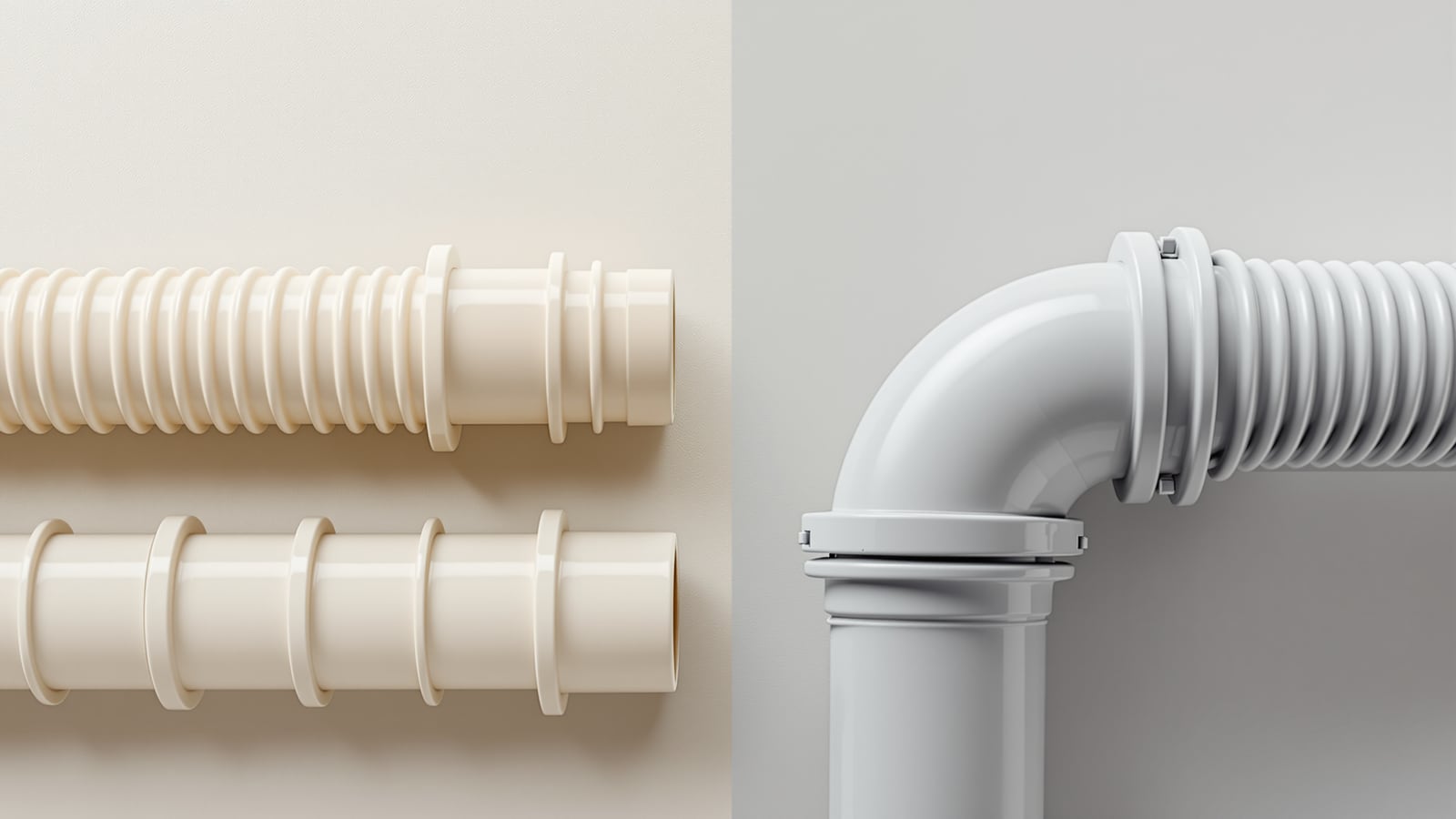
PVC vs CPVC Pipes: Which to Use Where in Your Indian Home
A fair, India-first head-to-head. The one fact that decides it: CPVC carries hot water (~93 C) so it runs your geyser supply; PVC is a cold-water, drainage and outdoor pipe. Temperature and pressure ratings, cost, lifespan, jointing and a verdict by use-case.
Walk into any Indian hardware shop and you will see two plastic pipes that look almost the same job apart — grey PVC and cream-white CPVC. They are chemical cousins, both solvent-welded, both far cheaper than copper or GI. The decision between them is not about which is "better": it is about what the pipe has to carry, and above all how hot the water inside it gets. This guide keeps to the direct comparison and ends with a plain verdict.
The short version, which the rest of the article backs up: CPVC can take hot water and PVC cannot. So CPVC runs your indoor hot-and-cold supply, and PVC runs your cold-only supply, your drainage and your outdoor lines. Each material already has its own full technical guide — PVC Pipes (India) and CPVC Pipes (India) — so here we stay strictly on where they differ and when to pick each.
For the whole pipe family (GI, copper, PEX, PPR too) go up to the pillar Plumbing Pipes Guide (India), and for the broader set of head-to-heads see the Plumbing Comparisons Guide (India).
The one difference that decides everything
PVC — PolyVinyl Chloride. The workhorse plastic of Indian plumbing. Rigid, cheap, corrosion-proof and available everywhere. It is excellent for cold water supply, for drainage (soil, waste and vent) and for outdoor runs. What it cannot do is carry hot water: push geyser-temperature water through PVC and it softens, loses pressure strength and, on a concealed line, sags and eventually weeps at the joints.
CPVC — Chlorinated PolyVinyl Chloride. Ordinary PVC put through a second chlorination step. That extra chlorine lets the polymer keep its strength in continuous hot water, giving a service rating of around 93 C — comfortably above any Indian geyser, which tops out near 55–65 C. That heat headroom is the entire reason CPVC exists and costs more.
So the crux is simple: CPVC is a hot-and-cold pipe; PVC is a cold-and-drainage pipe. Get that one call right and everything below is a secondary tie-breaker.
Temperature, pressure and lifespan, fairly compared
- Temperature. CPVC is rated for continuous hot service (~93 C). PVC pressure pipe is a cold-water material — treat anything much above 45–50 C as outside its safe envelope. This is not a defect in PVC; it is simply not its job.
- Pressure. Both hold working pressure well when cold. A rooftop-tank home (2–3 bar) or a pump-boosted home is fine on either for cold lines, provided you buy the correct pressure class. The difference shows only with heat: CPVC keeps useful pressure margin hot, while PVC's safe pressure collapses as it warms.
- Lifespan. Used within its design envelope, each easily lasts decades — neither rusts, scales or rots like old GI. The pipe that fails early is almost always one used in the wrong place: PVC on a hot line, or an under-rated pipe under a booster pump.
| Attribute | PVC | CPVC |
|---|---|---|
| Carries hot water | No — cold only | Yes, ~93 C |
| Best use | Cold supply, drainage, outdoor | Indoor hot + cold supply |
| Cost per metre | Cheaper | Dearer |
| Pressure (cold) | Good (buy right class) | Good |
| Lifespan in-envelope | Decades | Decades |
| Jointing | PVC solvent cement | CPVC solvent cement (different) |
| Sizing convention | Outer-diameter (OD) | CTS (Copper Tube Size) |
| Typical IS standard | IS 4985 (pressure), IS 13592 (soil-waste) | IS 15778 |
| Availability in India | Everywhere | Everywhere |
Cost and jointing — where the money and the mistakes are
Both pipes are joined the same way in principle — a solvent cement chemically fuses pipe and fitting into a single mass — but the two cements are not interchangeable. CPVC needs a CPVC-specific solvent cement; PVC uses standard PVC solvent cement. Using PVC cement on CPVC (or the reverse) makes a weak joint that holds a quick pressure test and then weeps months later, usually inside a wall. After the hot/cold mix-up, this is the most common site error.
Sizing differs too, which matters when your plumber orders fittings:
- PVC follows outer-diameter (OD) conventions and comes in a pressure grade (IS 4985) and a separate soil-and-waste grade (IS 13592) for drainage.
- CPVC follows CTS (Copper Tube Size) — 15 mm (1/2"), 20 mm (3/4"), 25 mm (1") for homes — so its fittings are a different range.
On price, PVC is meaningfully cheaper per metre; CPVC costs more but buys you hot-water capability. The gap is real but modest against a full re-pipe, so never let a small saving push PVC onto a hot line. Figures move with resin prices and city, so treat any number as indicative and size the actual bill with the Pipe Replacement Cost (India) guide.
| Item | PVC (pressure) | CPVC |
|---|---|---|
| Pipe, 15-20 mm | ~₹40-90 / m | ~₹60-130 / m |
| Fittings (elbow/tee) | ~₹10-45 each | ~₹15-60 each |
| Solvent cement | Standard PVC | CPVC-specific (not interchangeable) |
| Installed run vs the other | Cheaper | Dearer |
Where each one belongs in an Indian home
- CPVC — every indoor hot line (geyser to shower, mixer, basin, bath filler) and, ideally, the matching cold lines beside it, so the whole indoor supply is one material, one solvent, one fitting range.
- PVC (pressure, IS 4985) — cold supply where you want to save cost: cold feeds to the WC cistern, health faucet, utility and garden taps; and the underground/overhead runs from the sump and rooftop tank.
- PVC (soil & waste, IS 13592) — the drainage side entirely: basin and shower waste (32–50 mm), the WC soil pipe and the vertical stack (75–110 mm). CPVC is never used for drainage.
A very common and perfectly valid Indian setup is CPVC on all indoor hot and cold supply, PVC on drainage and outdoor cold runs. If you want to trim cost, PVC can also take the cold-only indoor supply — the only price is that your plumber now stocks two supply materials and two cements, and there is one more chance to put the wrong pipe on a hot line.
India-specific tie-breakers
Beyond hot-versus-cold, a few Indian realities nudge the call on the cold and outdoor lines where you genuinely have a choice:
- Hard water. Both are smooth-bored plastics that resist the scale that chokes old GI, so neither is at a disadvantage in hard-water cities. That is a reason to leave metal, not to pick between the two plastics.
- Sunlight and outdoor runs. Exposed rooftop and terrace lines take a beating from UV. PVC handles outdoor and underground runs well; keep any exposed supply pipe clipped, supported and, where advised, protected or painted. This is a natural PVC zone.
- Concealed hot lines. In a concealed wall, a hot line must be CPVC — there is no cheaper substitute that survives the heat. Pair it with the correct CPVC cement and there is exactly one material and one solvent to get right on that run.
- Pressure class under a booster pump. In pump-boosted or multi-storey homes, specify the correct pressure class whichever pipe you pick. A cheap, under-rated PVC cold line can burst under a booster just as a mis-specified CPVC one can.
For choosing across the whole material family and buying the right grade and class, work through Choosing Plumbing Pipes (India). If your real question is CPVC against the other rigid plastic, uPVC, see the dedicated CPVC vs uPVC Pipes (India) comparison.
The verdict
This is not really "PVC vs CPVC" — it is "where does the pipe run and how hot is the water." Decide by use-case:
| Your situation | Choose |
|---|---|
| Any indoor hot / geyser line | CPVC (no exceptions) |
| Indoor cold supply, tight budget | PVC pressure pipe |
| Indoor cold supply, want one material | CPVC (matches the hot lines) |
| Whole concealed indoor supply, fewest errors | CPVC throughout |
| Soil, waste and vent (drainage) | PVC soil-waste (IS 13592) |
| Outdoor, garden and underground cold runs | PVC pressure pipe |
| Retrofit replacing rusted GI (hot + cold) | CPVC |
The honest common-case recommendation for an Indian home: run CPVC for all indoor hot and cold supply, and PVC for drainage and outdoor cold runs. It costs a little more than dropping PVC into the indoor cold lines, but it removes the single biggest failure mode — the wrong pipe or the wrong cement ending up on a hot line — and leaves you one indoor supply material to inspect. Whatever you choose, insist on the printed IS mark as your proof of grade, match the cement to the pipe, and pressure-test every concealed run before tiling.
Bottom line: CPVC where it is hot, PVC where it is cold, dirty or outside. Get the temperature call right, buy the correct grade and cement, and both pipes will comfortably outlast the walls around them.
References
- IS 4985 — Unplasticised PVC Pipes for Potable Water Supplies — Specification.
- IS 13592 — Unplasticised PVC Pipes for Soil and Waste Discharge Systems (inside and outside buildings) — Specification.
- IS 15778 — Chlorinated PolyVinyl Chloride (CPVC) Pipes for Potable Hot and Cold Water Supply — Specification.
- ASTM D2846 — CPVC Plastic Hot- and Cold-Water Distribution Systems (Copper Tube Size).
- National Building Code of India (NBC) 2016, Part 9 — Plumbing Services (water supply, drainage and sanitation).
- CPWD Specifications and CPHEEO Manual on Water Supply & Treatment, Government of India — plumbing material and installation practice.
Export this guide
Related Guides — Deep-dive reading
Copper vs CPVC Pipes: Which to Use in India (2026)
A fair, India-first head-to-head: copper is the premium, decades-lasting, heat-proof metal that needs a skilled brazier and costs a fortune; CPVC is the cheaper, corrosion-proof, DIY-friendly plastic that has become the default modern Indian supply pipe. Cost, lifespan, heat, install skill, water quality, theft — and a clear verdict by use-case.
PlumbingCPVC vs UPVC Pipe: Which Is Better for Bathroom Plumbing? (India)
A fair, India-first head-to-head: CPVC carries HOT water (geyser lines), UPVC is cold-only. Pressure and temperature ratings, cost, jointing, where each belongs, IS standards, and why confusing the two causes concealed-wall failures.
BathroomsHow to Choose & Buy Plumbing Pipes in India: A Buyer's Guide
A shopping guide, not a materials lecture. Match the pipe to the job in one line each, then get the buying right — the ISI mark and correct IS number, the right class or pressure rating, branded vs local, spotting recycled or under-weight pipe, and matching fittings and solvent cement.
PlumbingRelated Tools — Try Free
Rainwater Tank Sizer
How big should your rainwater tank be? Computes annual harvest, recommended tank capacity in litres, water-bill savings, and payback — for 10 Indian cities.
RWH CalculatorPlumbing Pressure-Test & Leak Checklist
Pre-closure pressure and leak test — 9 categories, 60+ checkpoints across water supply, drainage, fixtures, waterproofing, hot water, tanks.
Pre-Closure TestCross-Ventilation Analyzer
Estimate airflow and air changes per hour (ACH) from room size, window areas, layout, and local wind — with NBC 2016 Part 8 compliance check.
Ventilation Calculator