
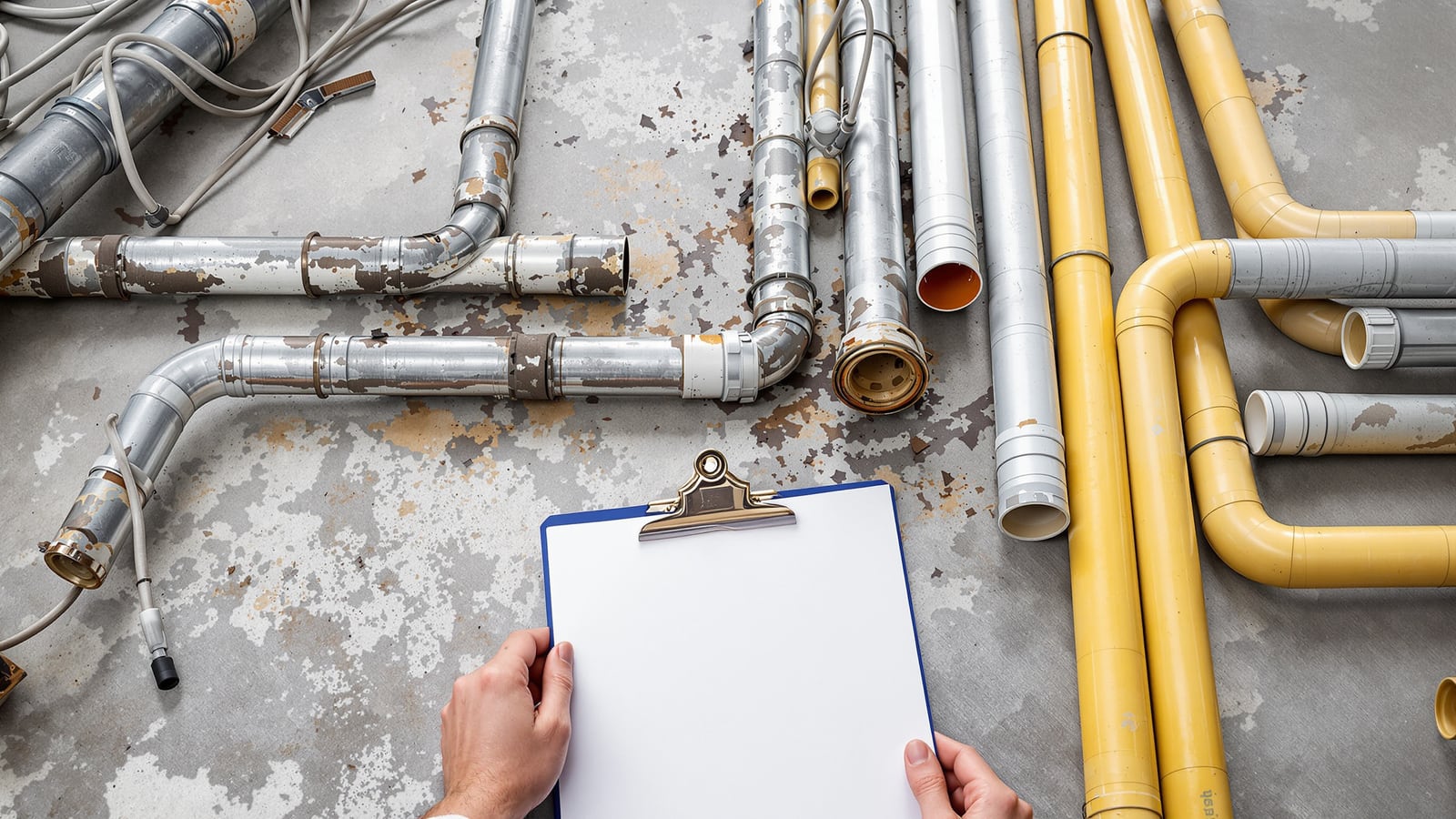
Pipe Replacement Cost in India 2026: Re-Piping Price Breakdown
What it really costs to re-pipe an Indian home in 2026 — the full ₹ breakdown of pipe, fittings, labour, wall chasing, re-plastering and tile restoration, priced per point, per running metre and per BHK, with the hidden cost of concealed work laid bare.
Ask a plumber what re-piping a house costs and the honest answer is another question: how much wall are you willing to open? The pipe itself is the cheapest line on the bill. What you actually pay for is the labour to chase concealed lines out of masonry, and then to make the walls and tiles good again afterwards. This guide is the Studio Matrx money-first breakdown of what pipe replacement really costs in India in 2026 — priced per point, per running metre and per BHK — so you can budget from a real number instead of a guess.
We cost the whole-house and system-level re-pipe here. For the strategy of when and how to renovate — reading failing pipes and sequencing with civil work — read the plumbing renovation guide for India. For the wider water-system budget beyond pipes, see the plumbing cost guide for India. Bathroom fixtures and single-bathroom builds live in the bathroom cluster; this guide owns the piping that connects the house.
The pipe is cheap and the wall is expensive. Every rupee in a re-pipe quote is really answering one thing: how deep is the pipe buried, and what has to be broken to reach it.
When re-piping is due
Most Indian homes built before the mid-2000s were plumbed in galvanised iron (GI). GI corrodes from the inside, scales up, narrows and eventually leaks — which is why old homes lose pressure and run rusty water in the morning. Once that starts across multiple rooms, patching one joint just relocates the next leak. The full symptom checklist and repair-versus-replace logic sit in the GI pipes guide for India; the short version is that any concealed GI supply system past about twenty years is a re-pipe waiting to happen.
The near-universal replacement is CPVC for hot and cold supply, with UPVC for cold-only and drainage — corrosion-proof, scale-proof and far cheaper to run long-term. The material trade-offs are covered in the CPVC pipes guide for India; this guide takes the choice as made and prices the job. Because a re-pipe is largely like-for-like on diameter, the cost drivers are labour and making-good, not the plastic.
What drives the cost
Four things move a re-pipe quote far more than the brand of pipe. Understand these and you can read any quotation critically.
- Concealed versus exposed. A concealed line must be chased into masonry, then plastered and re-tiled over. An exposed line is simply clamped to the wall. Concealment can double or more the cost of the same run — the pipe is identical, the destruction and restoration is not. The concealed plumbing guide for India explains the trade-off in detail.
- Number of points. Plumbers quote per point — each tap, mixer, WC, geyser or appliance connection. A 2 BHK typically has 25 to 40 points; a 3 BHK, 40 to 60. Point count, not floor area, sets the labour.
- Chasing and making-good. Cutting grooves in brick or concrete, then re-plastering, waterproofing wet areas and restoring tiles or paint, is routinely 30 to 50 percent of the whole bill — and the single most under-quoted item.
- Access and finish level. Ground-floor exposed runs are cheap; buried lines under premium imported tile are not, because restoring that finish costs more than the plumbing.
The ₹ breakdown
Here is the item-by-item breakdown a homeowner can budget from. All figures are indicative for 2026 and cover a mid-quality (Standard tier) concealed job in a metro or large city — get 2 to 3 local quotes, because rates vary sharply by city, brand and spec.
| Item | Unit | Indicative rate ₹ | Notes |
|---|---|---|---|
| CPVC pipe (hot & cold supply) | per running metre, 20 mm | ₹80 to ₹160 | Brand and pressure class swing this |
| UPVC pipe (cold & drainage) | per running metre | ₹60 to ₹180 | 75 mm waste to 110 mm soil dearer |
| Fittings (elbows, tees, valves) | per point | ₹250 to ₹700 | Concealed stop-valves cost more |
| Plumbing labour | per point | ₹450 to ₹900 | Core install of each connection |
| Wall chasing (cutting grooves) | per running metre | ₹120 to ₹300 | Concrete costs more than brick |
| Re-plastering over chases | per running metre | ₹90 to ₹220 | Includes chicken-mesh over grooves |
| Waterproofing (wet areas) | per sq metre | ₹120 to ₹350 | Around new pipe penetrations |
| Tile / finish restoration | per sq metre | ₹250 to ₹1,200+ | The big variable — matching old tile |
| Debris removal & clean-up | per job | ₹2,000 to ₹8,000 | Often forgotten in DIY budgets |
| Pressure test & commissioning | per job | ₹1,500 to ₹5,000 | Non-negotiable before closing walls |
The line that surprises people is tile and finish restoration. Break a wall of discontinued or imported tile and you may not be able to match it — pushing you to re-tile a whole wall or room to keep it uniform. That single item can outrun the entire plumbing cost, which is why concealed re-piping is priced by what it destroys, not what it installs.
Cost per point, per metre and per BHK
Homeowners meet three different units in quotes. They are not alternatives — they are lenses on the same job.
- Per point is the most honest unit for a re-pipe. A fully-loaded concealed point (pipe + fittings + labour + share of chasing and making-good) runs about ₹1,500 to ₹3,500 in 2026. An exposed point, with no chasing or re-tiling, runs roughly ₹700 to ₹1,500.
- Per running metre suits long feed lines — the house main from the tank, or a riser. Budget ₹350 to ₹800 per metre concealed, all-in, and roughly half that exposed.
- Per BHK is the planning-level number. Use the table below for a whole-house re-pipe, supply and drainage, excluding any premium tile restoration.
| Home size | Approx. points | Concealed re-pipe (indicative) | Exposed / partial (indicative) |
|---|---|---|---|
| 1 BHK | 18 to 28 | ₹45,000 to ₹95,000 | ₹22,000 to ₹50,000 |
| 2 BHK | 25 to 40 | ₹80,000 to ₹1,60,000 | ₹40,000 to ₹85,000 |
| 3 BHK | 40 to 60 | ₹1,30,000 to ₹2,60,000 | ₹65,000 to ₹1,40,000 |
| 4 BHK / villa | 60 to 90+ | ₹2,20,000 to ₹4,50,000+ | ₹1,10,000 to ₹2,40,000 |
Tier the numbers by quality. Budget uses economy-brand CPVC and basic making-good and sits near the low end. Standard uses reputed-brand pipe and proper waterproofing — the middle of each range. Premium adds top-brand fittings, concealed premium valves, imported-tile restoration and a longer warranty, and lands at or above the top. City variation is real too: Mumbai, Bengaluru, Delhi-NCR and Pune trend 15 to 30 percent above tier-2 and tier-3 towns, driven almost entirely by labour rates.
The hidden cost of concealed re-piping
The gap between a concealed and an exposed re-pipe is the whole story of this budget. The pipe, fittings and even the plumbing labour are broadly the same. What concealment adds is a destruction-and-restoration layer that the pipe never touches:
- Chasing grooves into finished walls and floors.
- Re-plastering and re-screeding over every run.
- Re-waterproofing wet areas where pipes now pierce the membrane.
- Tile, paint and finish restoration — the wildcard that can dwarf everything else.
Add it up and a concealed re-pipe can cost 1.8 to 2.5 times the same job run exposed. That is not a plumber's markup; it is the real cost of hiding the pipe inside a finished house. It is also why the smartest time to re-pipe is during a renovation, when the walls are already open — see how to time it in the plumbing renovation guide.
How to minimise disruption and cost
You cut a re-pipe bill by cutting how much wall you open, not by cutting corners on the pipe:
- Re-pipe the whole zone while it is open. If a wall is already broken for one leak, renew every line behind it. The marginal pipe cost is trivial against re-opening finished tile later.
- Run exposed where looks allow. Utility areas, service ducts, terraces and behind cabinets can take neatly-clamped exposed CPVC — no chasing, no re-tiling, a fraction of the cost.
- Piggy-back on a renovation. Re-piping during a planned renovation shares the demolition and making-good you were paying for anyway.
- Never skip the pressure test. A ₹2,000 test that finds a leak before you tile saves a ₹40,000 demolition after. It is the cheapest insurance in the whole job.
- Get itemised quotes. Insist the quote splits pipe, labour, chasing and making-good. A single lump sum hides where the money — and any padding — actually sits.
- Do not over-spec buried pipe. Premium brand for the concealed body is worth it; premium everywhere is not. Spend on what you cannot easily reach again.
A cheap re-pipe is one that opens the fewest walls, not one that buys the cheapest pipe. Judge quotes on chasing and making-good, because that is where the real money lives.
The one-line answer
Budget a concealed whole-house re-pipe at roughly ₹1,500 to ₹3,500 per point — about ₹80,000 to ₹1,60,000 for a 2 BHK and ₹1,30,000 to ₹2,60,000 for a 3 BHK in 2026 — knowing the pipe is barely a fifth of that and the wall is the rest. Re-pipe while the walls are open, run exposed where you can, pressure-test before you close, and get itemised quotes so you can see where every rupee goes. All figures are indicative — get 2 to 3 local quotes.
References
- National Building Code of India 2016, Part 9 (Plumbing Services), Bureau of Indian Standards: https://www.bis.gov.in/
- Indian Standard IS 15778 (CPVC pipes and fittings) and IS 4985 (UPVC pipes), Bureau of Indian Standards: https://www.bis.gov.in/
- Uniform Plumbing Code India (Indian Plumbing Association / IAPMO India): https://www.iapmoindia.org/
Export this guide
Related Guides — Deep-dive reading
Concealed Plumbing in India: Chasing, Fixing & Pressure-Testing In-Wall Pipes
How in-wall concealed plumbing is really done in Indian homes — chasing pipes into walls and floors without cutting structure, fixing and spacing them in the chase, the pressure test you must never skip, and marking routes so you can find them again.
PlumbingHouse Plumbing Cost Guide: What It Costs in India (2026)
The section pillar for house plumbing cost in India — how plumbing is priced (per point, per sqft, per BHK, or as a percent of construction), an indicative rupee breakdown of pipes, fittings, rough-in, labour, tank and pump for 1, 2 and 3 BHK, Budget / Standard / Premium tiers, what drives the cost, city variation, and honest ways to save.
PlumbingPlumbing Renovation Guide India: Re-Piping, Costs & Sequencing
When and how to re-plumb an existing Indian home — reading the signs of failing GI pipes, choosing between whole-house and partial re-piping, upgrading concealed lines, fixing leaks, retrofitting water savings, and sequencing plumbing with civil work.
PlumbingRelated Tools — Try Free
Plumbing Pressure-Test & Leak Checklist
Pre-closure pressure and leak test — 9 categories, 60+ checkpoints across water supply, drainage, fixtures, waterproofing, hot water, tanks.
Pre-Closure TestBathroom Renovation Cost Calculator
Cost to renovate an existing bathroom with a replace-vs-keep model — demolition, re-waterproofing, tiles, fittings and the money saved by keeping items.
Bathroom CalculatorMonsoon-Readiness Checklist
Pre-rain home audit across 9 categories — terrace, drains, waterproofing, electrical, HVAC, pest, vehicles, documents.
Seasonal Audit