
The Psychology of Outdoor Spaces — How People Use, Gather and Feel
The behavioural and social rules — prospect-refuge, proxemics, triangulation and defensible space — that decide whether an outdoor space fills with life or sits empty, read through India's own otla, chowk and maidan.
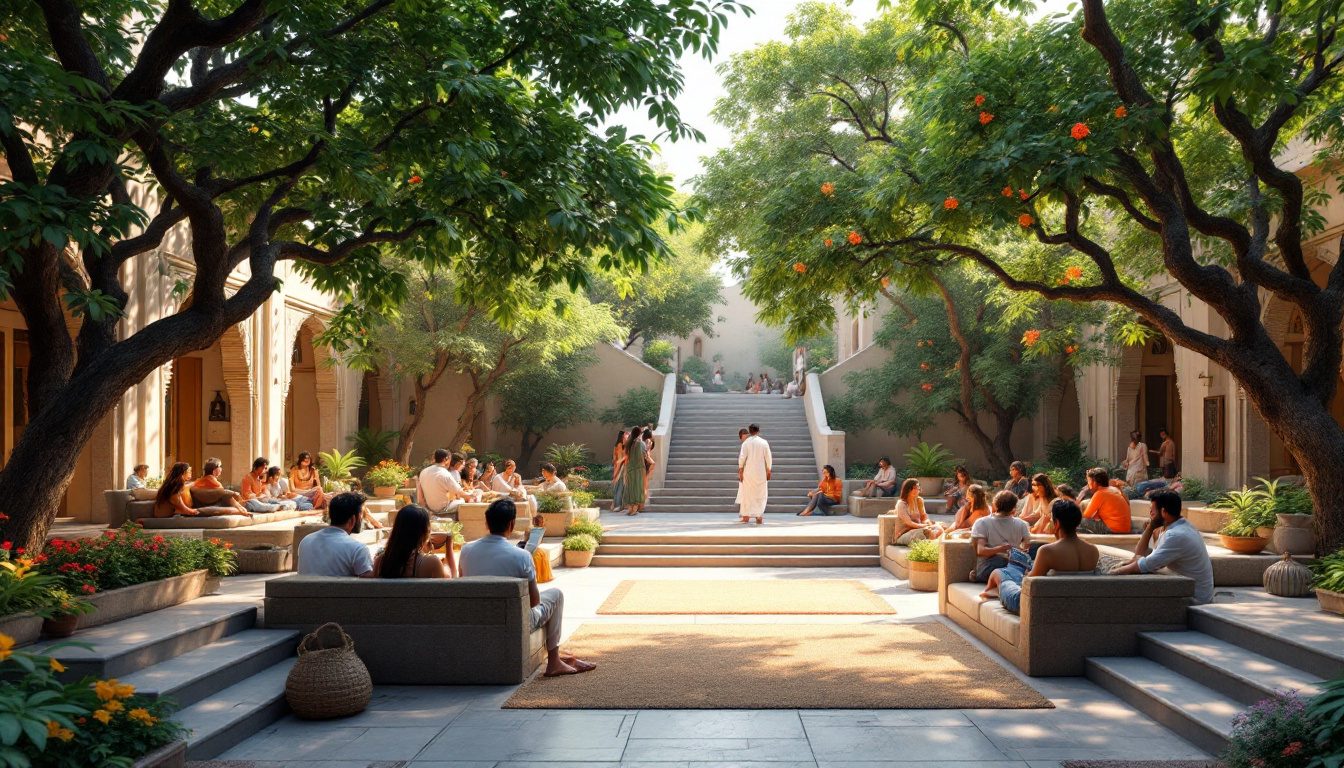
Walk into any well-loved public garden in India at six in the evening and watch where people actually settle. The wide open lawn in the middle stays empty. The benches under the trees fill first. Couples take the seats with their backs to a hedge and a clear view out. Children orbit the steps and the fountain edge. Elders claim the same shaded corner they sat in yesterday. Vendors cluster at the gate where everyone passes. Nobody planned this choreography, yet it repeats with uncanny consistency from a Bengaluru park to a Surat riverfront to the steps of a village temple.
That pattern is not random and it is not cultural accident. It is human behaviour expressing itself through space — the same set of instincts and social rules that govern where we stand at a party, which restaurant table we ask for, and why a busy chowk feels alive while an expensive plaza feels dead. Outdoor space is not a neutral container we fill with activity; it actively invites some behaviours and quietly forbids others.
This guide is about the behavioural and social psychology of outdoor space — how people choose where to sit, how close they let strangers come, what makes a place fill up or empty out, and why some open spaces feel safe and sociable while others feel exposed and abandoned. A garden can be beautiful and still be unused. Designing for use means designing for the predictable ways human beings seek edges, watch each other, gather in small triangulations and read a space for safety — and India's own outdoor traditions, from the otla and thinnai to the chowk, the maidan and the temple steps, have encoded these lessons for centuries.
Two different questions: how a space feels vs how it gets used
It helps to separate two questions that are often blurred. One is restorative: does this place lower my stress, slow my pulse, let me recover from mental fatigue? That is the territory of why some gardens feel deeply peaceful and of dedicated healing gardens, where the goal is the solitary nervous system winding down.
This guide asks the other question: how do people behave here together? Do they linger or pass through? Do strangers tolerate each other, watch each other, occasionally talk? Do children, elders and groups all find a place? A space can score high on one axis and low on the other. A serene private courtyard restores beautifully but supports almost no social life; a noisy, slightly chaotic neighbourhood maidan does little for solitary calm but is a triumph of public gathering. Most outdoor spaces around an Indian home — the otla and front threshold, the courtyard, the terrace, the lane-side seat — need to do both, which means the designer has to hold both psychologies in mind at once.
Prospect and refuge: why we choose edges and a back to the wall
The single most reliable behavioural fact about outdoor space comes from a theory the geographer Jay Appleton set out in The Experience of Landscape (1975): we are drawn to places that offer prospect (an open view out, so we can see what is coming) combined with refuge (a sheltered, enclosed back, so we cannot easily be approached from behind). It is an evolutionary inheritance — the ability to see without being seen kept our ancestors alive — and it shows up everywhere people are free to choose where to be.
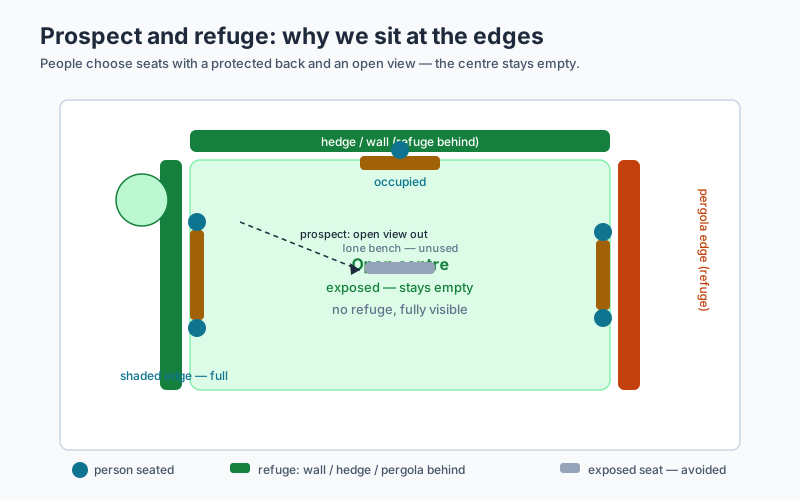
This is why the centre of a lawn is the last place to fill and the perimeter the first. It is why a bench with a tree canopy overhead, a hedge or wall behind, and an open lawn in front is occupied all day, while an identical bench marooned in the middle of the same lawn sits empty. The architect Christopher Alexander captured the same instinct in A Pattern Language as "the edge of the field is where life starts" and in patterns such as "Sitting Wall" and "Tree Places." For a home garden the practical reading is simple: put the good seats where a person can sit with something solid behind them — a wall, a planter, a pergola post, a dense shrub — and a view toward the activity, the gate or the planting in front. India's traditional otla (the raised front plinth of a Gujarati or Maharashtrian house) and the Tamil thinnai are textbook prospect-refuge: a sheltered, slightly elevated edge with the wall of the house behind and the whole street as the view.
Personal space and the geometry of social distance
How people use a space depends just as much on the invisible bubbles they carry around their bodies. The anthropologist Edward Hall named this study proxemics and described roughly four zones of social distance — intimate, personal, social and public — that expand and contract by culture, gender and familiarity. India runs, on average, at closer distances than Northern Europe; queues are tighter, benches are shared more readily, and a degree of crowding that would feel intrusive in Helsinki reads as ordinary in Howrah. But the underlying rule holds: when strangers must share a seat or a patch of ground, they space themselves to preserve the largest comfortable gap, and they fill a bench from the ends inward, not the middle.
| Proxemic zone (Hall) | Approx. distance | Outdoor design implication for Indian homes |
|---|---|---|
| Intimate | up to ~0.45 m | Reserved for family and close friends; never design seating that forces strangers this close |
| Personal | ~0.45–1.2 m | The bubble for friends/known neighbours; chairs that can be pulled to ~0.6–1.0 m support real conversation |
| Social | ~1.2–3.6 m | Strangers sharing a space; benches set 1.2 m+ apart, or long benches that let two parties keep distance |
| Public | beyond ~3.6 m | The scale of an address, a performance, a maidan crowd; needs a focal point, not intimacy |
The most actionable consequence is about movable versus fixed seating. William H. Whyte's research (below) found that the simple ability to turn and shift a chair — to fine-tune one's distance from others by a few centimetres — does more for social comfort than almost any expensive feature. A pair of light, movable chairs on a terrace will out-perform a grand fixed bench, because people can negotiate their own proxemics. Where fixed seating is unavoidable, generous length and L-shaped corners (which let two people sit at a sociable 90° rather than a confrontational face-off or a non-conversational side-by-side) do the most good.
The social life of small spaces: Whyte's triangulation
In the 1970s the urbanist William H. "Holly" Whyte mounted time-lapse cameras over plazas in New York and simply watched, publishing the results as The Social Life of Small Urban Spaces (1980). His findings were almost embarrassingly practical and have held up across decades and continents. The best predictor of whether a space was used, he found, was the most basic: "People sit where there are places to sit." Beyond seating, three ingredients drove life: sun (people follow it in cool seasons and flee it midday in the heat — critical in India), food (a chaiwala, a chaat cart, a kiosk anchors activity), and what he called triangulation — some external stimulus, a fountain, a street performer, a sculpture, a view, that gives strangers a reason to stand near each other and an excuse to talk.
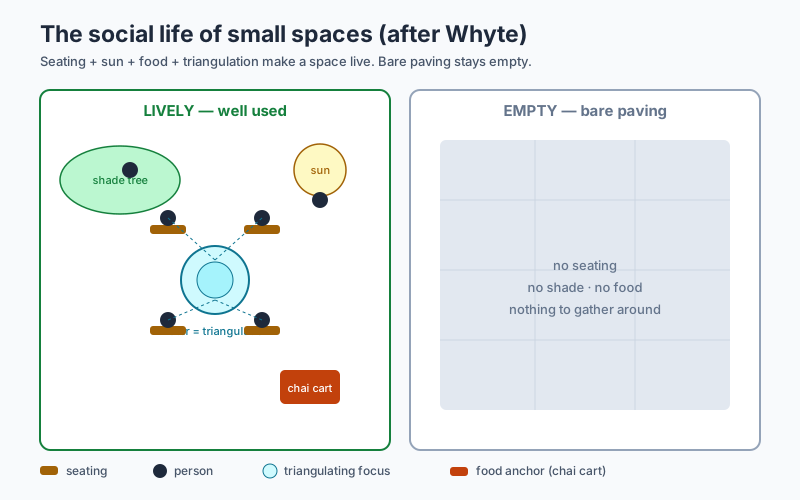
| Whyte ingredient | What it does | How to provide it at home / in a shared space |
|---|---|---|
| Sittable space | The base requirement; "ledges, steps, walls" all count | Generous edges: sitting-walls at ~40–45 cm, step-fronts, planter rims, movable chairs |
| Sun and shade | People chase shade in Indian summers, sun in cool mornings | Offer both: a shaded core for noon, an open edge that catches winter sun |
| Food | A vendor or kiosk reliably attracts and holds people | A chai corner, a snack counter, even a permanent spot for a cart at a community garden |
| Triangulation | An external focus that bonds strangers | A water feature, a play sculpture, a specimen tree, a chessboard table, a view out |
| Water | Sight and sound that draws people and masks noise | A small spout, rill or basin children can reach (echoes the temple tank and stepwell) |
The deeper lesson is that conviviality is mostly the by-product of getting the mundane things right — somewhere comfortable to sit, in the right amount of sun, near something worth looking at — rather than of grand architectural gestures. Whyte's collaborator the Project for Public Spaces turned this into the modern practice of placemaking: build for the people you want, with light, cheap, fast interventions, observe what they actually do, and adjust.
Defensible space, "eyes on the space" and the psychology of safety
Whether people use an outdoor space at all depends heavily on whether it feels safe — and safety, behaviourally, is less about the absence of crime than the presence of other people and the legibility of the space. Jane Jacobs, in The Death and Life of Great American Cities (1961), coined the phrase "eyes on the street": informal surveillance by ordinary occupants — shopkeepers, residents at windows, neighbours on their otla — is what makes a space feel and stay secure. Oscar Newman's idea of defensible space added that when residents feel a patch is "theirs" to watch over, they tend it and guard it; when it belongs to no one, it is neglected and avoided. The same logic underpins CPTED (Crime Prevention Through Environmental Design), now referenced in Indian urban-design practice, which leans on natural surveillance, clear sight lines, defined ownership and good lighting.
| Safety principle | Behavioural mechanism | Practical move (home / colony) |
|---|---|---|
| Natural surveillance ("eyes") | More watchers deter trouble and reassure users | Orient windows, balconies and the otla toward shared open space; avoid blank walls facing parks |
| Sight lines / legibility | We avoid spaces we cannot read or see across | Keep shrub masses below ~1 m and tree canopies above ~2 m at eye-level routes; no blind corners |
| Lighting | Even illumination lets the eye read faces and exits | Continuous warm, glare-free path lighting; avoid bright-pool-then-dark-gap patterns |
| Defined ownership | Cared-for, claimed space signals it is watched | Thresholds, low walls and gateways that mark "this is the colony's garden" |
| Activity / occupancy | A used space is a safe space, and vice versa | Mixed uses and seating that keep people present across the day, not just at one peak |
This is one place where Indian residential culture has a built-in advantage. The traditional house with its otla or thinnai facing the lane puts residents on the edge of public space by default, supplying exactly the informal eyes Jacobs prized. Gated layouts that turn blank compound walls to the street, by contrast, can strip a lane of its watchers — better for one household's privacy, worse for the collective safety of the outdoor commons.
Designing for different users: children, elders and groups
A shared outdoor space is used very differently by a five-year-old, a sixty-five-year-old and a group of teenagers, and a space that suits only one of them under-performs.
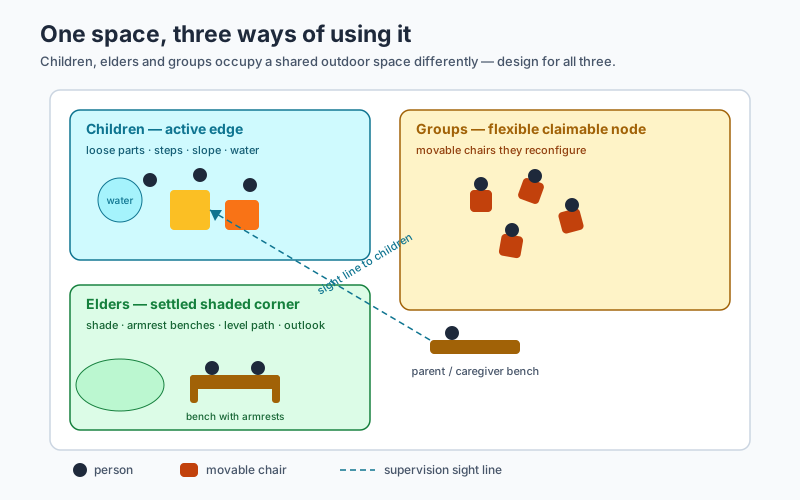
Children use the whole space as equipment. They are drawn to edges, steps, slopes, water, loose parts and "looseness" — Simon Nicholson's loose-parts theory holds that the play value of a setting is proportional to the number of movable variables in it. They want to be near, but not under, adult supervision: the best layouts let a parent on a shaded bench keep a clear line of sight to the play zone. Elders seek the opposite — they settle, often in the same favoured spot daily, and they need shade, firm level paths, backrests and armrests (which help getting up), and short, safe distances to a seat. The social value for them is "passive sociability": watching the life of the space and exchanging a word, as much as active conversation. Groups — families, friends, teenagers — need flexible nodes they can claim and reconfigure: movable chairs, a cluster of steps, a wide ledge, a corner of lawn defined just enough to feel like a room.
| User group | What they seek | Design response |
|---|---|---|
| Young children (2–8) | Loose parts, water, steps, slopes, climbable edges; nearness to a watching adult | Varied ground, sand/water play, low walls, clear sight line to adult seating |
| Older children / teens (9–17) | A claimable spot slightly apart; activity to do; to see and be seen | Movable seating clusters, a court or table, an edge they can adopt |
| Adults | A comfortable seat near company, sun/shade choice, something to watch | Movable chairs, L-shaped benches, triangulation, food nearby |
| Elders (60+) | Shade, level firm paths, backrests + armrests, a familiar settled corner, passive sociability | Shaded fixed seating with arms, short distances, an outlook over activity |
| Caregivers / parents | Sight lines to children while resting | Seating with an unbroken view of the play zone |
This is the social complement to thinking about outdoor wellness spaces: wellness asks what a body needs to recover, while user-zoning asks what different people need to coexist and gather in the same patch of ground.
Edges, thresholds and gathering nodes
If there is one spatial idea that ties all of this together, it is the edge. People gather where one condition meets another — where shade meets sun, paving meets lawn, wall meets walkway, indoor meets outdoor. Alexander observed that the life of a public square forms at its edges, not its middle; Whyte found the same for plazas; Jan Gehl, the Danish urbanist whose Life Between Buildings (1971) is the modern bible of this field, formalised it as the "edge effect." Activity radiates inward from the perimeter, and a thick, soft, occupiable edge — arcaded, planted, stepped, furnished — is worth more than a vast empty centre.
Thresholds — the otla, the gateway, the verandah, the porch, the temple step — are the most charged edges of all, because they let a person be simultaneously in and out, sheltered and visible, private and available. They are where neighbourly social life actually happens. Gathering nodes are the points where paths cross, where the triangulating feature sits, where the chai is. A good outdoor plan reads as a hierarchy: generous occupiable edges, a few strong thresholds, and one or two clear nodes that pull people together — rather than an undifferentiated field of grass.
What India's own outdoor culture already knows
None of this is new to the subcontinent. Indian settlement patterns have long embodied behavioural design without naming it:
| Indian outdoor type | Behavioural principle it embodies |
|---|---|
| Otla / thinnai (raised front seat) | Prospect-refuge + threshold + "eyes on the street" — sheltered back, street as view, informal surveillance |
| Chowk / courtyard | Defensible, surveilled common space; safe play; controlled proxemics within the household cluster |
| Temple steps and tank | Triangulation (water + ritual focus), tiered prospect-refuge seating, all-age gathering |
| Maidan | Public-distance gathering with flexible nodes for cricket, fairs, evening walks; democratic open ground |
| Chabutra / village platform under a tree | Shade + sittable edge + node + triangulation (the tree) — the original village plaza |
| Galli / lane | Thick social edge, slow movement, doorstep sociability, intense natural surveillance |
The professional lineage continues in the work of Indian landscape architects who design outdoor space around how people actually behave — figures profiled among India's landscape masters — and in the standards of bodies such as ISOLA (the Indian Society of Landscape Architects) and guidance like the NBC 2016 and CPWD landscape norms. The point is not to copy old forms literally but to read the behavioural logic inside them and re-use it.
A placemaking checklist for the spaces around your home
Before you finalise any shared outdoor space — a society garden, a terrace, a courtyard, a front threshold — test it against the behavioural fundamentals:
| Check | Ask yourself | Good sign |
|---|---|---|
| Sittable edges | Are there comfortable seats at the edges, with backs protected? | Sitting-walls, benches and movable chairs around the perimeter, not just the middle |
| Prospect + refuge | Can a person sit sheltered behind yet see out front? | Every primary seat has something solid behind and an open outlook |
| Sun and shade choice | Is there shade for noon and sun for cool mornings? | Both available; people can pick by season and hour |
| Triangulation | Is there a reason for strangers to gather and talk? | A water feature, specimen tree, play element or view |
| Food / anchor | Is there (or could there be) a chai/snack anchor? | A natural spot for a cart or kiosk |
| Movable furniture | Can people adjust their own distance? | At least some light, movable chairs |
| Eyes on the space | Do homes, windows or an otla overlook it? | Active frontage, no long blank walls |
| Lighting + sight lines | Is it readable and evenly lit after dark? | No blind corners; continuous, warm, glare-free light |
| All-age provision | Is there something for children, adults and elders? | Each group has a place it can claim |
| Thresholds | Are the in-between zones (porch, gate, verandah) made to linger in? | Generous, furnished, sheltered thresholds |
Run a real space through this list and the empty-lawn failure mode becomes obvious in advance: a flat green rectangle with one bench in the wrong place fails almost every line. For the wider craft of organising ground, planting and circulation around these social patterns, see the broader landscape design hub.
A closing thought
The deepest move in designing outdoor space is humility about how little of human behaviour we invent and how much we merely accommodate. People will seek the sheltered edge, follow the shade, fill the bench from the ends, gather where there is water and food and something to watch, and feel safe where other eyes are present — whether we plan for it or not. Our job is to read those instincts honestly, look hard at how a space is actually used rather than how a drawing imagines it, and then make the small, cheap, human adjustments that turn an empty lawn into a place people return to. India's otlas and chowks and maidans have been quietly doing exactly this for a very long time. The best new outdoor spaces will be the ones that listen to them.
References
- Appleton, Jay. The Experience of Landscape. Wiley, 1975 (prospect-refuge theory).
- Whyte, William H. The Social Life of Small Urban Spaces. Conservation Foundation, 1980 (sitting, sun, food, triangulation).
- Hall, Edward T. The Hidden Dimension. Doubleday, 1966 (proxemics and social distance).
- Jacobs, Jane. The Death and Life of Great American Cities. Random House, 1961 ("eyes on the street").
- Newman, Oscar. Defensible Space. Macmillan, 1972; and CPTED literature on natural surveillance.
- Gehl, Jan. Life Between Buildings: Using Public Space. 1971 (edge effect, life between buildings).
- Alexander, Christopher et al. A Pattern Language. Oxford University Press, 1977 (edges, thresholds, sitting walls).
- Nicholson, Simon. "How Not to Cheat Children: The Theory of Loose Parts." Landscape Architecture, 1971.
- Project for Public Spaces — placemaking principles and "Power of 10."
- ISOLA (Indian Society of Landscape Architects); NBC 2016 and CPWD landscape/site-planning guidance.
Export this guide
Related Guides — Deep-dive reading
Sequential Progressions: Why the Order of Spaces Matters
A home is experienced as a journey in time, not a plan seen all at once — and arranging that journey, with compression, release and thresholds from public street to private inner room, is what makes a house feel right.
Design PrinciplesThe Architectural Psychology of Comfortable Spaces
Why some rooms feel right and others never do — the science of space and the human mind
Design EducationZones of Retreat: Designing Spaces for Rest and Privacy
Why every Indian home needs protected nooks for solitude, focus and recovery — and how prospect-refuge theory helps you carve them from shared, crowded flats.
Design PrinciplesRelated Tools — Try Free
Cross-Ventilation Analyzer
Estimate airflow and air changes per hour (ACH) from room size, window areas, layout, and local wind — with NBC 2016 Part 8 compliance check.
Ventilation CalculatorInterior Layout Planner — Printable Graph Grid
Printable graph grid to sketch room layouts to scale before committing to furniture placement.
Layout ToolAcoustic Privacy (STC) Visualizer
Indian healthcare acoustic visualizer — compare wall assemblies and noise sources, see received SPL after STC attenuation, and check FGI 2018 / IS 1950 / NABH speech-privacy compliance with live dual-canvas waveform.
Acoustic Tool