
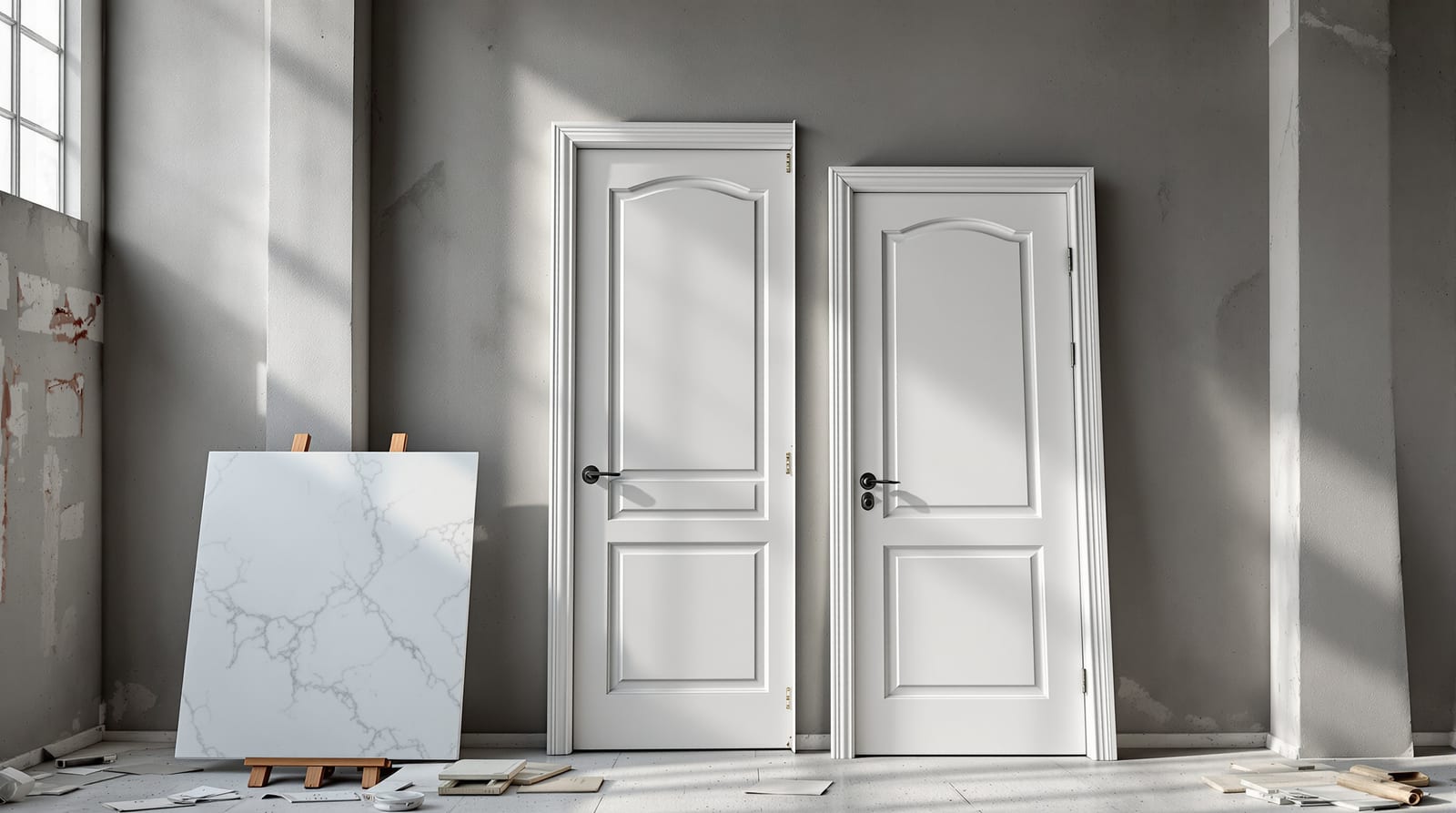
Prehung vs Slab Doors in India: Which to Buy (India 2026)
Factory leaf pre-hung in a frame versus buying just the leaf and hanging it on site — cost, speed, fit and where each wins.
When you order a door in India you are really choosing between two products. A prehung door arrives as a complete set — the leaf already hinged inside its frame (chowkhat), ready to drop into the wall opening. A slab door is just the bare leaf; you (or a carpenter) buy or build the frame separately and hang the shutter on site. The prehung vs slab doors decision quietly shapes your cost, your fitting time, how true the door hangs, and how much you can customise. This guide walks an Indian homeowner through both, with realistic ₹ bands, a strong comparison table, and a buying checklist.
What a prehung door set actually is
A prehung set is assembled in a factory or workshop: a frame (timber, WPC, uPVC or steel), the leaf already morticed and screwed onto its hinges, the strike-side rebate cut, and often the lock mortise pre-routed. WPC and flush-door brands sell these as standard kits in fixed sizes (for example 750×2100mm bathroom sets or 900×2100mm bedroom sets). Because the hinge gaps, the reveal and the swing were all set under controlled conditions, the leaf hangs true the moment the frame is plumb.
On site the fitter's job shrinks to one thing that really matters: setting the frame plumb, level and square in the opening, then fixing it with holdfasts, lugs or screws and grouting or foaming the gap. The clearances inside the set are already correct, so there is far less margin for a leaf that rubs, self-swings or refuses to latch — the classic symptoms of a frame that was racked out of square.
What a slab door is
A slab is the leaf alone — a flush door shutter to IS 2202, a moulded skin panel, a solid teak panelled leaf, or a WPC plank. You buy the frame separately (often a timber chowkhat made by the same carpenter), and the leaf is hung on site: hinges marked and morticed into both leaf and frame, the lock pocket routed at handle height, and the edges planed for an even reveal. Slabs dominate where the door is custom — a designer main door in solid teak, an odd opening size, or any job where a carpenter is already building the frame anyway.
The trade-off is craft dependence. A slab hung by a skilled carpenter is flawless and fully tailored. The same slab hung badly gives you uneven gaps, a binding leaf, or a door that won't shut — because every clearance is now a hand judgement, not a factory setting.
Prehung vs slab: the head-to-head
| Factor | Prehung set | Slab (leaf only) |
|---|---|---|
| What you buy | Leaf + frame, factory-hung | Just the leaf |
| Frame | Included, matched | Bought/built separately |
| Fitting speed | Fast — set frame, done (~1–2 hrs) | Slower — hang + mortise + lock (~3–5 hrs) |
| Fit accuracy | High — gaps factory-set | Depends on carpenter's skill |
| Sizes | Fixed standard sizes | Any size; trim to fit |
| Customisation | Limited to catalogue | Full — design, timber, finish |
| Skill needed on site | Moderate (frame plumb) | High (true hanging) |
| Best for | Bathrooms, bedrooms, repeat sizes | Main doors, odd openings, bespoke |
| Risk if done poorly | Frame out of square | Uneven reveal, binding leaf |
The short version: prehung trades flexibility for speed and a guaranteed true fit; slab trades guaranteed fit for lower cost and total freedom. For a builder fitting twenty identical bedroom doors, prehung WPC sets are a clear win. For a one-off carved teak main door, a slab hung by a master carpenter is the only sensible route.
Indicative costs (India 2026)
These are rule-of-thumb bands — actual prices swing with timber grade, size, brand and city. Add 18% GST on hardware and joinery; labour varies.
| Door type | Slab / leaf only | Prehung set (with frame) | Notes |
|---|---|---|---|
| WPC flush set | ₹3,000–6,000 | ₹5,500–11,000 | Termite/water-proof; ideal bathrooms |
| Laminate flush leaf | ₹1,800–4,500 | ₹4,500–9,000 | Frame timber/WPC adds the rest |
| Moulded skin door | ₹2,200–5,000 | ₹5,000–10,000 | Light internal doors |
| Solid teak panelled | ₹15,000–60,000+ | Usually slab + custom frame | Bespoke; rarely sold prehung |
| uPVC door (wet area) | — | ₹6,000–14,000 | Almost always a welded set |
A prehung set looks costlier on the invoice because the frame and hanging labour are already inside the price. Buy a slab and you still pay separately for the chowkhat (see our door frame cost breakdown) plus a half-day of skilled fitting. Run your own numbers with the door fitting cost estimator before deciding which line item is genuinely cheaper for your opening.
Where each one makes sense in an Indian home
Choose prehung when
- You have standard openings (750/900mm internal doors) and want speed and a guaranteed fit.
- It is a bathroom or wet area — a WPC or uPVC prehung set ships with the right termite- and damp-proof frame already matched (see WPC door frames).
- You are fitting many doors and want consistent reveals across the house with less reliance on carpenter skill.
- The site is rushed and you want the opening closed off quickly.
Choose a slab when
- You want a custom main door — solid teak, a carved or designer panel, an oversized leaf (main-door context in our door size standards).
- The opening is non-standard or out of square and the leaf must be trimmed to suit.
- A carpenter is already on site building the chowkhat anyway, so a matched frame is no saving.
- You are replacing one worn leaf in an existing good frame — buy a slab, not a whole set.
For the wet-area decision in particular, weigh termite and monsoon reality: untreated timber standing on a damp floor rots, so a matched WPC/uPVC prehung set often pays for itself. See termite-proofing doors for why this matters in Indian bathrooms.
What to check when buying — prehung
- Frame material suits the room. Timber for dry rooms; WPC/uPVC/RCC for bathrooms — never untreated timber on a wet floor.
- Size matches your opening plus a 10–12mm packing gap each side. Confirm against measuring for a door and the door rough opening calculator.
- Handing is correct — left-hand or right-hand, in-swing or out-swing. A pre-hung set is handed; the wrong hand cannot be reversed easily.
- Hinges and lock prep — count of hinges (usually 3), and whether the lock mortise is pre-cut for your lockset.
- Frame is straight — sight along jambs and head; a bowed factory frame defeats the whole point.
- Bottom undercut suits the finished floor (typically 6–12mm; more for ventilation in bathrooms).
What to check when buying — slab
- Leaf is to standard (flush doors to IS 2202; solid-core not hollow if you want acoustic privacy).
- It is dead flat — sight across the face; a warped slab will never hang square.
- Edges are lippable — solid timber lipping on flush doors lets the carpenter plane up to ~5–6mm per side equally, with a slight 2–3° bevel on the lock edge.
- The frame is ready and true — plumb and square before the leaf goes on, or every gap will fight you. See door frame plumb and level.
- Finish plan — paint, polish, laminate or veneer; raw slabs need sealing on all six edges to resist Indian humidity.
The on-site difference
With a prehung set, the fitter sets the frame plumb and square with wedges and packers, fixes it, grouts or foams the gap, then simply checks the swing — the leaf is already hung. With a slab, after the frame is in, the carpenter marks and mortises hinges into leaf and frame, hangs the leaf, planes the edges for an even reveal, then routes the lock pocket. That extra hand-fitting is where craft — and a few extra hours of labour — go in. For the full sequence either way, see how to fit a door and the broader door fitting guide.
Whichever you choose, the universals still apply: a true frame, even clearances, a damp-proof base, an undercut that clears the finished floor, and free, unobstructed egress with an accessible (≤12mm, bevelled or flush) threshold where wheelchair access is needed.
For everything around frames, leaves and openings, start at the complete door guide and the door frames guide.
Frequently asked questions
Is a prehung door more expensive than a slab?
On the invoice, yes — a prehung set bundles the frame and the hanging labour into one price. But once you add a separately built chowkhat and a half-day of skilled fitting to a slab, the gap narrows, and for standard bathroom or bedroom sizes a WPC prehung kit can work out comparable. Price your specific opening rather than assuming.
Can I trim a prehung door to fit my opening?
The frame is sized for a fixed opening plus a packing gap, so a prehung set is best matched to a standard opening. You can shave small amounts off the frame's height at the floor, but you cannot meaningfully reduce a factory frame's width. If your opening is non-standard, a slab and a custom frame are the better route.
Which is better for an Indian bathroom?
A prehung WPC or uPVC set, in most cases. The frame and leaf are both termite- and water-proof, the clearances arrive correct, and you avoid the classic mistake of standing an untreated timber chowkhat on a wet floor where it rots. Keep the threshold sloped and sealed.
How much can a carpenter trim off a slab door?
As a rule of thumb, up to about 5–6mm per side on the stiles, taken off equally so the leaf stays centred, with a slight 2–3° bevel on the lock edge to clear the rebate. Over-trimming weakens the lipping and exposes the core — buy the right size rather than planing away too much.
Do I need a frame if I buy a slab?
Yes. A slab is only the leaf; it must hang in a frame. If you are replacing a worn leaf in a sound existing chowkhat, a slab alone is exactly right. For a new opening you need a frame too — see the door frame cost guide.
Which option is faster on site?
Prehung, clearly. Once the frame is set plumb and square the door is already hung, so fitting can take roughly half the time of a slab, which still needs hinge mortising, hanging, planing and lock routing on site.
Export this guide
Related Guides — Deep-dive reading
Door Fitting Guide: Step-by-Step Installation (India 2026)
The complete step-by-step door fitting guide for India — set the frame plumb, fix it with holdfasts, grout, hang the leaf on three hinges, fit the lock, trim and seal — with the tools and checks a homeowner needs.
Home Doors & EntrancesThe Complete Home Door Guide for Indian Homes (2026): Types, Materials, Cost, Security & Vastu
Everything an Indian homeowner needs to specify the right door for every opening — from main entrance to bathroom — with real 2026 prices, IS/NBC standards and Vastu sense.
Home Doors & EntrancesCustom vs Ready-Made Doors: Buyer's Guide India 2026
Factory ready-made, made-to-order from a brand, or carpenter-built on site — costs, lead times, fit and warranty compared for Indian homes.
Home Doors & EntrancesRelated Tools — Try Free
Door Material Comparison Tool
Compare 2–4 door materials on cost, durability, maintenance, security and moisture resistance.
Comparison ToolDoor Cost Calculator
Estimate the all-in cost of a door — leaf, frame, hardware, fitting and GST — by type, material and size.
Door CalculatorBefore vs After — Cost Reality Check
Compare what you expected to pay vs what you actually paid, category by category.
Reality Check