
Polyurethane Waterproofing India: PU Membrane, Cost & When It's Worth It (2026)
How polyurethane (PU) liquid membranes waterproof Indian bathrooms — high elongation and crack-bridging, seamless single- vs two-component films, primers and adhesion, the UV catch, and where the premium over cementitious actually pays back — with rupee costs and two diagrams.
Most bathroom leaks in India are not holes — they are hairlines. The slab flexes, the screed shrinks, a corner opens up a fraction of a millimetre, and a rigid coating that was watertight on day one cracks straight through and starts feeding the ceiling below. Polyurethane (PU) waterproofing exists to solve exactly that problem: it cures into a tough, rubbery, seamless film that stretches several times its own length and stays bonded across a moving crack instead of tearing. That elasticity is the whole reason to pay more for it.
This guide is about PU membranes specifically — when they earn their premium in an Indian bathroom and when a cheaper system is the smarter buy. For the full method — surface prep, coving, ponding tests, tiling over the membrane — start with the bathroom waterproofing guide for India. To place PU against every other option, read waterproofing membrane types in India; for the broader family of brush-applied coatings, see liquid waterproofing membranes in India. This page goes deep on polyurethane alone.
A rigid coating waterproofs the surface as it is today. A PU membrane waterproofs it as it will move for the next twenty years. In a bathroom, things always move.
What polyurethane waterproofing actually is
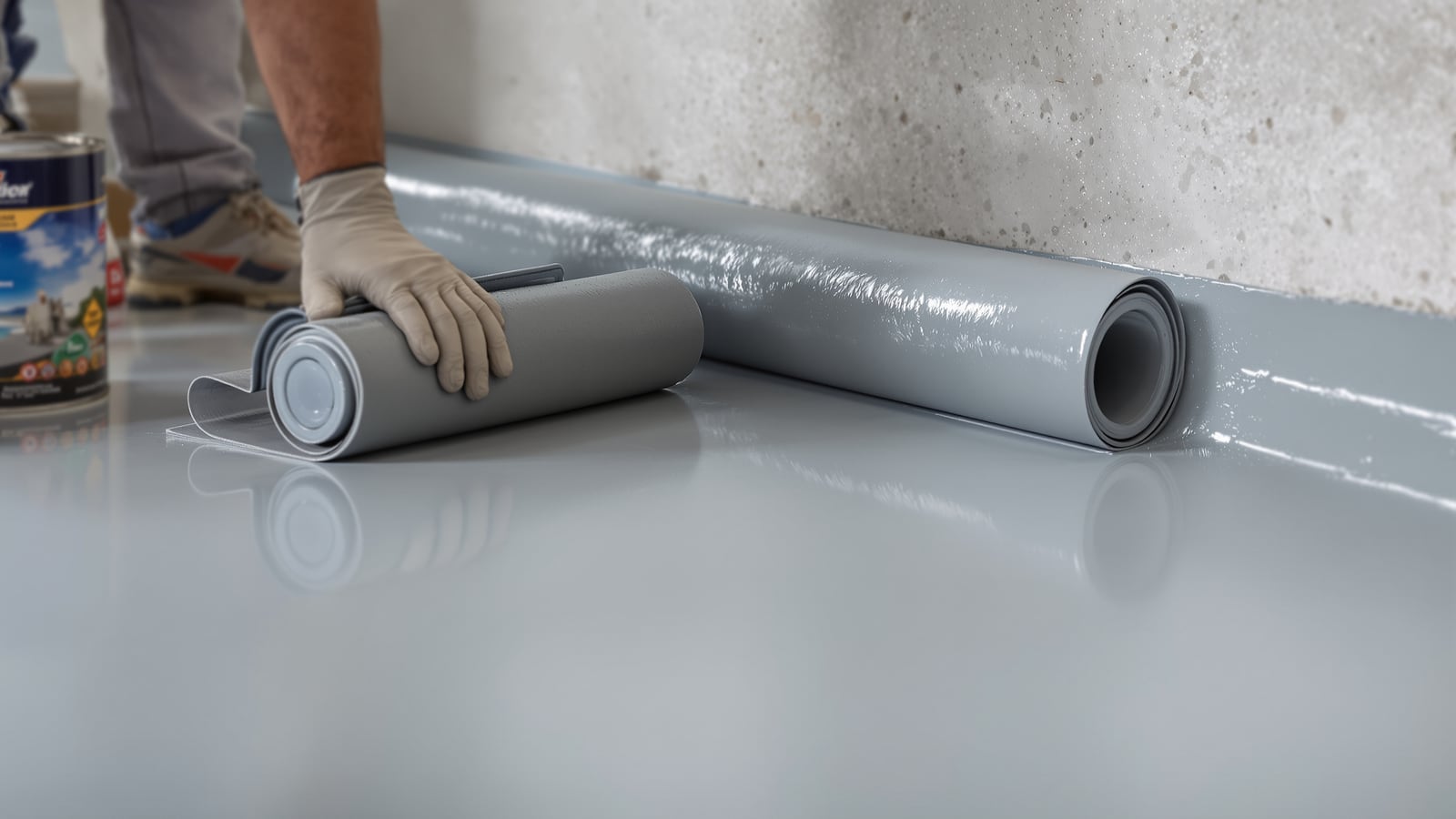
PU waterproofing is a liquid-applied membrane: you roll or trowel a liquid resin onto the prepared surface, it cures chemically, and it becomes a continuous elastomeric sheet with no joints, laps or seams. Because it flows before it sets, it wraps around drains, pipe penetrations, corners and the awkward geometry that defeats sheet membranes.
The defining property is elongation — how far the cured film stretches before it breaks. A good bathroom-grade PU sits around 300 to 600 percent elongation; premium and exposed-grade products go higher. Compare that with a typical cementitious (cement-polymer) coating at roughly 10 to 60 percent, and you can see why PU bridges cracks that snap a cement coat. This crack-bridging is what you are really buying.
PU also cures into a genuinely tough film — abrasion-resistant, chemically stable against the mild alkalis and cleaning agents a bathroom sees, and fully bonded to the substrate so water cannot track sideways underneath it the way it can beneath a loose sheet.
Single-component vs two-component PU
PU membranes come in two chemistries, and the choice matters for both site behaviour and price.
| Single-component (1K) | Two-component (2K) | |
|---|---|---|
| Mixing | Ready to use, moisture-cured | Base + hardener mixed on site by weight |
| Cure trigger | Ambient humidity | Chemical reaction between the two parts |
| Ease on site | Very forgiving; low skill | Needs correct ratio + pot-life discipline |
| Cure speed | Slower in dry weather, faster in humidity | Faster, more predictable, thicker per coat |
| Typical use | Bathrooms, small wet areas, DIY-adjacent | Podiums, terraces, tanks, heavy-duty decks |
| Relative cost | Higher per litre | Often lower per litre, but needs a mixer |
For a residential bathroom, single-component PU is usually the right answer: it is idiot-proof, needs no weigh-batching, and Indian bathroom humidity actually helps it cure. Two-component systems shine where you need thick films fast, higher mechanical strength, or coverage over large decks and podiums — situations where the mixing overhead pays off. A common mistake is buying a heavy-duty 2K roof system for a 40 sq ft bathroom; you inherit the pot-life stress for no benefit.
Aromatic vs aliphatic — the UV note
Standard PU membranes are aromatic: excellent waterproofing, but they chalk and yellow under direct sunlight and slowly lose surface integrity if left exposed. Inside a tiled bathroom this is irrelevant — the membrane is buried under adhesive and tile, never sees UV, and lasts indefinitely. The moment you take PU outdoors and leave it exposed — an open terrace bathroom, a balcony WC, an exposed parapet — you need either an aliphatic PU (UV-stable, more expensive) or a UV-protective topcoat over the aromatic film. Do not leave a bare aromatic membrane exposed to the sun expecting it to survive; that is the single most common PU failure on Indian terraces. For an exposed terrace bathroom or a balcony bathroom, specify UV-stable and budget for it.
Primer and adhesion — where PU jobs succeed or fail
PU is only as good as its bond to the substrate, and this is where site work goes wrong. Two things decide it:
- Moisture. PU hates a damp or green substrate. Trap water vapour under the membrane and it lifts into blisters. The concrete or screed must be properly cured and dry, and freshly plastered surfaces given time. This is a real disadvantage against cementitious coatings, which happily go onto — and even like — a damp surface.
- Primer. Most PU systems specify a PU or epoxy primer to seal the porous screed, kill dust, and give the membrane something to key into. Skipping primer to save a few rupees per square foot is the classic false economy: the film debonds and water tracks underneath.
Good adhesion practice for an Indian bathroom PU job:
- Grind or wire-brush the screed; remove all laitance, oil and curing-compound residue.
- Round every internal corner into a cove fillet — PU cannot bridge a sharp 90-degree re-entrant corner reliably.
- Prime, let the primer become tacky per the datasheet, then apply PU in two coats at right angles to hit the specified dry film thickness (typically 1.0 to 1.5 mm total for a bathroom).
- Reinforce corners, drains and pipe collars with a PU-compatible fabric/scrim embedded in the first coat.
- Turn the membrane up the wall at least 150 mm, and 300 mm or full height in the shower zone.
- Cure fully, then flood-test (pond) 24 to 48 hours before tiling. Never skip this.
Pros and cons — the honest ledger
| Strengths of PU | Trade-offs of PU |
|---|---|
| Very high elongation (300–600%+) bridges live cracks | Costs more than cementitious per sq ft |
| Fully seamless — no joints or laps to fail | Needs a dry, well-cured substrate |
| Tough, abrasion- and chemical-resistant film | Aromatic grades chalk/yellow under UV |
| Wraps drains, pipes, corners easily | Primer and prep discipline are non-negotiable |
| Long service life when buried under tile | Overkill for a small, stable, dry-ish area |
The short version: PU buys you movement tolerance and a seamless film. If your bathroom will genuinely move — an upper-floor slab, a long span, a renovation over an old cracked screed, a wet room where the whole floor is tanked — that is worth real money. If it is a small, well-built ground-floor bathroom on a stable slab, a good cementitious coating may waterproof it just as reliably for less.
Where PU is worth the premium
PU earns its premium clearly in these situations:
- Upper-floor and cantilevered bathrooms, where slab deflection is real and a leak damages someone else's ceiling.
- Renovations over old, cracked screeds — where you cannot guarantee the substrate won't keep moving.
- Wet rooms and fully-tanked floors, where the whole floor is the waterproofing plane and a seam or crack anywhere fails.
- Complex geometry — many penetrations, floating drains, niches — where a seamless liquid beats a jointed system.
- Exposed decks where you accept the cost of aliphatic/UV-stable grade.
PU cost versus cementitious and acrylic
Rupee figures are applied cost for the membrane system — material plus labour — for typical residential bathroom work in 2026. Local rates, brand and coats vary; treat these as planning bands, not quotes.
| System | Elongation | Crack-bridging | Applied cost (₹/sq ft) | Best for |
|---|---|---|---|---|
| Cementitious (cement-polymer) | ~10–60% | Low–moderate | ₹35–70 | Stable slabs, damp substrates, budget |
| Acrylic liquid membrane | ~100–300% | Moderate | ₹45–90 | Light wet areas, low foot traffic, interior |
| Polyurethane (PU) — aromatic | ~300–600% | High | ₹90–170 | Bathrooms, wet rooms, upper floors |
| Polyurethane — aliphatic / UV-stable | ~300–600% | High | ₹150–280 | Exposed terrace / balcony bathrooms |
Two honest caveats. First, cost per square foot for a small bathroom is a small line item — the difference between cementitious and PU across a 40 sq ft floor might be a few thousand rupees, trivial against the cost of ripping out tiles to fix a leak later. On any bathroom where movement is plausible, PU is cheap insurance. Second, a badly applied PU costs more than a well-applied cement coat and still leaks — the money only works if the primer, thickness and flood test are done properly. Waterproofing is 20 percent product and 80 percent workmanship, whatever the chemistry.
The bottom line
Polyurethane is the membrane you choose when you want to stop hairline cracks becoming ceiling stains — a seamless, high-elongation, tough film that moves with the building. Use single-component aromatic PU buried under tile for the great majority of Indian bathrooms; step up to two-component for large decks and aliphatic/UV-stable grades only where the membrane is left exposed to sun. Prime properly, build the thickness, cove the corners, and always flood-test. Where you are unsure PU is necessary, weigh it against the alternatives in waterproofing membrane types in India and liquid waterproofing membranes in India, then confirm the full method in the bathroom waterproofing guide for India.
References
- NBC 2016 (National Building Code of India), Part 9 — plumbing and services; waterproofing of wet areas and slabs.
- IS 2645 — Integral cement waterproofing compounds (specification), the baseline for cementitious systems PU is compared against.
- IS 3067 — Code of practice for general design details and preparatory work for damp-proofing and waterproofing of buildings.
- CPWD Specifications — Central Public Works Department, waterproofing treatment sections for wet areas and terraces.
- IGBC / GRIHA — green-rating references for durable, low-maintenance building envelopes and moisture control.
- Manufacturer technical datasheets (Dr. Fixit / Pidilite, Fosroc, Sika, MYK Laticrete, BASF and equivalents) — always follow the specific product's primer, coats, thickness and cure data.
Export this guide
Related Guides — Deep-dive reading
Cementitious Waterproofing India: Coatings, Coats & Cost (2026)
How cement-based waterproofing coatings work in Indian bathrooms — one- vs two-component, polymer-modified slurries, surface prep, number of coats, curing, where they suit sunken slabs and wet areas, and where their low flexibility lets you down, with rupee costs.
BathroomsBathroom Leak Prevention India: Detailing the Junctions That Stop Water Reaching the Flat Below
Bathroom leaks almost never come from a broken pipe — they come from a badly detailed junction. Here is how to get the wall-floor corner, pipe penetrations, floor trap, nahani trap and door threshold right, plus the flood test that catches a leak before you tile.
BathroomsLiquid Waterproofing Membrane India: Acrylic & Elastomeric Coatings for Bathrooms
How liquid-applied acrylic and elastomeric membranes waterproof an Indian bathroom — the seamless brush/roller coat, coats and dry film thickness, reinforcing fabric at every junction, drying times, ₹ costs, and where they beat cementitious and sheet systems.
BathroomsRelated Tools — Try Free
Bathroom Renovation Cost Calculator
Cost to renovate an existing bathroom with a replace-vs-keep model — demolition, re-waterproofing, tiles, fittings and the money saved by keeping items.
Bathroom CalculatorBathroom Waterproofing Calculator
Work out waterproofing material (kg/L) and cost for a bathroom by area, wall band, system type and coats — cementitious, acrylic, PU or SBR.
Bathroom CalculatorPlumbing Pressure-Test & Leak Checklist
Pre-closure pressure and leak test — 9 categories, 60+ checkpoints across water supply, drainage, fixtures, waterproofing, hot water, tanks.
Pre-Closure Test