
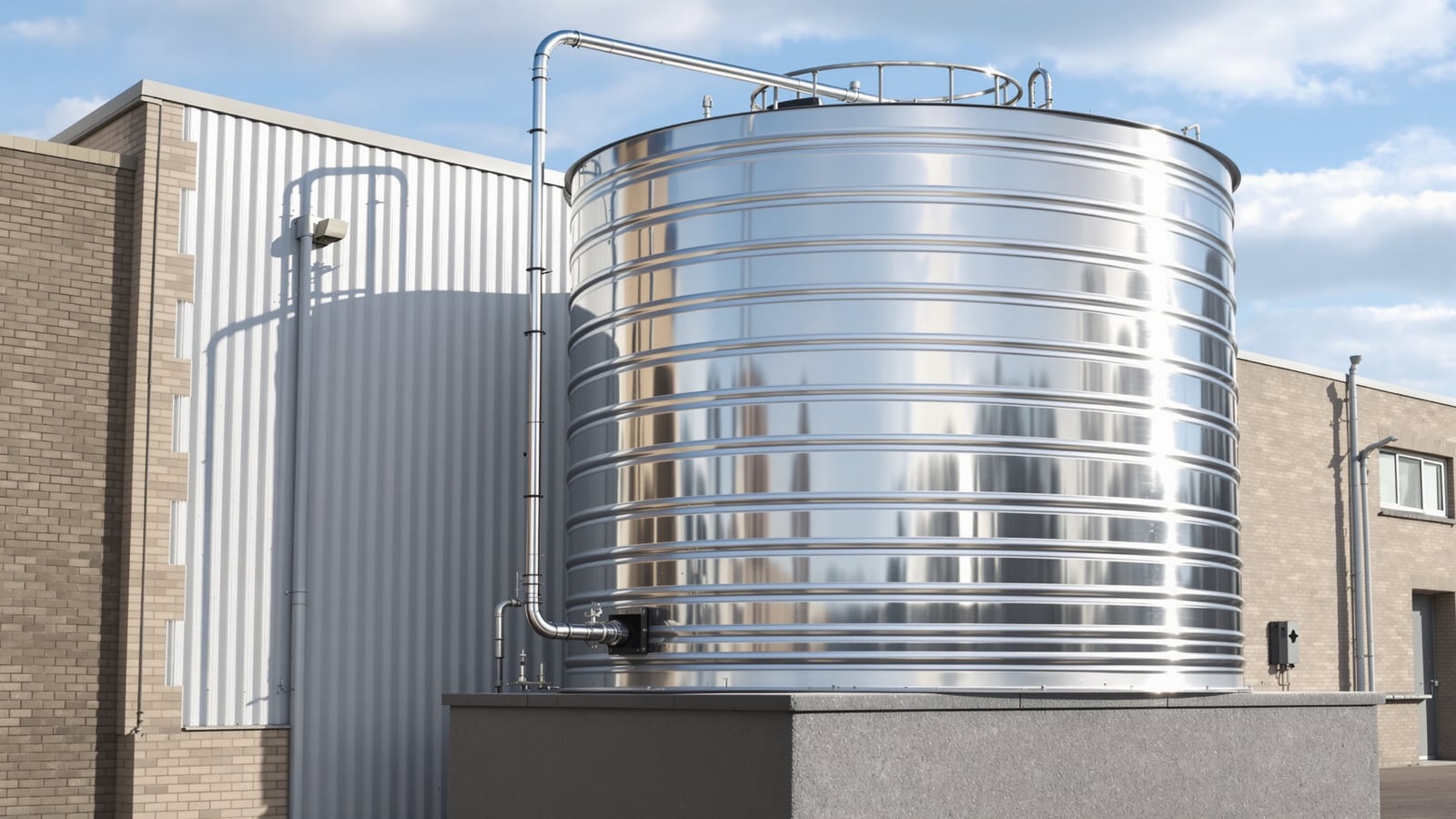
Steel Water Tanks in India: Stainless Steel Storage for Hygiene and 25-Year Life
The homeowner's guide to stainless steel (SS304/SS316) and pressed-steel water tanks — why they beat plastic on hygiene and lifespan, where they earn their premium, cylindrical versus rectangular, insulation, capacities, and indicative cost.
A steel water tank is what you fit when the water it holds is going into people — patients, hotel guests, or a family that simply refuses to drink from a plastic drum. Stainless steel does not grow algae in sunlight, does not crack in the heat, does not leach a plastic taste, and lasts two to three decades. It is the premium tier of Indian water storage, and this guide explains exactly where that premium is worth paying.
This is a material profile within the Studio Matrx Water Storage Tanks hub. It sits alongside the plastic (PE) tank guide and the modular / sectional tank guide — the two options a steel water tank most often competes against. For piping the tank out in matching material, see the stainless steel pipes guide.
Stainless steel does not "resist" contamination the way a liner does — the metal itself is inert and non-porous, so there is no surface for biofilm to key into and nothing to degrade in UV. That is why a hospital or a five-star kitchen specifies it, and why a 25-year life is a defensible number rather than a sales claim.
Where the steel tank sits in the system
The tank does not change the shape of the supply chain — it changes what the chain is made of. In a typical Indian home water flows: municipal or borewell inlet → underground sump → pump → overhead tank → gravity down to taps. The overhead tank is the one people see, clean, and drink from, so it is the one most often upgraded to steel.
- Overhead / terrace tank: the classic steel application. Exposed to sun all day, this is where plastic tanks bake, warp, and breed algae — and where steel earns its keep.
- Underground sump: usually RCC or plastic; steel is rare here because it is buried and out of sight.
- Point-of-use kitchen tank: small SS304 tanks feeding drinking-water lines or an RO plant in premium homes and restaurants.
Sizing the tank is a separate question from choosing its material. Do not guess litres — use the Studio Matrx water tank size calculator, which sizes by people and bathrooms at roughly 135 litres per person per day. This guide assumes you already know the volume and are choosing what to store it in.
Grades: SS304 vs SS316 (and pressed/GI)
Not all "steel" tanks are the same metal, and the label matters more than the shine.
- SS304 (18/8 stainless): the standard, food-grade choice for the vast majority of Indian homes and buildings. Excellent for normal municipal and borewell water. This is what "stainless steel tank" almost always means at a dealer.
- SS316: adds molybdenum for far better resistance to chlorides. Specify it for coastal homes (salt air), high-TDS or high-chloride borewell water, and hospital or pharma-grade storage. It costs noticeably more.
- Pressed steel / GI panel tanks: large panels of galvanised steel bolted into a rectangular tank, usually for big commercial or industrial storage. Durable and cheaper per litre at scale, but the galvanised (zinc) coating is sacrificial — it is not the hygienic, inert surface stainless gives you.
The single most common — and expensive — mistake near the coast is fitting an SS304 tank where the air and water are chloride-heavy. Over years, chloride can pit 304. Within a few kilometres of the sea, step up to SS316.
Cylindrical vs rectangular
Shape is a real decision, not just looks.
- Cylindrical (vertical): the default steel tank. It has no flat sides to bulge under water pressure, so it needs less bracing, cleans easily (no corners for sludge), and is the cheapest steel shape per litre. Ideal for terraces with open space.
- Rectangular / cuboid: fits tight against a parapet or into a duct where a cylinder wastes space, and stacks better for very large volumes. It costs more (flat panels need internal stays) and has corners that need scrubbing.
For most homes, cylindrical wins on price, hygiene, and simplicity. Choose rectangular only when the footprint forces it.
Hygiene: the whole reason to pay more
This is where steel separates from every plastic tank.
- No algae: stainless is opaque and non-porous. Sunlight cannot drive photosynthesis inside it, so the green algae bloom that plagues translucent and sun-baked plastic tanks simply does not start.
- No plastic taste or leaching: food-grade SS304 is biologically inert. Water stored a week tastes the same going out as coming in.
- Smooth, non-porous wall: biofilm and scale have nothing to key into, so cleaning is quick and the surface does not degrade under a scrubbing brush.
- UV and heat proof: steel does not become brittle in Indian summer roof heat the way an unshaded plastic tank slowly does.
Every steel tank still needs the basics of a safe overhead tank: a tight, lockable lid to keep out lizards, birds, and mosquitoes; a screened vent and overflow so it can breathe and spill safely; and an auto-fill float valve on the inlet so it never dry-runs the pump or floods the terrace. A periodic clean is still needed (Studio Matrx covers tank cleaning schedules in a forthcoming maintenance guide) — steel just makes that clean faster and rarer.
Insulation option
Bare steel conducts heat, so a tank in full sun delivers warm water by afternoon and can feel scalding in peak summer. Two fixes:
- Double-walled insulated steel tank: an outer shell with PUF (polyurethane foam) between the walls, like a large flask. Keeps water noticeably cooler in summer and warmer in winter. Adds cost but transforms the terrace experience.
- Shade or a simple lagging jacket: cheaper, retrofittable, and worth it even on a single-wall tank.
If your family draws water in the afternoon or you are in a hot, dry region, budget for insulation from the start.
Weight, structural load and cost
Steel is heavier and pricier than plastic — plan for both.
- Empty weight: an SS304 tank is heavier than an equal PE tank, but the water dwarfs both — a full 1,000-litre tank is roughly 1,000 kg regardless of material. Design the slab and stand for the full load; consult a structural engineer above 1,000 litres or on an older slab.
- Stand: steel tanks usually sit on a welded steel stand to lift the outlet and give gravity head. Factor this into cost and load path.
- Premium cost: steel is a genuine premium buy — commonly two to four times the price of an equivalent plastic tank, and more again for SS316 or insulated double-wall versions.
Capacities, cost and lifespan at a glance
Indicative all-India figures for planning only. Prices swing with steel rates, grade, gauge (wall thickness), single vs double wall, and city — always confirm a local quote.
| Capacity | Typical use | Material | Indicative price (single-wall SS304) | Design life |
|---|---|---|---|---|
| 500 L | Small flat, kitchen drinking line | SS304 | ₹9,000 – ₹16,000 | 20 – 25 yrs |
| 1,000 L | Standard family home overhead | SS304 | ₹15,000 – ₹28,000 | 20 – 30 yrs |
| 2,000 L | Large home / small commercial | SS304 | ₹28,000 – ₹50,000 | 20 – 30 yrs |
| 5,000 L | Villa, clinic, small hotel | SS304 / SS316 | ₹70,000 – ₹1,20,000 | 25 – 30 yrs |
| 10,000 L+ | Hospital, hotel, apartment block | Pressed steel / SS | Project-quoted | 25 – 30 yrs |
Double-wall insulated versions add roughly 40 to 70 percent; SS316 adds a further premium over SS304.
Steel vs plastic vs RCC
| Factor | Steel (SS304) | Plastic (PE) | RCC (concrete) |
|---|---|---|---|
| Hygiene / algae | Best — inert, no algae | Good if triple-layer & shaded | Can spall & harbour scale |
| Lifespan | 20 – 30 yrs | 10 – 15 yrs | 30+ yrs if built well |
| Upfront cost | High (premium) | Low | Medium (site-built) |
| Weight (empty) | Heavy | Light | Very heavy / fixed |
| Taste / leaching | None | Slight in cheap tanks | None |
| Repair / move | Weldable, movable | Replace whole | Not movable |
| Looks | Premium, exposed-friendly | Utilitarian | Hidden / built-in |
- Choose steel for premium homes, hospitals, hotels, restaurants, drinking-water lines, hot terraces, and any exposed tank where looks and hygiene matter.
- Choose plastic where budget rules and the tank is shaded — see the plastic tanks guide.
- Choose RCC or modular for very large underground or built-in storage — see the modular / sectional tanks guide.
Buying checklist
- Confirm the grade in writing: SS304 food-grade minimum, SS316 near the coast.
- Check the wall gauge — thin-gauge tanks dent and flex; heavier gauge lasts.
- Insist on a lockable, gasketed lid, screened vent and overflow, and sized inlet, outlet, and washout bosses.
- Raise the outlet ~50 mm above the base; put the washout at the very bottom.
- Decide on insulation up front if the tank sits in full sun, and size with the tank calculator, not guesswork.
References
- Bureau of Indian Standards codes govern potable water storage and stainless steel sheet grades; ask your supplier for the relevant IS conformance certificate for the grade and food-contact suitability. Verify grade, gauge, and warranty locally before purchase — figures here are indicative and vary by manufacturer, steel price, and city.
Export this guide
Related Guides — Deep-dive reading
Water Storage Tanks Guide for India: Sump, Overhead, Sizing, Materials & Fittings
The master overview of how an Indian home stores water — why storage exists at all, the sump to pump to overhead-tank to gravity chain, how much to hold, underground versus overhead placement, plastic versus RCC versus steel, food-grade and hygiene, the inlet-outlet-overflow-vent-washout fittings, and cleaning at a glance.
PlumbingPlastic (Polyethylene) Water Tanks in India: Layers, Food-Grade, Sizes, Lifespan & Cost
The black or blue rotomoulded PE tank on almost every Indian roof — how rotational moulding works, single versus triple and four or five layer construction, food-grade FDA and BIS material, black anti-algae versus white and coloured bodies, common 500, 1000, 2000 and 5000 litre sizes, UV degradation and lifespan, cleaning, fittings, pros and cons against RCC and steel, and indicative prices.
PlumbingHow to Choose a Water Tank in India: Buyer's Guide (2026)
A homeowner's shopping guide to buying the right water tank — layers, food-grade ISI mark, capacity, warranty and a brand-vs-local checklist so you pay for quality, not marketing.
PlumbingRelated Tools — Try Free
Rainwater Tank Sizer
How big should your rainwater tank be? Computes annual harvest, recommended tank capacity in litres, water-bill savings, and payback — for 10 Indian cities.
RWH CalculatorOverhead Tank Size Calculator
Size the overhead roof water tank for a home from occupants, per-person use and the share of the day's water it holds, with a standard tank size.
Plumbing CalculatorApartment vs Villa Interior Planning Guide
Compare ceiling height, structural flexibility, lighting, storage, and services between apartments and villas.
Planning Guide