
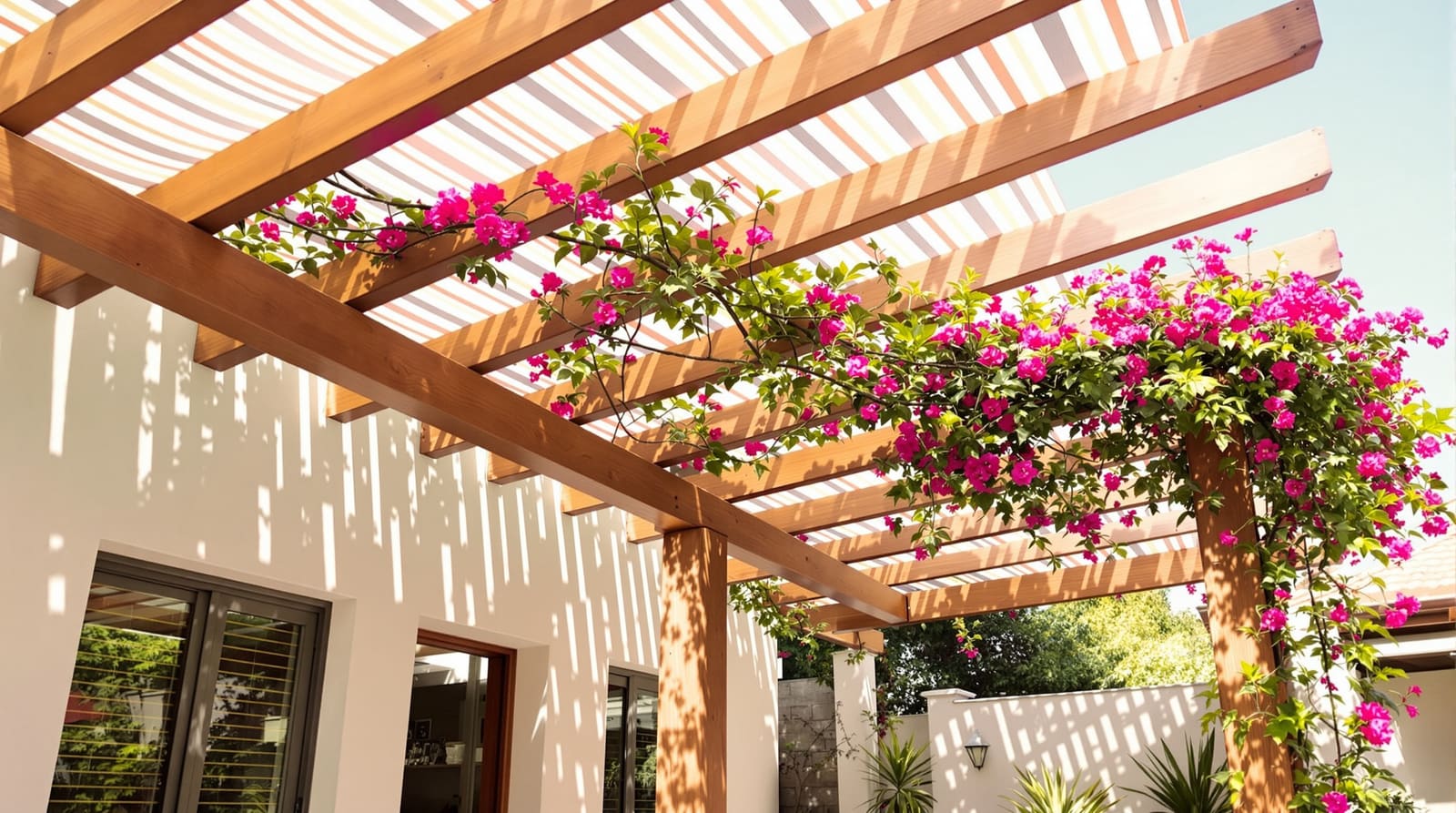
Pergola Design Guide
Designing a pergola — types and materials, anatomy and spans, louvre spacing and sun control, roofing options, climbers, foundations and cost
A pergola is the cheapest way to turn raw outdoor space into a room you actually use — an open frame of posts and rafters that throws striped shade, defines an outdoor "living room", carries a flowering climber, and frames the best view your plot has, all without the cost or byelaw weight of a roofed structure.
For an Indian home — where the terrace bakes from March to June, the monsoon arrives like a fire-hose, and termites treat soft timber as a buffet — getting the pergola right is mostly about three decisions: what you build it from, how the rafters are spaced and angled against the sun, and how deep you sink the footings. Get those three right and a pergola lasts decades. Get them wrong and you have a rusting, sagging, termite-riddled liability within three monsoons.
What a pergola actually does
A pergola earns its keep in four ways, and it is worth being honest about which one you want before you draw a single member.
- Filtered shade, not full shade. An open-rafter pergola does not waterproof anything. Its job is to cut the harsh overhead sun into bearable stripes — typically 40–60% shade depending on rafter spacing — while keeping air moving. If you want a dry, rain-proof sit-out, you want a roofed structure or a polycarbonate-topped pergola, which is a different (and heavier) animal.
- Defining an outdoor room. Four posts and a top frame psychologically enclose a patch of garden, terrace or driveway edge into a "destination". This is the single biggest reason urban Indian homes build them: they convert leftover setback or terrace into a dining or lounging zone.
- A trellis for climbers. The classic Mediterranean and Indian courtyard pergola is a living roof — madhumalti or bougainvillea trained across the top so the structure greens over and cools by evapotranspiration.
- Framing a view or a feature. A pergola over a water feature, at the end of a garden path, or aligned to a sunset directs the eye and gives a focal point.
Types of pergola
Attached vs freestanding
An attached (or "lean-to") pergola fixes one beam to the house wall via a wall plate / ledger, with posts only on the outer edge — ideal over a sit-out, a kitchen-garden window, or a terrace edge, and cheaper because it needs half the posts. The wall fixing must go into RCC or solid masonry with chemical anchors (Hilti/Fischer-type), never into plaster or hollow block. A freestanding pergola stands on four-plus posts and can go anywhere — lawn centre, terrace, driveway — but needs proper footings on every leg and more lateral bracing against wind.
Flat vs pitched
A flat top (rafters horizontal) is the urban default — clean, modern, easy to build. A pitched or mono-slope top (5–15° fall) is worth the extra trouble anywhere you add a polycarbonate or fabric roof, because it sheds monsoon water and dust instead of ponding.
With or without a roof
- Open — rafters only, maximum airflow, partial shade, the lightest and cheapest.
- Louvred — fixed or adjustable slats that let you tune shade and even close out rain (motorised "bioclimatic" aluminium pergolas).
- Roofed — polycarbonate, glass, fabric/shade-sail or a green vine canopy laid over the frame.
Materials compared — the decision that defines the build
Material choice drives cost, span, maintenance and how the thing survives an Indian monsoon and termite season. This is where most homeowners over- or under-spend.
| Material | Indicative cost (₹/sq ft of footprint, supply+fit) | Max practical clear span | Maintenance | Monsoon / termite durability | Look |
|---|---|---|---|---|---|
| Treated pine / sal | 350–700 | 2.5–3 m | Re-oil/seal every 1–2 yrs | Moderate — only if pressure-treated; untreated sal is termite bait | Warm, casual |
| Teak / Burma teak | 1,500–3,500+ | 3–3.5 m | Low; oil yearly to keep colour | Excellent — naturally oily, termite-resistant | Premium, classic |
| Steel / MS (powder-coated) | 450–900 | 4–6 m | Re-paint every 3–5 yrs; watch weld rust | Good if galvanised+coated; bare MS rusts fast in coastal/monsoon air | Industrial, slim |
| Aluminium (incl. louvred/motorised) | 1,200–4,500+ | 4–6 m | Near-zero | Excellent — no rust, no termite | Sleek, modern |
| RCC (cast posts/beams) | 600–1,200 | 3–4 m | Very low; re-paint occasionally | Excellent; effectively permanent | Heavy, solid |
| Bamboo (treated) | 150–400 | 2–2.5 m | Re-treat yearly; expect 5–8 yr life | Poor unless borax-boron treated and capped against rain | Rustic, eco |
A few India-real truths behind the table:
- Bare MS is a trap on the coast. In Mumbai, Goa, Chennai or Kochi, untreated or thinly painted mild steel will bleed rust at every weld within two monsoons. Specify hot-dip galvanised sections or at minimum a zinc-rich primer plus two coats of PU/epoxy, and detail welds to drain.
- Untreated softwood is termite food. Sal and rubberwood are cheap but must be pressure-treated (CCA/ACQ) or you are building a buffet. Teak is the only Indian timber that shrugs off both termites and rain without chemical treatment — hence its premium.
- Aluminium has crossed over. Motorised louvred ("opening-roof") aluminium pergolas were once import-only; Indian fabricators now make them, and while still the priciest option, they are genuinely maintenance-free and let you close the roof when the monsoon hits.
- RCC lasts forever but reads heavy — best where the pergola doubles as a structural pergola-cum-porch and you want zero maintenance.
For a fuller breakdown of what outdoor structures cost in the Indian market, see the Landscape Cost Guide.
Anatomy and structure
A pergola is a simple post-and-beam frame, but the member sizes and spacings are where amateur builds go wrong — too-thin rafters sag, too-wide post spacing wobbles.
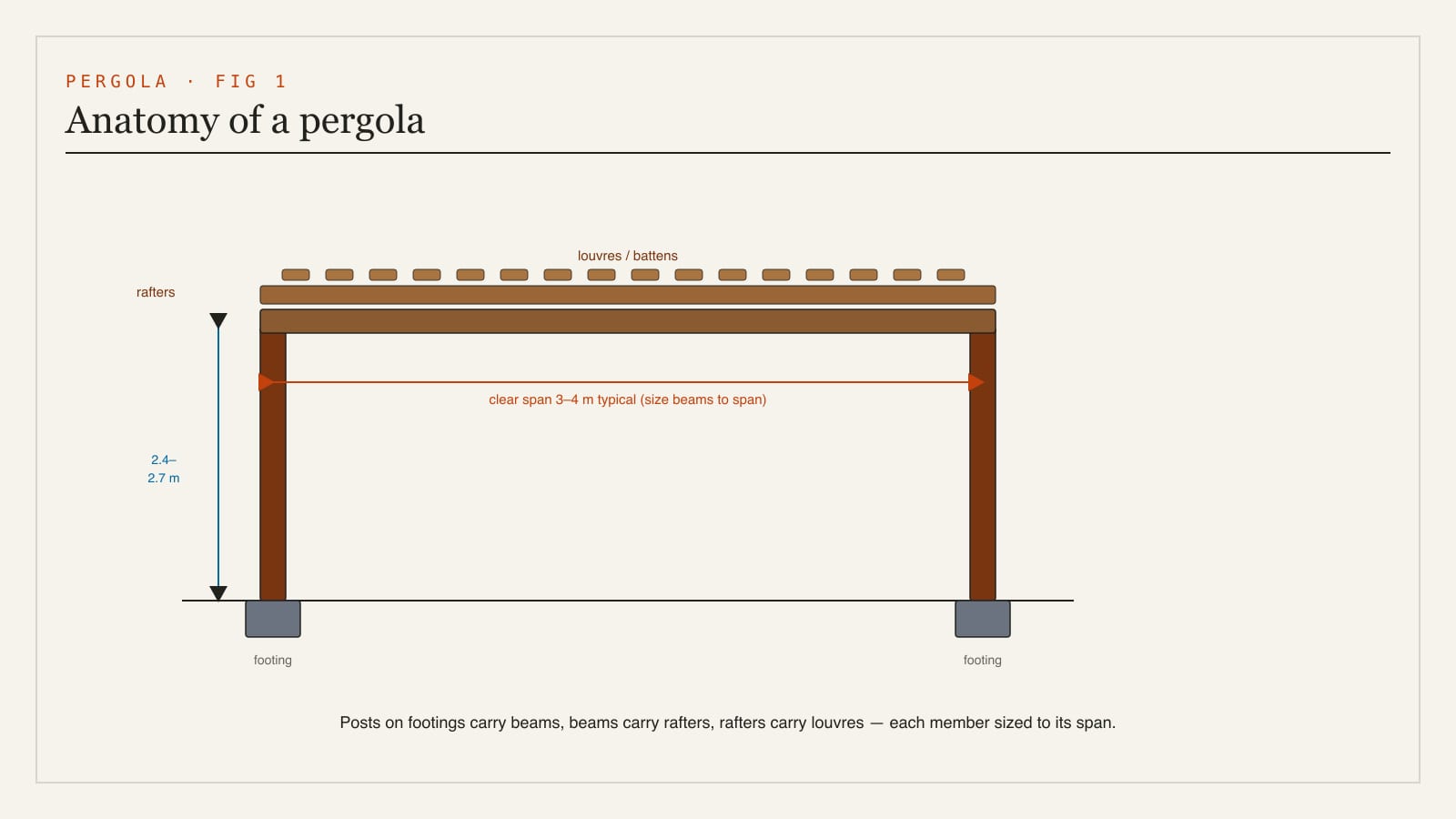
From the ground up:
- Footings / foundation. Each post sits on an isolated RCC footing. For a domestic pergola, a footing roughly 450 × 450 × 450 mm in M20 concrete, taken 450–600 mm below ground (deeper in black-cotton/expansive soil or where wind is high), with the post anchored on a base plate and holding-down bolts or cast into the concrete. On a terrace, you cannot dig — posts bolt to base plates fixed to the slab, and the load must be checked against the slab's capacity and over a beam line, not mid-span.
- Posts (columns). The vertical legs. Typical sizes: 100 × 100 mm timber, 100–150 mm dia or square MS/aluminium hollow section, or 200 × 200 mm RCC. Post spacing of 2.4–3.0 m is the comfortable domestic range; beyond ~3.6 m you must up-size beams.
- **Beams (the main horizontal members) span post-to-post and carry the rafters. Size to the span — e.g. 50 × 150 mm to 75 × 200 mm timber, or 100 × 50 mm MS RHS for a 3 m span.
- Rafters run across the beams at right angles. This is the "comb" you see overhead. Typical rafters: 50 × 100 mm to 50 × 150 mm timber at 300–450 mm centres, or 40 × 40 / 50 × 50 mm MS sections.
- Battens / louvres are the smaller top layer laid over the rafters to fine-tune shade — slats at 50–100 mm spacing, fixed flat or angled.
A useful rule of thumb for spans and members:
| Clear span between posts | Suggested beam (timber) | Rafter (timber) at 350 mm c/c |
|---|---|---|
| Up to 2.4 m | 50 × 150 mm | 50 × 100 mm |
| 2.4–3.0 m | 75 × 175 mm | 50 × 125 mm |
| 3.0–3.6 m | 75 × 200 mm (or steel) | 50 × 150 mm |
| Over 3.6 m | Steel/aluminium beam advised | 50 × 150 mm |
These are guideline sizes for an unroofed garden pergola; the moment you add a polycarbonate roof, a vine load, or live access (people on top), get the members sized by an engineer per the relevant loading.
Sun control — the part most people skip
A pergola's whole personality comes from its rafters: their spacing, depth and orientation decide whether you get crisp moving shade or a useless open grid.
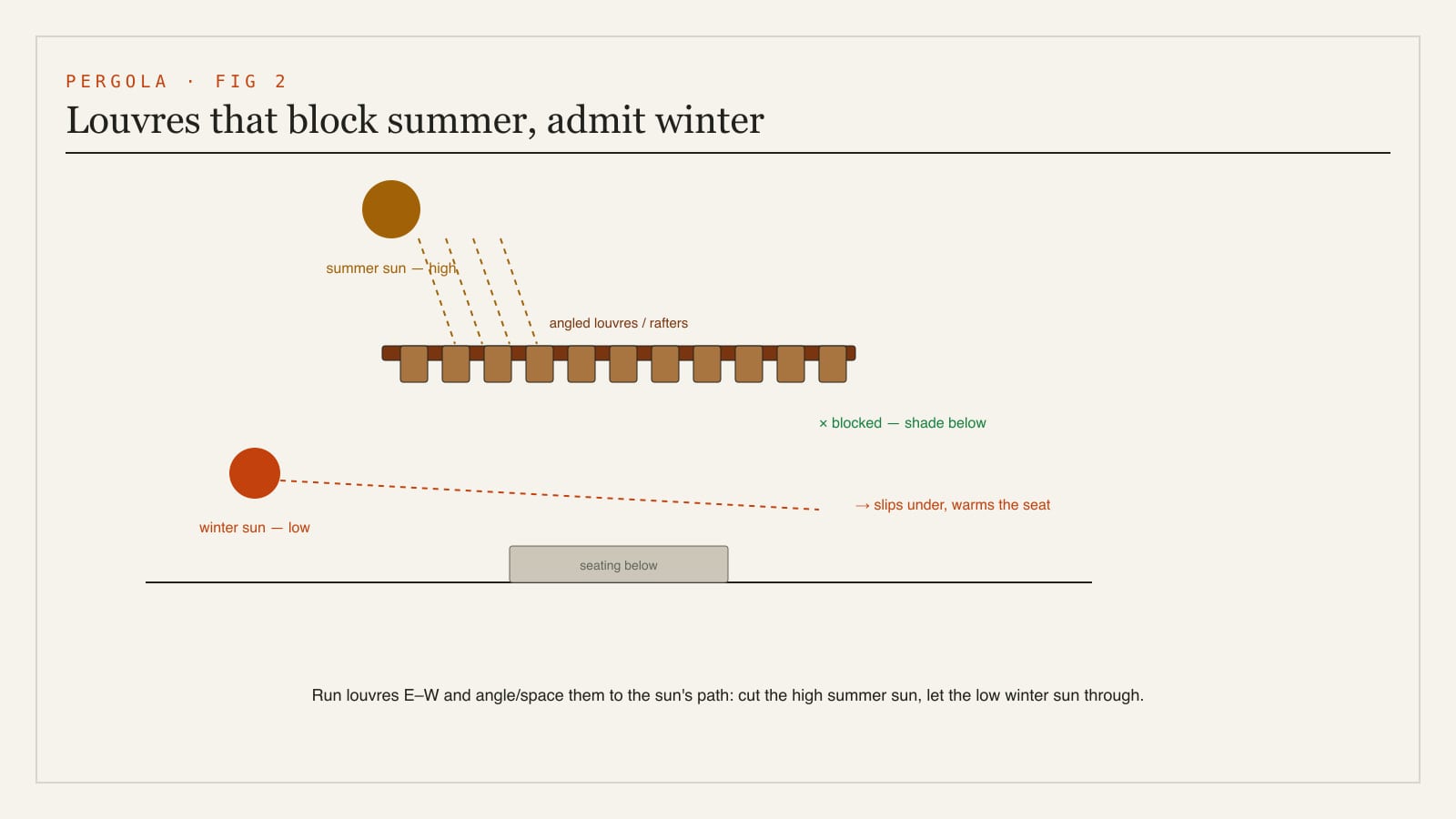
The physics is simple and worth using. In India the summer sun rides very high (near overhead at solar noon, altitude well above 75–80° across most of the country in May–June), while the winter sun stays low (often 40–45° at noon in December across north and central India). A pergola can be tuned to block the high summer sun and admit the lower winter sun:
- Deep rafters, closer together, block more overhead sun. Tall slats (depth greater than the gap) at close spacing cut almost all of the steep midday summer light while still letting low-angle morning/evening light slip between them.
- Orientation matters. Run rafters north–south and they cast moving east-west shadows that track the sun through the day — good for an all-day sit-out. Run them east–west and a deep rafter shades the steep noon sun but lets the low winter sun rake under.
- Angle the louvres. Sloping fixed louvres at roughly the local latitude angle (about 13° in Chennai, 19° in Mumbai, 28° in Delhi) lets you cut the summer beam while admitting winter sun — the same logic as a window overhang.
- Adjustable / motorised louvres are the luxury answer: aluminium bioclimatic pergolas let you rotate the blades from fully open to fully closed (and shut out rain) at the touch of a button — ideal for a Delhi terrace that is brutal in May and lovely in December.
This sun-tuning logic is the outdoor cousin of orientation-led design covered in Climate-Responsive Landscape Design; orient the pergola, then space the rafters to suit.
Roofing options
| Roof type | Rain protection | Heat | Notes |
|---|---|---|---|
| Open rafters | None | Stays cool, airy | Cheapest; partial shade only |
| Polycarbonate (multiwall) | Full | Can trap heat — vent it | Pitch 5–15° to drain; UV-coated sheets only |
| Glass / toughened | Full | Hot without low-E | Premium look; needs cleaning, monsoon load checks |
| Fabric / shade-sail / retractable | Good | Cool, breathable | HDPE shade-cloth 90%+; tension and slope for runoff |
| Green / vine canopy | Partial | Coolest (evaporative) | Living roof; needs the structure sized for the load |
For monsoon India, the practical winners are UV-stabilised multiwall polycarbonate on a slight pitch (dry sit-out, lets light through) or a retractable shade-sail (cool, removable before storm season). Avoid flat untreated polycarbonate that ponds water and goes brittle in two summers.
Climbers for an Indian pergola — and their structural load
A green pergola is the most rewarding version, but plants are a real, growing load and a moisture trap, so the structure must be sized and detailed for it.
- Madhumalti / Rangoon creeper (Combretum indicum) — the classic Indian pergola climber; fast, fragrant, masses of pink-white flowers. Vigorous and heavy at maturity.
- Bougainvillea — sun-loving, drought-tolerant, spectacular colour; woody and very heavy once established, with thorns — give it the strongest frame.
- Jasmine (mogra / chameli / Star jasmine) — fragrant, moderate weight, loves a warm courtyard pergola.
- Passionflower (Passiflora) — pretty, fast, moderate load; good for a lighter frame.
- Grape vine — deciduous, so it greens over in summer and bares in winter (perfect natural sun control), edible bonus; needs sturdy wires.
- Money plant (Pothos) / creeping fig — low-load green cover for shaded urban pergolas.
Structural load realities:
- A mature woody climber (bougainvillea, madhumalti) plus wet foliage can add a sustained dead load of 15–40 kg per square metre, and far more after rain. Treat it as a roof load, not decoration.
- Use stainless-steel wire or a separate trellis layer to train climbers, not the structural rafters alone — it keeps tendrils off the joints and lets you re-tension.
- Climbers trap moisture, which accelerates rot in untreated timber and rust at steel welds. Plant near the posts, train upward, and keep timber sealed and steel galvanised.
- Deciduous climbers (grape) give you free seasonal shade control — dense in summer, bare in winter.
If you are planning the planting around the pergola too, Best Trees for Indian Homes and Backyard Design Ideas pair naturally with this.
Foundations, wind and the things that fail
Wind, not weight, is what topples pergolas — an open frame catches little, but a roofed or vine-clad one becomes a sail.
- Footing depth beats footing width for overturning. In normal soil, 450–600 mm deep isolated footings per post are adequate for an open domestic pergola; go deeper and wider for tall, roofed or coastal/high-wind sites, and check the National Building Code wind-load map for your zone (the Indian coast and parts of the east face the highest basic wind speeds).
- Brace against racking. Freestanding pergolas need either moment-fixed (welded/bolted) joints or knee-braces at the post-beam junctions, especially once a roof or vine adds windage.
- Detail every joint to drain. Standing water at a horizontal timber joint or an unsealed steel weld is where decay and rust start. Cap post tops, slope beam tops slightly, and seal end-grain.
- On terraces, respect the slab and the byelaws. A terrace pergola loads a slab never designed for posts — keep posts over beams/columns below, and check it. Many municipalities and RWAs treat a roofed terrace structure as covered area / FSI; an open pergola is usually fine, but confirm before you build a polycarbonate roof that quietly becomes an enclosed room.
Putting it together — a quick spec for a typical 3 × 3 m terrace pergola
For a 3 × 3 m freestanding lounge pergola on a north Indian terrace: four 100 mm SHS galvanised+powder-coated steel posts on slab base plates over the beam line; 100 × 50 mm RHS beams; 40 × 40 mm rafters at 350 mm centres running north–south for moving all-day shade; an optional retractable HDPE shade-sail for May–June; and a single bougainvillea or madhumalti trained up one corner on stainless wire. Budget roughly ₹40,000–₹90,000 for the steel frame; add ₹30,000–₹1,50,000+ for a motorised louvred aluminium upgrade.
Designed with the sun in mind, footed properly, and built from a material that suits your climate, a pergola is among the highest-return moves in any Indian garden or terrace — turning unused, sun-blasted space into the room the family actually wants to sit in.
References & further reading
- National Building Code of India 2016 (BIS), Part 6 (Structural Design) and Part 3 (Development, Building & Plumbing) — wind loads, footings and covered-area definitions.
- IS 875 (Part 3): Code of Practice for Design Loads (Other than Earthquake) — Wind Loads — for basic wind-speed zones used in footing and bracing design.
- IS 401: Code of Practice for Preservation of Timber and IS 1141: Seasoning of Timber — treatment and durability of structural timber against decay and termites.
- IS 4671 / IS 14246 and CBRI guidance on galvanised and coated steel sections for outdoor durability.
- Building Materials & Technology Promotion Council (BMTPC), Govt. of India — material durability and bamboo treatment guidance for Indian climates.
- Time-Saver Standards for Landscape Architecture (Harris & Dines) — recognised reference for pergola/arbour geometry, member sizing and shade-structure detailing.
Export this guide
Related Guides — Deep-dive reading
Understanding Sun Path Analysis for Your Home
How the sun actually moves over an Indian site through the day and the year — and why that single fact quietly decides where your kitchen, bedroom and living room should sit.
Site PlanningCompound Wall Piers and Columns in India: Spacing, Reinforcement and Stability (2026)
Why a long, free-standing boundary wall needs intermediate piers or RCC columns to stay up — the physics of overturning in plain terms, thickened masonry piers vs reinforced-concrete columns on footings, indicative spacing that an engineer sets to your height and wind zone, the coping or tie beam that braces the top, and where to break a long run with movement joints.
Compound WallsThe Best Trees for Indian Homes
A research-grade guide to choosing and placing trees around an Indian home — the real cooling and clean-air numbers, the right species for shade, flowers, fragrance and fruit, and the placement science that keeps roots out of your walls and drains.
LandscapeRelated Tools — Try Free
Cross-Ventilation Analyzer
Estimate airflow and air changes per hour (ACH) from room size, window areas, layout, and local wind — with NBC 2016 Part 8 compliance check.
Ventilation CalculatorRainwater Tank Sizer
How big should your rainwater tank be? Computes annual harvest, recommended tank capacity in litres, water-bill savings, and payback — for 10 Indian cities.
RWH CalculatorBrise-Soleil Visualizer
Interactive horizontal-louvre cut-off angle calculator — sun altitude, louvre depth, and spacing inputs with a live shadow preview. Computes θ = arctan(spacing/depth) for façade shading, ECBC envelope compliance, hospital daylight design, and tropical sun-control detailing.
Sun Shading Tool