
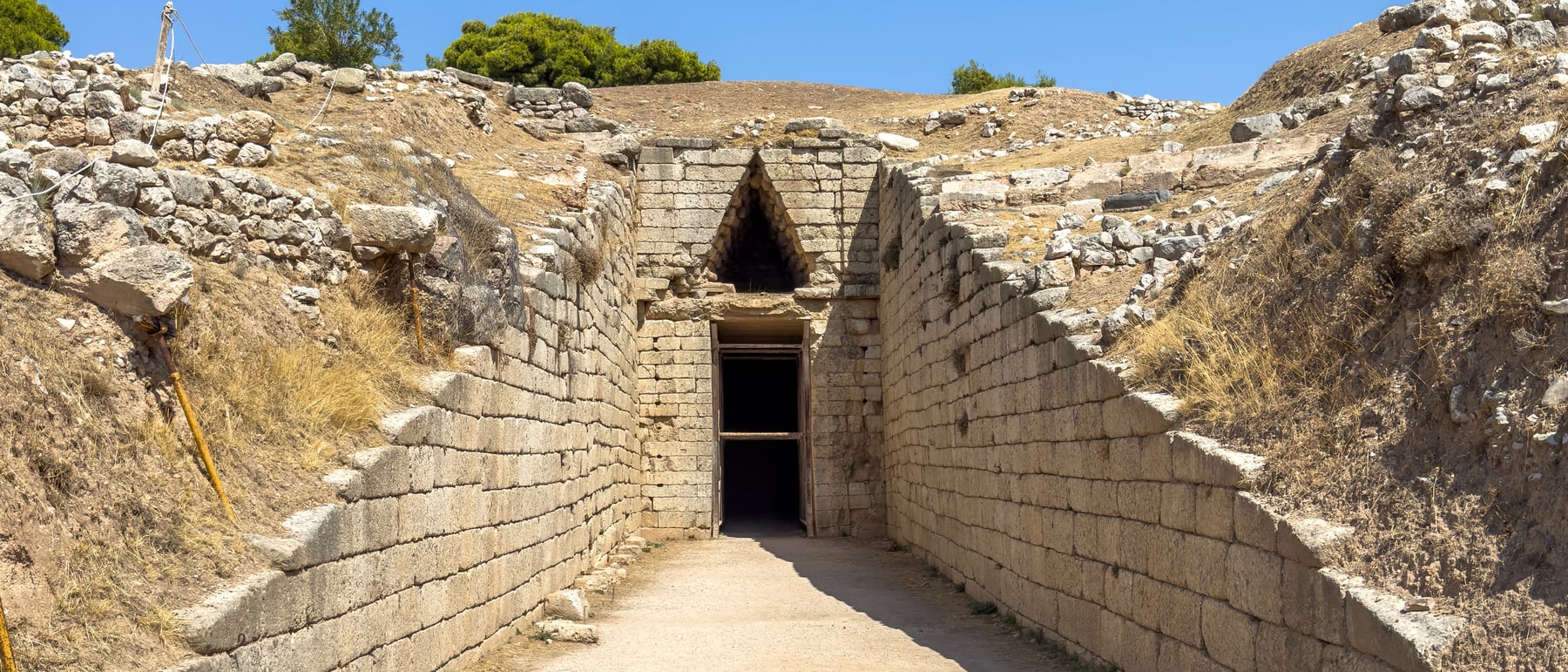
The Treasury of Atreus: The Beehive That Beat the Pantheon by 1,400 Years
How Bronze Age Greeks buried a king under a stone beehive at Mycenae — raising a corbelled dome that stayed the widest in the world for over a thousand years, balancing a 120-tonne lintel above the door, and inventing the relieving triangle to keep it from cracking — a masterpiece that is not a treasury, and almost certainly not the tomb of Atreus or Agamemnon at all.
From a green Irish hillside we travel to a dry Greek one, and forward about two thousand years — from Newgrange to the golden age of Bronze Age Greece. At Mycenae, the citadel Homer called "rich in gold," the Mycenaeans buried their kings not under mounds of turf but inside vast domes of cut stone — and the greatest of them is a building that broke a world record and kept it for fourteen centuries.
It is known as the Treasury of Atreus, or the Tomb of Agamemnon — and, as we will see, almost every word of both names is wrong. What it truly is: a colossal tholos, or "beehive," tomb from around 1250 BCE, roofed by a corbelled stone dome that remained the tallest and widest in the world until the Romans built the Pantheon. Above its doorway sits a single lintel stone weighing perhaps 120 tonnes, and above that, one of the most elegant structural inventions in all of ancient architecture. It is the pinnacle of Mycenaean building, and a landmark in the long human story of tombs.
This is the thirty-ninth article in our Architectural Wonders series.
1. The tomb with the wrong name
Before we admire it, we have to un-name it — because the romantic labels everyone knows are, on the evidence, almost entirely fiction.
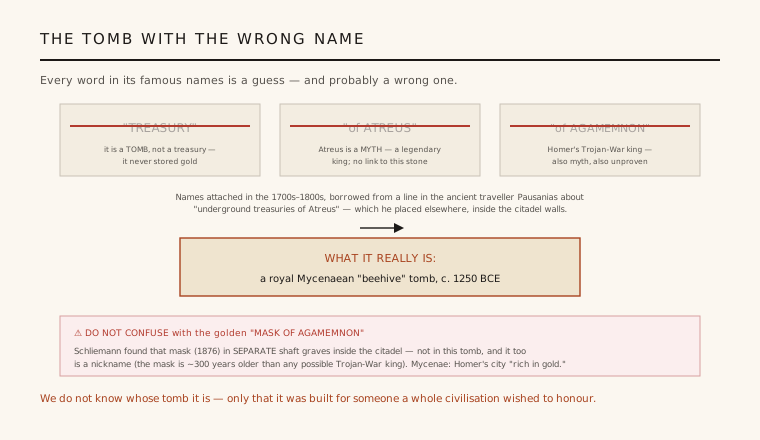
It is not a treasury — it is a tomb, and never stored gold. And there is no proven link to Atreus or his son Agamemnon, the doomed king of Homer's Trojan War — both are figures of myth, and nothing connects them to this stone. The names were pinned on in the 1700s and 1800s, borrowed from a stray line in the ancient traveller Pausanias about "underground treasuries of Atreus" — which he actually located elsewhere, inside the citadel walls. (Beware, too, a second confusion: the golden "Mask of Agamemnon" that Heinrich Schliemann unearthed in 1876 came from separate, older shaft graves inside the citadel, not from this tomb — and its name is a nickname too.) So the honest description is humbler and, in its way, more moving: a royal Mycenaean beehive tomb, built for someone so important that a whole civilisation poured its finest engineering into their grave — and whose name we have completely lost.
2. A beehive of stone
Set the names aside and look at the form, which is one of the most striking tomb-types ever devised.
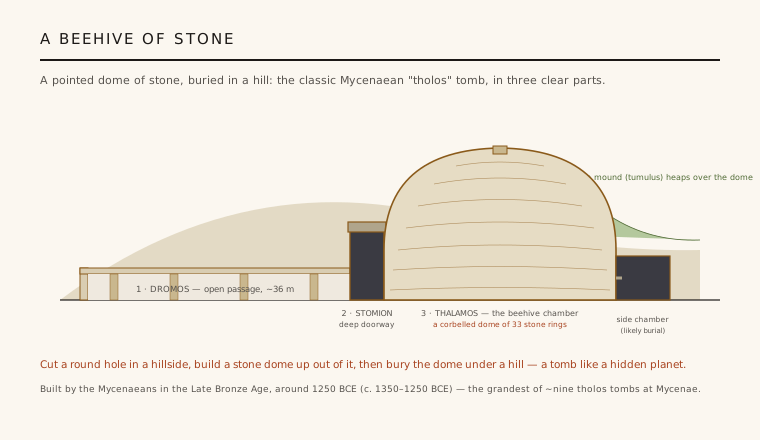
A Mycenaean tholos tomb has three parts, and the Treasury of Atreus is their perfect expression. First, a long, open, roofless passage — the dromos — about 36 metres long, walled on both sides with beautifully cut ashlar masonry, cut straight into the flank of a hill. It ends at a deep, tapering doorway — the stomion. And through the doorway opens the wonder: a great circular chamber — the thalamos — roofed by a pointed dome shaped like a beehive, built up from the ground in thirty-three rings of stone and then buried under an earthen mound. The whole thing is a hidden sphere of stone, sunk into a hillside. It is the same fundamental idea as Newgrange — a corbelled chamber under a mound — but scaled up, cut in precise ashlar, and refined into something monumental. Where Newgrange is a rugged mound of a farming people, this is the polished mausoleum of a warrior aristocracy at the height of its power.
3. The greatest dome for a thousand years
Step inside and stand under that dome, and you are standing under a record that held longer than almost any in the history of building.
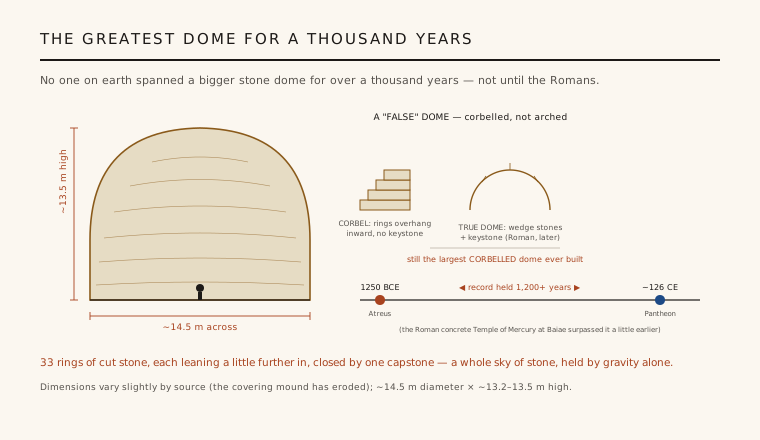
The dome is about 14.5 metres across and 13.5 metres high — and for over a thousand years, no larger stone dome existed anywhere on earth. It held that record from around 1250 BCE until the Roman period, when concrete finally surpassed it (first a dome at Baiae, then, most famously, the mighty Pantheon in Rome around 126 CE) — roughly fourteen centuries later. And here is the subtle, important thing: this is not a true dome. A Roman dome is built of wedge-shaped stones locked around a keystone. This is a corbelled dome — a "false" dome — built of thirty-three flat rings of stone, each one cantilevered a little further inward than the last, holding together by sheer weight and precision until a single capstone closes the top. To span fourteen and a half metres that way, with no mortar and no keystone, purely by the discipline of overlapping stone, is an astonishing feat — and to this day it remains the largest corbelled dome ever built. The Romans beat its size; no one has ever beaten its method.
4. A 120-tonne stone, and a clever triangle
Now look up at the doorway you came through — because it hides the tomb's greatest piece of engineering, and one of the cleverest ideas in ancient architecture.
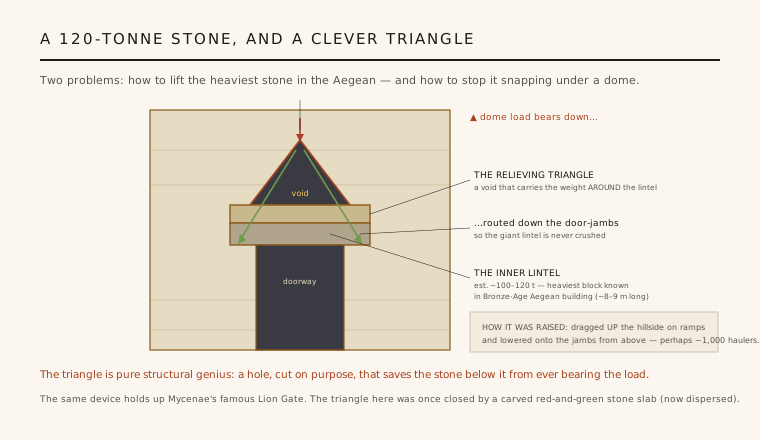
Spanning the doorway is a colossal lintel stone — the inner of two — estimated at 100 to 120 tonnes, the heaviest single block known from all of Bronze Age Aegean architecture. Just moving it was a feat: it was dragged up the hillside and lowered onto the door-jambs from above, perhaps by a thousand haulers. But a stone that heavy, with a fourteen-metre dome piled on top of it, would crack under the load. So the builders cut a triangular hole directly above it — the "relieving triangle." That empty triangle does something beautiful: it diverts the enormous weight of the dome away from the middle of the lintel and channels it down and outward, through the solid door-jambs at the sides. The lintel below carries almost nothing. It is a piece of pure structural genius — a void, cut on purpose, that saves the stone beneath it — and the Mycenaeans used the same trick to hold up their famous Lion Gate. The triangle was originally filled by a carved slab of red and green stone; that, like much of the tomb's decoration, is now gone — which brings us to the last, sadder part of the story.
5. A face scattered across Europe
The Treasury of Atreus was once far more colourful and ornate than the bare grey stone we see today. Its glory has been stripped and scattered.
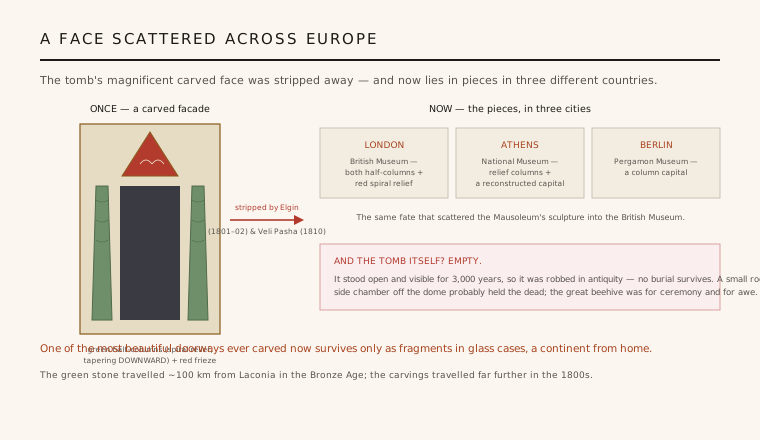
The doorway was once framed by a pair of green stone half-columns — carved with running spirals, and unusual in that their shafts taper downward, narrower at the base than the top, a distinctly Minoan touch — above which ran a band of red stone carved with rosettes and spirals. It was one of the most beautiful facades of the ancient world. And in the early 1800s it was taken apart: pieces were carried off by Lord Elgin's agents (1801–02) and by the Ottoman governor Veli Pasha (1810), and today the fragments are scattered across three countries — the green columns and red relief in the British Museum in London, more in the National Archaeological Museum in Athens, a capital in the Pergamon Museum in Berlin. It is the very fate we watched befall the Mausoleum of Halicarnassus, whose sculptures also ended up in London. As for the tomb's occupant: the great beehive stood open and visible for three thousand years, so it was robbed in antiquity and found completely empty — the king it was built to honour was long gone, and even his name went with him. A small side chamber, cut into the rock, probably held the actual burial; the vast dome was for ceremony, and for awe. What remains is the awe.
6. What a modern architect can learn from the Treasury of Atreus
- A void can carry a load. The relieving triangle is empty on purpose — a hole that saves the stone below it. The most elegant engineering is often about removing material to redirect force, not piling more on. Learn where to leave a gap.
- Master one method completely. With nothing but overlapping stone rings, the Mycenaeans out-spanned the whole world for a thousand years. Deep mastery of a single, "primitive" technique can outperform fancier ones — and endure longer.
- Question the famous name. "Treasury of Atreus" is wrong three times over. Received labels calcify into false certainty; a good designer, like a good historian, keeps asking what the evidence actually supports.
- The approach is part of the architecture. The long, narrowing dromos builds anticipation before the doorway; the reveal of the dome is staged. Sequence and procession — how you arrive — can matter as much as the room itself.
- Grandeur is often for the living. The corpse lay in a small side room; the giant dome was for the mourners and the memory. Much funerary architecture is really civic architecture — a stage for a community's grief and pride.
- Decoration is fragile; guard it. The tomb's carved face is now in glass cases a continent away. What is applied to a building — its ornament, its colour, its meaning — is the first thing lost. Build the significance into the structure, not only onto its surface.
References & further reading
1. UNESCO World Heritage Centre — Archaeological Sites of Mycenae and Tiryns (inscribed 1999). https://whc.unesco.org/en/list/941/
2. Encyclopaedia Britannica — Treasury of Atreus. https://www.britannica.com/topic/Treasury-of-Atreus
3. The British Museum — Half-columns from the Treasury of Atreus (mus. no. 1905,1105.1–3). https://www.britishmuseum.org/collection/object/G_1905-1105-1-3
4. World History Encyclopedia — Treasury of Atreus, Mycenae. https://www.worldhistory.org/image/461/treasury-of-atreus-mycenae/
5. Ancient World Magazine — The Treasury of Atreus. https://www.ancientworldmagazine.com/articles/treasury-atreus/
6. Pausanias — Description of Greece 2.16 (the ancient "treasuries of Atreus" reference), via Perseus. https://www.perseus.tufts.edu/hopper/text?doc=Paus.+2.16
Last verified 2026-07-04. Figures follow the standard archaeological record and are given as widely cited approximations that vary by source. The tomb is a Mycenaean tholos dated to c. 1250 BCE (scholarly range c. 1350–1250 BCE) by pottery stratigraphy. The names "Treasury of Atreus," "Tomb of Agamemnon" (and "of Clytemnestra" for a neighbour) are traditional 18th–19th-century misnomers with no evidential basis; Atreus and Agamemnon are legendary figures, and Pausanias's "treasuries of Atreus" reference was located inside the citadel, not at this tholos. The corbelled dome is ~14.5 m in diameter and ~13.2–13.5 m high (the covering mound has eroded), built of 33 rings — the tallest and widest stone dome in the world for over a thousand years, until surpassed in the Roman period (a concrete dome at Baiae, then the Pantheon, c. 126 CE); it remains the largest corbelled dome ever built. The inner lintel is estimated at ~100–120 tonnes (the heaviest known block in Aegean Bronze-Age architecture; ~8–9 m long), relieved by the triangular void above it. The green half-column and red-stone facade decoration was removed in the early 1800s (Elgin's agents 1801–02; Veli Pasha 1810) and is dispersed among the British Museum, the National Archaeological Museum in Athens, and Berlin; the tomb was robbed in antiquity and found empty. Do not conflate this tholos with the Mask of Agamemnon and Grave Circle A shaft graves (Schliemann, 1876), which are earlier and separate. Mycenae/Tiryns is a UNESCO World Heritage Site (1999).
Export this guide
Related Guides — Deep-dive reading
The Pantheon: The Dome That Has Never Been Beaten
Nearly nineteen centuries ago the Romans poured a hemisphere of concrete 43 metres across, left a single round hole open to the sky at its summit, and walked away — and it is still, today, the largest unreinforced concrete dome on Earth. A temple to all the gods that became a church, the best-preserved building of ancient Rome, and the ancestor of every great dome from Florence to the United States Capitol.
Architectural WondersThe Parthenon: The Perfect Temple That Has No Straight Lines
On a rock above Athens, a democracy at the height of its powers built a marble temple to its virgin goddess — and tuned it so subtly, with curved floors, swelling columns and walls that lean inward, that a building full of curves reads to the eye as flawlessly straight. Temple, treasury, church, mosque, gunpowder store and ruin by turns, blown apart in a single night in 1687 and stripped of half its sculpture, it remains the most imitated building in the Western world.
Architectural WondersThe Colosseum: The Machine That Fed a City Its Pleasures
Rome's greatest emperors built palaces for themselves; the Flavian emperors did something shrewder — they drained a fallen tyrant's private lake and raised, on the spot, a stupendous arena for fifty thousand ordinary citizens. The largest amphitheatre ever built is a masterpiece of crowd engineering, a hidden stage-machine of lifts and trapdoors, and a place of real, organised killing — all at once. The fourth article in our chapter on the palaces and pleasures of worldly power, and the first on pleasure.
Architectural WondersRelated Tools — Try Free
Design Brief Generator
Answer 10 questions and generate a professional interior design brief PDF for your designer or architect.
Brief GeneratorDesign Style Finder Quiz
Answer 10 visual questions to discover your Indian interior style profile with materials and colours.
Interactive QuizHome Colour Studio
Colour every room — living, bedroom, dining, kitchen, bathroom — surface by surface in any HEX/RGB/CMYK colour, or from 80+ curated Indian shades.
Colour Studio