
Hadrian's Villa at Tivoli: The Emperor Who Rebuilt the World He Loved
The Roman emperor Hadrian had travelled almost the whole of his vast empire — and then, in the hills outside Rome, he built himself a private pleasure-world the size of a city, where he recreated the places he had loved on his journeys. It is a memory-palace of an entire empire, a laboratory of daring curved concrete a millennium and a half ahead of its time, and a monument quietly shaped by grief. The fifth article in our chapter on the palaces and pleasures of worldly power.
Our last article, the Colosseum, was pleasure built for fifty thousand people at once — mass, public, roaring. This one is its perfect opposite: pleasure built, in the end, for one man alone. We move from the greatest crowd-machine of Rome to the most personal building an emperor ever made — a private world so large it was a city, and so intimate it had a room you could reach only by pulling up the bridges behind you. This is Hadrian's Villa at Tivoli, and it is one of the most beautiful and moving places in this entire series.
This is the sixty-eighth article in our Architectural Wonders series, and the fifth in our chapter on the great palaces and pleasures of worldly power.
There is a reason to linger on this one. Every wonder in this series is, in some sense, a work of memory — but Hadrian's Villa is made of memory, deliberately and openly. It is the country retreat of a man who had seen the whole world of his day and could not bear to leave it behind, so he rebuilt the pieces he loved around his own home. In that, it is the most personal building we will meet: an emperor's diary, his travels and even his grief, written in brick and water and marble. For a series that is itself, quietly, a map of one traveller's life, no wonder speaks more directly.
1. The emperor who designed
To understand the villa, you first have to understand its unusual owner.
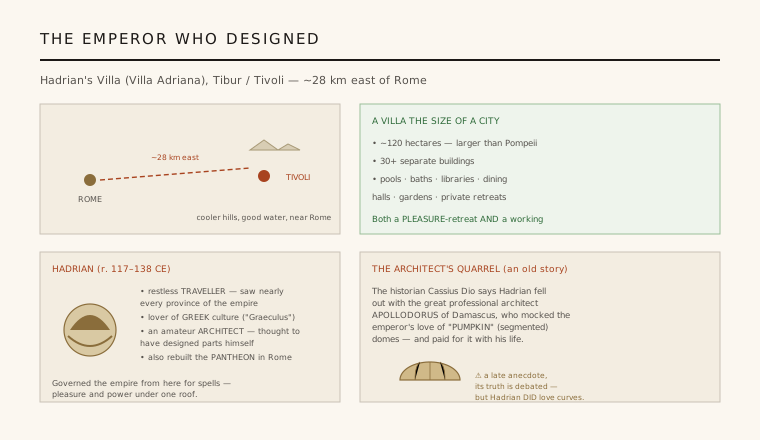
Hadrian (who ruled from 117 to 138 CE) was one of the most extraordinary of all Roman emperors: a restless traveller who personally visited nearly every province of his enormous empire, a passionate Grecophile (his enemies sneered at him as Graeculus, "the little Greek"), an intellectual — and, unusually, a genuine amateur architect who is thought to have shaped many of his own buildings, including the great dome of the Pantheon in Rome. Around 118 CE he began building himself a country estate at Tibur — modern Tivoli — some 28 kilometres east of Rome, in cooler hills with good water. And "estate" hardly covers it. It sprawled over roughly 120 hectares — larger than the whole city of Pompeii — with more than thirty separate buildings: pools, bath-suites, libraries, dining halls, gardens, guest quarters and private hideaways. It was a pleasure-retreat, yes; but it was also a working seat of government, from which Hadrian ran the empire for long stretches — the ancient world's answer to a presidential country residence. (A famous piece of ancient gossip, from the historian Cassius Dio, has Hadrian falling out with the leading professional architect Apollodorus of Damascus, who scoffed at the emperor's fondness for "pumpkin" domes — and was supposedly put to death for it. The story is late and much doubted; but Hadrian's love of curves, as we will see, was absolutely real.)
2. A world in miniature
Here is the idea that makes the villa unique in the ancient world — and unforgettable.
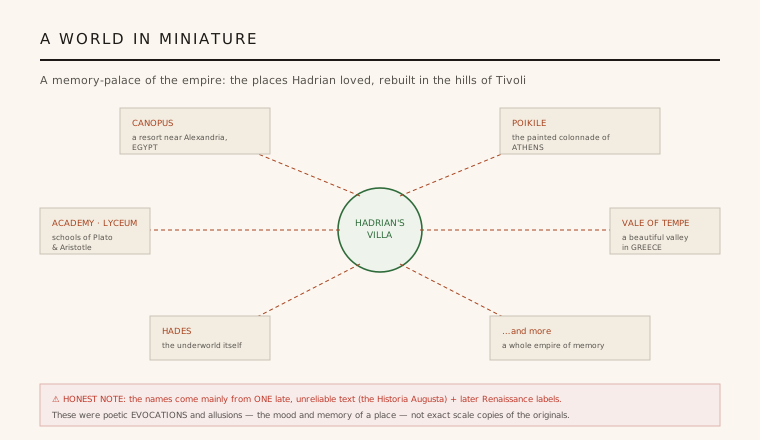
Because Hadrian had seen the wonders of his world, he did something no one had quite done before: he brought them home. According to ancient tradition, he recreated across his villa the places he had loved on his travels, and gave them their real names — a Canopus, after the pleasure-resort near Alexandria in Egypt; a Poikile, after the famous painted colonnade of Athens; an Academy and a Lyceum, after the schools of Plato and Aristotle; a Vale of Tempe, after the lovely Greek valley; even, it was said, a Hades, the underworld itself. The villa became a greatest-hits of the empire — and, more tenderly, a diary of one man's journeys, a place where he could walk from Greece to Egypt to the land of the dead in a single afternoon, surrounded by the architecture of his own memories. It is, in the most literal sense, a memory-palace.
We must add an honest note, because this is the villa's most romantic claim and it needs care. The famous names come mainly from one late and unreliable source (the Historia Augusta) and from labels applied much later by Renaissance antiquarians; which ruin is "really" the Canopus or the Poikile is often a modern guess. And scholars now think these were never meant as exact scale copies — they were evocations, allusions, moods: the feeling of Canopus, the idea of the Academy, not a tourist's replica. But that, if anything, makes the villa more sophisticated, not less. It is architecture working the way memory really works — not photographing the past, but evoking it.
3. The Canopus
Of all these recreated worlds, one survives well enough to take your breath away — and it carries a secret sorrow.
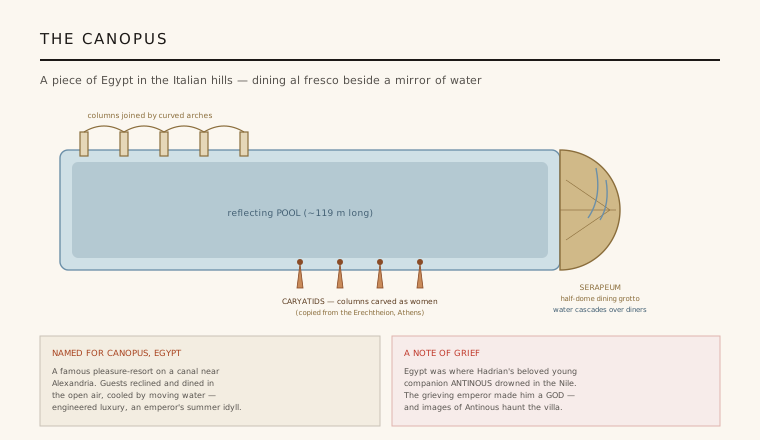
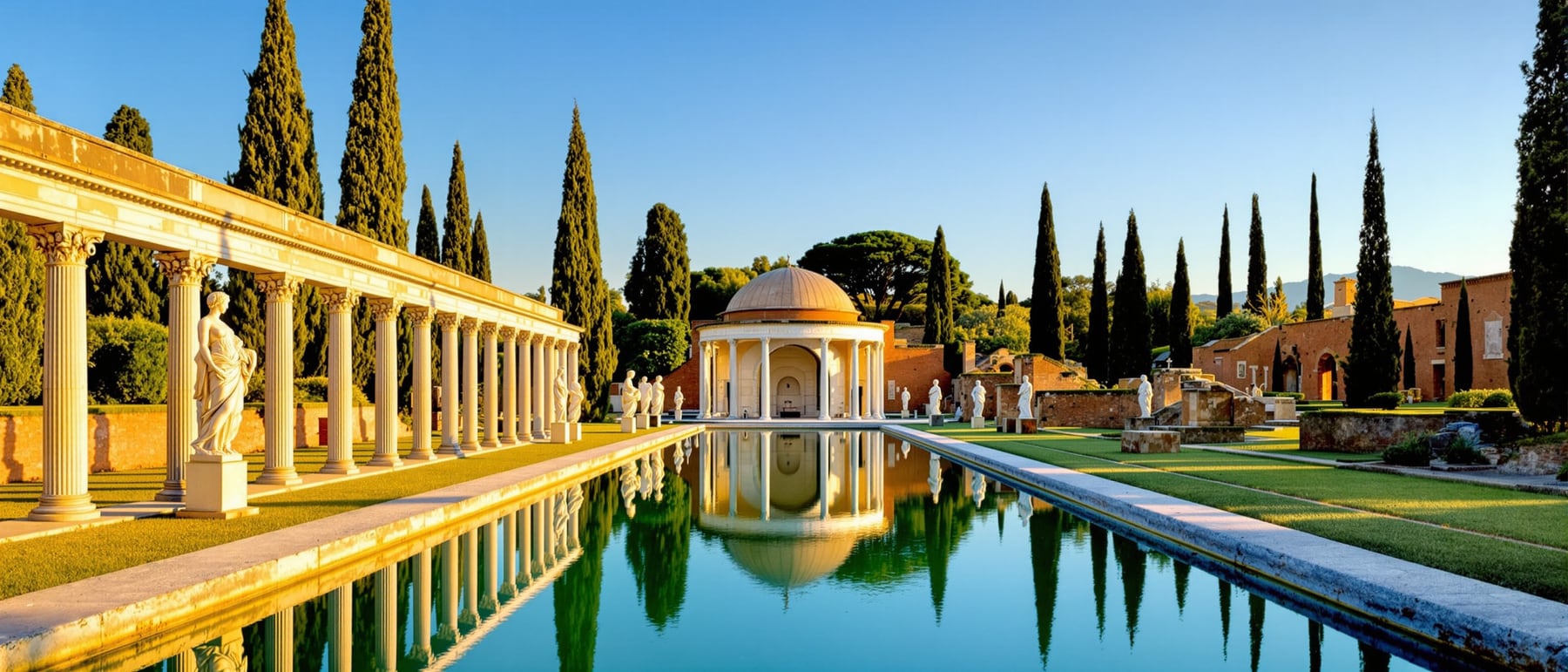
The Canopus is the villa's great set-piece: a long, still reflecting pool — around 119 metres — lined with an elegant colonnade whose columns are joined by gently curved arches, and set about with copies of celebrated Greek statues, among them the caryatids (columns carved as standing women) copied from the Erechtheion on the Athenian Acropolis. At the pool's far end opens a great half-domed grotto, the Serapeum, where the emperor and his guests reclined to dine in the open air while cooling water cascaded down around and over them — engineered luxury, a summer idyll of shade and moving water. And it is named, of course, for Canopus, the pleasure-town on a canal near Alexandria, in Egypt.
That name is not innocent. Egypt was where, in 130 CE, Hadrian's beloved young companion Antinous had drowned in the Nile — a death still wrapped in mystery. The emperor's grief was total and public: he had Antinous declared a god, founded a city in his name, and scattered his image across the empire, so that the beautiful, downcast face of Antinous survives in more ancient portraits than almost anyone but the emperors themselves. And it haunts this villa. To build a "Canopus," a corner of the very country where the boy had died, at the heart of his private world, was to make the architecture itself a form of mourning. Here the series' long thread — that the greatest buildings are so often shaped by love and loss — runs very close to the surface. Hadrian, master of the world, built beauty around a grief he could not undo. It is the most human thing in the whole chapter.
4. The architecture of curves
Set aside the poetry for a moment, and the villa is also one of the boldest engineering laboratories in the history of building.
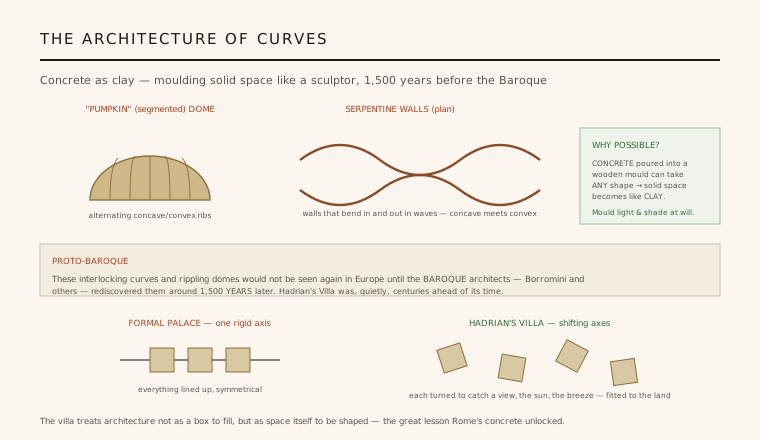
Most Roman buildings — even magnificent ones — are made of straight walls and simple half-round domes. Hadrian's Villa is different: it ripples. Its walls bend in and out in serpentine waves; its domes are shaped like segmented pumpkins with alternating ribs (exactly the form Apollodorus is supposed to have mocked); its spaces are built from concave and convex curves that interlock and flow into one another. The reason it could do this is Rome's supreme material: concrete. Because concrete is poured wet into a timber mould and only then sets hard, a Roman builder could give solid space almost any shape he liked — could mould architecture, and the light and shade within it, almost like clay. Hadrian's designers pushed that freedom further than anyone before them, and the results are astonishing: curved, plastic, restless interiors that would not be seen again in Europe until the Baroque architects — Borromini and his heirs — rediscovered them some fifteen hundred years later. In its geometry, the villa is centuries ahead of its time.
The plan is just as radical. A formal palace lines everything up along one grand, rigid axis, insisting on symmetry. Hadrian's Villa refuses. Its thirty-odd buildings are set at shifting angles, each one turned to catch a particular view, the morning sun, or a cooling breeze, and fitted loosely and cleverly to the rolling landscape rather than bulldozing it flat. It is designed the way you might actually live — around comfort, delight and the lie of the land — not the way you might wish to be seen. The whole villa treats architecture not as a box to be filled, but as space itself to be shaped. That, more than any single room, is Hadrian's gift to every architect who came after.
5. The island of solitude — and the scattering
The villa's most touching building is also its smallest and most private; and its ending is the saddest, and most fitting, in the chapter so far.
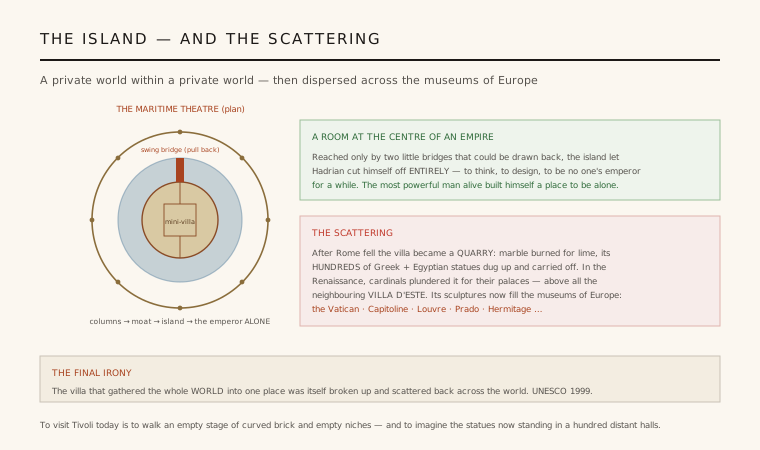
In the middle of this world-the-size-of-a-city, Hadrian built himself a place to be utterly alone. The Maritime Theatre is a perfect circle: a ring of columns enclosing a circular moat of water, and in the very centre of the water, on a small round island, a complete miniature villa — with its own little rooms, its own tiny baths, its own courtyard — reached only by two small swing bridges that could be pulled back. When the bridges were drawn in, the emperor was marooned by choice, cut off completely: a private world within his private world, a single room of solitude at the dead centre of an empire. There is something almost unbearably human in it. The most powerful man alive spent a fortune to build himself a place where, for a few hours, he could be no one's emperor — just a man, alone with his thoughts, his drawings, and perhaps his grief.
And then the ending. When Rome declined, the villa was abandoned, and for over a thousand years it served as a quarry: its marble burned in kilns for lime, its hundreds of Greek and Egyptian statues dug from the earth and carried off. In the Renaissance, cardinals and popes plundered it to adorn their own palaces — above all Cardinal Ippolito d'Este, whose glittering nearby Villa d'Este was decorated with Hadrian's spoils. So the sculptures of the villa — the very "world in miniature" Hadrian had so lovingly gathered — were broken up and scattered across the great museums of Europe: the Vatican, the Capitoline, the Louvre, the Prado, the Hermitage. The final irony is almost too perfect: the villa that gathered the whole world into one place was itself dispersed back across the world. To walk Tivoli today (it became a UNESCO World Heritage Site in 1999) is to move through an empty stage of curved brick and vacant niches, and to imagine all the missing statues standing now in a hundred distant halls — the memory-palace, scattered into other people's memories.
6. What a modern architect can learn from Hadrian's Villa
- Architecture can be a form of memory. Hadrian built the places he loved so he could keep living among them. A building can hold a memory, a journey, a person — and designing with that intent, rather than only for function, is one of the deepest things architecture can do. Ask what a place is meant to help someone remember.
- Evoke, don't photocopy. The villa's "Canopus" and "Academy" were never exact replicas — they were evocations, the mood of a place rather than its measured copy. The most powerful references are allusions, not reproductions; suggest, and let the visitor's own memory finish the work.
- Let the material set the form free. Concrete let Hadrian shape space like clay, and he seized it — curves, ripples, pumpkin domes centuries ahead of their time. When you truly understand what your material can do, you unlock forms no one has dared. Push the medium.
- Fit the building to the land, not the land to the building. The villa's shifting, un-axial plan bends to catch each view, sun and breeze. Designing with a site's slopes and orientations — instead of flattening them into one rigid geometry — is older, wiser, and more humane than forced symmetry.
- Design for solitude, too. In the largest villa of the Roman world, the most moving room is the one built for being alone. Even the most public, powerful life needs a place of retreat; a great design remembers the human need for stillness and privacy, not just for spectacle.
- What you gather may be scattered — so let the idea be the treasure. Hadrian's statues are gone, dispersed across a continent, yet the idea of his villa — the memory-palace, the world drawn into one loving place — reaches us intact. Build so that even if the objects are lost, the meaning survives. That, in the end, is the whole hope of this series.
References & further reading
1. UNESCO World Heritage Centre — Villa Adriana (Tivoli) (inscribed 1999). https://whc.unesco.org/en/list/907/
2. World History Encyclopedia — Hadrian's Villa. https://www.worldhistory.org/Hadrian's_Villa/
3. Encyclopaedia Britannica — Hadrian's Villa and Hadrian. https://www.britannica.com/topic/Hadrians-Villa
4. William L. MacDonald & John A. Pinto — Hadrian's Villa and Its Legacy (Yale University Press). https://yalebooks.yale.edu/book/9780300053814/hadrians-villa-and-its-legacy/
5. Villa Adriana — official site (Istituto Villa Adriana e Villa d'Este / VILLÆ). https://www.levillae.com/en/
6. The Metropolitan Museum of Art — The Age of Hadrian and Antinous. https://www.metmuseum.org/toah/hd/hadr/hd_hadr.htm
*Last verified 2026-07-05. Figures follow UNESCO, the World History Encyclopedia, Britannica and standard scholarship (incl. MacDonald & Pinto), and are given as widely cited approximations that vary by source. Hadrian's Villa (Villa Adriana) is at Tivoli (ancient Tibur), ~28 km east of Rome; built for the emperor Hadrian (r. 117–138 CE) from c. 118 CE. It covers roughly 120 hectares (larger than Pompeii) with 30+ structures, and served as both a luxury retreat and a working seat of imperial government. Hadrian — a much-travelled Grecophile and amateur architect associated with the Pantheon's design — is said to have recreated famous places from around the empire (the Canopus, Poikile, Academy, Lyceum, Vale of Tempe, and reputedly a Hades); NB these identifications derive largely from the late, unreliable Historia Augusta and later Renaissance labels, and are now read as evocative allusions rather than literal copies. The Canopus is a ~119 m reflecting pool with an arched colonnade, statue copies (incl. Erechtheion caryatids) and a half-domed dining grotto (the "Serapeum") with water features; it is named for the resort near Alexandria, Egypt — poignant because Hadrian's companion Antinous drowned in the Nile in 130 CE and was deified. The villa pioneered daring curved concrete architecture (serpentine walls, segmented "pumpkin"/umbrella domes, interpenetrating curves) anticipating the Baroque, with a deliberately non-axial plan fitted to the landscape. The Maritime Theatre (Teatro Marittimo) is a circular island-villa within a moat, reached by retractable bridges — a private retreat. The Apollodorus of Damascus "pumpkin domes" quarrel/execution (Cassius Dio) is a late anecdote of doubtful reliability. After antiquity the villa was quarried and its sculptures dispersed (esp. in the Renaissance, e.g. by Cardinal Ippolito d'Este for the Villa d'Este) across European museums (Vatican, Capitoline, Louvre, Prado, Hermitage). UNESCO World Heritage Site 1999. This is the fifth article in the "palaces and pleasures of worldly power" chapter of the Architectural Wonders series.
Export this guide
Related Guides — Deep-dive reading
The Colosseum: The Machine That Fed a City Its Pleasures
Rome's greatest emperors built palaces for themselves; the Flavian emperors did something shrewder — they drained a fallen tyrant's private lake and raised, on the spot, a stupendous arena for fifty thousand ordinary citizens. The largest amphitheatre ever built is a masterpiece of crowd engineering, a hidden stage-machine of lifts and trapdoors, and a place of real, organised killing — all at once. The fourth article in our chapter on the palaces and pleasures of worldly power, and the first on pleasure.
Architectural WondersThe Pantheon: The Dome That Has Never Been Beaten
Nearly nineteen centuries ago the Romans poured a hemisphere of concrete 43 metres across, left a single round hole open to the sky at its summit, and walked away — and it is still, today, the largest unreinforced concrete dome on Earth. A temple to all the gods that became a church, the best-preserved building of ancient Rome, and the ancestor of every great dome from Florence to the United States Capitol.
Architectural WondersThe Baths of Caracalla: A Palace of Pleasure for Everyone
Rome's emperors gave the people spectacle in the Colosseum; here they gave them something they could enjoy every single day. The Baths of Caracalla were a free public pleasure-palace the size of a cathedral — a swimming pool, gym, library, art gallery and social club rolled into one, roofed by concrete vaults so magnificent they became the model for New York's Penn Station. The sixth article in our chapter on the palaces and pleasures of worldly power.
Architectural WondersRelated Tools — Try Free
False Ceiling Cost Estimator
Live ₹/sqft across 8 ceiling types — POP, gypsum, designer, metal, PVC, wooden — with cove and spot lighting for 20 Indian cities.
Cost CalculatorCircadian Light Meter
Patient-centric circadian lighting visualizer for Indian healthcare design — time-of-day × intensity → CCT, melanopic lux (EML / mEDI), melatonin suppression, and an alertness curve. Calibrated against WELL v2 L03 Circadian Lighting Design, CIE S 026:2018, Brainard 2001, and Lucas et al. 2014.
Circadian ToolFee Proposal Builder
Build a professional architectural design fee proposal with itemised stages and deliverables.
Fee Proposal