
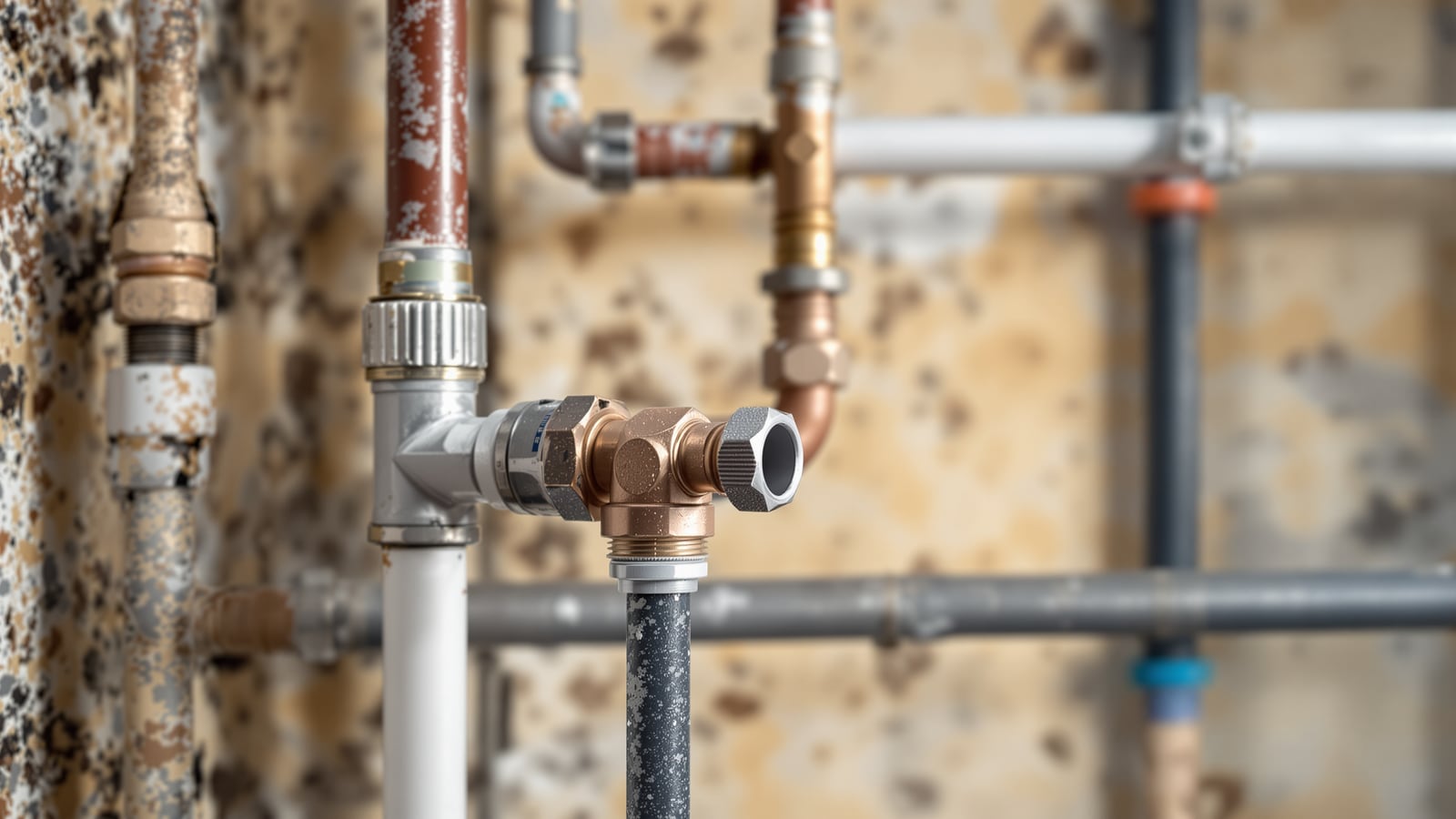
Noisy Pipes & Water Hammer in India: Causes, Diagnosis & Fixes
Why household plumbing bangs, hums, ticks, whistles and rattles — how to tell water hammer from thermal ticking, high-pressure hum, a whistling valve or a loose-pipe rattle, and how to fix each one safely with arrestors, air chambers, pressure control and proper pipe support.
Plumbing is supposed to be quiet. When it starts banging, humming, ticking or whistling, the sound is telling you something specific — and most of the time it is fixable in an afternoon. This is a homeowner's guide to diagnosing noisy pipes in an Indian home, with the loudest and most damaging culprit, water hammer, front and centre.
This guide sits under the Studio Matrx plumbing maintenance guide. It leans on three companions: pipe supports for the loose-pipe rattle, pipe expansion joints for thermal ticking in CPVC, and pressure reducing valves for the high-pressure noises. Match your noise to the section below.
First, listen: what each noise means
Different sounds come from different physics. Naming the noise correctly is 80% of the fix.
- Bang or knock — a sharp, single thud when a tap or appliance shuts off. This is water hammer, and it is the one that can actually damage your plumbing.
- Hum or drone — a continuous vibration while water is flowing. Almost always high pressure or high velocity through a pipe or a partly closed valve.
- Tick, tap or creak — a soft, repetitive clicking that starts a minute or two after you run hot water and fades as things cool. This is thermal expansion, typically of hot-water CPVC.
- Whistle or squeal — a high-pitched tone while a specific tap runs. Usually a partly closed or worn valve, or scale narrowing the pipe.
- Rattle or shudder — pipes visibly shaking or knocking against masonry and slab when flow starts or stops. A loose or missing pipe support.
Golden rule: a bang happens at the moment a valve closes; a hum happens while water flows; a tick happens after hot water, as the pipe cools. Timing tells you the cause before you touch a tool.
Water hammer: the big one
Water hammer is a pressure shockwave. Water moving through a pipe has momentum. When a valve, solenoid or tap slams shut suddenly, that moving column of water is stopped dead in a fraction of a second — and its energy has nowhere to go but into a pressure spike that travels back up the pipe as a hammer blow. You hear the bang; the pipework feels a stress far above its normal working pressure.
The classic triggers in an Indian home are fast-acting solenoid valves: washing machines, dishwashers and some RO systems snap shut electrically in milliseconds, which is exactly the condition that creates the worst hammer. Single-lever mixers slammed shut and quarter-turn taps do it too.
Why it matters beyond the noise
Repeated shock loading is not cosmetic. Over months and years it works loose threaded and push-fit joints, stresses solvent-welded CPVC/UPVC joints, cracks fittings, and can damage the diaphragm inside pressure-sensitive appliances. A banging pipe today is a slow weeping joint next year.
How to fix water hammer
Work through these in order — cheapest and most likely first.
- Fit a water-hammer arrestor. This is the proper, permanent fix. An arrestor is a small sealed device with a spring-loaded piston or a cushion of gas behind a diaphragm; it absorbs the shockwave in a controlled way. Fit one close to the offending appliance — the washing-machine and dishwasher taps are the priority spots. Mini screw-on arrestors that go between the tap and the appliance inlet hose are a genuinely easy DIY item.
- Restore or add air chambers. Older homes relied on a capped vertical stub of pipe near each fixture — an air chamber — that trapped a pocket of air to act as a shock absorber. Over time the air dissolves into the water and the chamber "waterlogs" and stops working. You can often recharge them: isolate the supply, open the highest and lowest taps to drain the system fully so the chambers refill with air, then close up and restore supply. It is free; the catch is it can waterlog again, so an arrestor is the durable answer.
- Reduce the pressure. High mains or overhead-tank pressure makes every hammer event harder. If your incoming pressure is high, a pressure reducing valve dialled to a sensible level takes the venom out of hammer across the whole house. See that guide for target pressures and sizing.
- Secure and cushion the pipe. Hammer is worse when the pipe is free to move and slap against structure. Adding clamps and cushioned supports (see pipe supports) stops the shockwave from turning into an audible knock against masonry.
The diagram below shows why the shockwave forms and where an arrestor intercepts it.
Humming and vibration: too much pressure or speed
A steady hum or drone while water runs is the sound of water moving too fast or under too much pressure. Common causes:
- High supply pressure, especially from a tall overhead tank or a strong municipal main.
- Undersized pipe forcing high velocity, or a booster pump running harder than it needs to.
- A partly closed valve creating turbulence — a full-bore ball valve left half-open is a classic offender.
The fix is usually a pressure reducing valve to bring whole-house pressure into a comfortable band, plus making sure isolation valves are either fully open or fully closed rather than throttled. A humming toilet fill valve is a separate, common case — the float valve diaphragm is worn and should be replaced.
Ticking and creaking: thermal expansion
That soft ticking a minute or two after you turn on a geyser or a hot tap is not a leak — it is CPVC hot-water pipe expanding. Plastic pipe grows measurably in length when hot water passes through it, and if it is clamped tightly or passing through a snug hole in a wall or slab, it slides against that surface in tiny jerks. Each jerk is a tick.
- It is usually harmless noise, not a fault.
- The cure is to let the pipe move where it needs to and prevent it from rubbing — sleeve the pipe where it passes through masonry, avoid over-tight clamps on hot lines, and on long hot runs allow for movement with proper detailing. See pipe expansion joints for how hot-water pipe is meant to accommodate this growth.
Whistling: a restriction in the flow
A whistle or squeal from one specific tap or valve is flow being forced through a narrowed opening.
- A partly closed or worn valve — a stop valve not fully open, or a worn washer/cartridge fluttering in the stream.
- Scale build-up narrowing the pipe or aerator, common in hard-water areas of India.
- A worn tap washer in an old-style pillar tap.
Open the isolating valve fully; if the whistle persists, descale or replace the aerator, and replace a worn washer or cartridge. A whistle that only appears at one fixture is almost never a whole-house problem.
Rattling: a loose pipe
If you can see pipes shaking or hear them knocking against wall and slab when flow starts or stops, the pipe simply is not held firmly enough. This is a support problem, not a pressure one.
- Add or tighten clamps so the run cannot move.
- Use cushioned or acoustic clamps where the pipe passes near masonry, so any residual movement does not transmit as a knock.
- Space supports correctly for the pipe material — under-supported CPVC and UPVC sag and shudder. Our pipe supports guide gives spacing by material and size.
Diagnose it: symptom, cause, fix
| Symptom (the noise) | Most likely cause | First fix |
|---|---|---|
| Sharp bang / knock when a tap or appliance shuts off | Water hammer — shockwave from sudden valve closure | Fit a water-hammer arrestor near the appliance; recharge air chambers; reduce pressure |
| Bang only when washing machine / dishwasher / RO cuts off | Fast solenoid valve slamming shut | Mini screw-on arrestor on that appliance's tap |
| Continuous hum / drone while water flows | High pressure or velocity; throttled valve | Pressure reducing valve; open isolation valves fully |
| Humming toilet after flush | Worn float/fill valve diaphragm | Replace the fill valve |
| Soft ticking a minute after hot water | Thermal expansion of CPVC hot pipe | Sleeve pipe through walls; relieve tight clamps |
| Whistle / squeal at one tap | Partly closed or worn valve; scale | Open valve fully; descale aerator; replace washer |
| Rattle / shudder against wall and slab | Loose or missing pipe support | Add and tighten cushioned clamps |
Match the fix to the noise: quick decision map
DIY or call a plumber
| Job | DIY-friendly? | When to call a plumber |
|---|---|---|
| Screw-on arrestor on an appliance tap | Yes | If the tap connection leaks or is corroded |
| Recharging waterlogged air chambers | Yes | If draining/refilling does not fix it |
| Descaling an aerator, replacing a tap washer | Yes | Cartridge or concealed-valve replacement |
| Fitting an inline water-hammer arrestor into a pipe run | Sometimes | Any cut-and-solder / soldered or concealed pipework |
| Fitting a pressure reducing valve on the incoming main | No | Always — mains isolation and sizing needed |
| Adding clamps behind concealed / chased walls | No | Yes — needs opening up the wall |
A safety note before you start
- Isolate the water at the relevant stop valve or the main before undoing any fitting, and open a downstream tap to release pressure. Do not open a joint under pressure.
- Keep electricity away from water. If a noise comes from around a geyser or an electric pump, switch it off at the isolator and unplug before working near it. Never poke at a pump or heater with the power live.
- Gas geysers: if a noise involves a gas water heater, treat it as a gas appliance — do not improvise, and call a qualified technician.
- If pipes are banging hard enough to shake the wall, treat it as urgent: repeated water hammer can burst a joint. Reduce use of the offending appliance until it is fixed.
Fix the noise and you usually fix a slow-motion failure at the same time — a silenced pipe is a pipe that is no longer being hammered loose.
References
- National Building Code of India (NBC), Part 9 — Plumbing Services, for water supply and pressure guidance (indicative; confirm the current edition).
- Bureau of Indian Standards codes for CPVC and UPVC plumbing pipe cover working pressure and thermal behaviour relevant to pipe noise — refer to the specification for your pipe material.
- Studio Matrx: plumbing maintenance guide, pipe supports, pipe expansion joints, pressure reducing valves.
Export this guide
Related Guides — Deep-dive reading
Low Water Pressure at Home in India: Causes, Room-by-Room Diagnosis and Fixes
Why your taps trickle and your shower dribbles — how to tell low flow from low pressure, the India-specific causes from an empty overhead tank and clogged aerators to scaled-up GI pipes and half-shut valves, a symptom-to-cause-to-fix table, cheap DIY checks versus a booster pump or re-pipe, and when to call a plumber.
PlumbingBathroom Leak Repair in India: Find & Fix Common Leaks (2026)
A practical, India-first guide to finding and fixing the everyday bathroom leaks — dripping taps, weeping traps and angle valves, a running cistern, failed silicone seals — plus how to tell a simple fixture leak from a waterproofing failure that needs a professional.
BathroomsBathroom Water Supply India: Cold & Hot Feed, Pipe Sizing, Pressure & Booster Pumps (2026)
How water actually reaches your fixtures in an Indian home — gravity-fed cold from the overhead tank, hot from the geyser, the pipe sizes that decide whether your shower gushes or dribbles, isolation valves at every fixture, booster pumps and hard-water protection, all mapped to IS 1172.
BathroomsRelated Tools — Try Free
Plumbing Pressure-Test & Leak Checklist
Pre-closure pressure and leak test — 9 categories, 60+ checkpoints across water supply, drainage, fixtures, waterproofing, hot water, tanks.
Pre-Closure TestRainwater Tank Sizer
How big should your rainwater tank be? Computes annual harvest, recommended tank capacity in litres, water-bill savings, and payback — for 10 Indian cities.
RWH CalculatorElectrical Safety & Load Audit
Home electrical audit — 10 categories, 65+ checkpoints across earthing, RCCB, MCB, wiring, switchboards, appliance circuits, DG/inverter backup.
Safety Audit