
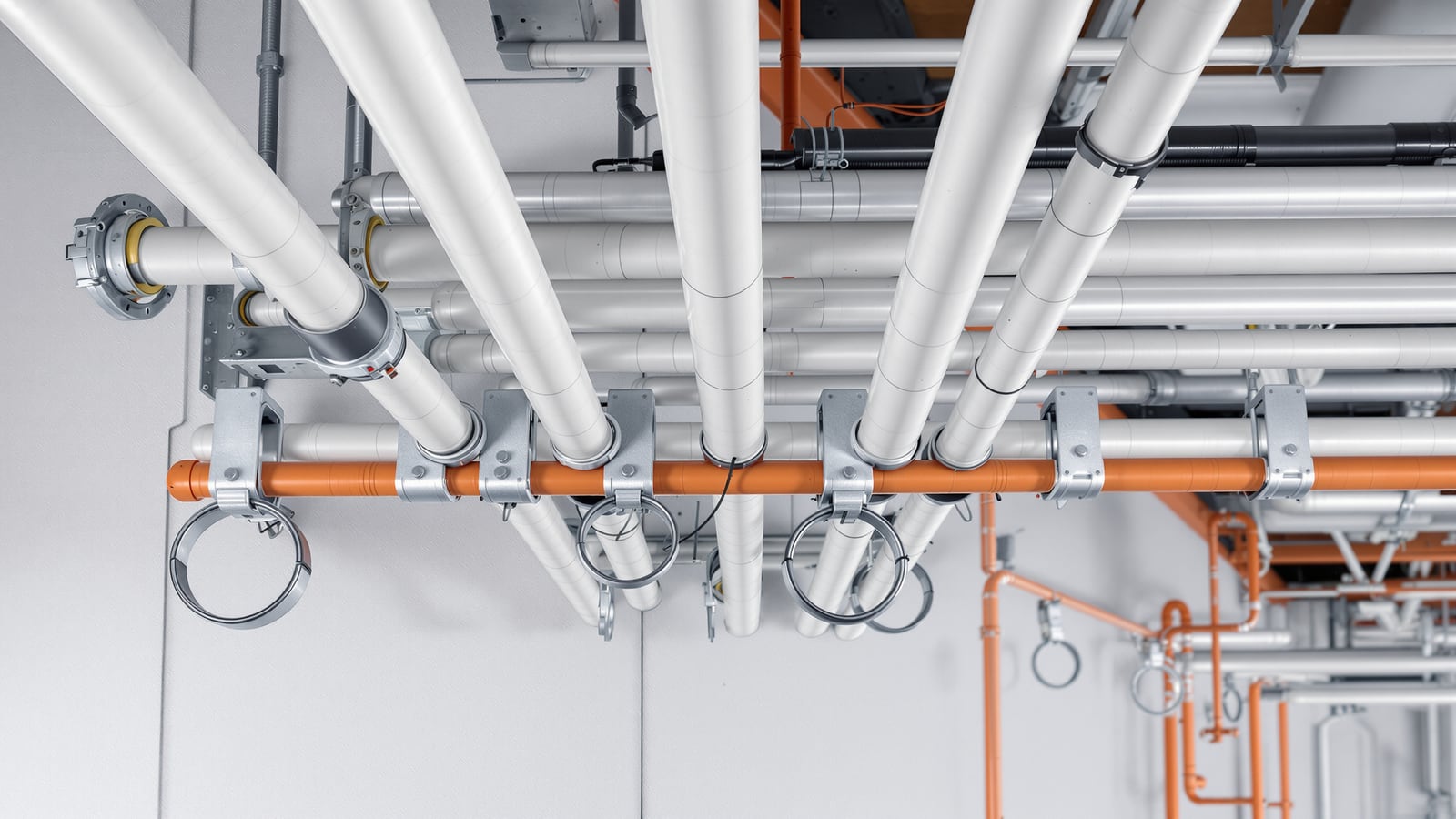
Pipe Supports, Clamps & Hangers in India: Spacing, Fixing & Anti-Vibration
The clamps, clevis hangers, riser clamps and channel brackets that hold a plumbing system in place — why support spacing matters, how far apart to fix pipe by material and size, how to support risers versus horizontal runs, how to allow for thermal movement, and how to fix into RCC and masonry.
Every metre of pipe in a building is only as good as the thing holding it up. Supports are the least glamorous part of a plumbing system and the most quietly consequential — get the spacing, the fixing and the allowance for movement right and the installation is silent, straight and leak-free for decades; get them wrong and the same pipe sags, cracks a joint, hammers against masonry and drips. This is a professional's guide to pipe supports in Indian construction: what to use, how far apart, and how to fix it.
This guide sits under the Studio Matrx plumbing pipes hub. It is the companion to routing and detailing work like exposed plumbing and pipe expansion joints, and it assumes the material choices covered elsewhere — especially CPVC, whose thermal movement drives much of the spacing logic below.
Why proper support actually matters
Support is not just about stopping a pipe from falling. Four separate failures all trace back to it.
- Sag and ponding. A pipe supported too far apart bows between fixings. On a supply line this looks ugly; on a drainage or waste line it is a functional defect, because the sag creates a low belly that holds water and solids, breaking the fall gradient and causing blockages.
- Joint stress. An unsupported run hangs its dead weight on the nearest joint. Solvent-welded and threaded joints are strong in the direction they were designed for, not in bending — sustained bending load creates a slow leak or a crack years after commissioning.
- Noise. A pipe that can shake transmits water hammer, pump vibration and flow noise into the structure. A loose clamp lets the pipe knock against masonry every time a tap slams shut.
- Thermal damage. Hot-water plastic pipe expands significantly. If it is clamped rigidly everywhere with nowhere to move, that expansion has to go somewhere — it snakes, buckles between fixings, or shears the clamp.
A support system does three jobs at once: it carries dead and water weight, it controls where the pipe is allowed to move, and it isolates vibration. A clamp that only does the first is only doing a third of the job.
The families of support
Supports fall into a handful of types, chosen by whether the run is horizontal or vertical, concealed or exposed, and how much load and movement it carries.
- Saddle and standard clamps. The workhorse for small supply pipe. A plastic or metal half-clip (saddle) or two-part clamp screwed to the surface. Cheap, fast, fine for CPVC/UPVC up to about 50 mm.
- Clevis hangers. A U-shaped metal hanger suspended from a threaded rod, cradling the pipe. The standard way to hang horizontal runs from a slab soffit — used widely for drainage, larger supply and services in false ceilings.
- Brackets and stand-offs. L-brackets or purpose-made stand-off clamps hold pipe a fixed distance off a wall, essential for exposed and external runs so the pipe can be painted and inspected behind.
- Riser clamps. Two-part clamps with extended ears that bear on the top of a floor slab or on a bearing plate, carrying the weight of a vertical stack at each floor.
- Channel / strut systems. Slotted metal channel (the generic term for the branded strut systems) bolted to the structure, with matching pipe clamps sliding into it. Used where many pipes run together, in plant rooms, shafts and service ceilings — it makes a tidy, modular, re-adjustable rack.
Support spacing: the number that matters most
The single most important support decision is how far apart to fix. The controlling fact is simple: plastics need much closer support than metal. A steel pipe is stiff and self-supporting over long spans; a thermoplastic is flexible and sags under its own weight, and it sags far more when hot because the material softens. That is why CPVC hot lines are clamped roughly twice as tightly as the cold line right beside them.
The table below is an indicative starting point for horizontal runs, carrying water, at room temperature unless noted. Always defer to the pipe manufacturer's published support chart and the project consultant — these move with pipe class and temperature.
| Pipe material | Small (15–25 mm) | Medium (32–50 mm) | Large (63–110 mm) |
|---|---|---|---|
| CPVC — cold | 900 mm (≈3.0 ft) | 1050 mm (≈3.5 ft) | 1200 mm (≈4.0 ft) |
| CPVC / PPR — hot | 600 mm (≈2.0 ft) | 750 mm (≈2.5 ft) | 900 mm (≈3.0 ft) |
| UPVC / PVC — cold & waste | 900 mm (≈3.0 ft) | 1200 mm (≈4.0 ft) | 1200–1500 mm (≈4–5 ft) |
| HDPE | 500–600 mm (≈2.0 ft) | 700–900 mm (≈3.0 ft) | 1000 mm (≈3.3 ft) |
| Copper | 1200 mm (≈4.0 ft) | 1800 mm (≈6.0 ft) | 2400 mm (≈8.0 ft) |
| GI / mild steel | 1800 mm (≈6.0 ft) | 2400 mm (≈8.0 ft) | 3000 mm (≈10 ft) |
A few rules the table encodes:
- Halve it for hot. Any thermoplastic carrying hot water needs its spacing tightened, typically to about two-thirds of the cold figure, because a warm pipe droops between clamps.
- Support the fitting, not just the pipe. Place a clamp within a short distance of every change of direction, tee and valve so the fitting is not carrying an unsupported cantilever.
- HDPE almost wants a continuous cradle. Because it is so flexible, HDPE on a warm or large line is often laid in a channel or on a continuous tray rather than on point supports.
Vertical risers versus horizontal runs
The two orientations fail differently and are supported differently.
Horizontal runs are fighting sag — the pipe's own weight plus water pulls it down between fixings. Here the spacing table governs, and clevis hangers or saddle clamps do the work. On drainage the extra rule is that supports must preserve the fall; a support set too low creates the belly that holds waste.
Vertical risers are fighting their own accumulated weight dragging down through the joints. You cannot solve this with more wall clamps alone — wall clamps stop the pipe swinging but do not carry its vertical load. You need riser clamps that bear on the structure at each floor, so every floor's length of stack transfers its weight to that slab rather than hanging off the floors below. As an indicative rule, support a riser at every floor level (roughly every 3 m), and never let more than one floor of pipe hang unsupported.
Allowing for movement: anchors versus guides
A hot-water plastic riser can grow tens of millimetres between an empty morning and a running geyser. If every clamp grips the pipe tight, that growth has nowhere to go and the pipe buckles or the clamps shear. The professional answer is to deliberately split supports into two kinds:
- Anchors grip the pipe hard and fix it to the structure. They define where the pipe is not allowed to move — the point from which expansion is thrown outward in both directions.
- Guides hold the pipe in line but let it slide axially through the clamp. Between two anchors, the pipe is guided so that when it grows it moves along its length into an expansion joint or loop rather than bowing sideways.
The design pattern is: one anchor, then a run of guides leading to the expansion device, then the next anchor. Get this wrong — clamp everything as an anchor — and you have engineered a fight between the pipe and its own supports.
Fixing to masonry and RCC
A clamp is only as strong as its fixing into the wall. The substrate decides the fastener, and Indian sites mix several within one building.
| Substrate | Recommended fixing | Notes |
|---|---|---|
| RCC slab / beam | Cast-in insert, or drop-in / expansion anchor drilled after | Highest pull-out; use for clevis rods and heavy risers |
| Solid burnt-clay brick | Nylon wall plug + screw, or expansion anchor | Drill into the brick, not the mortar joint |
| AAC / lightweight block | Purpose-made AAC or frame-fixing anchor | Ordinary plugs strip out — do not use standard wall plugs |
| Hollow / cored block | Toggle, spring or long chemical anchor | The fastener must grip the far web or bond into the void |
| Steel structure | Beam clamp or U-bolt | No drilling; clamp to the flange |
Workmanship rules that matter more than the fastener spec:
- Drill clean and to depth. Blow or brush dust from the hole; a plug or chemical anchor set in dust holds a fraction of its rated load.
- Never fix into a mortar joint in brickwork — the joint is the weakest line. Land the fixing in the solid unit.
- Match the plug to the pipe weight — a full riser clamp needs a metal expansion anchor, not the plastic plug that suits a 20 mm saddle.
- On exposed and external work, use stainless or hot-dip fasteners and stand-off brackets so the pipe can be painted behind — see exposed plumbing for the detailing.
Anti-vibration and acoustic support
Where a pipe carries pump pulsation, water hammer or simply fast flow, a rigid metal clamp turns the pipe into a loudspeaker coupled straight to the structure. The fix is to break the metal-to-metal path.
- Rubber-lined (cushion) clamps — a clamp with an EPDM or rubber insert isolates the pipe and is the default for any pump discharge, riser near living space, or exposed run in a bedroom wall.
- Resilient sleeves at penetrations. Where a pipe passes through a slab or wall, wrap it so it never touches the concrete directly; a hard contact point telegraphs every knock into the room.
- Flexible connectors at pumps absorb the vibration at source so it never reaches the clamped run — pair them with cushioned clamps for the first few metres.
- Avoid over-tightening. A clamp crushed tight onto plastic both damages the pipe and defeats the guide function; it should locate the pipe, not strangle it.
Silence is a support detail. Cushioned clamps, isolated penetrations and a flexible connector at the pump together do more for a quiet home than any amount of pipe upgrade.
Testing, inspection and common mistakes
- Inspect before concealing. Check spacing against the chart, confirm every riser bears on its floor, and verify anchors and guides are where the design put them — you cannot fix a support once it is buried in a chase.
- Load-test with water in the line. A run that looks fine empty can sag once full; commissioning and pressure-test with the system charged.
- The recurring failures: spacing set by eye and too wide (sag); wall clamps used to try to carry a riser's weight; every clamp made an anchor so hot pipe has nowhere to grow; fixings landed in mortar joints or in AAC with the wrong plug; and rigid clamps where a cushioned one was needed, leaving a noisy system.
Done well, support is invisible — straight runs, silent flow, joints under no load they were not designed for. That invisibility is the whole point.
References
- National Building Code of India (NBC) 2016, Part 9 — Plumbing Services — the governing framework for building water supply and drainage installation, including fixing and support of pipework.
- Manufacturer support and spacing charts — CPVC, PPR, UPVC and HDPE makers publish pipe-specific support intervals by size and temperature; these override any general table for warranty purposes.
- IS 15778 (CPVC) and the material standards linked from the plumbing pipes hub — for the pipe properties that drive spacing.
- All spacing figures here are indicative for planning; confirm the current code edition, the manufacturer's chart for the exact pipe class, and the fixing pull-out values for your substrate with a licensed plumber and the project consultant.
Export this guide
Related Guides — Deep-dive reading
Pipe Expansion Joints & Thermal Expansion in India: Stopping Buckled, Sagging, Stressed Pipe Runs
Why CPVC, PPR and PVC pipes move so much when they heat and cool, how that movement buckles pipe and cracks joints on long or sun-exposed runs, and how to absorb it with expansion loops, offsets, bellows, and supports that let the pipe slide.
PlumbingBathroom Plumbing Code India: NBC 2016 Part 9, UPC-I & the IS Standards That Govern Pipework
A professional reference to the codes and standards that govern bathroom plumbing in India — the National Building Code (NBC 2016) Part 9 on Plumbing Services, the Uniform Plumbing Code India (UPC-I), the CPHEEO Manual, and the IS standards for water supply, drainage, trap seals, pipe sizing, slopes and venting — with a caveat to always verify the current code and your local authority.
BathroomsBathroom Plumbing India: The Complete Guide to Water Supply, Drainage, Traps & Pipes
The whole plumbing picture for an Indian bathroom in one place — the two systems (cold and hot water supply, and waste/soil drainage with its vented SWV stack), traps and the floor trap, slopes and gradients, concealed vs exposed pipework, pipe materials (CPVC/UPVC/PEX/GI) and the overhead-tank pressure reality — with the coordination that must happen before any civil work starts.
BathroomsRelated Tools — Try Free
Acoustic Privacy (STC) Visualizer
Indian healthcare acoustic visualizer — compare wall assemblies and noise sources, see received SPL after STC attenuation, and check FGI 2018 / IS 1950 / NABH speech-privacy compliance with live dual-canvas waveform.
Acoustic ToolPlumbing Pressure-Test & Leak Checklist
Pre-closure pressure and leak test — 9 categories, 60+ checkpoints across water supply, drainage, fixtures, waterproofing, hot water, tanks.
Pre-Closure TestCross-Ventilation Analyzer
Estimate airflow and air changes per hour (ACH) from room size, window areas, layout, and local wind — with NBC 2016 Part 8 compliance check.
Ventilation Calculator