

Mosquito-Proof Window Solutions for Indian Homes
Mesh frames, sliding, pleated, retractable and magnetic DIY screens — the cheapest dengue defence, matched to your window type
In most Indian homes the choice at dusk is brutal: keep the windows shut and swelter, or open them and invite the mosquitoes that carry dengue, malaria and chikungunya. A good insect mesh ends that trade-off. It is the cheapest, most reliable dengue defence you can buy — it lets you keep windows open for cross-ventilation through the evening peak-biting hours while the Aedes and Anopheles stay outside.
This guide is about the product formats — how you actually mosquito-proof a specific window, and which solution suits which window TYPE. For the mesh material science (fibreglass versus SS304, gsm, nano-fibre), see our companion Window Screens and Meshes Guide. Here we focus on frames, fit and format.
A Rs 30 mosquito coil burnt nightly costs more in a year than a one-time fibreglass mesh that protects you for a decade. Mesh is preventive public health you install once.
Why the format matters more than the mesh
The same fibreglass net can be a fixed panel, a sliding shutter, a pleated curtain, a roller, or a magnetic strip you stick on yourself. The format decides whether it actually seals, whether you can still open the window, whether a child can push through it, and whether you can clean it. A great mesh in a badly fitted format leaks mosquitoes at the edges — and a single 2 mm gap is an open door.
The solution formats, head to head
Fixed and openable mesh frames. A rigid aluminium frame holding the net, either screwed permanently over the opening (fixed) or hinged to swing open (openable). The fixed version is the cheapest tight seal but you cannot reach the glass to clean it; the openable hinged version solves that. Best for windows you rarely need to reach through.
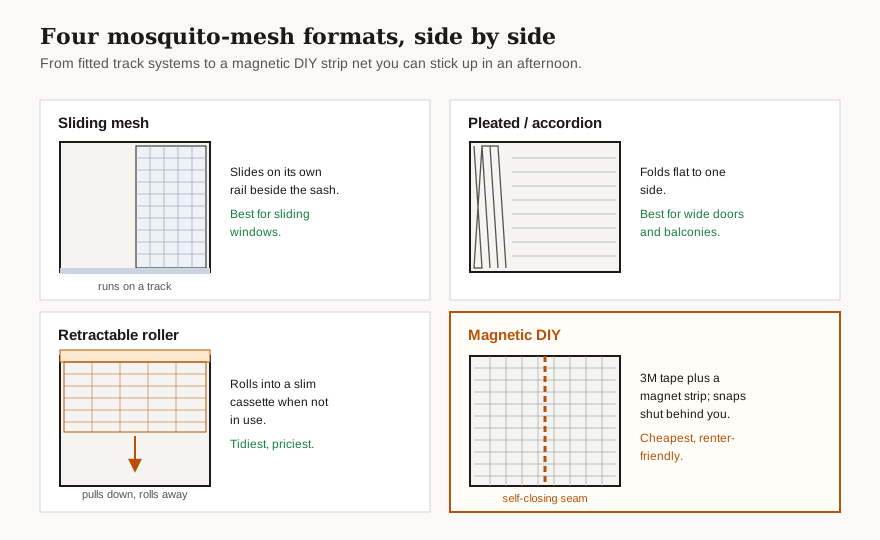
Sliding mesh. A mesh shutter running on its own track, parallel to a sliding glass window. You slide the net across exactly as you slide the glass — natural for the most common Indian window type. The catch: tracks collect dust and the brush-seal at the meeting edge must be intact or mosquitoes slip through the gap.
Pleated / accordion mesh. The net folds like a concertina and pulls across on a slim top-and-bottom track, then springs back out of sight. It spans large openings and balcony doors that a single rigid frame cannot, and it is barely visible when retracted. Premium-ish, and the pleats need gentle handling.
Retractable roller mesh. The net rolls into a slim cassette like a roller blind and pulls down (or sideways) only when you want it. The most minimal, "invisible" option — ideal where you do not want a permanent net spoiling the view. Spring-loaded, so it self-stores; from about Rs 75 per square foot, rising for motorised versions.
Magnetic DIY retrofit. A net edged with a soft magnetic strip; you stick a steel/magnetic counter-strip around the existing frame with 3M double-sided adhesive tape. The two snap shut when you pass through and self-close behind you. The cheapest retrofit and fully DIY — no drilling, ideal for rentals. Less durable, and the adhesive can lift in heat or after a few seasons.
Velcro nets. A net rimmed with the hook side of Velcro, pressed onto an adhesive loop strip around the frame. Even cheaper than magnetic, removable for washing, but you peel the whole net off each time and the Velcro frays.
| Format | How it works | Effectiveness | Cost (indicative) | Best for |
|---|---|---|---|---|
| Fixed mesh frame | Rigid frame screwed over opening | Excellent seal | Low–medium | Windows you do not reach through |
| Openable mesh frame | Hinged rigid frame, swings open | Excellent seal | Medium | Windows you clean often |
| Sliding mesh | Net shutter on its own track | Very good (mind the edge brush) | Low–medium | Sliding windows |
| Pleated / accordion | Concertina net on slim track | Very good | Medium–high | Large openings, balcony doors |
| Retractable roller | Net in a roll-down cassette | Very good | From ~Rs 75/sqft | Minimal look, occasional use |
| Magnetic DIY | Magnet strip + 3M tape on frame | Good (DIY-fit dependent) | Lowest | Rentals, quick retrofit |
| Velcro net | Velcro rim on adhesive strip | Fair (frays over time) | Lowest | Temporary, wash-often |
Match the format to the window TYPE
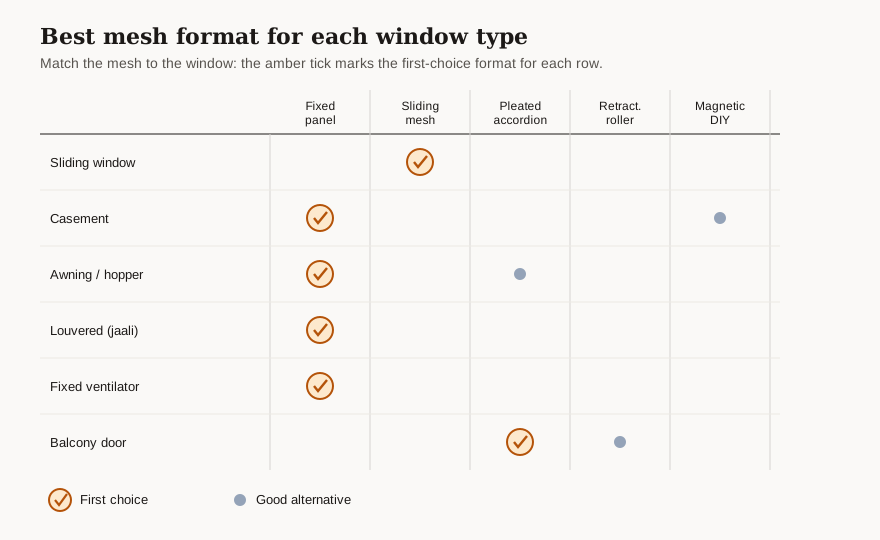
The format follows the window. A sliding window wants a sliding mesh that mirrors its motion; an outward-swinging casement wants a fixed or magnetic mesh on the inside so the sash can still open; a fully fixed ventilator wants nothing but a permanent panel.
| Window type | Best mesh format | Why |
|---|---|---|
| Sliding (2 or 3 track) | Sliding mesh on dedicated track | Mirrors the glass motion; keeps half the window usable |
| Casement (outward swing) | Fixed or magnetic mesh inside | Net stays put while the sash swings out |
| Awning / hopper | Fixed or pleated inside | Sash tilts; rigid net does not foul it |
| Louvered / jalousie | Fixed mesh frame | High free area stays mosquito-tight behind one panel |
| Large opening / balcony door | Pleated / accordion or retractable | Only formats that span the width and let you walk through |
| Fixed ventilator / clerestory | Fixed mesh panel | Permanent, set-and-forget |
This is why pairing your airflow window type with the right mesh format is the whole game. To pick the window that moves the most air in the first place, start with our pillar, Best Windows for Airflow in India, and the broader Types of Home Windows in India.
The magnetic DIY retrofit, step by step
The magnetic format is what most renters and budget homes actually fit, so it is worth getting right. The whole job is clean and tape-fitting — done wrong, it leaks at the corners.
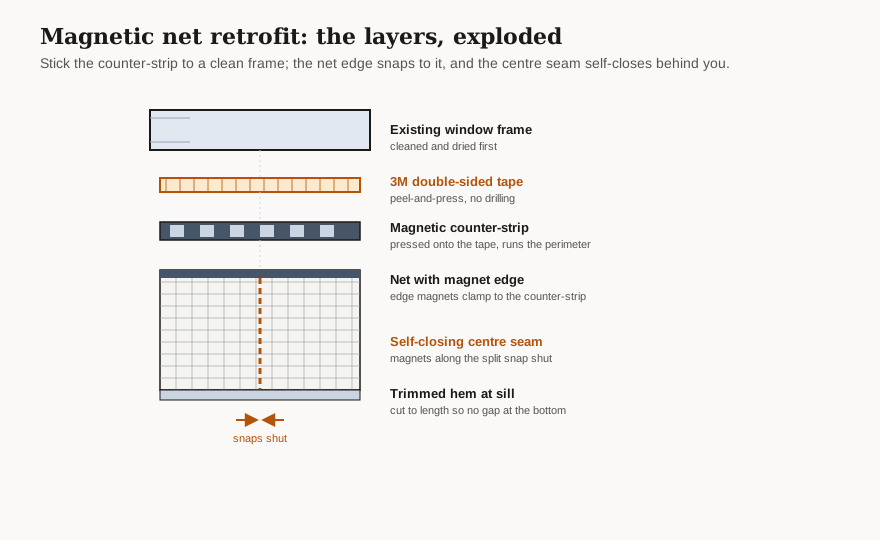
- Measure the full frame opening and buy a net slightly oversized — you want overlap, not a stretched gap.
- Clean the frame with isopropyl/spirit and let it dry fully. The 3M tape will not bond to dust or oily uPVC.
- Press the adhesive loop/steel strip around the perimeter, corners first, working out the slack.
- Hang the net so its magnet edge meets the strip; check that the centre seam self-closes along its whole length with no light showing.
- Trim the bottom to brush the sill — a flapping hem is a mosquito gap.
In summer heat, press the tape down again after a week and re-seat any corner that has lifted.
Effectiveness, safety and maintenance
Effectiveness. A correctly fitted mesh of any standard density (around 120 gsm fibreglass is the airflow-versus-block sweet spot) stops mosquitoes outright. Failures are almost always gaps — a torn corner, a lifted magnetic strip, a worn track brush — not the mesh itself. Inspect edges every monsoon.
Child and pet safety. A mesh is an insect screen, not a fall barrier — never let a child or pet lean on one at height. For homes with toddlers or cats above ground floor, SS304 mesh in a rigid, screwed openable frame resists pushing and clawing far better than a magnetic net; pair it with a window restrictor or grille for actual fall protection. Magnetic and Velcro nets are for ground-floor and low-risk openings.
Maintenance. Vacuum or soft-brush the mesh monthly; sliding-track meshes need the track cleared of dust so the brush seal keeps contact. Fibreglass and SS304 do not rust; nylon and adhesive-mounted nets are the ones that age. Budget a net replacement every few years for DIY formats, a decade-plus for rigid framed ones.
The public-health framing: keep windows open, safely
Closing windows to keep mosquitoes out defeats ventilation and traps stale, humid air — which is its own health problem. The right move is screened ventilation: mesh every openable window so you can keep them open through the dusk biting peak for cross-flow, exactly as described in Passive Cooling Through Windows. NBC 2016 already asks for openable area of at least about 10 per cent of floor area; meshing that openable area is what lets you actually use it after dark. For rain-season fit, combine this with our Monsoon-Friendly Window Designs so the same window stays bug-tight and water-tight.
The cheapest dengue intervention in your home is not a fumigant or a coil — it is a fitted mesh on every window you open. Install it once, inspect it each monsoon, and keep the air moving.
References
- National Building Code of India 2016 (NBC), Bureau of Indian Standards: https://www.bis.gov.in/standards/technical-department/national-building-code/
- National Center for Vector Borne Diseases Control (dengue/malaria prevention), Government of India: https://ncvbdc.mohfw.gov.in/
- World Health Organization — Dengue and severe dengue: https://www.who.int/news-room/fact-sheets/detail/dengue-and-severe-dengue
- Bureau of Indian Standards (IS codes portal): https://www.bis.gov.in/
Export this guide
Related Guides — Deep-dive reading
Window Screens and Meshes Guide for India
The full mesh catalogue — fibreglass to SS304 to nano-fibre PM2.5 — with weave density, frame formats, real costs and the airflow trade-off
Windows & GlazingDust Control Through Window Design
Seal the gaps, pick the right window type and the right mesh to keep PM2.5, pollen and road dust out of Indian homes
Windows & GlazingMosquito Mesh Doors in India (2026): Types, Mesh Materials, Cost & Fitting Guide
Hinged, sliding, pleated and magnetic insect-screen doors for Indian homes — choosing the right mesh and frame for dengue, monsoon and pets.
Home Doors & EntrancesRelated Tools — Try Free
Cross-Ventilation Analyzer
Estimate airflow and air changes per hour (ACH) from room size, window areas, layout, and local wind — with NBC 2016 Part 8 compliance check.
Ventilation CalculatorMosquito Mesh Calculator
Estimate insect-screen cost by mesh material (fibreglass, SS304, aluminium) and frame format.
Window CalculatorWindow Material Comparison Tool
Compare uPVC, aluminium, wood, steel and composite windows on cost, life, upkeep and insulation.
Compare