

Dust Control Through Window Design
Seal the gaps, pick the right window type and the right mesh to keep PM2.5, pollen and road dust out of Indian homes
In much of India, the window is the single biggest entry point for the grit that settles on your shelves every morning and for the fine PM2.5 haze that you cannot even see. Delhi-NCR routinely posts winter PM2.5 readings many times the safe limit, and even coastal and inland cities battle road dust, construction grit and seasonal pollen. The good news is that most of this is a window-design problem, and it is solvable. The wrong window type leaks and traps dust no matter how often you clean it; the right combination of sealing, window type and mesh keeps your indoor air visibly and measurably cleaner.
This guide is the design-and-sealing approach to dust. For the catalogue of mesh materials and densities, see our companion Window Screens and Meshes Guide — that page tells you what mesh to buy; this one tells you how to design the window so dust never gets a foothold.
A clean home is not won with a duster. It is won at the gasket, the track and the mesh.
Where the dust actually comes in
Dust enters through two paths: gaps (uncontrolled air leakage around a poorly sealed sash) and the opening itself (the air you deliberately let in for ventilation, carrying whatever is in it). Both are design levers.
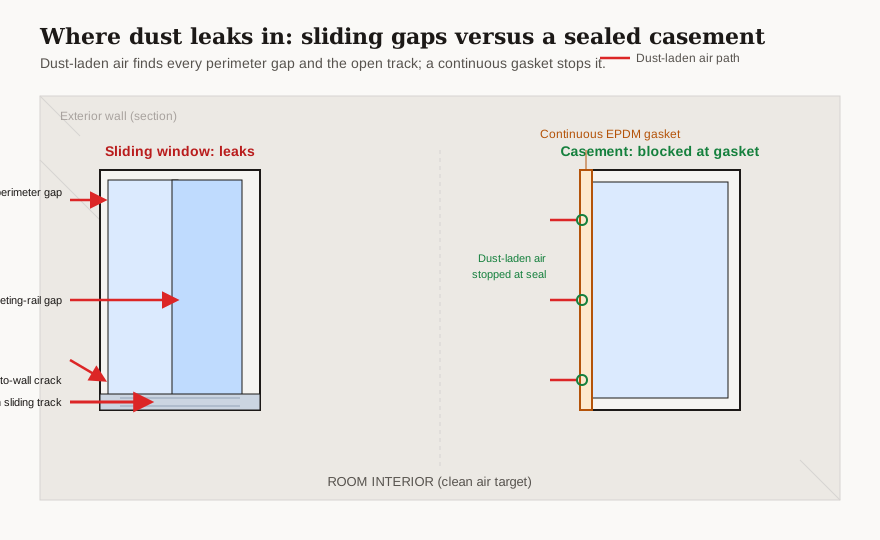
| Dust source | Why it enters | The window fix |
|---|---|---|
| Sash-perimeter gaps | No gasket; warped wood; loose hardware | EPDM or silicone gasket; compression-sealing window type |
| Sliding-track joints | Tracks are open channels that never seal fully | Prefer casement/awning; if sliding, add brush seals and flush tracks |
| Open ventilation air | The PM2.5 and pollen ride in on the breeze | Anti-dust nano-fibre mesh on the opening |
| Frame-to-wall junction | Poor grouting or shrinkage cracks | Backer rod plus weatherproof sealant at the reveal |
| Settled track dust | Recessed tracks collect grit and re-disperse it | Flush, removable tracks; easy-clean detailing |
The biggest lever: window type
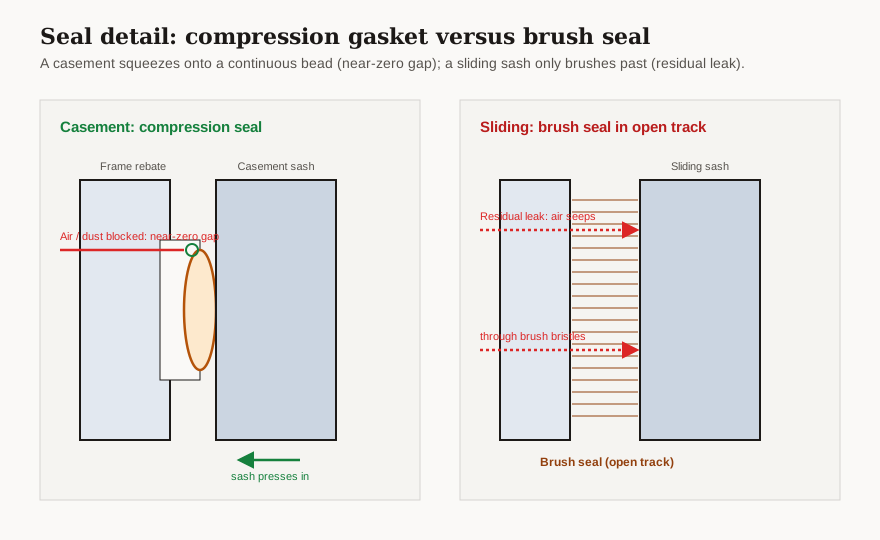
How well a window seals when shut is decided almost entirely by its type, because sealing depends on whether the sash compresses against a gasket or merely slides past a brush.
- Casement and awning windows seal tightest. The sash swings against the frame and clamps onto a continuous EPDM gasket, like a fridge door. When shut, the leakage path is nearly zero. Casement also delivers up to roughly 90 to 100 per cent openable area when you do want air (see the Best Windows for Airflow guide), so you are not trading dust control for stuffiness.
- Sliding windows are the weak link. Their tracks are open channels that brush seals never fully close, so they leak air and they collect dust in the bottom track. A sliding window also opens only about 50 per cent of its area, so for the same airflow you must open it wider, pulling in more dust. They are popular in India for being cheap and not swinging into the room, but for dust control they are the hardest type to keep clean.
- uPVC and good aluminium frames carry multi-chamber profiles and factory gaskets, so they seal far better than site-fabricated wooden frames, which warp and leave gaps.
| Window type | Seal quality when shut | Dust-trapping risk | Verdict for dust |
|---|---|---|---|
| Casement | Excellent (compression gasket) | Low | Best |
| Awning | Excellent (compression gasket) | Low | Best, and vents in light rain |
| Tilt-and-turn | Excellent (multi-point lock) | Low | Excellent, premium |
| Fixed | Total (never opens) | None | Best for sealed picture windows |
| Sliding | Poor to fair (brush seal) | High (open tracks) | Weakest; needs extra care |
Sealing: gaskets and the air-leakage path
Even the right window type fails if it is not sealed properly. Three lines of defence:
1. The sash gasket — a continuous EPDM or silicone bead in the frame rebate. EPDM stays flexible for years and survives Indian summers; cheap PVC gaskets harden and crack. Replace any gasket that has gone stiff.
2. Weatherstripping — brush strips for sliding tracks and meeting rails; foam or rubber tape as a retrofit on older windows.
3. The frame-to-wall junction — the gap behind the window reveal. Pack it with backer rod and a weatherproof sealant; a hairline shrinkage crack here can leak as much dust as a missing gasket.
A positive-pressure strategy helps in extreme-dust homes: if you supply filtered air indoors (even a modest fresh-air unit or filtered exhaust balance) the slight overpressure pushes air out through any residual gaps, so dust cannot leak in. It only works if the envelope is reasonably sealed in the first place — which is why sealing comes first.
The opening: anti-dust and PM2.5 mesh, and the core tradeoff
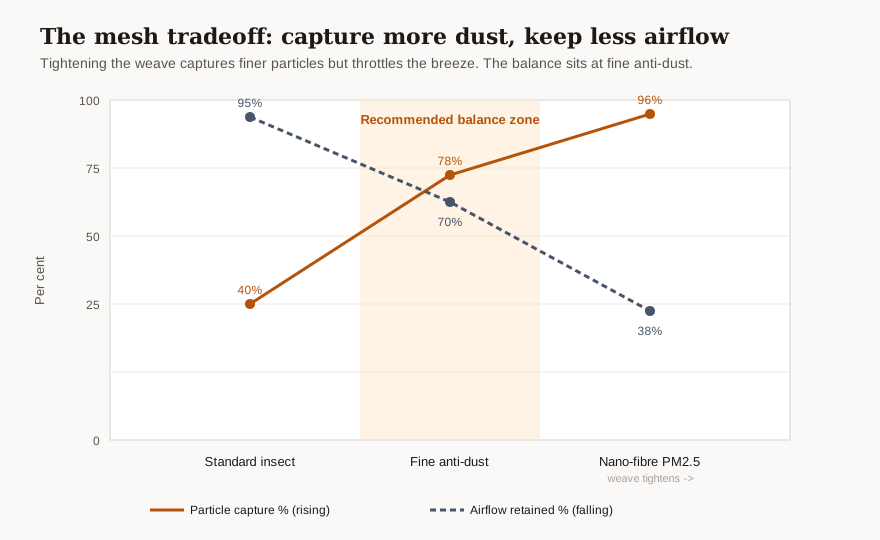
When the window is open for ventilation, the only thing between your lungs and the city is the mesh. Standard insect mesh stops mosquitoes but lets PM2.5 and pollen through freely. Anti-dust and nano-fibre PM2.5 screens weave a far finer membrane that traps fine particles — but here is the unavoidable physics:
Finer mesh means cleaner air and less airflow. There is no mesh that gives you both maximum cleanliness and maximum breeze.
| Mesh type | Particle capture | Airflow retained | Best use |
|---|---|---|---|
| Standard insect mesh (fibreglass) | Insects only | High (about 80 per cent plus) | Low-dust areas; mosquito defence |
| Fine anti-dust mesh | Coarse dust, pollen | Medium-high | Suburban, moderate road dust |
| Nano-fibre PM2.5 screen (Nasofilters-type, around Rs 400 per panel) | Fine PM2.5 and pollen | Lower; noticeable airflow loss | Delhi-NCR winter; allergy sufferers |
The smart design is layered and seasonal: a fine PM2.5 panel on the rooms you sleep and work in, standard mesh elsewhere, and the option to run filtered mechanical ventilation when the AQI spikes so you are not forced to choose between fresh air and clean air. For the full material-by-material breakdown and gsm densities, the Window Screens and Meshes Guide is the catalogue.
City-air context: Delhi-NCR and beyond
Delhi-NCR has a brutal dust-and-PM2.5 season from roughly October to February — stubble smoke, winter inversion and construction dust stack up, and indoor PM2.5 tracks outdoor unless the envelope is sealed. For NCR homes, casement or tilt-and-turn frames with PM2.5 mesh and a winter habit of keeping windows shut during peak-AQI hours pays off the most. Coastal cities fight salt-laden dust (favour SS304-framed mesh that will not corrode); cities near arterial roads and metro construction fight coarse grit (flush, easy-clean tracks matter most).
Easy-clean detailing
Dust control is also about recovery — how easily you reset a window to clean:
- Removable sashes and clip-out mesh frames so you can wash them at a tap, not on a ladder.
- Flush, shallow tracks instead of deep recessed channels that hoard grit.
- Smooth powder-coated or uPVC surfaces that wipe clean, versus textured frames that hold dust.
Do and avoid
| Do | Avoid |
|---|---|
| Choose casement/awning/tilt-and-turn for tight sealing | Defaulting to sliding windows in high-dust zones |
| Specify EPDM gaskets and replace them when stiff | Hard PVC gaskets that crack in two summers |
| Add PM2.5 nano-fibre mesh in bedrooms and study | One blanket insect mesh everywhere expecting clean air |
| Seal the frame-to-wall junction with backer rod and sealant | Leaving a shrinkage crack behind the reveal |
| Use flush, removable, easy-clean tracks and sashes | Deep recessed tracks that hoard grit |
| Keep NCR windows shut during peak-AQI winter hours | Night-purging on a 400-plus AQI evening |
Done well, dust control costs little extra at the design stage and saves you years of daily dusting and respiratory grief. Pair the right window type with a real gasket and the right mesh, and your home breathes the city's air without inhaling its grime.
For where to actually place these windows for a clean cross-breeze, see Window Design for Cross Ventilation; for cooling without inviting dust, see Passive Cooling Through Windows; and to choose a window type from scratch, start with Types of Home Windows in India.
References
- National Building Code of India 2016 (BIS), Part 8 — ventilation and openable-area provisions: https://www.bis.gov.in
- Central Pollution Control Board, National Air Quality Index (PM2.5 standards and AQI): https://cpcb.nic.in
- System of Air Quality and Weather Forecasting And Research (SAFAR), India: http://safar.tropmet.res.in
- Bureau of Energy Efficiency — windows, sealing and building envelope: https://beeindia.gov.in
Export this guide
Related Guides — Deep-dive reading
Window Screens and Meshes Guide for India
The full mesh catalogue — fibreglass to SS304 to nano-fibre PM2.5 — with weave density, frame formats, real costs and the airflow trade-off
Windows & GlazingMonsoon-Friendly Window Designs: Keeping Wind-Driven Rain Out
Drainage channels, baffled weep holes, outward-sloped sills, EPDM seals and the right window type for an Indian monsoon
Windows & GlazingThe Complete Home Door Guide for Indian Homes (2026): Types, Materials, Cost, Security & Vastu
Everything an Indian homeowner needs to specify the right door for every opening — from main entrance to bathroom — with real 2026 prices, IS/NBC standards and Vastu sense.
Home Doors & EntrancesRelated Tools — Try Free
Cross-Ventilation Analyzer
Estimate airflow and air changes per hour (ACH) from room size, window areas, layout, and local wind — with NBC 2016 Part 8 compliance check.
Ventilation CalculatorWindow Maintenance Cost Calculator
Estimate annual window upkeep by frame material — yearly, per-window and 5-year cost.
Window CalculatorFalse Ceiling Cost Estimator
Live ₹/sqft across 8 ceiling types — POP, gypsum, designer, metal, PVC, wooden — with cove and spot lighting for 20 Indian cities.
Cost Calculator