
Smart Switches: How They Work & What to Check Before You Buy
Wi-Fi and app-controlled switches explained for Indian homes — the crucial neutral-wire question that decides whether they fit your wiring, the types (smart switch, smart module, smart plug), what they can and cannot do, and how to make a home smart-ready without regret.
A smart switch lets you control a light, fan or appliance from your phone, by voice, or on a schedule — and, done right, it is a genuinely useful upgrade. But smart switches trip up more Indian buyers than almost any other electrical product, for one reason: many need a neutral wire at the switch box that older homes simply do not have. This guide explains how smart switches work, the neutral question that decides whether they fit, the types available, and how to make a home smart-ready without an expensive surprise.
It sits alongside the modular switches guide and connects to the broader Smart Home Hub, which covers automation, hubs and ecosystems in depth — this guide focuses on the electrical reality of the switch itself.
The safety line. Choosing a smart switch is yours; installing one means working in a live switch box and is a licensed electrician's job. A smart switch is still a mains switch — it must be correctly wired, earthed where required, and suited to the load. This guide helps you choose and specify, not install.
The neutral-wire question (read this first)
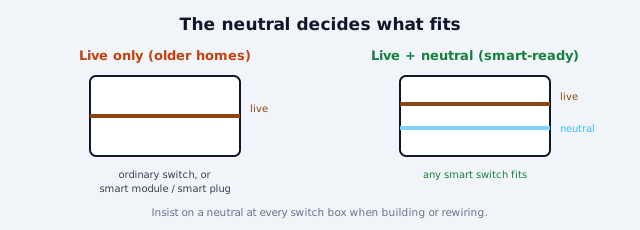
An ordinary switch only needs the live wire — it simply breaks the live going to the light. But a smart switch contains electronics (Wi-Fi radio, relay, processor) that need a continuous small power supply to stay alive even when the light is off. To get that, most smart switches need both a live and a neutral wire in the switch box.
Here is the catch: in India, switch boxes traditionally carry only the live, with the neutral going straight to the light fitting. So:
- New or rewired homes: insist on a neutral at every switch box. It costs almost nothing during wiring and makes any smart switch fit later. This is the single most important smart-ready decision — see the home electrical planning guide.
- Older homes without a neutral at the switch: you are not stuck, but your options narrow — no-neutral smart switches exist (they trickle a tiny current through the light, which can cause LED flicker or glow), or you use smart modules at the fitting or smart plugs instead.
The three ways to make a point smart
| Option | What it is | Needs neutral at switch? | Best for |
|---|---|---|---|
| Smart switch | Replaces the wall switch itself | Usually yes | New/rewired homes; whole-wall control |
| Smart module (relay) | A small relay hidden behind the existing switch or at the fitting | Depends on model/location | Retrofit while keeping existing switches |
| Smart plug | Plugs into a socket; the appliance plugs into it | No | Lamps, appliances on a socket — easiest retrofit |
For a retrofit without a neutral, a smart module behind the switch (wired at the fitting where the neutral is) or a smart plug is often the cleaner answer than fighting a no-neutral switch.
What smart switches can — and cannot — do
Can: switch on/off remotely and on schedules, dim compatible lights, respond to voice assistants, report energy use (some), and automate scenes ("all off at night"). Genuinely convenient, and useful for accessibility and security (lights on a schedule while away).
Cannot / caveats: they depend on your Wi-Fi and the cloud — an internet outage can disable app control (good ones keep manual and local control), and a discontinued app can strand a device. They add cost and complexity, and a cheap smart switch is still a mains device where poor quality is a real safety concern. And they do not make bad wiring safe — the RCCB, earthing and correct loads still matter.
A smart switch is a convenience layer on top of a sound installation — never a substitute for one. Get the wiring, earthing and protection right first; add smart control second.
Making a home smart-ready the cheap way
If you are building or rewiring, three near-free decisions make the home smart-ready for any future system:
1. A neutral at every switch box — the decisive one.
2. Deeper switch boxes — smart switches and modules are bulkier than plain ones and need room.
3. Good Wi-Fi coverage planned to reach switch locations.
Do these and you can add any smart switch later, from any brand, without breaking a wall. Skip them and every future upgrade fights the wiring.
The one-line answer
Smart switches control lights and appliances by app, voice and schedule, but most need a neutral wire at the switch box — which older Indian homes usually lack. In a new or rewired home, insist on a neutral at every switch (and deeper boxes) to stay smart-ready for any brand; in an older home without a neutral, prefer smart modules at the fitting or smart plugs over no-neutral switches. Treat smart control as a layer on a sound, correctly protected installation — and let a licensed electrician do the wiring.
Where to go next
- The switch basics: Modular Switches & Sockets.
- The whole ecosystem: Smart Home Hub.
- Smart-ready wiring: Home Electrical Planning.
- Retrofitting an old home: Electrical Renovation & Rewiring.
References
- IS 3854 : 2023, Switches for Domestic and Similar Purposes — Specification, Bureau of Indian Standards.
- IS 732 : 2019, Code of Practice for Electrical Wiring Installations, BIS.
- National Electrical Code of India, SP 30 : 2023, BIS: https://www.bis.gov.in/
Smart-device capabilities and compatibility change quickly and vary by brand — verify current specifications before buying. Installation must be by a licensed electrician. Verify any standard's status via the BIS catalogue before relying on it.
Export this guide
Related Guides — Deep-dive reading
Retrofit Smart Home India: Automate Without Rewiring
You do not need to break a single wall to make an existing Indian flat smart. Here is the honest, room-by-room retrofit playbook — the neutral-wire problem and its workarounds, wireless-first devices, rental-friendly options, and where retrofit genuinely hits its limits.
Smart HomeInstalling Smart Lighting in India: A Step-by-Step Guide (Bulbs & Switches)
The two ways to make your lights smart — screw-in smart bulbs you can fit in five minutes, and in-wall smart switches that need the MCB off, a neutral wire and a licensed electrician. Tools, wiring, pairing, dimmer compatibility, testing and the problems that trip up Indian homes.
Smart HomeHow to Choose a Security System (2026): The Master Buying Guide for Indian Homes and Buildings
The mental model that ties the whole buying decision together: start from your own risk, not a product; build the layers your situation actually needs; make the big architecture choices (wired vs wireless, local vs cloud, DIY vs professional); tell real product quality from marketing; and choose a vendor you can trust.
SecurityRelated Tools — Try Free
Electrical Safety & Load Audit
Home electrical audit — 10 categories, 65+ checkpoints across earthing, RCCB, MCB, wiring, switchboards, appliance circuits, DG/inverter backup.
Safety AuditEarth Conductor Size Calculator
Find the minimum protective (earth) conductor size for a circuit from its phase conductor size, using the standard IS 732 / IEC 60364 rule.
ElectricalSmart Home Cost Calculator
13 device categories across 5 ecosystems (Apple HomeKit, Alexa, Google Home, Mi, Wipro). Live floor-plan that lights up as you add devices, per-room and per-category breakdown.
Smart Home Calculator