
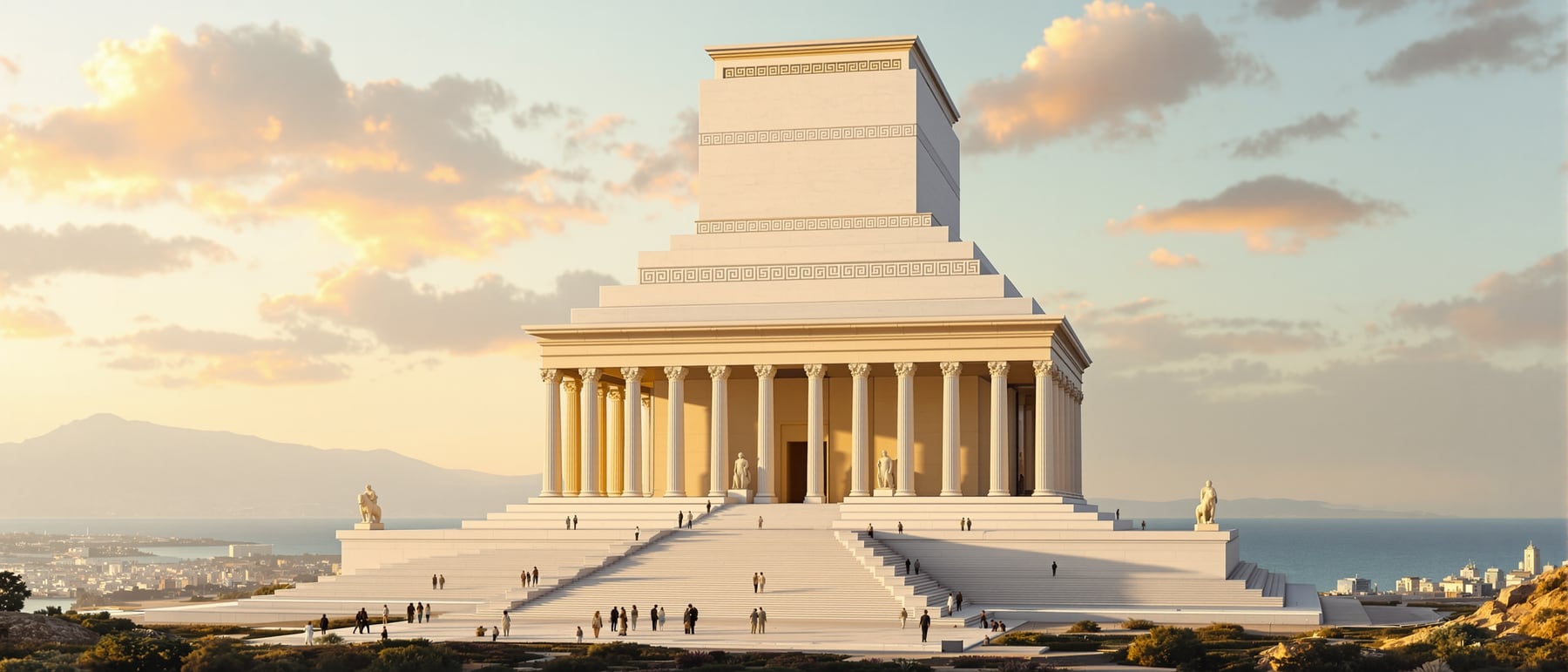
The Mausoleum of Halicarnassus: The Tomb That Named All Tombs
How a grieving queen raised a 45-metre tomb for her husband-brother — a temple stacked on a plinth and a pyramid stacked on the temple, carved by the four greatest sculptors of the age — so famous that every grand tomb since, from the Taj Mahal to Lenin's, still carries the dead king's name: mausoleum.
Every wonder so far has left us a marvel — a shape, a statue, a garden. This one left us a word. You have used it. You will use it again. When you call any grand tomb a mausoleum — Lenin's, Grant's, the Taj Mahal — you are speaking, without knowing it, the name of a Persian-appointed governor of a small kingdom in what is now Turkey, dead 2,400 years. His name was Mausolus, and the tomb built for him at Halicarnassus (modern Bodrum) was so overwhelming that his name became the very word for a monumental tomb, in every language of Europe, forever.
The Mausoleum of Halicarnassus was a tomb like no tomb before it: roughly 45 metres tall, a temple lifted onto a great plinth and crowned with a pyramid, its marble carved by the four finest sculptors of the age — a private grave raised to the scale and richness of a god's temple. And its story runs from a queen's grief to a Crusader castle. It stood where the Aegean resort of Bodrum stands today.
This is the thirty-fifth article in our Architectural Wonders series.
1. The tomb that named all tombs
Start with that astonishing afterlife, because it is the truest measure of how famous this building was.
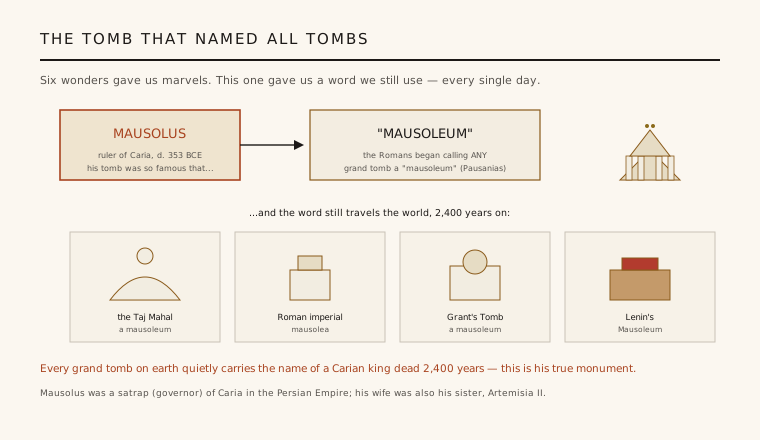
The tomb was raised for Mausolus, a satrap — a provincial governor — of Caria within the Persian Empire, who ruled from about 377 to 353 BCE and made Halicarnassus his glittering capital. His wife was also his sister, Artemisia II (sibling marriage ran in the Carian royal house). When the monument he was buried in turned out to be one of the marvels of the world, the effect on language was permanent: the traveller Pausanias records that the Romans were so awed that they began calling any grand tomb of their own a "Mausoleum," after Mausolus. And the word simply never stopped travelling. The Taj Mahal is a mausoleum. Roman emperors built mausolea. Lenin lies in a Mausoleum in Red Square. Of all seven wonders, this is the only one whose name you still say — Mausolus's real monument is not the ruin in Bodrum, but a word on the lips of the whole world.
2. A grief, a queen, and a showcase
Behind the word is a love story, and one of the stranger tales of dedication in the history of building.
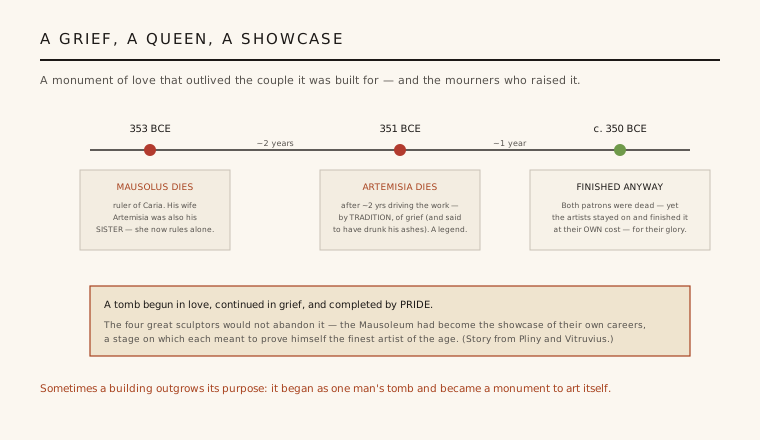
Mausolus died in 353 BCE, and his sister-wife Artemisia was, by all accounts, shattered. She ruled Caria alone for the two years left to her and threw herself into building his tomb — and tradition adds a haunting, probably legendary flourish: that she mixed his ashes into her drink, making herself a living urn, and died of grief around 351 BCE. Here is the remarkable part. Both patrons were now dead, with the tomb unfinished — and the artists did not stop. They stayed on and completed it at their own expense, because the Mausoleum had become something more than a commission: it was the showcase of their careers, a stage on which each of them meant to prove himself the greatest artist alive. A tomb begun in love and continued in grief was finished by pride — and it is a lovely truth about architecture, that a building can outgrow the reason it was started and become a monument to the makers themselves.
3. Three wonders stacked into one
Now the design — because what made it a wonder, rather than merely a rich tomb, was a startling act of architectural invention.
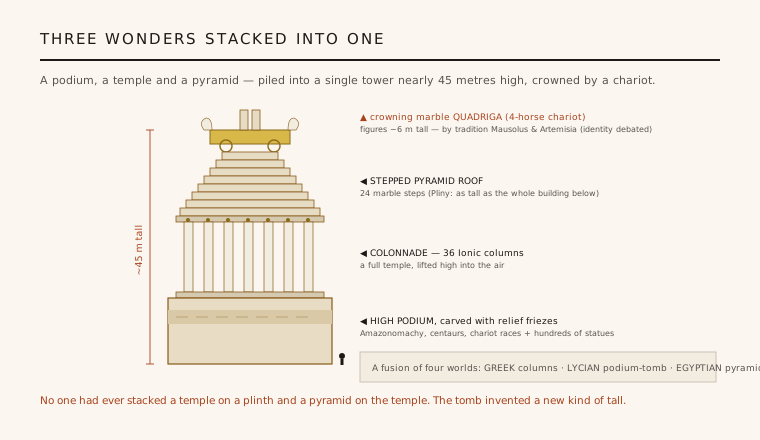
No one had ever built like this. The architects Pythius and Satyros took three separate architectural ideas and stacked them vertically into one soaring tower nearly 45 metres high. At the bottom, a tall rectangular podium, its faces wrapped in carved relief friezes. On top of that, a full Greek temple — a colonnade of 36 Ionic columns — but lifted high into the air. And on top of that, a stepped pyramid of 24 steps, which the ancient writer Pliny says was as tall as the whole building beneath it. And at the very summit, touching the sky, a colossal marble four-horse chariot — a quadriga — carrying two figures, traditionally taken to be Mausolus and Artemisia riding into eternity (the identification is debated). It was a deliberate fusion of worlds: Greek columns, a Lycian podium-tomb tradition, an Egyptian pyramid, all paid for by a Persian governor. The Mausoleum did not copy a temple or a pyramid — it invented a new kind of tall building by combining them, the way, centuries later, Blaak 31 or any hybrid tower borrows and recombines. Stacking, it turns out, is one of architecture's oldest tricks for reaching the sky.
4. A dream team of sculptors
The tomb's other glory was not its shape but its skin — and the extraordinary group of artists who carved it.
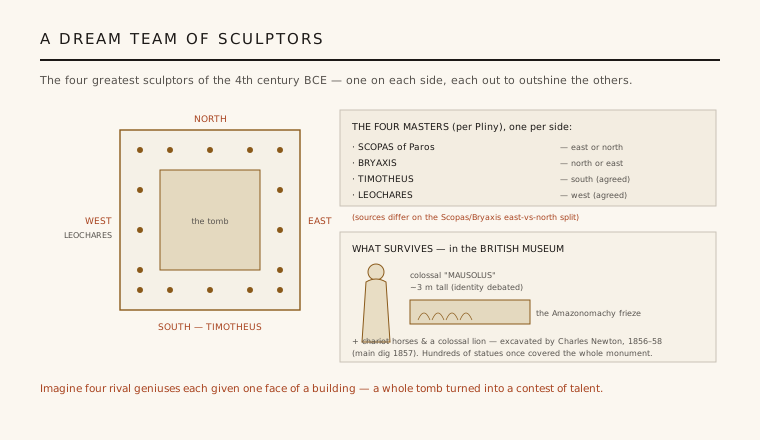
According to Pliny, the four most celebrated sculptors of fourth-century Greece each took one side of the monument: Scopas, Bryaxis, Timotheus and Leochares (the sources agree Timotheus took the south and Leochares the west, but disagree on which of Scopas and Bryaxis took the east and which the north). Imagine that: four rival geniuses, each handed one face of a building, each determined to outshine the other three. The whole structure was covered in hundreds of free-standing statues and bands of dramatic relief — Greeks battling Amazons, centaurs, racing chariots. And this is the wonder that best rewards a modern visitor, because a good deal of that sculpture survives. In the British Museum in London stand slabs of the Amazonomachy frieze, fragments of the chariot horses, a colossal lion, and two great statues traditionally called "Mausolus" and "Artemisia" (their identity, like so much here, is debated). They were excavated by Charles Newton in the 1850s. Where the Statue of Zeus left us only coins and descriptions, the Mausoleum left us actual marble we can stand before — Scopas, who also carved a column at the Temple of Artemis nearby, still speaking to us across 2,400 years.
5. Ground down to build a castle
And then the ending — the most poignant and best-documented death of any wonder, because we know almost exactly how it happened, and it is heartbreaking.
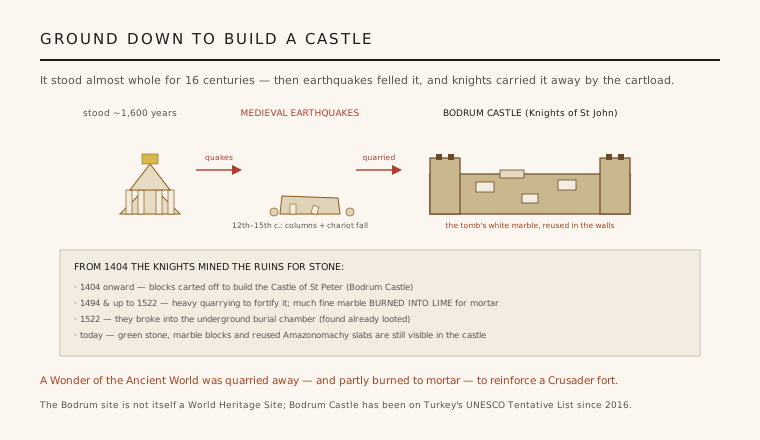
The Mausoleum was almost indestructible: it stood, largely intact, for some sixteen centuries — outliving the Roman Empire itself. What finally brought it down was, first, a series of medieval earthquakes (roughly the 12th to 15th centuries) that toppled the columns and threw down the chariot. And then came the part that stings. The Knights of St John (the Knights Hospitaller), Crusaders who held Bodrum, needed stone to build and strengthen their fortress, Bodrum Castle. So from 1404 onward — and heavily in 1494 and up to 1522 — they systematically quarried the ruins of the Mausoleum, carting off its marble, building blocks and even carved relief slabs straight into the castle walls, and burning much of the finest marble into lime for mortar. In 1522 they broke into the burial chamber itself. One of the seven wonders of the world was, quite literally, ground up to reinforce a castle — and to this day you can see blocks and Amazon-frieze slabs from the tomb embedded in the walls of Bodrum Castle. It is the same fate we saw befall the Pharos lighthouse, whose stones became a fort: a wonder does not always fall to catastrophe. Sometimes it is simply, patiently, recycled. (The Bodrum site itself is not a listed World Heritage Site; Bodrum Castle has been on Turkey's UNESCO Tentative List since 2016.)
6. What a modern architect can learn from the Mausoleum
- A name can outlast the stone. The building is a ruin, but "mausoleum" is immortal. The deepest legacy of a work can be an idea or a word it seeds — influence travels further than any wall.
- Invent by combining. Podium plus temple plus pyramid, stacked, made something no single tradition had. Much great architecture is not invention from nothing but the bold synthesis of existing ideas into a new whole.
- Bring the best people together and let them compete. Four rival masters on four faces produced work none might have made alone. A little rivalry among great talents, well marshalled, can lift a project beyond any single vision.
- A building can outgrow its brief. It began as one man's tomb and became a monument to art itself, finished by artists working for nothing but their own name. The finest projects often acquire a purpose larger than the one they were commissioned for.
- Nothing built is safe from being reused. A wonder was ground into mortar for a fort. Materials are always someone's future quarry; permanence is never guaranteed, and every ruin is a temptation to the next builder.
- Document your work — it may be all that survives. We know the Mausoleum through Pliny's description, its surviving sculpture, and Pythius's own lost treatise. The record of a building can outlive the building; write down what you make and why.
References & further reading
1. World History Encyclopedia — Mausoleum at Halicarnassus. https://www.worldhistory.org/Mausoleum_at_Halicarnassus/
2. Encyclopaedia Britannica — Mausoleum of Halicarnassus. https://www.britannica.com/topic/Mausoleum-of-Halicarnassus
3. The British Museum — The Mausoleum of Halikarnassos (Room 21; Amazonomachy frieze, colossal statues, lion). https://www.britishmuseum.org/collection
4. Pliny the Elder — Natural History 36.30–31 (dimensions, 36 columns, 24 steps, the four sculptors), via Perseus. http://www.perseus.tufts.edu/hopper/text?doc=Perseus:text:1999.02.0137
5. National Geographic History — The Mausoleum at Halicarnassus. https://www.nationalgeographic.com/history/history-magazine/article/mausoleum-halicarnassus-tomb-wonder-ancient-world
6. UNESCO World Heritage Centre — Türkiye Tentative List (Bodrum Castle, listed 2016). https://whc.unesco.org/en/statesparties/tr
Last verified 2026-07-04. The Mausoleum survives only as foundations, sculpture (chiefly in the British Museum, excavated by Charles Newton 1856–58, main dig 1857) and spolia in Bodrum Castle, so most detail rests on ancient sources — above all Pliny the Elder (Natural History 36.30–31) for the dimensions, the 36 Ionic columns, the 24-step pyramid and the four sculptors, and Vitruvius for the architects Pythius and Satyros. Figures are widely cited approximations that vary by source: height ~45 m (Pliny ~140 Roman ft), base roughly 30–40 m per side, the statue count (up to ~400) and the ~6 m quadriga figures. Built for Mausolus (satrap of Caria, d. 353 BCE) and completed c. 350 BCE under and after Artemisia II (d. c. 351 BCE); her "death of grief" and mixing his ashes in her drink are tradition, not documented fact. The four-sculptors tradition is Pliny's; sources differ on the Scopas/Bryaxis east-north assignment (Timotheus-south, Leochares-west are stable). The statues called "Mausolus" and "Artemisia" are traditionally, but not securely, identified. The end — medieval earthquakes then Knights Hospitaller quarrying (1404, 1494, to 1522, burning marble into lime for Bodrum Castle) — follows the archaeological record. The Bodrum Mausoleum site is not an inscribed World Heritage Site; Bodrum Castle is on Turkey's UNESCO Tentative List (2016), and the separate "Hecatomnus at Milas" entry is a different tomb.
Export this guide
Related Guides — Deep-dive reading
The Lighthouse of Alexandria: The Wonder That Became a Word
How Ptolemy's Egypt raised a 100-metre tower of light on the island of Pharos — the tallest building on earth after the Great Pyramid, the model for every lighthouse since, and so famous its island's name became the word for 'lighthouse' itself — which stood 1,600 years, fell to earthquakes, and was reborn as a fort and a field of ruins on the sea floor.
Architectural WondersGreat Zimbabwe: The Stone City Europe Refused to Believe Africans Built
In the hills of southern Africa stand the largest ancient stone ruins south of the Sahara — a whole city of massive granite walls built without a drop of mortar, the wealthy capital of a gold-trading kingdom. For a century, colonists refused to accept that Africans had raised it, and invented every other builder they could. This is the story of that architecture, and of the lie it outlived. The article that closes our chapter on the palaces and pleasures of worldly power.
Architectural WondersThe Pyramids of Giza: The Only Wonder Still Standing
How three Fourth-Dynasty kings raised the greatest stone monuments on Earth — 2.3 million blocks placed with a precision that shames a modern surveyor, by a paid and well-fed town of workers, not slaves — and why the Great Pyramid, oldest of the Seven Wonders of the Ancient World, is the only one that has not vanished.
Architectural WondersRelated Tools — Try Free
Circadian Light Meter
Patient-centric circadian lighting visualizer for Indian healthcare design — time-of-day × intensity → CCT, melanopic lux (EML / mEDI), melatonin suppression, and an alertness curve. Calibrated against WELL v2 L03 Circadian Lighting Design, CIE S 026:2018, Brainard 2001, and Lucas et al. 2014.
Circadian ToolBefore & After Studio
Generate AI before-and-after renders to preview how your redesign could look.
DesignAIDesign Brief Generator
Answer 10 questions and generate a professional interior design brief PDF for your designer or architect.
Brief Generator