
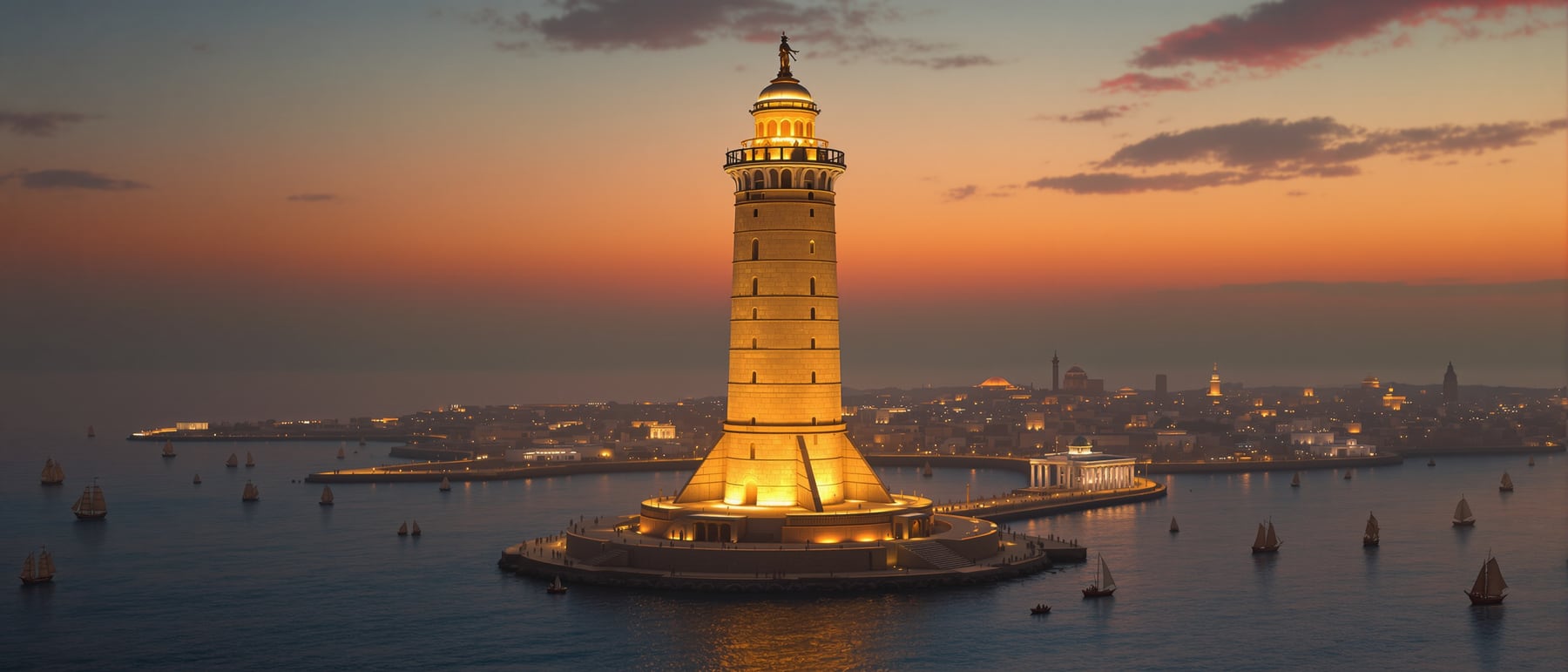
The Lighthouse of Alexandria: The Wonder That Became a Word
How Ptolemy's Egypt raised a 100-metre tower of light on the island of Pharos — the tallest building on earth after the Great Pyramid, the model for every lighthouse since, and so famous its island's name became the word for 'lighthouse' itself — which stood 1,600 years, fell to earthquakes, and was reborn as a fort and a field of ruins on the sea floor.
We end where the ancient world's list of marvels was often said to end — with the one wonder built not to house a god or a king, but to do a job: to keep sailors from drowning in the dark. On the little island of Pharos, at the mouth of the harbour of Alexandria, the Greek kings of Egypt raised a tower of light so tall, so useful and so beautiful that it became the seventh wonder, the prototype of every lighthouse ever built, and — uniquely — a word in the mouths of half the world.
The Lighthouse of Alexandria rose around 280 BCE, stood roughly 100 metres high, and burned its guiding fire for more than sixteen centuries — outlived, among the seven wonders, only by the Pyramids with which we began. This is the thirty-seventh article in our Architectural Wonders series, and its natural close: a wonder that fell into the sea, and yet is still, in a sense, standing.
1. The word for light itself
Begin, as we did with the Mausoleum, with the astonishing linguistic afterlife — because it tells you at once how famous this building was.
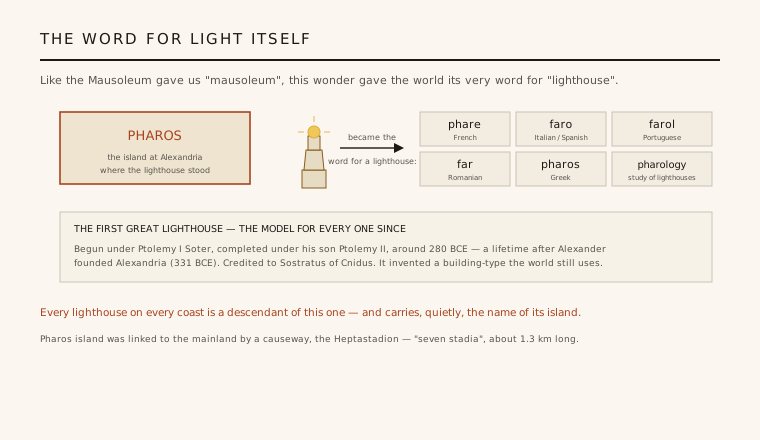
The lighthouse stood on an island called Pharos, and it became so completely the lighthouse that its island's name turned into the ordinary word for "lighthouse" across Europe and the Mediterranean: French phare, Italian and Spanish faro, Portuguese farol, Romanian far, Greek pháros — the very root of "pharology," the study of lighthouses. It was the first great lighthouse in history and the model for every one that followed, begun under Ptolemy I Soter and finished around 280 BCE under his son Ptolemy II, barely two generations after Alexander the Great founded the city. Just as Mausolus's tomb gave every grand tomb its name, this tower gave the whole idea of a coastal beacon its name. When you see a lighthouse anywhere on earth, you are looking at a descendant of the Pharos — and saying, without knowing it, the name of a small Egyptian island.
2. Square, octagon, circle
What did it actually look like? No complete ancient description survives, but from Roman coins, mosaics and the accounts of travellers who saw it standing, one unmistakable form emerges.
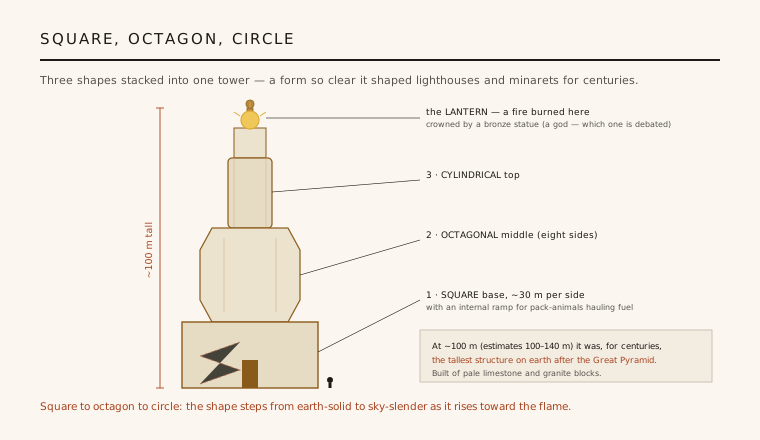
The Pharos was built in three stacked stages, and the progression is one of the most satisfying shapes in all of architecture: a broad square base (around thirty metres to a side), then a narrower octagonal middle, then a slender cylindrical top holding the lantern, all crowned by a statue of a god (whether Zeus the Saviour, Poseidon or Helios, the sources disagree). The shape steps from earth-solid to sky-slender as it climbs toward the flame. At roughly 100 metres (estimates run from 100 to 140), it was for centuries the tallest structure on earth after the Great Pyramid — built of pale limestone and granite, with an internal ramp up which pack animals are said to have hauled the fuel. That square-octagon-circle massing was so clear and so strong that it echoed down the centuries into the design of towers and minarets. It is the same principle we saw the Mausoleum invent — stacking distinct geometric stages to reach the sky — here turned to the purpose of throwing light as far as possible out to sea.
3. A fire that reached the horizon
The whole 100 metres existed to lift one thing as high as possible: a flame.
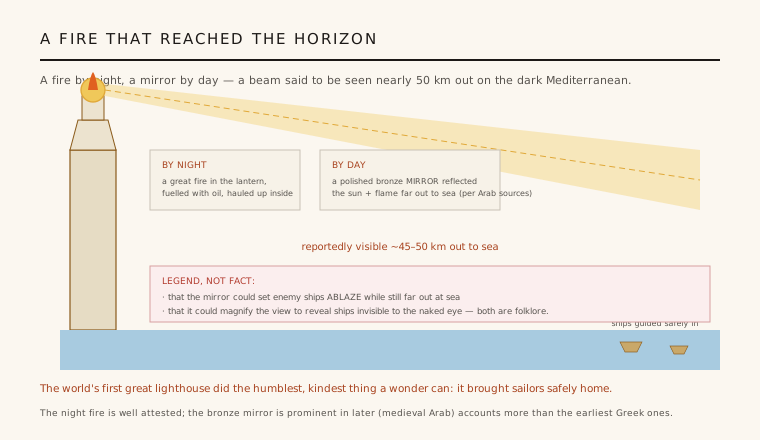
By night, a great fire blazed in the open lantern at the summit, fed with oil hauled up through the tower. By day, later accounts — mostly the medieval Arab geographers — describe a polished bronze mirror that caught the sun and the flame and threw the light far out over the water, a beam reportedly visible some 45 to 50 kilometres out to sea. Around that mirror grew wonderful legends — that it could set enemy ships ablaze while they were still far offshore, or magnify the horizon to reveal ships invisible to the naked eye. Those are folklore, not fact, and worth naming as such. But the true function needs no exaggeration, and it is the gentlest purpose of any wonder in this whole series. The Pyramids housed the dead; the Statue of Zeus overawed the living; the Colossus celebrated a war. The Pharos did the humblest, kindest thing a great building can do: night after night, for sixteen hundred years, it brought sailors safely home.
4. Sostratus's secret signature
Every wonder has its human story, and the Pharos's is the most charming — a quiet act of defiance by the man who built it.
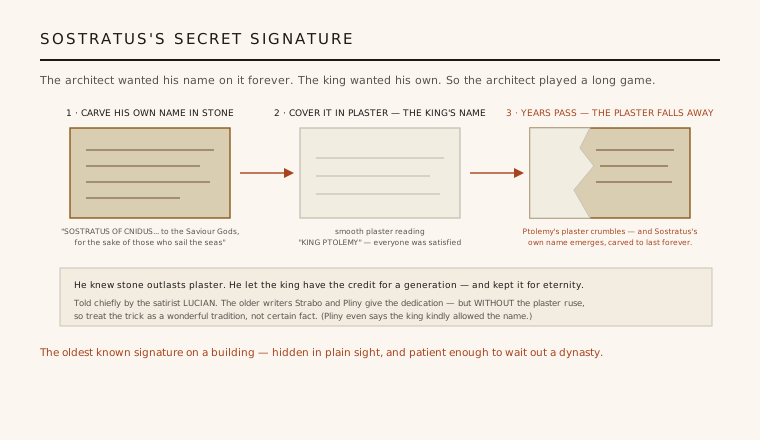
The architect, Sostratus of Cnidus, wanted his own name on his masterpiece. The king wanted the royal name. So, the story goes, Sostratus carved his own dedication deep into the stone — "Sostratus of Cnidus, son of Dexiphanes, to the Saviour Gods, for the sake of those who sail the seas" — and then plastered over it with an inscription bearing King Ptolemy's name. Everyone was satisfied. But Sostratus knew something about materials: that stone outlasts plaster. Over the years the royal plaster would crack and flake away, and his own name, cut in the rock beneath, would emerge to stand forever. It is perhaps the oldest architect's signature in history — hidden in plain sight, patient enough to outwait a dynasty. (Honesty compels a footnote: this delicious tale comes chiefly from the satirist Lucian; the older writers Strabo and Pliny record the dedication without the plaster trick — Pliny even says the king graciously allowed Sostratus his name. Treat the ruse as a wonderful tradition.) Either way, the lesson is real, and we have met it again and again in this series: the maker who leaves his mark is the one we still remember.
5. Sixteen centuries, then the sea
And so to the end — which, fittingly for the last of the wonders, is not really an end at all, but a pair of afterlives.
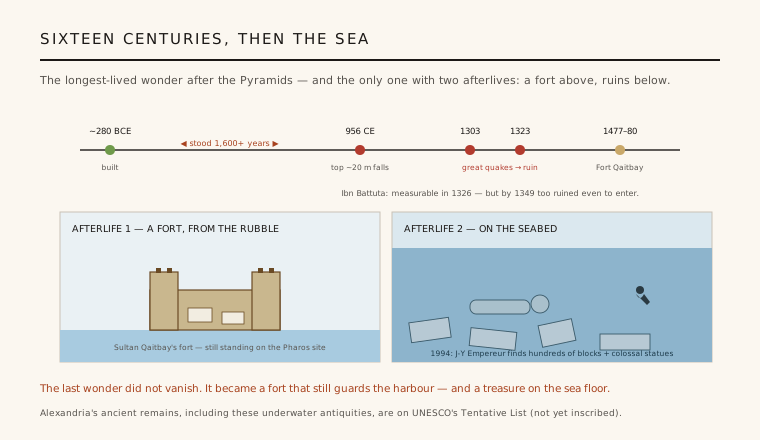
The Pharos was almost indestructible. It stood for more than sixteen hundred years — longer than any wonder but the Pyramids — its fire guiding ships through the fall of Alexandria's Greek kings, the Roman centuries, and the coming of Islam. What finally beat it was the same force that felled the Colossus and stripped the Pyramid's casing: earthquakes. A tremor in 956 CE brought down the top; the great quakes of 1303 and 1323 CE reduced it to a stump. The traveller Ibn Battuta could still climb to its ruined doorway in 1326, but returning in 1349 he found it so shattered he could not get in at all. And then came its two rebirths. In 1477–1480, the Mamluk sultan Qaitbay built a fortress on the exact site, out of the lighthouse's own fallen stone — the Fort of Qaitbey, which still stands today and still guards the same harbour mouth, its walls studded with oversized ancient blocks. And in 1994, the French archaeologist Jean-Yves Empereur dived into Alexandria's Eastern Harbour and found the rest of the Pharos lying on the sea floor — hundreds of colossal blocks, columns, and giant statues of the Ptolemies, toppled by the earthquakes into the water where they still rest. So the last wonder did not vanish like the library of Alexandria or the Hanging Gardens. It became two things at once: a fort above the waves, and a sunken city of stone below them. A lighthouse, in the end, that refuses to go dark.
6. What a modern architect can learn from the Pharos — and from the seven
- Usefulness is its own beauty. The Pharos was the only wonder built to serve, not to awe — and it awed anyway, for sixteen centuries. A building that does its job superbly, for real people, can be as immortal as any monument.
- A clear form travels. Square, octagon, circle — a shape so legible it became the template for lighthouses and minarets everywhere. Clarity of form is how a good idea outlives its first building and spreads across the world.
- Understand your materials deeply. Sostratus won eternity because he knew stone outlasts plaster. Mastery of what things are made of, and how they age is the quiet foundation of every lasting design — and every clever one.
- Design for the maker's memory. The name in the rock survived the name in the plaster. Build the record of who made a thing, and why, into the thing itself; it may be what endures longest.
- Ruin is not the end. The Pharos became a fort and a reef of sculpture; across this series, wonders were quarried into castles, reborn as words, remade in New York Harbor. What we build is never truly lost while its stone, its idea, or its name is still in use somewhere.
- And, across all seven: of the Seven Wonders of the Ancient World, six are gone and only the Great Pyramid still stands — yet all seven are here, in our language, our lighthouses, our tombs, our idea of what it means to build greatly. That is the deepest lesson of this whole collection, and of Studio Matrx itself: the things we build in love and ambition outlast their own stone, and reach across time to whoever comes after.
In Amogh's frame
Of all the seven wonders, this is the one whose very ground Amogh stood upon. This is him — second from the right, with his sister, his mother and his father — in front of the honey-coloured walls of the Fort of Qaitbay in Alexandria. And that fort, as we have just seen, was raised on the exact site of the Lighthouse of Alexandria, out of the Pharos's own fallen stones. So when Amogh smiled for this photograph, he was standing where the last of the Seven Wonders of the Ancient World once threw its fire out to sea — on the very spot, made of the very stone. There could be no more fitting place to close this journey than a wonder he reached with his own feet.
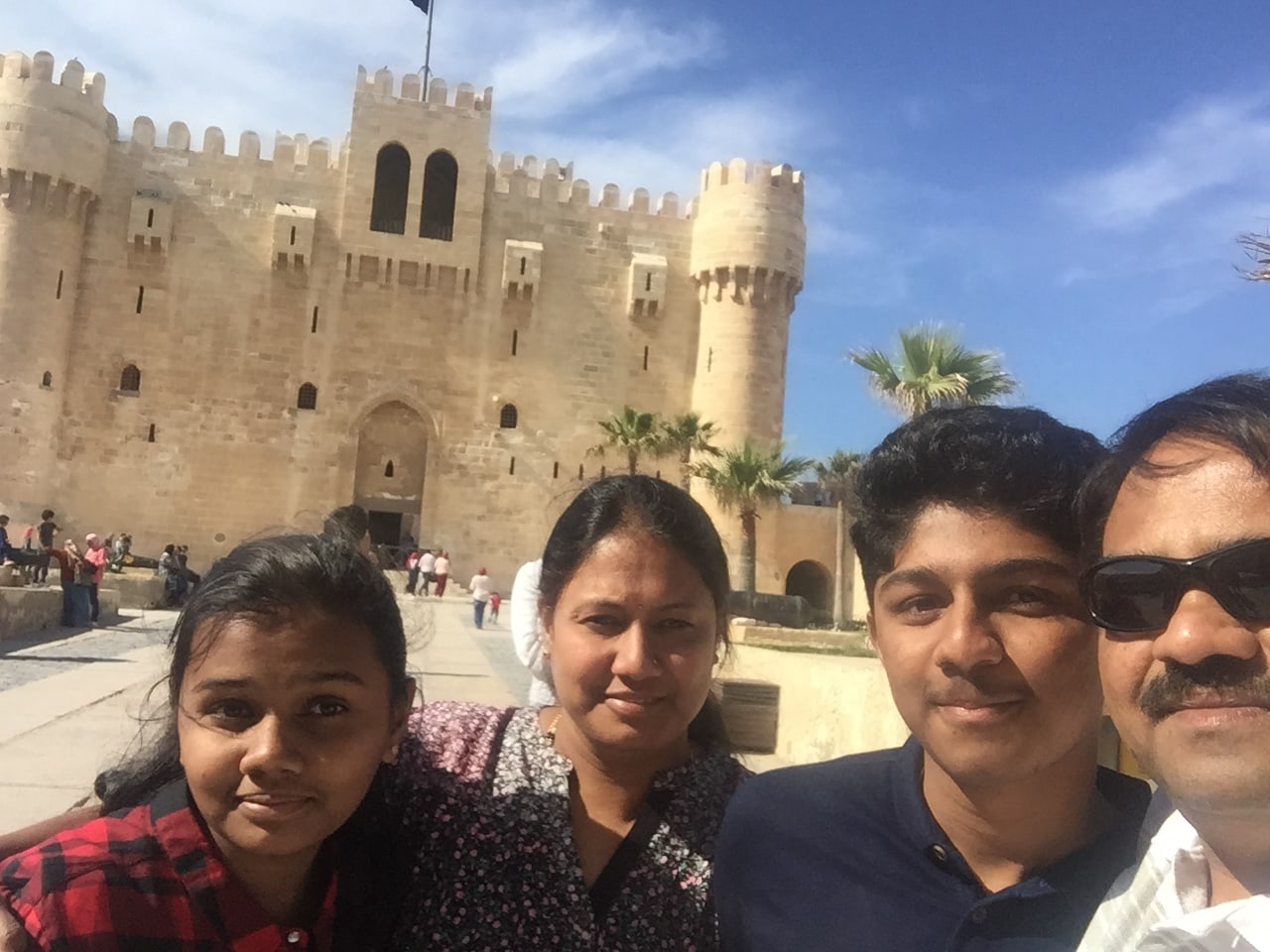
Studio Matrx is built in his memory. Some of these wonders he walked through himself; this is one of them.
References & further reading
1. World History Encyclopedia — Lighthouse of Alexandria. https://www.worldhistory.org/Lighthouse_of_Alexandria/
2. Encyclopaedia Britannica — Lighthouse of Alexandria. https://www.britannica.com/topic/lighthouse-of-Alexandria
3. Ministère de la Culture (France) / CEAlex — Underwater Archaeology at Alexandria (Jean-Yves Empereur). https://archeologie.culture.gouv.fr/archeo-sous-marine/en/alexandria-egypt
4. Encyclopaedia Romana (University of Chicago) — Pharos: The Lighthouse at Alexandria (Strabo, Pliny, Lucian, Posidippus). https://penelope.uchicago.edu/encyclopaedia_romana/greece/paganism/pharos.html
5. Muslim Heritage — The Lighthouse of Alexandria in the Sources from Islamic Civilisation (al-Masudi, al-Idrisi, Ibn Battuta). https://muslimheritage.com/lighthouse-of-alexandria/
6. UNESCO World Heritage Centre — Tentative List: Alexandria, ancient remains and the new library. https://whc.unesco.org/en/tentativelists/1822/
Last verified 2026-07-04. No complete contemporary description of the Pharos survives; its appearance is reconstructed from Roman coins and mosaics, ancient authors (Strabo, Pliny, Lucian, Posidippus), medieval Arab geographers (al-Masudi, al-Idrisi, Ibn Battuta) who saw it before its final collapse, and underwater finds since 1994. Figures are widely cited approximations that vary by source: height ~100 m (estimates 100–140 m); built c. 300–280 BCE under Ptolemy I and II; credited to Sostratus of Cnidus (whether as architect or as dedicator/financier is disputed). The three-stage (square-octagonal-cylindrical) form, the crowning statue (deity disputed), the night fire and the bronze mirror (prominent in medieval more than earliest Greek sources) follow the reconstructed record; the mirror's ship-burning and magnifying powers are legend. Sostratus's plaster-and-signature trick is told chiefly by Lucian; Strabo and Pliny give the dedication without it. The lighthouse was progressively destroyed by earthquakes (notably 956, 1303 and 1323 CE); Sultan Qaitbay built Fort Qaitbay on the site from its rubble (1477–1480), and Jean-Yves Empereur's team rediscovered submerged blocks and statuary in Alexandria's Eastern Harbour from 1994. Alexandria's ancient remains are on UNESCO's Tentative List (ref. 1822), not an inscribed World Heritage Site.
Export this guide
Related Guides — Deep-dive reading
Fort Qaitbey: A Wonder Built on the Grave of a Wonder
How a 15th-century sultan raised a sea-fortress on the exact spot — and partly from the fallen stone — of the Lighthouse of Alexandria, one of the Seven Wonders of the Ancient World, whose drowned remains still lie in the water at its feet.
Architectural WondersThe Palace of Sennacherib at Nineveh: The Palace Without Rival
Twenty-seven centuries ago, on the Tigris opposite modern Mosul, an Assyrian king built a palace so vast he named it, in his own words, 'the Palace that has no rival' — and lined its walls, room after room, with miles of carved stone panels telling the story of his wars. It is the birthplace of narrative art, the home of the winged guardian, and a wonder destroyed not once but twice. The second article in our chapter on the palaces of worldly power.
Architectural WondersThe Pyramids of Giza: The Only Wonder Still Standing
How three Fourth-Dynasty kings raised the greatest stone monuments on Earth — 2.3 million blocks placed with a precision that shames a modern surveyor, by a paid and well-fed town of workers, not slaves — and why the Great Pyramid, oldest of the Seven Wonders of the Ancient World, is the only one that has not vanished.
Architectural WondersRelated Tools — Try Free
Before & After Studio
Generate AI before-and-after renders to preview how your redesign could look.
DesignAIMaterial Schedule Generator
Generate a room-wise finish schedule — walls, floors, ceilings, trim, and joinery by location.
Material ScheduleArchitect Fee Calculator
Estimate architect fees based on COA guidelines, project scope, and city.
ArchitectAI