
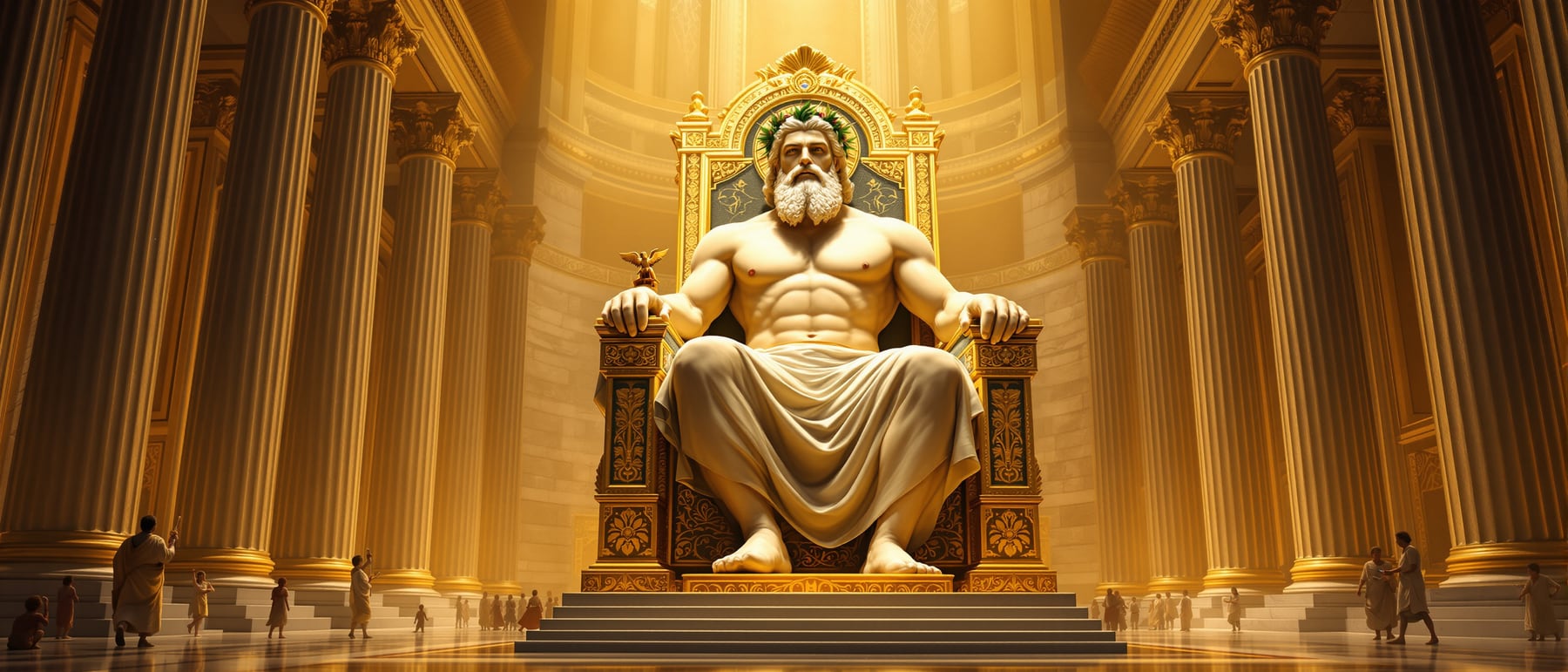
The Statue of Zeus at Olympia: The God Made of Gold and Ivory
How the sculptor Phidias built a 13-metre seated Zeus of ivory flesh and golden robes — so vast that if the god stood he would unroof his own temple, so beautiful that men said it was a misfortune to die without seeing it — and how, uniquely among the lost wonders, we dug up the master's own workshop and perhaps his drinking cup.
The wonders we have visited so far have been buildings — mountains of stone, forests of marble. This one is different: the wonder was not the temple but the statue inside it. In the great Temple of Zeus at Olympia — the sacred valley in the Greek Peloponnese where the ancient Olympic Games were held — there sat a figure of the king of the gods so overwhelming that, for the ancient world, it did not merely depict Zeus. It was Zeus. To see it was, people said, to see the god himself.
The Statue of Zeus at Olympia was the masterpiece of Phidias, the greatest sculptor of Classical Greece, made around 435 BCE. It was roughly thirteen metres tall, seated, built of gold and ivory, and it inspired a devotion no other wonder quite matched — one writer said it was a misfortune to die without having seen it. And it gives us something no other lost wonder does: not a rumour and an absence, but the sculptor's actual workshop, dug from the Greek earth, tools and all.
This is the thirty-fourth article in our Architectural Wonders series.
1. The god made visible
Begin with what the statue did to people, because the ancient testimony is unusually personal and unusually consistent. This was the most moving of the wonders.
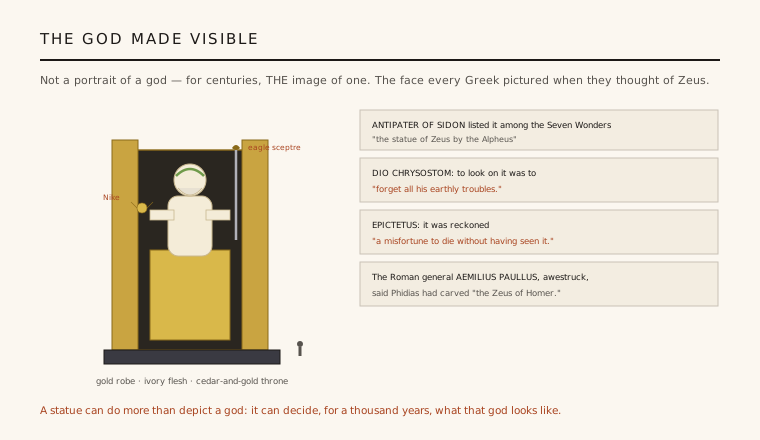
Antipater of Sidon listed it among the Seven Wonders. The orator Dio Chrysostom said that a man standing before it would "forget all his earthly troubles." The philosopher Epictetus reckoned it a misfortune to die without having made the journey to see it. And when the Roman general Aemilius Paullus first laid eyes on it, he was, says Livy, "moved to his very soul, as if he had seen the god in person" — Phidias, he said, had sculpted "the Zeus of Homer." That is the deepest thing about this wonder: it did not just represent a god, it fixed him. For a thousand years afterwards, when a Greek or Roman closed their eyes and pictured Zeus, they saw Phidias's Zeus — the serene, bearded, benevolent king on his throne. A single work of art had defined the face of a god.
2. Gold and ivory
How do you build a god thirteen metres tall that glows in the dark of a temple? Phidias's answer was a technique the Greeks reserved for their most sacred images: chryselephantine.
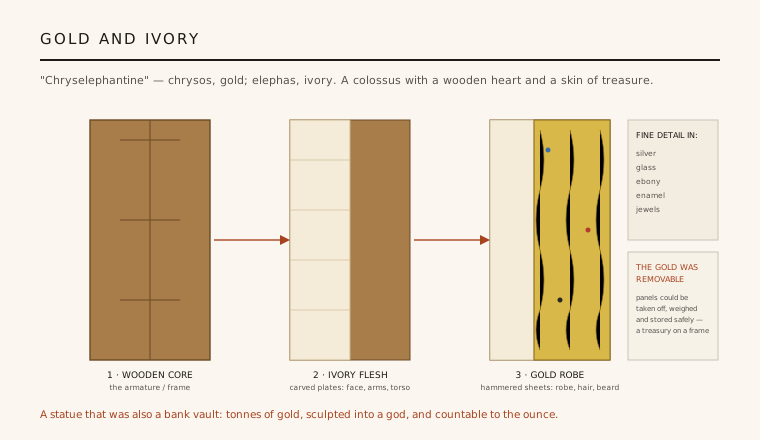
The word says it all — chrysos, gold; elephas, ivory. Inside was a wooden core, a great carpentered armature. Over it, for every part of the god's bare flesh — face, arms, torso, feet — went carved plates of ivory, warm and pale as living skin. And over the rest — the flowing robe, the hair, the beard — went hammered sheets of gold, catching the light. The details were picked out in silver, glass, ebony, enamel and inlaid jewels; the robe was chased with lilies and animals. It was a statue that was also, quite literally, a treasury: the gold panels were reportedly removable, so they could be taken down, weighed, and safeguarded — tonnes of bullion, sculpted into a god and countable to the ounce. This was the same technique, and the same hand, behind the colossal Athena Phidias had already made for the Parthenon in Athens; at Olympia he surpassed himself.
3. Too big to stand
Now the scale — and here the ancients themselves reached for the joke that says it best.
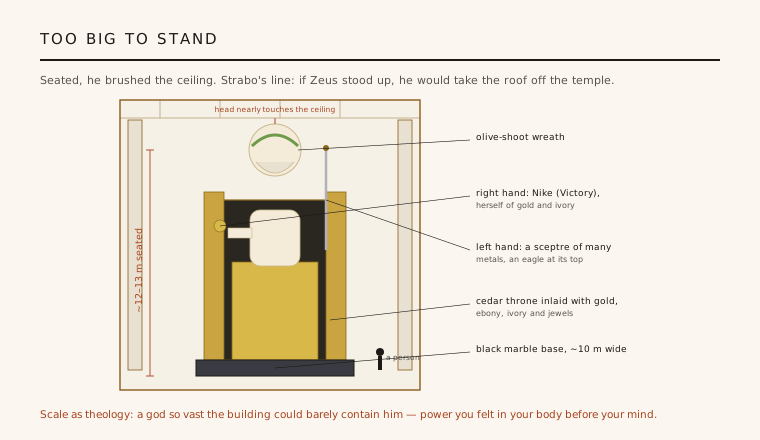
Seated, the statue rose some twelve to thirteen metres — as tall as a four-storey building — and his head came so near the coffered ceiling that the geographer Strabo made the observation everyone has repeated ever since: if Zeus stood up, he would unroof his own temple. The effect was deliberate. You did not look at this god so much as feel dwarfed beneath him. On his head lay a wreath of olive shoots; on his outstretched right hand stood a figure of Nike, Victory herself, of gold and ivory; in his left he held a sceptre of many metals crowned by an eagle. He sat on a vast cedar throne inlaid with gold, ebony, ivory and gems, carved with the Graces and the Seasons and darker myths — sphinxes seizing children, the slaughter of Niobe's brood — all on a base of black marble some ten metres wide. Scale, here, was theology: power you felt in your body before your mind could name it. It is a lesson we saw carried in stone at Kailasa — that sheer overwhelming size can itself be a form of worship.
4. The pool of oil, and the man who made him
Two details lift this wonder above the others — one a piece of exquisite care, the other a stroke of archaeological luck that no other lost wonder enjoyed.
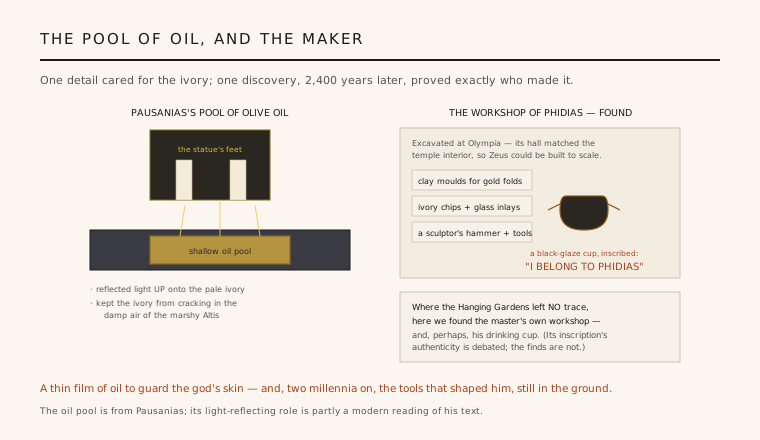
First, the pool of oil. The traveller Pausanias, who stood before the statue and left us its fullest description, noticed a shallow basin of olive oil set into the black marble floor at the god's feet. It was not decoration. Olympia's valley was damp, and ivory cracks in damp air; the film of oil kept the atmosphere around the statue moist and the ivory sound — and, reflecting the light up onto the pale figure, it made the god seem to glow. It is climate-conscious material science, twenty-four centuries early — the same instinct we admired in the daylight-tuned reading room of the Bibliotheca Alexandrina.
Second, and astonishingly: we found Phidias's workshop. Archaeologists digging at Olympia uncovered the very building where the statue was made — its interior matching the temple's hall almost exactly, so Phidias could build his god to scale before it was moved next door. Inside were his clay moulds for shaping the gold drapery, chips of ivory, fragments of glass inlay, a sculptor's hammer — and, most hauntingly, a plain black cup scratched with the words "I belong to Phidias." Where the Hanging Gardens left not a single trace to prove they ever existed, here we have the master's tools and, perhaps, his drinking cup. (Scholars debate whether that inscription is genuinely his; the workshop itself is beyond doubt.) It is the closest we will ever come to standing at the elbow of an ancient genius while he worked.
5. The god who laughed, and vanished
For all its majesty, the statue's ending is a mystery wrapped in a legend — the wonder that slipped quietly out of history.
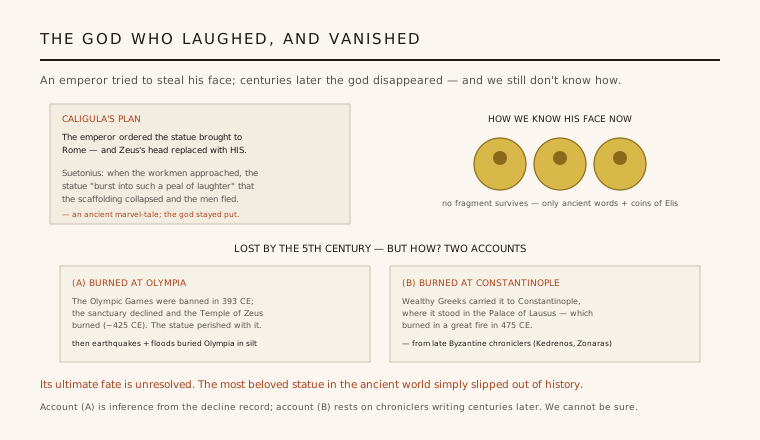
The mad emperor Caligula, the story goes, coveted the statue: he ordered it shipped to Rome so its head could be swapped for his own. According to Suetonius, when the workmen came to move it the statue burst into a peal of laughter so loud that the scaffolding collapsed and the terrified men fled — a marvel-tale, no doubt, but a telling one. The god stayed. What finally became of him, though, no one can say for certain. There are two competing ends. In one, the statue perished at Olympia: after the Christian emperor Theodosius banned the Olympic Games in 393 CE, the sanctuary was abandoned, the Temple of Zeus burned around 425, and the god burned with it — after which earthquakes and floods buried Olympia under metres of silt. In the other, wealthy Greeks had already carried the statue off to Constantinople, where it stood in the private Palace of Lausus until that palace burned in a great fire in 475 CE. The first account is an inference from the ruins; the second rests on Byzantine chroniclers writing centuries later. We simply do not know. No fragment of the statue survives; we know its face only from ancient words and the little images stamped on coins. The most beloved statue in the ancient world — the one it was a misfortune to die without seeing — vanished so completely that we cannot even say how it died.
6. What a modern architect can learn from the Zeus
- Scale can be a message. Phidias made Zeus too large to stand so you would feel the god's power in your body. Size, used with intent, communicates before a single detail is read — but it must serve meaning, not ego.
- Materials carry emotion. Ivory for warm living flesh, gold for divine radiance — the substance did half the storytelling. Choose materials for what they make a person feel, not only for how they perform.
- Protect what you make from its environment. The oil pool kept the ivory from cracking in a damp valley. The greatest work still needs humble, ongoing care against climate and time; conservation is part of design, not an afterthought.
- The maker matters — leave your evidence. We know Phidias because his workshop survived. A building or artwork lives longer in memory when the record of who made it, and how survives alongside it. Document the making.
- A masterpiece can define a whole idea. For a thousand years, "Zeus" meant Phidias's Zeus. The most powerful design doesn't just solve a problem; it sets the template everyone after reaches for.
- Even the most loved things can be lost — cherish and record them now. The statue people crossed the world to see disappeared without even a clear account of its end. Nothing is guaranteed permanence; honour and document what matters while it stands.
References & further reading
1. World History Encyclopedia — Statue of Zeus at Olympia. https://www.worldhistory.org/Statue_of_Zeus_at_Olympia/
2. Pausanias — Description of Greece 5.11 (the eyewitness description), via Encyclopaedia Romana. https://penelope.uchicago.edu/encyclopaedia_romana/greece/hetairai/zeus.html
3. Archaeological Museum of Olympia — The Workshop of Phidias. https://ancientolympiamuseum.com/index.php/2026/01/18/the-workshop-of-phidias/
4. Encyclopaedia Romana (University of Chicago) — The Workshop of Phidias. https://penelope.uchicago.edu/encyclopaedia_romana/greece/hetairai/pheidias.html
5. UNESCO World Heritage Centre — Archaeological Site of Olympia (inscribed 1989). https://whc.unesco.org/en/list/517/
6. Encyclopaedia Britannica — Olympia (ancient site, Greece). https://www.britannica.com/place/Olympia-ancient-site-Greece
Last verified 2026-07-04. The statue survives only in ancient descriptions and coin images, so detail rests on classical sources — chiefly Pausanias (Description of Greece 5.11), with Strabo (the "unroof the temple" line), Suetonius (the Caligula laughter anecdote), Livy and Plutarch (Aemilius Paullus), Epictetus and Dio Chrysostom (its emotional effect), and Antipater of Sidon (the wonder-list). Figures vary by source and are given as widely cited approximations: the statue was made c. 435–430 BCE by Phidias, about 12–13 m (40–43 ft) tall, on a black-marble base roughly 10 m wide, inside the Doric Temple of Zeus (architect Libon of Elis, c. 470–456 BCE). The chryselephantine technique, the olive-oil pool (Pausanias; its light-reflecting function is partly a modern reading) and the excavated Workshop of Phidias with its gold-drapery moulds, ivory and glass, and the disputed "I belong to Phidias" cup follow the archaeological record. The statue's destruction is genuinely unresolved: it either burned at Olympia after the Games were banned (393 CE) or was removed to Constantinople and lost in the Palace of Lausus fire (475 CE, per late Byzantine chroniclers). Olympia is a UNESCO World Heritage Site (1989).
Export this guide
Related Guides — Deep-dive reading
The Palace of Sennacherib at Nineveh: The Palace Without Rival
Twenty-seven centuries ago, on the Tigris opposite modern Mosul, an Assyrian king built a palace so vast he named it, in his own words, 'the Palace that has no rival' — and lined its walls, room after room, with miles of carved stone panels telling the story of his wars. It is the birthplace of narrative art, the home of the winged guardian, and a wonder destroyed not once but twice. The second article in our chapter on the palaces of worldly power.
Architectural WondersThe Pyramid of the Sun: A Mountain Raised Over a Cave by a People With No Name
In the Valley of Mexico, a civilisation we cannot name built one of the largest pyramids on Earth — a man-made mountain of a million cubic metres — and set it precisely over a sacred cave they believed was the womb of the world. They left no writing we can read; even the words 'Pyramid of the Sun' were given, a thousand years later, by the Aztecs, who found the city in ruins and called it the birthplace of the gods.
Architectural WondersHadrian's Villa at Tivoli: The Emperor Who Rebuilt the World He Loved
The Roman emperor Hadrian had travelled almost the whole of his vast empire — and then, in the hills outside Rome, he built himself a private pleasure-world the size of a city, where he recreated the places he had loved on his journeys. It is a memory-palace of an entire empire, a laboratory of daring curved concrete a millennium and a half ahead of its time, and a monument quietly shaped by grief. The fifth article in our chapter on the palaces and pleasures of worldly power.
Architectural WondersRelated Tools — Try Free
Before & After Studio
Generate AI before-and-after renders to preview how your redesign could look.
DesignAICross-Ventilation Analyzer
Estimate airflow and air changes per hour (ACH) from room size, window areas, layout, and local wind — with NBC 2016 Part 8 compliance check.
Ventilation CalculatorFalse Ceiling Cost Estimator
Live ₹/sqft across 8 ceiling types — POP, gypsum, designer, metal, PVC, wooden — with cove and spot lighting for 20 Indian cities.
Cost Calculator