
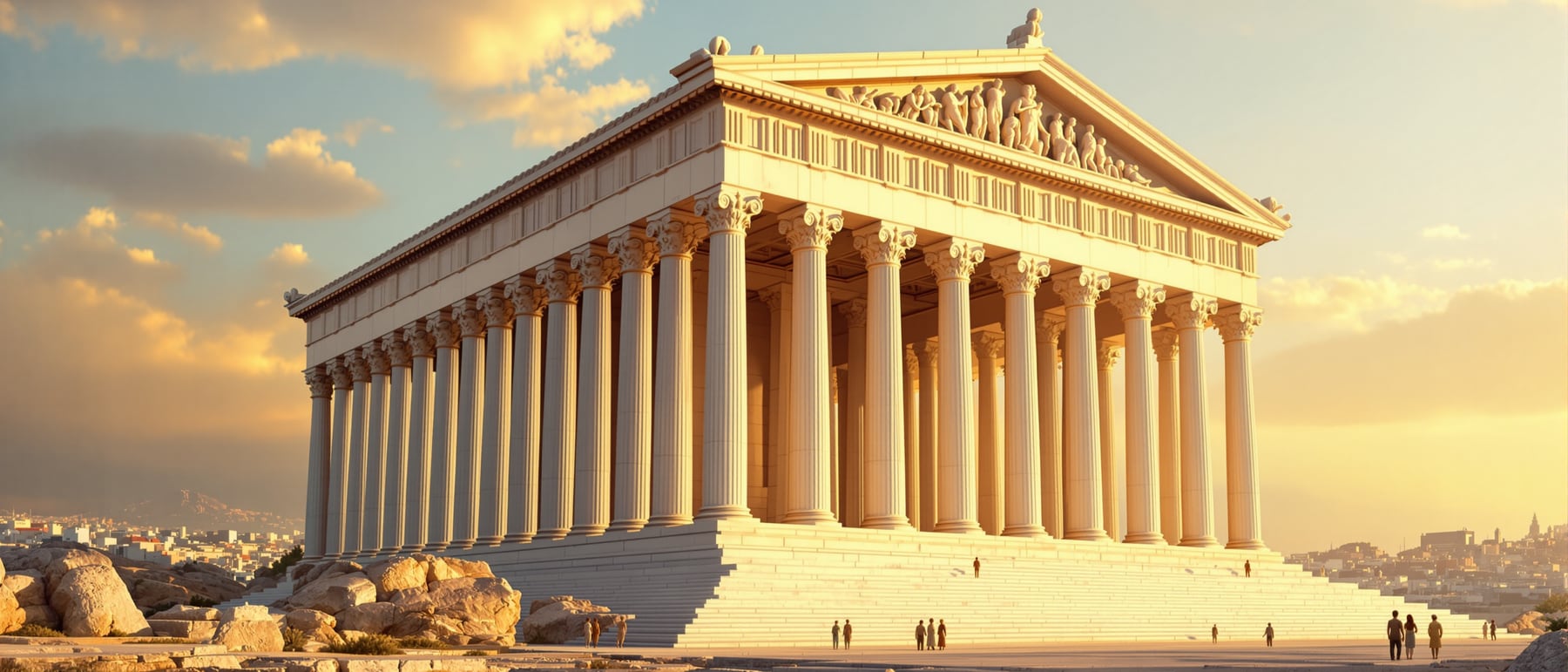
The Temple of Artemis at Ephesus: The Most Beautiful Wonder
How a marble forest of 127 columns at Ephesus became the most breathtaking of the Seven Wonders — the first Greek temple built wholly of marble, raised on a swamp by ingenious engineers — only to be burned down by a man who wanted his name to live forever, rebuilt grander, and finally lost to a single column in the reeds.
Of the six lost wonders, this is the one the ancients themselves loved best. When the poet Antipater of Sidon drew up his famous list, he wrote that he had seen the walls of Babylon, the pyramids, the Colossus, the tomb of Mausolus — "but when I saw the house of Artemis that mounted to the clouds, those other marvels lost their brilliancy." The Temple of Artemis at Ephesus — the Artemision — was, by common ancient agreement, the most beautiful building in the world.
It was a marble forest: more than a hundred columns, each as tall as a six-storey building, reputedly the first Greek temple ever built entirely of marble. And its story is the strangest of any wonder — a tale of a swamp turned into an ally, of a genius engineer's tricks, of a man who burned beauty itself just to be remembered, and of a slow fade to a single lonely column standing in the reeds. It stood where the modern town of Selçuk sits today, in western Turkey.
This is the thirty-third article in our Architectural Wonders series.
1. The most beautiful of the seven
Start with the reputation, because it is unanimous and it is old. Where the Pyramids overwhelmed by sheer mass, the Artemision overwhelmed by grace and scale together.
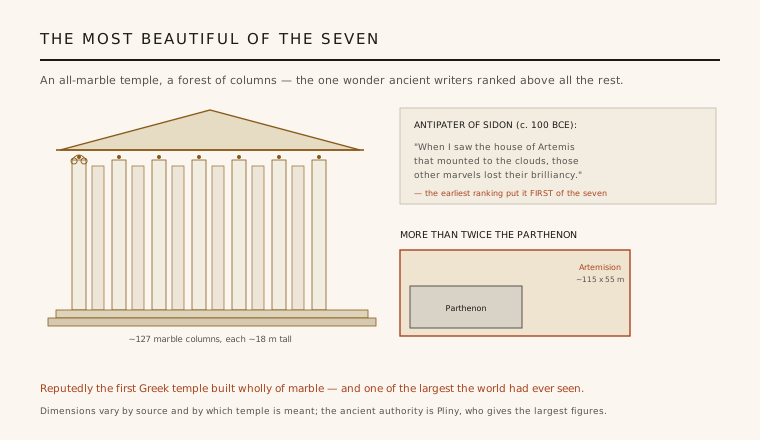
It was enormous — on the order of 115 metres long by 55 metres wide on its platform (the figures vary by source and by which of the successive temples is meant; the ancient authority, Pliny the Elder, gives even larger numbers). That is more than twice the footprint of the Parthenon at Athens. And it was reputedly the first Greek temple built wholly of marble — a claim of primacy passed down from Pliny, and a genuine leap: gleaming white stone where others still used limestone and timber. To an ancient traveller who had already seen the great temples of the Greek world, the Artemision was simply bigger, whiter, and more dazzling than anything else — a building that seemed, as Antipater said, to climb into the clouds.
2. A double ring of marble
Step closer and the source of that beauty becomes clear. The temple's genius was not one bold shape but a rhythm — a colonnade so deep it became a landscape.
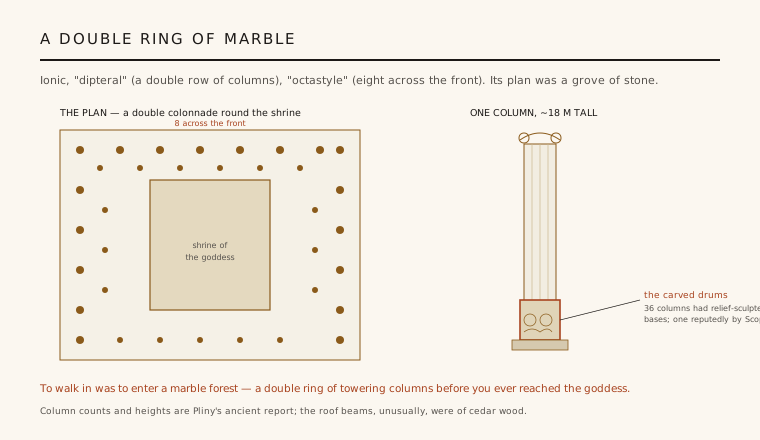
It was Ionic — the slender, scroll-capitalled order — and it was dipteral, meaning wrapped not in one row of columns but two, with eight across the front (octastyle). Pliny counted 127 columns, each about 18 metres tall. To approach the shrine you passed through row upon row of towering marble trunks, a built grove — light and shadow, column behind column, before you ever reached the goddess within. And thirty-six of those columns were extraordinary: their lowest drums were carved with relief sculpture (the columnae caelatae), one of them reputedly by the hand of the great fourth-century sculptor Scopas. Fragments of these carved drums survive today in the British Museum. Even the ceiling was special — beams of fragrant cedar rather than ordinary timber. It was less a building than an enchanted wood made permanent in stone.
3. Building on a swamp
Here is the part engineers love. The Artemision stood on soft, marshy ground — the last place you would choose to raise the heaviest columns in the Greek world. That choice, and the tricks it forced, became legendary.
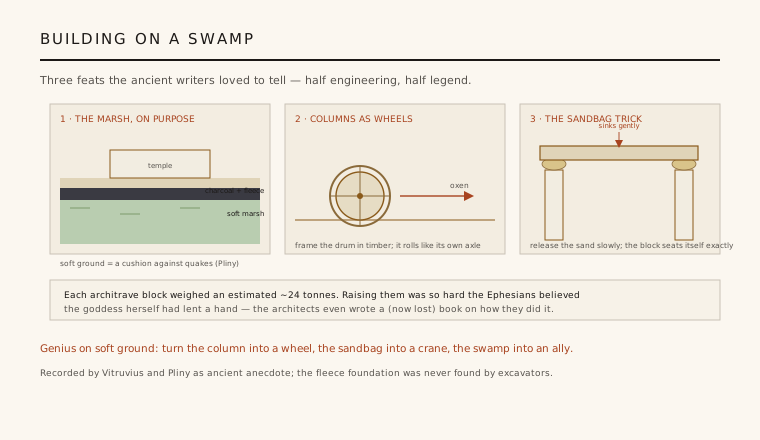
Pliny says the swamp was chosen on purpose — soft ground as a cushion against earthquakes in a shaky region — with foundations packed on charcoal and fleeces. (Excavators later found the charcoal layers; the fleeces they never found, so treat that detail as ancient testimony.) To move the colossal column drums across ground too soft for sledges, the architect Chersiphron and his son Metagenes are said to have framed each drum in a great wooden wheel-cage, so the drum became its own axle and could be rolled, drawn by teams of oxen. And to settle a massive lintel block exactly onto its capital, Chersiphron reportedly stacked bags of sand on top and let the block sink slowly and perfectly into place as the sand ran out — an ancient hydraulic crane made of nothing but sacks. Each architrave weighed an estimated 24 tonnes; raising them was so hard the Ephesians believed the goddess had lent a hand. It is the same lesson we met at Brihadeeswara: before the beauty, always, comes the unglamorous, brilliant problem of moving the impossible stone.
4. Burned for fame, rebuilt grander
Then, in 356 BCE, came the most notorious act of vandalism in history — and the temple's strangest twist.
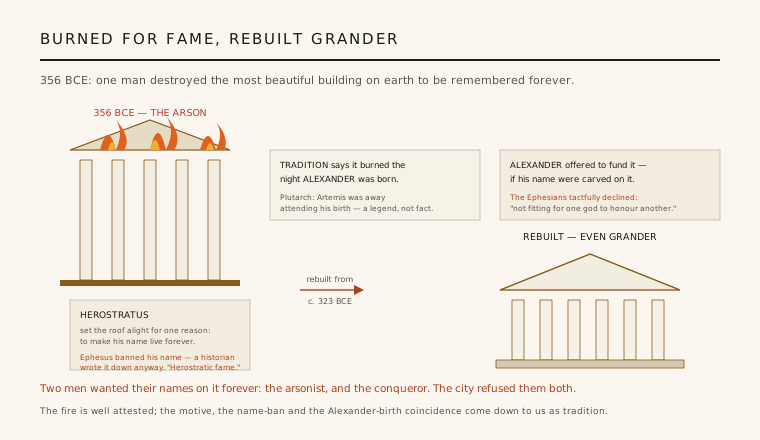
A man named Herostratus set the temple's roof-beams alight and burned the most beautiful building on earth to the ground — for no reason at all except to make his own name immortal. Ephesus was so appalled that it made speaking his name a capital offence — a damnatio memoriae meant to erase him from history. It failed: a historian recorded the name anyway, and to this day "Herostratic fame" means glory won by destruction. (Tradition adds a haunting coincidence — that the temple burned the very night Alexander the Great was born, the goddess supposedly away attending his birth. It is a lovely legend, and almost certainly just that.) The Ephesians rebuilt, on the same spot, even grander — and when Alexander himself later offered to pay for the completion if his name were carved on it, they refused him with exquisite tact: it was "not fitting for one god to make a dedication to another." Two men each wanted their name on this temple forever — the arsonist and the conqueror — and the city denied them both. Only the goddess's name would stand.
5. The Lady of Ephesus, and the long end
The temple was never only a temple. It was the home of a strange and ancient goddess, and the beating heart of the city's life — which is exactly why its end was so total.
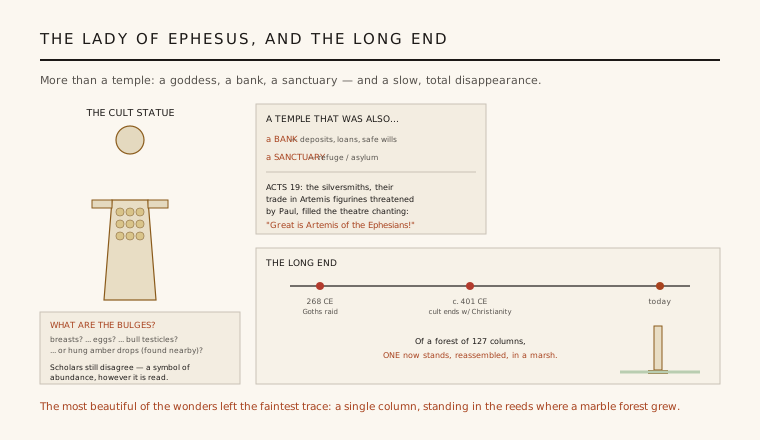
Inside stood the "Lady of Ephesus" — not the huntress of Greek myth but a stiff, ancient, pillar-like figure whose chest was covered in rows of bulbous ornaments. Whether these were breasts, eggs, bull-offerings, or hung amber drops (some were found near where the statue stood) scholars still argue; whatever they were, they signalled abundance and nourishment. The temple was also a bank — safe enough to hold deposits, loans and wills — and a place of sanctuary where even fugitives could claim refuge. Its wealth ran so deep into the city's economy that when the Apostle Paul preached at Ephesus, it was the silversmiths — whose trade in little Artemis figurines was threatened — who rioted, filling the great theatre with the chant recorded in Acts 19: "Great is Artemis of the Ephesians!" That chant marks the turning tide. The temple was raided by the Goths in 268 CE, and as Ephesus became Christian its cult withered and was gone by around 401 CE; its marble was carried off for other buildings. Today, of a forest of 127 columns, exactly one stands — reassembled from broken drums, alone in a marsh where the most beautiful building in the world once climbed into the clouds. As with the lost library we rebuilt in spirit at the Bibliotheca Alexandrina, the Artemision now lives mostly in words — and in the memory of everyone who ever wrote that nothing else was so grand.
6. What a modern architect can learn from the Artemision
- Rhythm can be more beautiful than form. The Artemision's magic was the deep double colonnade — a marble forest you moved through. Repetition, light and depth can move people as powerfully as any single bold shape.
- Solve the ground first. The whole wonder rested on a swamp, and its fame began with charcoal foundations, rolling column-wheels and a sandbag crane. The unseen engineering of a difficult site is where great buildings are truly won.
- Turn a constraint into a strategy. They chose the marsh on purpose, as earthquake insurance. A weakness, understood deeply enough, can be converted into a defence. Read the site's problems as latent tools.
- Beauty is fragile; protect it from vanity. One man's hunger for a name destroyed the finest building on earth. Ambition unmoored from care is a wrecking force — and a culture is judged by whether it builds, or only wants to be remembered for building.
- A great building is also an institution. The Artemision was temple, bank, sanctuary and civic anchor at once. The most enduring architecture does many jobs for its community; it is woven into how people actually live.
- Even the most admired thing can vanish — so record it well. The most praised wonder left the faintest trace. What survives of it is testimony. Document what you make; the written memory may outlast the stone.
References & further reading
1. World History Encyclopedia — Temple of Artemis at Ephesus. https://www.worldhistory.org/Temple_of_Artemis_at_Ephesus/
2. Encyclopaedia Britannica — Temple of Artemis, Ephesus. https://www.britannica.com/topic/Temple-of-Artemis-temple-Ephesus-Turkey
3. The British Museum — Sculpted column drum from the Temple of Artemis at Ephesos. https://www.britishmuseum.org/collection/object/G_1872-0803-10
4. Pliny the Elder — Natural History, Book 36 (dimensions, 127 columns, the marble, the engineering) via Encyclopaedia Romana. https://penelope.uchicago.edu/encyclopaedia_romana/greece/paganism/artemis.html
5. Antipater of Sidon — Greek Anthology 9.58 (the wonder-ranking epigram). https://www.attalus.org/poetry/antipater1.html
6. UNESCO World Heritage Centre — Ephesus (inscribed 2015). https://whc.unesco.org/en/list/1018/
Last verified 2026-07-04. The Artemision survives only as foundations, scattered fragments and one re-erected column, so most detail rests on ancient literary sources — above all Pliny the Elder — written centuries after the archaic temple and often conflating its successive phases (an early archaic shrine; the great "Croesus" temple begun c. 560 BCE and funded partly by King Croesus of Lydia; and the Hellenistic rebuild from c. 323 BCE). Dimensions and the "127 columns ~18 m / first all-marble temple / 120 years to build" figures are Pliny's ancient report and vary by source and phase; they are given as widely cited approximations. Architect attribution (Chersiphron, Metagenes, Theodorus, Paeonius) is genuinely disputed among ancient sources. The engineering anecdotes (marsh/charcoal-and-fleece foundation, rolling column-wheels, the sandbag lintel) come from Vitruvius and Pliny as recorded tradition; the fleece foundation was not found by excavators. Herostratus's 356 BCE fire is well attested, but his motive, the name-ban and the Alexander-birth coincidence are tradition (Plutarch, Theopompus via later writers). The cult statue's "many breasts" reading is contested (breasts / eggs / bull-testes / amber ornaments). The Goths' 268 CE raid, Christian-era closure (~401 CE) and reuse of stone (including a much-repeated but poorly documented tradition of columns reused in Hagia Sophia) follow the late-antique record; Ephesus is a UNESCO World Heritage Site (2015).
Export this guide
Related Guides — Deep-dive reading
The Palace of Sennacherib at Nineveh: The Palace Without Rival
Twenty-seven centuries ago, on the Tigris opposite modern Mosul, an Assyrian king built a palace so vast he named it, in his own words, 'the Palace that has no rival' — and lined its walls, room after room, with miles of carved stone panels telling the story of his wars. It is the birthplace of narrative art, the home of the winged guardian, and a wonder destroyed not once but twice. The second article in our chapter on the palaces of worldly power.
Architectural WondersĠgantija: The Oldest Temple Standing, Built by 'Giants'
How a Neolithic island people on Malta — with no metal and no wheel — raised the oldest free-standing stone temples on Earth a thousand years before Stonehenge or the pyramids, moving fifty-tonne blocks on stone balls into clover-leaf sanctuaries for a faith we can trace but cannot read, then vanished, leaving stones so vast that later islanders swore only giants could have built them.
Architectural WondersThe Pyramid of the Sun: A Mountain Raised Over a Cave by a People With No Name
In the Valley of Mexico, a civilisation we cannot name built one of the largest pyramids on Earth — a man-made mountain of a million cubic metres — and set it precisely over a sacred cave they believed was the womb of the world. They left no writing we can read; even the words 'Pyramid of the Sun' were given, a thousand years later, by the Aztecs, who found the city in ruins and called it the birthplace of the gods.
Architectural WondersRelated Tools — Try Free
False Ceiling Cost Estimator
Live ₹/sqft across 8 ceiling types — POP, gypsum, designer, metal, PVC, wooden — with cove and spot lighting for 20 Indian cities.
Cost CalculatorBefore & After Studio
Generate AI before-and-after renders to preview how your redesign could look.
DesignAICircadian Light Meter
Patient-centric circadian lighting visualizer for Indian healthcare design — time-of-day × intensity → CCT, melanopic lux (EML / mEDI), melatonin suppression, and an alertness curve. Calibrated against WELL v2 L03 Circadian Lighting Design, CIE S 026:2018, Brainard 2001, and Lucas et al. 2014.
Circadian Tool