
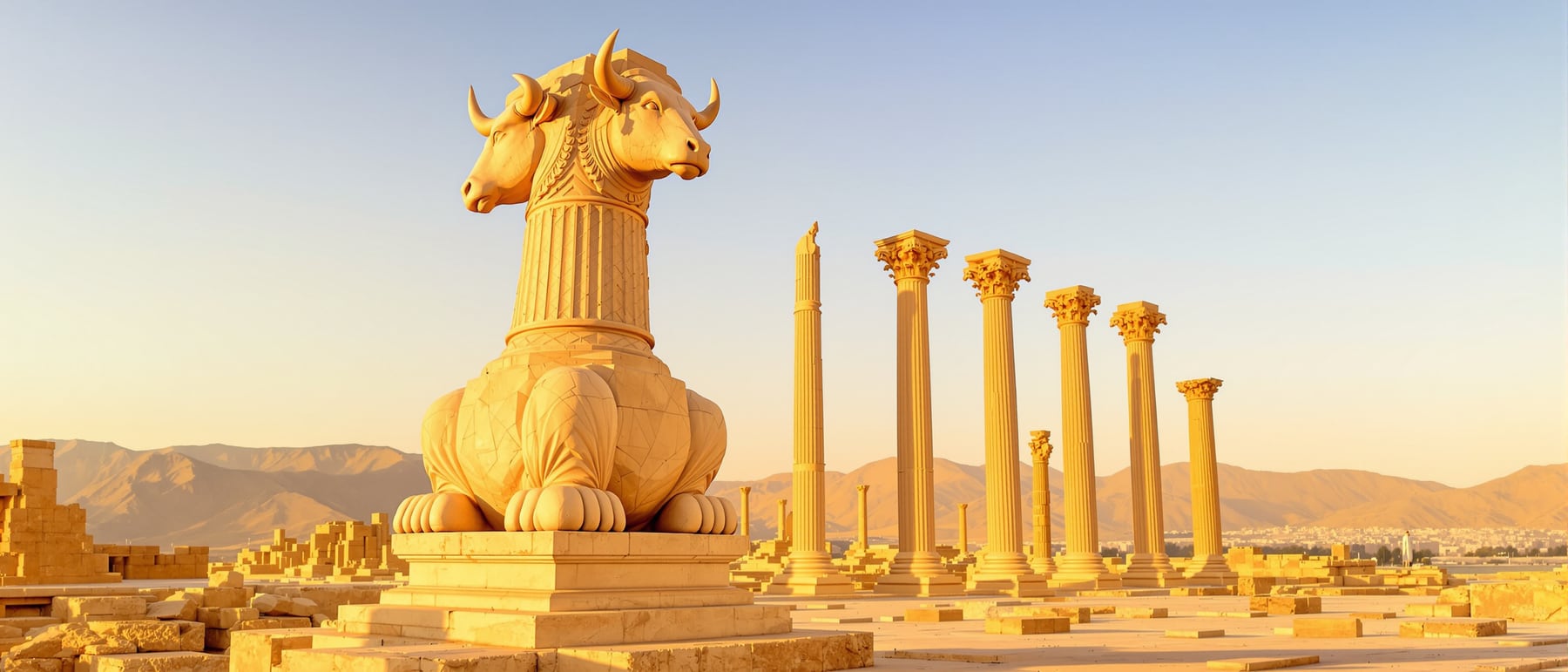
Persepolis: The Palace Where Every Nation Came Bearing Gifts
On a vast stone terrace in southern Iran, the kings of Persia built the grandest ceremonial capital of the ancient world — a forest of impossibly tall columns whose walls, unlike those of any conqueror before them, carved not war and captives but a peaceful procession of twenty-three nations bringing gifts. It is the gentlest image of empire the ancient world produced — until Alexander burned it to the ground. The third article in our chapter on the palaces of worldly power.
In our last two articles we climbed onto the terraces of two very different palaces — the maze of Minoan Knossos, and the war-carved halls of Assyrian Nineveh, where the king lined his walls with the burning of every city he had crushed. Now we come to the palace that answered Nineveh — that took the very same tools (the raised terrace, the guardian bulls, the carved processional wall) and used them to say the opposite thing. This is Persepolis, the ceremonial capital of the Persian empire, and it holds the ancient world's single most surprising image of power: not a wall of conquest, but a wall of nations arriving in peace, bearing gifts.
This is the sixty-sixth article in our Architectural Wonders series, and the third in our chapter on the great palaces and pleasures of worldly power.
Persepolis rises on a great stone terrace in Fars province, in southern Iran, near modern Shiraz — the heartland of the Achaemenid dynasty that ruled the largest empire the world had yet seen, stretching from the edge of India to the shores of the Aegean. The Persians called it Parsa; the Greeks, who both feared and admired the Persians, called it Persepolis — "the city of the Persians." It was begun by Darius the Great around 518 BCE, and it is one of the most beautiful ruins on Earth. But its deepest lesson is not in its stones. It is in the story those stones chose to tell.
1. The terrace of the King of Kings
Everything at Persepolis begins with the platform — a single, staggering act of levelling and building.
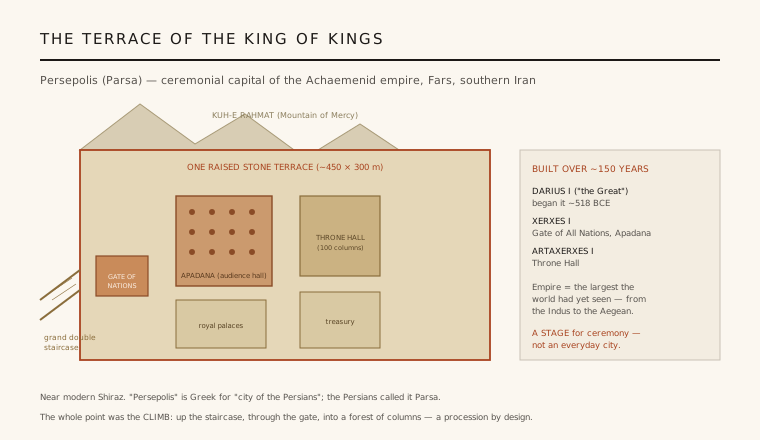
The Persians raised the whole complex on one enormous artificial terrace — roughly 450 by 300 metres, part-cut from and part-built against the base of a mountain they called Kuh-e Rahmat, the "Mountain of Mercy." Onto this vast stone stage, three generations of kings — Darius I ("the Great"), his son Xerxes I, and his grandson Artaxerxes I — built over roughly 150 years: a monumental double staircase rising to a great gate; the huge audience hall called the Apadana; a hundred-columned Throne Hall; royal palaces; and a treasury that would one day hold the accumulated wealth of an empire. And here is the first surprising thing about Persepolis: it was almost certainly not an ordinary city. No one lived their daily lives here in great numbers. It seems to have been a ceremonial capital — a stage built for spectacle, above all (as we will see) for a great annual gathering of the empire's peoples. The Persians governed from Susa, Ecbatana and Babylon; Persepolis was where they performed being an empire. (Its exact purpose is still debated — but its whole design, a slow procession up and in, is built for ceremony.)
2. The gate and the forest of columns
To arrive at Persepolis was to be walked, deliberately, through a sequence designed to make you feel small — and then to lift your eyes.
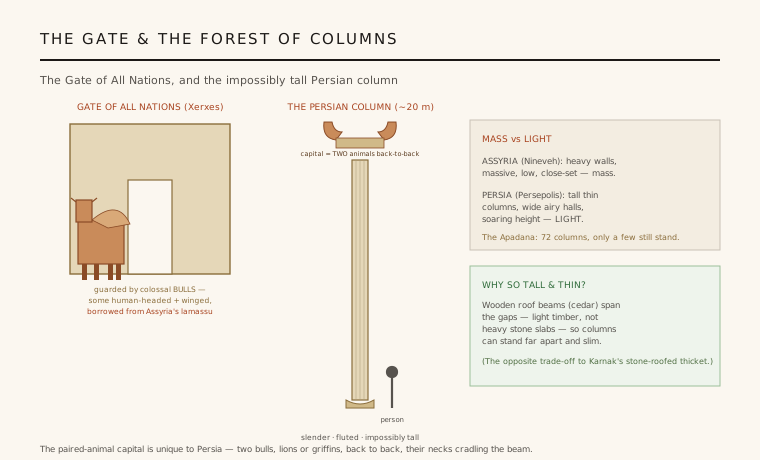
At the top of the stairs stood Xerxes's Gate of All Nations, and its doorways were guarded by colossal stone bulls — some of them human-headed, bearded and winged. If they look familiar, they should: they are the direct cousins of the lamassu we met guarding the gates of Sennacherib's palace at Nineveh. The Persians, who had conquered and absorbed the old Assyrian and Babylonian lands, deliberately took over the guardian-bull idea from their Mesopotamian predecessors — the first of many borrowings we will see. But pass through the gate, and the architecture changes utterly. Before you rose the Apadana, the great audience hall — once a forest of seventy-two columns, of which only a handful still stand. And the Persian column is like nothing else in the ancient world: impossibly tall and slender, around twenty metres high, delicately fluted, and crowned by an astonishing capital shaped as two animals set back to back — usually bulls, sometimes lions or griffins — the hollow between their paired necks cradling the wooden roof-beam. Where Assyrian architecture was heavy mass — thick walls, low dark rooms — Persian architecture was airy height and light, wide bright halls held up on the thinnest of stone stems. (The trick that let the columns be so slim and so far apart was a light cedar roof, not heavy stone slabs — the opposite trade-off to the stone-roofed thicket of Karnak.)
3. The procession of nations
Now we come to the walls — and to the reason Persepolis matters more than almost any building in this series.
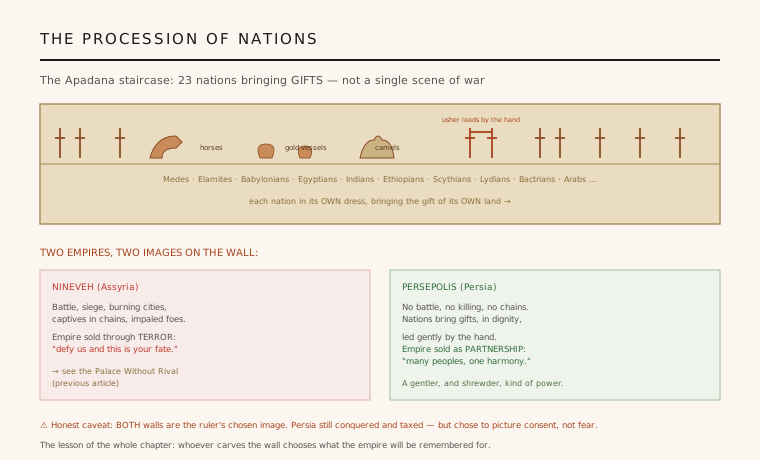
The staircase walls of the Apadana are carved with one of the most famous processions in all of art: a long, patient line of twenty-three delegations from the nations of the empire — Medes, Elamites, Babylonians, Egyptians, Indians, Ethiopians, Scythians, Lydians, Bactrians, Arabs and more — each coming before the King of Kings bearing gifts: fine horses and camels, gold vessels, precious cloth, tusks, exotic animals, the treasures of every land. And the astonishing thing is what these walls do not show. Recall the walls of Nineveh — the burning cities, the impaled prisoners, the files of captives in chains. At Persepolis there is none of it. No battle. No killing. No one in bonds. Instead every subject people is carved with real dignity, wearing its own national dress, often led gently by the hand by a Persian usher, as an honoured participant in a shared ceremony. Where Assyria advertised empire through terror — defy us and this is your fate — Persia advertised empire as partnership — many peoples, brought into one peace. It is the gentlest, most inclusive image of imperial power the ancient world ever carved.
We should be clear-eyed, though — and it is the same clear-eyed lesson this whole chapter keeps teaching. This, too, is the ruler's chosen image. The Persian empire was won by conquest and held by force and taxation like any other; the "gifts" were, in plain terms, tribute demanded from subject peoples. The difference is not that Persia was gentle where Assyria was cruel. The difference is what each chose to carve on the wall — what each wanted to be remembered as. Assyria chose fear; Persia chose harmony. And that choice — the decision about which story a building will tell about power — is itself one of the most consequential things a ruler, or an architect, ever makes.
4. An empire built by every nation
Look closely at how Persepolis is made, and the message of the reliefs turns out to be built into the very stones.
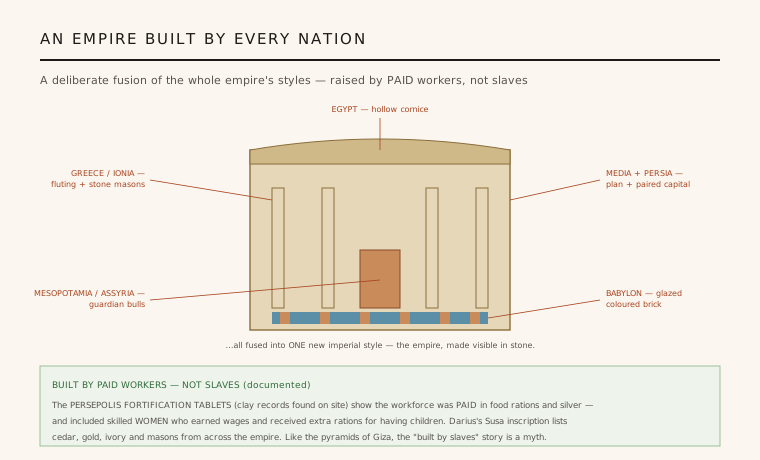
Persepolis is a deliberate mosaic of the whole empire's craft. Its slender fluted columns and much of its fine stone-carving came from Greek and Ionian masons; its deep hollow cornices are borrowed from Egypt; its guardian bulls and glazed, coloured brick come from Mesopotamia and Assyria; and the plan and the paired-animal capitals are Persian and Median — all fused into one dazzling new imperial style. This was not accident but policy. A famous foundation inscription of Darius from his palace at nearby Susa boasts, in effect, that the whole world built it: cedar from Lebanon, gold from Sardis and Bactria, ivory from Ethiopia and India, lapis from Sogdiana, and craftsmen who were Ionians, Lydians, Egyptians, Babylonians. The building doesn't just depict the empire of many nations — it is physically made of it.
And there is one more thing the stones — and the clay — tell us, which corrects a very old slander. It is often assumed that a monument this vast, raised by an ancient despot, must have been built by slaves driven under the lash. It was not. Thousands of clay administrative tablets found at the site — the Persepolis Fortification Archive — record the actual running of the works, and they show a workforce that was paid, in rations of food, wine and silver. More striking still, they record skilled women among the workers, earning wages in their own right and receiving extra rations when they bore children — a form of paid maternity provision, twenty-five centuries ago. As with the pyramids of Giza, the popular image of the slave-built wonder simply dissolves on contact with the evidence. Persepolis was raised by paid professionals from across the world.
5. The night it burned
Every wonder in the "lost" thread of this series has its moment of destruction. Persepolis has one of the most dramatic — and most ironic — of all.
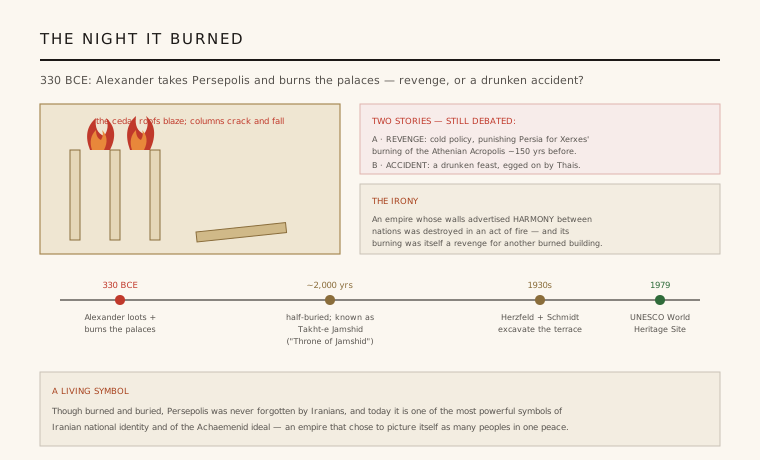
In 330 BCE, Alexander the Great of Macedon — having shattered the Persian army — captured Persepolis, seized its colossal treasury (ancient writers claim it took thousands of pack animals to carry the gold away), and then burned the great palaces to the ground. The cedar roofs blazed, the walls calcined, and the tall columns cracked and toppled where they stood. Why he did it has been argued over for twenty-three centuries, and our ancient sources give two rival stories. In one, it was cold policy and revenge — a deliberate, symbolic payback for the day, 150 years earlier, when Xerxes had marched into Greece and burned the temples of the Athenian Acropolis (the very hill on which the Parthenon would later rise). In the other, it was a drunken accident — a wild victory feast that got out of hand, with an Athenian courtesan named Thais laughingly urging the torch. Perhaps it was both. Either way, the irony is almost unbearable: the one empire that chose to carve harmony rather than conquest on its walls was itself annihilated by fire — and its burning was, on one telling, itself an act of revenge for another burned building. In this chapter of palaces, no one's stones are safe.
The ruins lay half-buried for over two thousand years. The Persians never forgot them — they called the place Takht-e Jamshid, the "Throne of Jamshid," after a legendary king — and it was only in the 1930s that archaeologists led by Ernst Herzfeld and Erich Schmidt properly excavated the great terrace, lifting the reliefs and the fallen columns back into the light. Persepolis was inscribed by UNESCO in 1979, and it remains today one of the most potent symbols of Iranian identity — a burned and broken stage on which, for a few generations, an empire told the world the gentlest story power has ever told about itself. (Persia itself would rise again: some nine centuries later the Sasanians, the second Persian empire, revived its glory and raised their own colossal throne-hall — the great brick Arch of Ctesiphon — as we will see later in this chapter.)
6. What a modern architect can learn from Persepolis
- Architecture chooses the story. Nineveh and Persepolis used the same tools — terrace, guardian, processional wall — to say opposite things. The tools are neutral; the message is a choice. Every building broadcasts a story about who made it and why; the honest, powerful move is to decide that story on purpose, not by default.
- Design the arrival. Persepolis is a masterclass in sequence — the long climb, the narrow gate, the sudden forest of columns. The experience is authored as a journey in time, not a single view. Ask not just what a space looks like, but what it feels like to move into it, step by step.
- Fusion can be a strength, not a compromise. The Persians deliberately braided Greek, Egyptian, Mesopotamian and Median craft into one new style — and it reads as confident and whole, not as a muddle. Borrowing well, and synthesising honestly, is not a lack of originality; it can be the highest originality of all.
- Structure sets the poetry. Those unforgettable slender columns exist because of an unglamorous engineering decision — a light timber roof instead of heavy stone. The most expressive quality of a building often traces straight back to a quiet structural choice. Know your structure and you unlock your form.
- Honour the maker. The Fortification tablets — paid workers, waged women, maternity rations — are as moving as any relief. A civilisation reveals itself in how it treats the hands that build for it. The dignity of the people who make a building is part of the building's true worth.
- Even ashes speak. Burned, buried, and half-forgotten for two millennia, Persepolis still carries its message to us intact. What endures is not always the roof or the gold, but the idea carved patiently enough that even ruins can still say it. Build meaning that can survive its own destruction.
References & further reading
1. UNESCO World Heritage Centre — Persepolis (inscribed 1979). https://whc.unesco.org/en/list/114/
2. World History Encyclopedia — Persepolis. https://www.worldhistory.org/persepolis/
3. Encyclopaedia Britannica — Persepolis. https://www.britannica.com/place/Persepolis
4. The Oriental Institute, University of Chicago — Persepolis and the Persepolis Fortification Archive (the excavations of Herzfeld and Schmidt; the administrative tablets). https://oi.uchicago.edu/research/projects/persepolis-fortification-archive
5. The British Museum — The Achaemenid Persian empire and the Apadana reliefs. https://www.britishmuseum.org/collection/galleries/ancient-iran
6. Metropolitan Museum of Art — The Achaemenid Persian Empire (550–330 B.C.). https://www.metmuseum.org/toah/hd/acha/hd_acha.htm
*Last verified 2026-07-05. Figures follow UNESCO, the World History Encyclopedia, Britannica, the Oriental Institute (University of Chicago) and standard Achaemenid scholarship, and are given as widely cited approximations that vary by source. Persepolis (Old Persian Parsa; modern Takht-e Jamshid) is in Fars province, southern Iran, near Shiraz; it was the ceremonial capital of the Achaemenid Persian empire, begun by Darius I c. 518 BCE and continued by Xerxes I and Artaxerxes I over roughly 150 years. It stands on a ~450 × 300 m raised terrace against Kuh-e Rahmat, and includes the Gate of All Nations (Xerxes; guarded by lamassu-type human-headed/winged bulls borrowed from Assyro-Babylonian tradition), the Apadana audience hall (originally 72 slender fluted columns ~20 m tall with distinctive addorsed double-animal capitals; a few survive), the hundred-column Throne Hall, palaces (Tachara, Hadish), and the treasury. The Apadana staircase reliefs show a peaceful procession of ~23 subject delegations bringing gifts/tribute — with no scenes of war, killing or captives, a deliberate contrast to Assyrian palace reliefs (both are the ruler's chosen image; Persian rule was still conquest/taxation). The architecture is a deliberate synthesis of Greek/Ionian, Egyptian, Mesopotamian/Assyrian, Median and Persian elements; Darius's Susa foundation inscription lists materials/craftsmen from across the empire. The Persepolis Fortification Archive (clay tablets) shows a PAID workforce (rations, silver), including women who earned wages and received extra rations for childbirth — i.e. NOT slave-built. Alexander the Great captured Persepolis in 330 BCE, looted the treasury and burned the palaces; ancient sources (Arrian; Diodorus, Plutarch, Curtius, incl. the Thais story) debate deliberate revenge (for Xerxes' 480 BCE burning of the Athenian Acropolis) versus drunken accident. Excavated by Ernst Herzfeld and Erich Schmidt (Oriental Institute) in the 1930s; UNESCO World Heritage Site 1979; a major symbol of Iranian national identity. This is the third article in the "palaces and pleasures of worldly power" chapter of the Architectural Wonders series.
Export this guide
Related Guides — Deep-dive reading
The Palace of Sennacherib at Nineveh: The Palace Without Rival
Twenty-seven centuries ago, on the Tigris opposite modern Mosul, an Assyrian king built a palace so vast he named it, in his own words, 'the Palace that has no rival' — and lined its walls, room after room, with miles of carved stone panels telling the story of his wars. It is the birthplace of narrative art, the home of the winged guardian, and a wonder destroyed not once but twice. The second article in our chapter on the palaces of worldly power.
Architectural WondersThe Arch of Ctesiphon: The Largest Brick Vault the World Has Ever Built
On the Tigris near Baghdad stands a single, staggering arch of bare brick — nearly 37 metres high and the widest unreinforced brick vault ever raised, built without a scrap of wooden scaffolding. It is the ghost throne-hall of the Sasanian Persian kings, the empire that revived the glory of Persepolis; its court was a legend of jewelled carpets and suspended crowns; and it outlived the empire that built it by fourteen centuries. The eighth article in our chapter on the palaces and pleasures of worldly power.
Architectural WondersChan Chan: The Vast City of Mud Where Every King Built His Own Palace
On the desert coast of Peru sprawl the ruins of the largest city ever built of mud — a thousand-year-old capital of adobe walls three storeys high, carved with fish and seabirds, that survived only because it almost never rains. It was a city of ten royal palaces, one for each king, driven by a strange rule of inheritance; and today, an earthen city in a warming world, it is racing the rain to survive. The ninth article in our chapter on the palaces and pleasures of worldly power.
Architectural WondersRelated Tools — Try Free
Design Style Finder Quiz
Answer 10 visual questions to discover your Indian interior style profile with materials and colours.
Interactive QuizBefore & After Studio
Generate AI before-and-after renders to preview how your redesign could look.
DesignAIConcept Generator
Get 3 AI-generated design concepts for any room with style, materials, and cost estimate.
DesignAI