
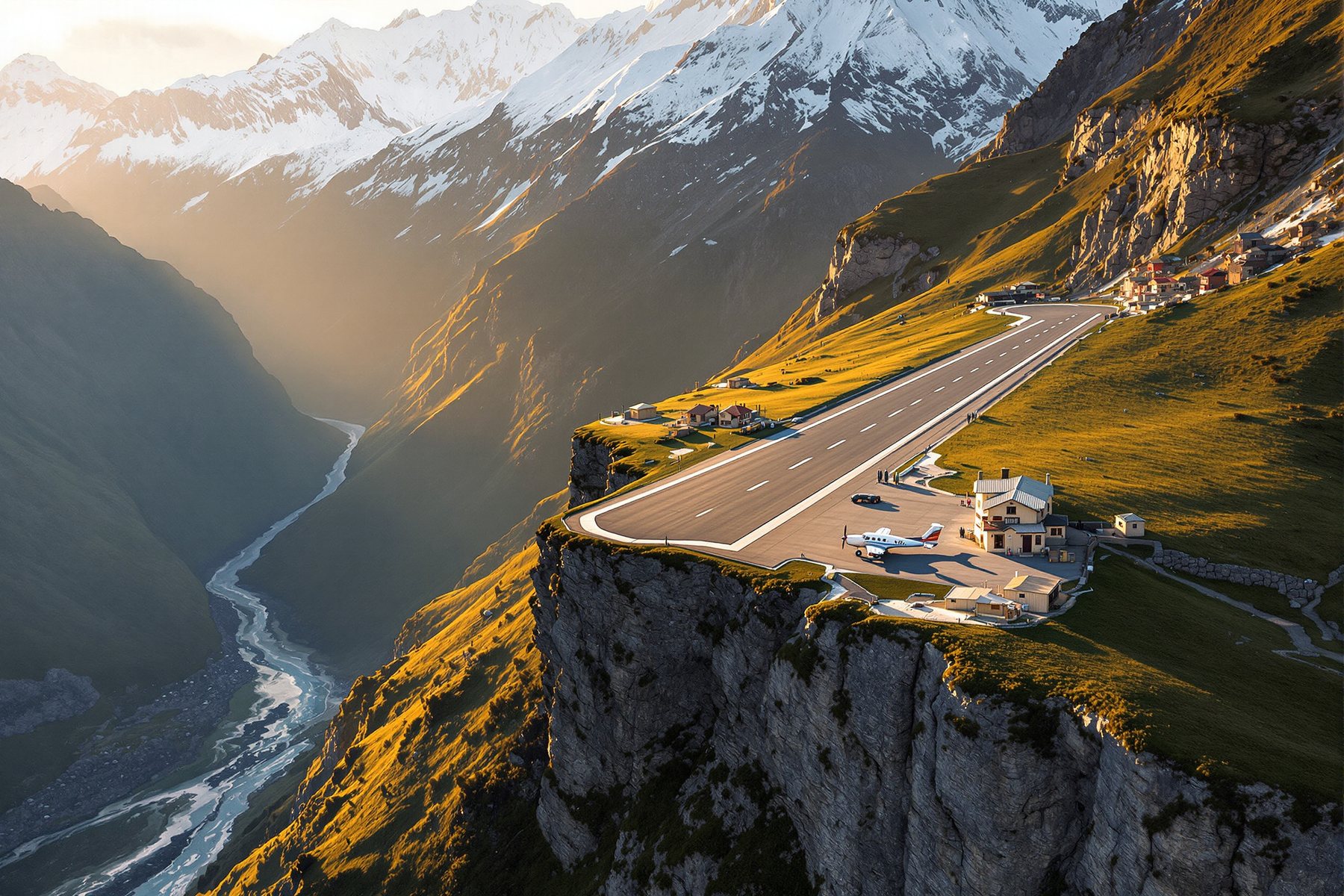
Lukla: The Runway That Turned a Mountain into a Solution
How a 527-metre strip of asphalt, pinned to a Himalayan ledge between a rock wall and a 600-metre cliff, became the gateway to Everest — and why its terrifying slope, which should make it impossible, is the very thing that makes it work. The boldest lesson in this series: design with the terrain.
After eighteen temples, tombs, forts and palaces, this article ends the journey with something completely different — and, in its way, the boldest wonder of them all. It is not built for a god, an emperor, or the dead. It is a strip of asphalt on the side of a mountain in Nepal: the Tenzing-Hillary Airport at Lukla, the gateway through which almost everyone who walks to Everest Base Camp begins their journey. It is routinely called the most extreme airport in the world. And it is here, to close this collection, because it is the purest possible expression of the one lesson this whole series keeps teaching: do not fight the land — design with it.
Every wonder before this added something beautiful to the world. Lukla adds almost nothing, and takes almost nothing away. It simply accepts an impossible mountain, and answers it with a single, breathtaking idea.
This is the nineteenth article in our Architectural Wonders series.
1. A runway pinned between a wall and a void
Start with the raw, alarming facts. The runway at Lukla is just 527 metres long — a fraction of an ordinary airport's — about 20 metres wide, and it sits at 2,845 metres of altitude in the thin Himalayan air. And it is not level. It slopes at roughly 12% — a gradient so steep that one end stands tens of metres higher than the other.
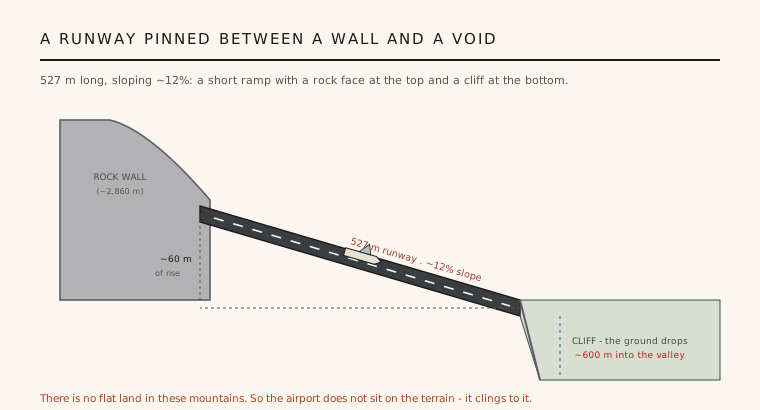
And here is the part that makes pilots' palms sweat: at the top of the slope, the runway runs straight into a solid rock mountain wall — there is no overrun, no room to stop beyond it. At the bottom, the ground simply falls away off a cliff, some 600 metres straight down into the valley. The strip is a short, steep ramp wedged between a wall you cannot hit and an edge you cannot cross. By every conventional standard of airport design, it should be unusable. It is, in fact, one of the most reliable lifelines in the Himalaya — because of an idea so simple and so clever it is almost a magic trick.
2. The flaw is the feature
Conventional thinking says a sloped runway is a dangerous defect. Lukla's genius is to realise that the slope, correctly used, is not the problem — it is the solution.
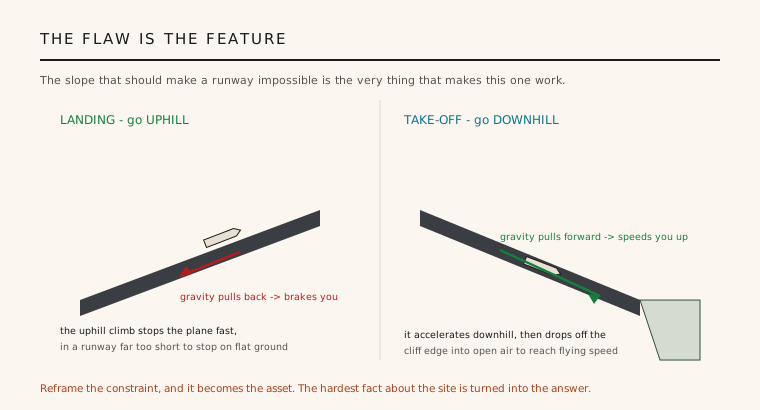
Aircraft land going uphill. Running up the slope, gravity pulls back on the plane, helping it brake and stop in a distance far too short to stop on level ground — the hill itself does much of the braking. And aircraft take off going downhill. Running down the slope, gravity pulls the plane forward, helping it accelerate to flying speed in that tiny length — and at the bottom it simply drops off the cliff edge into open air, falling slightly to gain the last of its speed. The single most terrifying fact about the site — the steep gradient — is turned into the very thing that lets a full-size aircraft use a runway a third of the normal length. Reframe the constraint, and it becomes the asset. There is no more elegant idea in this entire series.
3. A shelf cut into the Himalaya
Why build here at all, in such an impossible spot? Because in the high Khumbu, there is no other choice. There is no flat land. There are only mountainsides.
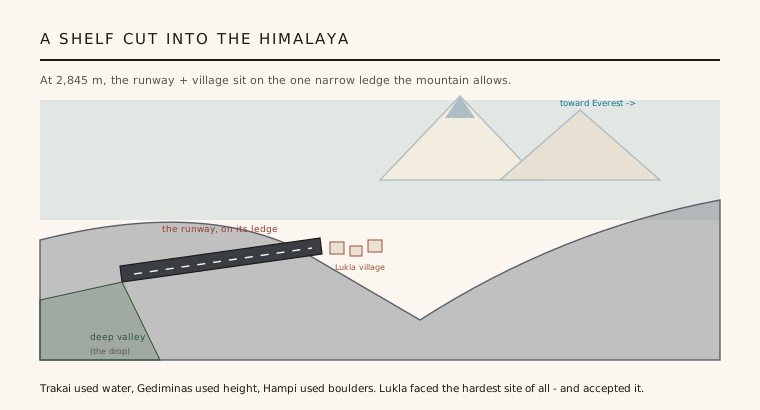
The airport occupies the one narrow ledge the mountain offers, with the village of Lukla beside it, the valley plunging away below, and the white peaks climbing toward Everest above. This is the lesson of the whole series, carried to its absolute limit. Trakai made a wall of water; Gediminas' Tower made a wall of height; Hampi made ramparts of boulders; Pashupatinath settled into its valley. Lukla faces the hardest site any of them met — and does the wisest thing of all: it stops trying to find flat ground, and works with the slope it has. When you cannot change the site, you change the design.
4. No go-around, no second chance
The discipline this demands is total, and it rhymes with a theme we met deep in the rock of India.
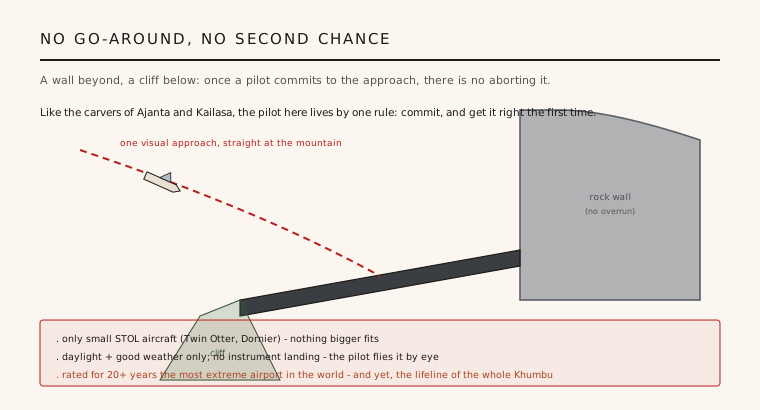
A pilot approaching Lukla flies a single visual approach, by eye, straight toward the mountainside — and once committed, there is effectively no go-around: the wall ahead and the cliff below leave no room to climb away and try again. Only small STOL (short take-off and landing) aircraft — the Twin Otter, the Dornier — can use it, and only in daylight and good weather. It asks of the pilot exactly what the rock asked of the carvers at Ajanta and Kailasa: get it right the first time, because there is no undoing it. Irreversibility, which ran through this series as a discipline of stone, lives here as a discipline of flight.
5. A gift, and a gateway
And finally, the human story — which is the warmest in the whole collection. Lukla was not commanded by a king. It was built as an act of gratitude.
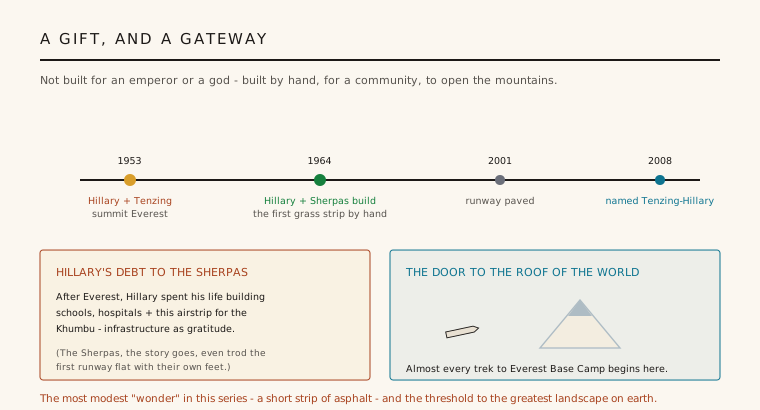
After Sir Edmund Hillary and Tenzing Norgay Sherpa became the first to summit Everest in 1953, Hillary spent much of the rest of his life repaying his debt to the Sherpa people — building schools, hospitals, and, in 1964, this airstrip, raised by hand with the labour of the local community (the Sherpas, it is said, even trod the first grass runway flat with their own feet). It was paved in 2001 and named the Tenzing-Hillary Airport in 2008, after the two men who first stood on the top of the world. Today it is the gateway through which almost every journey to Everest Base Camp begins. It is the most modest wonder in this series — a short strip of asphalt — and yet it is the threshold to the greatest landscape on earth, a humble piece of infrastructure that opens the door to the high Himalaya for the whole world. A fitting place to end a journey through the buildings that move us.
6. What a modern architect can learn from Lukla
- When you cannot change the site, change the design. This is the deepest lesson of the entire series, and Lukla states it most starkly. The land here cannot be altered, so everything — length, slope, direction of travel — bends to fit it. The greatest design intelligence is almost always a response to constraint, not an escape from it.
- Turn your biggest problem into your defining feature. The slope should be fatal; instead it is the solution. When a constraint seems impossible, ask whether it can be reframed as the very mechanism that makes the thing work. The flaw and the feature are often the same fact, seen differently.
- Fitness for purpose is its own beauty. Lukla has no ornament, no symmetry, nothing spare — and it is breathtaking, precisely because every metre is earned and everything fits. After the Taj's perfection, here is a different perfection: the austere elegance of a thing that does exactly, and only, what it must.
- Infrastructure is architecture too. A runway, a bridge, a well, an airstrip — the humble, vital structures shape human lives as profoundly as any monument. Never think the unglamorous, useful building is beneath your best thinking.
- The best reason to build is for people. Lukla exists because one man wanted to repay a community and open their mountains to the world. Of all the motives in this series — power, faith, grief, glory — service may be the finest, and the buildings born of it the most quietly enduring.
References & further reading
1. Encyclopaedia Britannica — Lukla and the Khumbu region. https://www.britannica.com/place/Nepal
2. Himalayan Trust — Sir Edmund Hillary's work in the Khumbu. https://www.himalayantrust.org/
3. Civil Aviation Authority of Nepal — Tenzing-Hillary Airport, Lukla. https://caanepal.gov.np/
4. UNESCO World Heritage Centre — Sagarmatha (Everest) National Park. https://whc.unesco.org/en/list/120/
Last verified 2026-06-30. Runway dimensions, gradient, elevation and dates follow standard aviation and reference sources and are given as widely accepted approximations; the uphill-landing and downhill-takeoff operation, the 1964 construction under Edmund Hillary with the Sherpa community, the 2001 paving and the 2008 renaming follow the established record.
Export this guide
Related Guides — Deep-dive reading
Kailasa at Ellora: A Mountain Carved into a Temple
How 8th-century carvers made the largest monolith on earth — a complete multi-storey Dravidian temple, gateway to spire, released top-down from a single basalt hill with no scaffolding and no chance to correct a mistake. The supreme act of subtraction, and the climax of India's rock-cut story.
Architectural WondersHadrian's Villa at Tivoli: The Emperor Who Rebuilt the World He Loved
The Roman emperor Hadrian had travelled almost the whole of his vast empire — and then, in the hills outside Rome, he built himself a private pleasure-world the size of a city, where he recreated the places he had loved on his journeys. It is a memory-palace of an entire empire, a laboratory of daring curved concrete a millennium and a half ahead of its time, and a monument quietly shaped by grief. The fifth article in our chapter on the palaces and pleasures of worldly power.
Architectural WondersBrihadeeswara: The Chola Tower That Never Fell
How an 11th-century Tamil emperor raised a 216-foot tower of solid granite — with no mortar, no iron and no machine — and why this colossal corbelled mountain has stood for over a thousand years where Konark's fell. The engineering, the 80-tonne capstone, and the lesson.
Architectural WondersRelated Tools — Try Free
Acoustic Privacy (STC) Visualizer
Indian healthcare acoustic visualizer — compare wall assemblies and noise sources, see received SPL after STC attenuation, and check FGI 2018 / IS 1950 / NABH speech-privacy compliance with live dual-canvas waveform.
Acoustic ToolBefore & After Studio
Generate AI before-and-after renders to preview how your redesign could look.
DesignAIBrise-Soleil Visualizer
Interactive horizontal-louvre cut-off angle calculator — sun altitude, louvre depth, and spacing inputs with a live shadow preview. Computes θ = arctan(spacing/depth) for façade shading, ECBC envelope compliance, hospital daylight design, and tropical sun-control detailing.
Sun Shading Tool