
Trakai: The Castle That Made a Wall of Water
How the Grand Dukes of Lithuania built a red-brick Gothic fortress on an island in a lake — using the water itself as its outermost wall — and how a 20th-century nation chose to rebuild it from ruin. The defensive idea, the Brick Gothic, and the reconstruction debate.
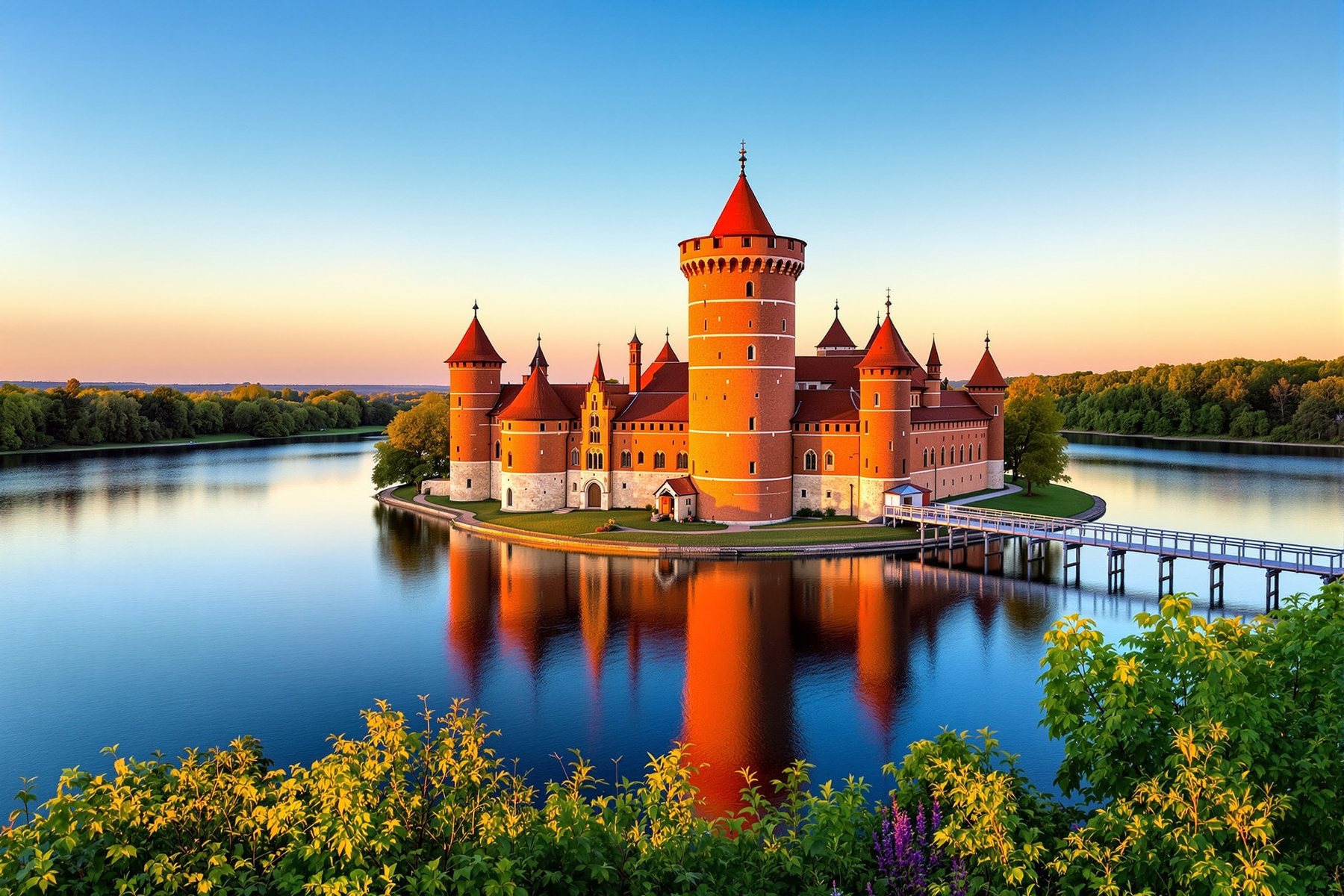
For eight articles this series has stayed in the warm stone of India and the desert. Now travel to the cold lakes of the north, to Lithuania, and to a building that solves the oldest problem in fortification — how to keep an enemy out — with one of the most elegant answers ever found. The Trakai Island Castle does not sit beside a lake. It sits _in_ one. The Grand Dukes of Lithuania built their fortress on an island, and in doing so turned an entire lake into its outermost wall.
It is a red-brick Gothic castle of the kind you draw as a child — towers, a keep, a drawbridge, water all around — and it is real, and it has a story that touches every theme this series has followed: defence shaped by site, building from the material a land actually has, and the long question of what to do with a ruin.
This is the ninth article in our Architectural Wonders series, and the second to leave India — a companion, across half a world and a thousand years, to Petra.
1. A castle on its own island
Trakai lies about 28 kilometres west of Vilnius, in a landscape so full of lakes that the old town sits on a neck of land almost surrounded by water. The island castle stands on its own small island in Lake Galvė, one of a scatter of wooded islands, reached today by a long wooden footbridge.
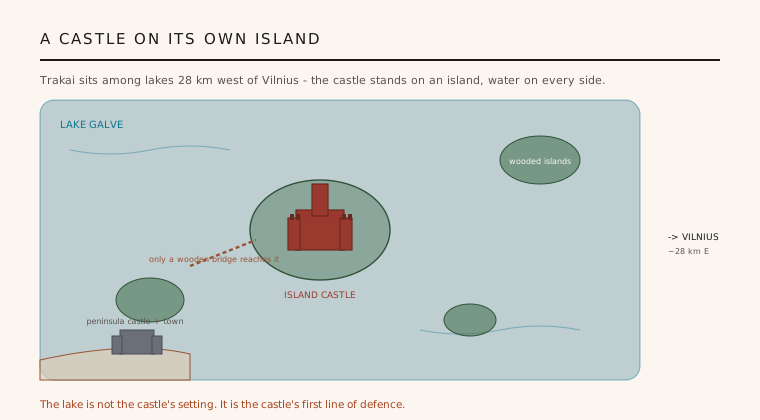
In the 14th century Trakai was one of the principal centres of the Grand Duchy of Lithuania — then one of the largest states in Europe — and the castle was a seat of its rulers. There was already an older castle on the nearby peninsula; the island castle was the bold next step, planted in the water itself, where the lake would do the defending.
2. Water as the first wall
This is the central idea, and it is worth admiring slowly. The genius of Trakai is that its most important defence costs nothing and can never be climbed: the lake.
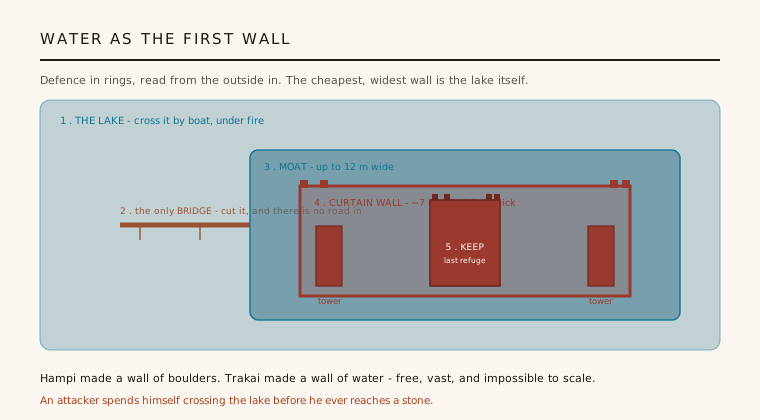
Think of an attacker arriving. First he faces the open water — to reach the castle at all he must cross the lake in boats, slow and exposed, under fire the whole way. If he takes the one wooden bridge, it can simply be cut, and there is no road in. Survive that, and there is still a broad moat (up to twelve metres wide) ringing the island's defences, then the curtain walls — about seven metres tall and three and a half metres thick — then the corner towers, and only then the keep. The lake is the outermost ring of a whole series of walls, and it is the cheapest and widest of them all.
Compare it with Hampi, which laced its boulder hills into ramparts, or Brihadeeswara, defended by its sheer mass. Trakai's insight is the same in spirit: let the site fight for you. Find what the land already offers — boulders, height, or here a lake — and make it do the heavy work before a single brick is laid.
3. Two castles in one
Cross the bridge and you find that Trakai is really two linked castles, with their own private stretch of water between them.
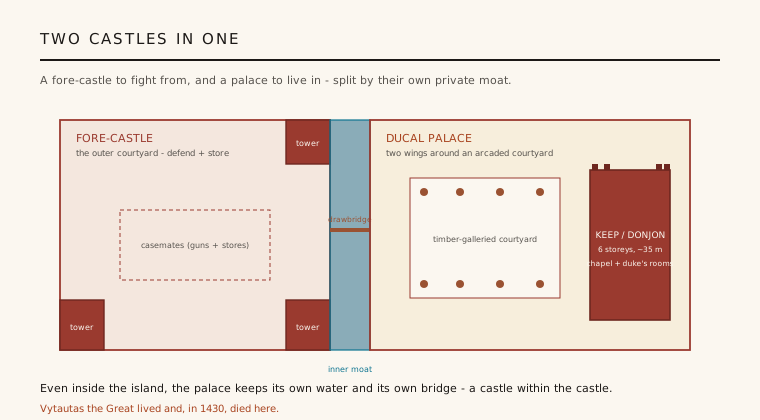
The outer part is the fore-castle — a defensible courtyard ringed by walls, with three great corner towers and casemates for guns and stores: the part you fight from. The inner part is the ducal palace — a two-winged residence wrapped around an arcaded courtyard with timber galleries, and on its south side a tall keep (donjon) of six storeys, roughly 35 metres high, holding the grand duke's own rooms and a chapel. Remarkably, the palace keeps its own moat and its own drawbridge, separating it from the fore-castle: a castle within the castle, a last redoubt inside the island. It was here, in this palace, that the greatest of the Lithuanian rulers, Vytautas the Great, lived — and here, in 1430, that he died.
4. Brick, where there is no stone
How Trakai is _built_ ties it straight back to a theme this series keeps finding. The northern plain of Lithuania is a flat land of clay, lake and forest, with little good building stone for a long way. So Trakai is built of what the land does offer: heavy boulders and fieldstone for the footings, and above them, walls of red fired-clay brick — the great northern tradition known as Brick Gothic, which gives the castles and churches of the whole Baltic their distinctive deep-red colour and pointed arches.
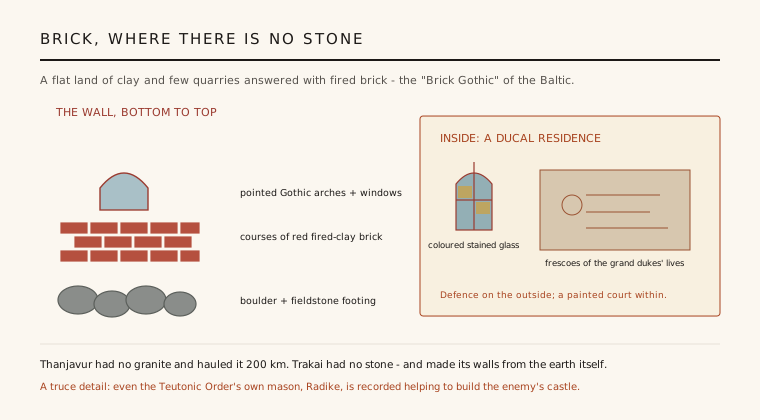
Set this beside Brihadeeswara, whose builders had no granite at Thanjavur and hauled it 200 kilometres across the plain. Trakai's builders had no stone either — and made the opposite, equally honest choice: instead of importing rock, they made their walls from the earth itself, firing the local clay into brick. Two lands, two answers, one principle: build with what you have.
And inside the grim defensive shell was a court. The ducal halls were lit by coloured stained glass and painted with frescoes of the lives of the Lithuanian grand dukes — a residence of real richness wrapped in a fortress. (One lovely human detail survives in the record: during a truce, even the Teutonic Order's _own_ stonemason, a man named Radike, is said to have helped build this castle of their enemy.)
5. Ruined — and then rebuilt
Here Trakai's story turns, and becomes the most interesting of any building in this series. Because Trakai did not stay a ruin.
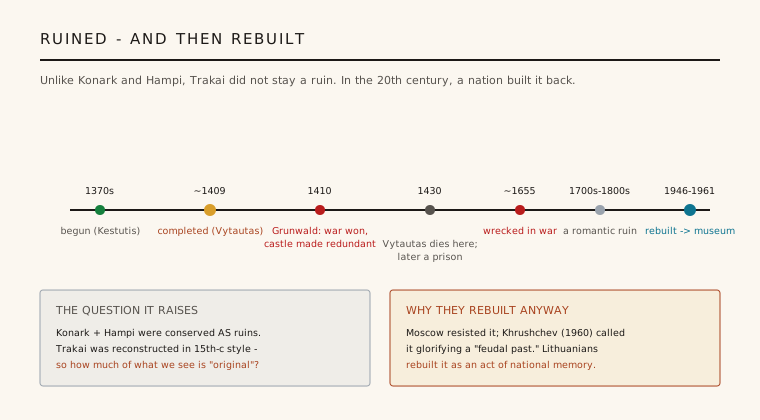
The castle was begun in the 1370s by Grand Duke Kęstutis and substantially completed around 1409 by his son Vytautas the Great. And then, with cruel irony, the very next year it was made obsolete by a victory. At the Battle of Grunwald (Žalgiris) in 1410, the Polish–Lithuanian alliance shattered the Teutonic Knights — the enemy the castle had been built to resist. With its great foe broken, Trakai's military purpose largely vanished almost as soon as it was finished. It served as a royal residence and later, more sadly, as a prison, and in the wars of the 1650s it was wrecked. For two centuries it stood as a romantic ruin in the lake.
Then, in the 20th century, Lithuanians chose to rebuild it — a major reconstruction running from 1946 to about 1961, restoring the castle to its 15th-century form. And this is where Trakai poses a genuine question, one every conservation architect still argues about. Konark and Hampi were preserved _as ruins_; we admire exactly what time left. Trakai was reconstructed — so how much of what you photograph today is medieval, and how much is a thoughtful 20th-century rebuild "in the style of" the original? There is no clean answer, and the honest thing is to hold both truths at once.
What makes Trakai's case unforgettable is _why_ they rebuilt it. Under Soviet rule the project met fierce resistance from Moscow; in 1960 Khrushchev himself attacked it as a glorification of Lithuania's "feudal past." The Lithuanians pressed on and rebuilt their castle anyway — not only as architecture, but as an act of national memory and quiet resistance, a way of holding on to who they were. The reconstruction is, in its own right, a piece of history.
6. What a modern architect can learn from Trakai
- Let the site fight for you. Trakai's masterstroke is defensive economy: the lake is a wall that needs no building and can never be scaled. The best design extracts the most from what the place already gives — water, slope, boulders, sun — before adding anything.
- Build with the earth you have. No stone in the clay plains of Lithuania? Then fire the clay into brick. Material honesty — using what is local and abundant rather than what is fashionable or far away — is both cheaper and truer, and it gives a place its own face. (It is the instinct our sustainability writing keeps pressing.)
- Wrap comfort inside necessity. Trakai is a hard fortress with a painted, stained-glass court inside. Architecture rarely has to choose between protection and delight; the great buildings deliver both, one within the other.
- Reconstruction is a real, hard choice — make it with eyes open. To rebuild a ruin is to make a claim about authenticity and memory. There is no automatically right answer between "conserve as ruin" and "build it back"; what matters is honesty about which one you have done, and why.
- Buildings carry identity. A nation rebuilt this castle against a superpower's objection because it _meant_ something. Architecture is never only shelter or defence; it is one of the deepest ways a people remembers itself.
In Amogh's frame
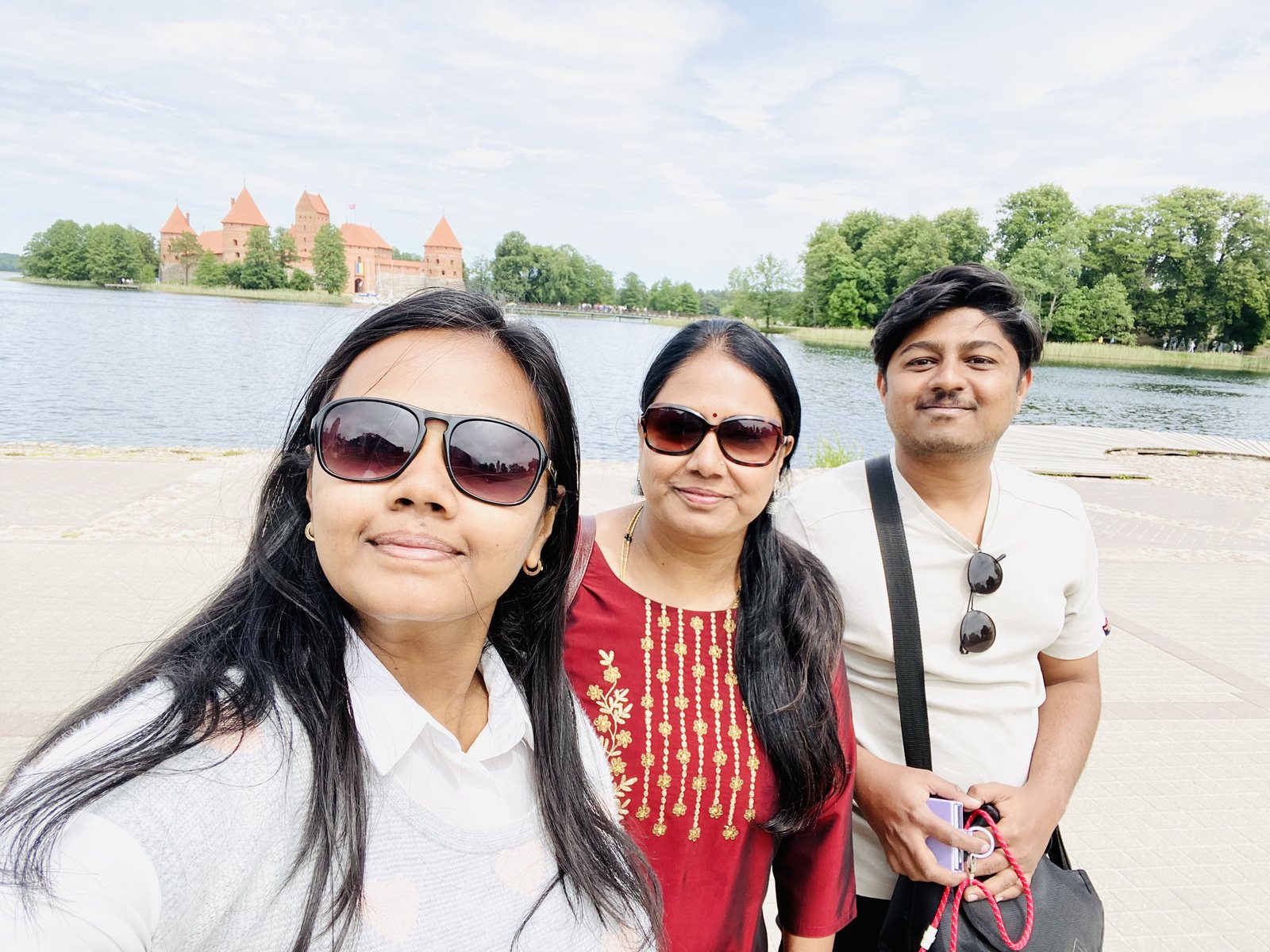
Like Petra, Trakai is a place Amogh saw with his own eyes. Here he is with his family on the shore of Lake Galvė, the red towers of the island castle rising across the water behind them — the very water-wall this whole article is about, seen not as a diagram but as a bright afternoon by a northern lake.
Studio Matrx is built in his memory. Some of these wonders he walked through himself; this is one of them.
References & further reading
1. Trakai History Museum — Trakai Island Castle. https://trakaimuziejus.lt/en/apie-mus/salos_pilis/
2. Encyclopaedia Britannica — Trakai and the Grand Duchy of Lithuania. https://www.britannica.com/place/Trakai
3. Official Trakai tourism — Trakai Island Castle. https://www.trakai-visit.lt/en/traku-salos-pilis/
4. Association of Castles and Museums around the Baltic Sea — Trakai Island and Peninsula Castles. https://www.visitcastles.eu/
Last verified 2026-06-30. Dates, dimensions and attributions follow standard historical and museum reference sources and are given as widely accepted approximations; the 1410 Battle of Grunwald, the 1946–1961 reconstruction and the Soviet-era objections to it follow the established historical record.
Export this guide
Related Guides — Deep-dive reading
Chan Chan: The Vast City of Mud Where Every King Built His Own Palace
On the desert coast of Peru sprawl the ruins of the largest city ever built of mud — a thousand-year-old capital of adobe walls three storeys high, carved with fish and seabirds, that survived only because it almost never rains. It was a city of ten royal palaces, one for each king, driven by a strange rule of inheritance; and today, an earthen city in a warming world, it is racing the rain to survive. The ninth article in our chapter on the palaces and pleasures of worldly power.
Architectural WondersVilnius Cathedral: The Building Rebuilt a Thousand Years
How one sacred spot in Lithuania carried a pagan altar, a medieval cathedral and finally a serene Neoclassical temple — a palimpsest whose whole history lies stacked in the crypt beneath your feet, and whose square became the heart of a nation's return.
Architectural WondersSomapura Mahavihara: The Buddhist University Hidden Inside a Hill
Twelve hundred years ago in Bengal, a Pala emperor built one of the largest monasteries the Buddhist world had ever seen — a walled quadrangle a fifth of a mile across, ringed by 177 monks' cells, with a great cross-shaped, terraced temple rising from its courtyard. For four centuries scholars came from as far as Tibet to study here; then it was abandoned, and slowly buried, until villagers knew it only as Paharpur — 'the hill-town.'
Architectural WondersRelated Tools — Try Free
Design Style Finder Quiz
Answer 10 visual questions to discover your Indian interior style profile with materials and colours.
Interactive QuizHome Building & Interior Cost Calculator — 20 Cities
Construction + interior costs for 20 Indian cities across kitchen, wardrobes, flooring, painting, ceiling.
Cost CalculatorHome Colour Studio
Colour every room — living, bedroom, dining, kitchen, bathroom — surface by surface in any HEX/RGB/CMYK colour, or from 80+ curated Indian shades.
Colour Studio