
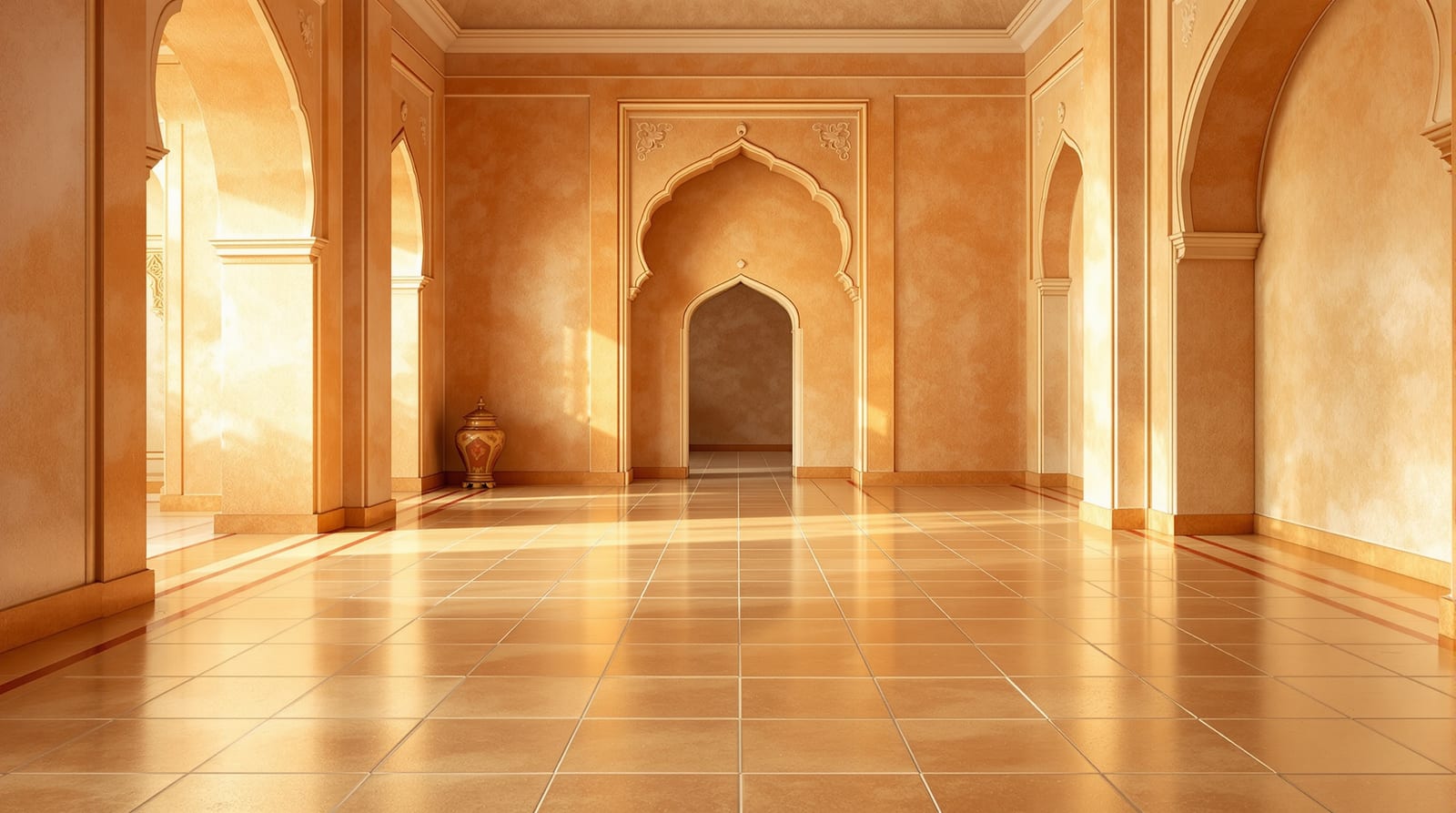
Lime Flooring in India: Araish, Lime-Concrete & Burnished Lime Floors — Cost, Process & Care
Lime flooring — slaked-lime plaster floors (araish), lime concrete and burnished lime topping — is the breathable, cool, low-carbon traditional finish behind India's havelis and palaces, now reviving in eco and heritage homes; here is what it is, how it is hand-applied and burnished, costs of ₹150–500 per sq ft, durability, care and where it suits.
Long before cement reached Indian sites, our havelis, palaces and temple floors were finished in lime — slaked lime mixed with marble dust, sand or brick aggregate, hand-applied in thin layers and burnished by hand for days until it glowed like polished stone. Known as araish in the north and by many regional names elsewhere, lime flooring is breathable, naturally cool underfoot, almost carbon-neutral and quietly beautiful in a way no factory tile can copy. At ₹150–500 per sq ft it is not the cheapest floor, because the cost is skilled craft and slow time rather than material — and that is exactly why it is reviving in eco homes and heritage restoration across India.
This guide explains what lime flooring really is, the traditional recipe and natural additives, how it is built up and burnished layer by layer, honest durability and care, where it suits, and how it compares with the cement floors that replaced it.
What lime flooring is
Lime flooring is a family of in-situ floor finishes whose binder is lime — not cement. Quarried limestone is burnt to make quicklime, then slaked with water into a putty or hydrated lime powder, which is mixed with an aggregate (fine sand, marble dust, surkhi or crushed brick, sometimes stone chips) and applied wet, by hand, over a prepared base. As it cures it slowly reabsorbs carbon dioxide from the air and turns back into a hard, stone-like calcium-carbonate surface. The floor is literally setting back into the rock it came from.
There are three broad types you will meet in India:
- Araish (lime-marble-dust plaster): the fine, polished palace finish — slaked lime and very fine marble dust burnished to a glassy, stone-smooth surface. This is the luxury heritage floor of Rajasthan and Mughal architecture, sometimes called Tadelakt in the Moroccan tradition and araish/araayish here.
- Lime concrete (lime terracing / IPS-style lime topping): lime mixed with brick aggregate (surkhi) and coarse sand laid as a thicker, structural-ish floor and roof terracing — robust, breathable and the historic alternative to a cement screed.
- Burnished lime topping / lime-plaster floor: a thinner pigmented lime finish over a stable base, burnished to a soft matte or low sheen — the version most eco homes choose today as a sealing, hand-troweled finish.
What unites all three is that the binder is breathable lime, the floor is built and finished by hand, and the colour and texture come from natural aggregates and pigments rather than a glaze.
The traditional recipe and natural additives
The classic lime floor is deceptively simple — lime, aggregate, water — but the craft tradition enriched it with natural additives that improved workability, water resistance, hardness and shine. These are still used by heritage artisans:
- Jaggery (gur): boiled into the lime mix or its curing water, jaggery acts as a natural plasticiser and retarder, improving workability and contributing to a harder, glossier final surface.
- Methi (fenugreek) water: soaked fenugreek yields a mucilage that binds the mix and aids burnishing.
- Urad dal (black gram) paste: another traditional binder/water-repellent additive used in fine araish and lime plasters.
- Kadukkai (terminalia / myrobalan), bel fruit, aloe (gwarpatha), eggwhite and curd: regional additives used variously as binders, water-proofers and surface hardeners in temple and palace work.
Some recipes also add fibres (jute, hemp, hair) in thicker coats to control cracking, and natural pigments — iron oxides for reds and ochres, lamp black for greys — for colour. None of these are gimmicks; they are centuries-old chemistry that gives a lime floor its durability and depth. A skilled karigar (artisan) tunes the mix to the climate and the base.
How a lime floor is made: layers, burnishing and slow curing
Lime flooring is slow, layered and almost entirely manual. The quality of the floor is in the patience, not the material. A typical fine lime floor is built up in stages over days.
The diagram below shows the cross-section build-up — a stable base, a coarse lime-concrete levelling coat, then progressively finer lime coats, finished with a burnished araish skin.
1. Base preparation. Over a sound, stable sub-floor (traditionally a brick-bat or rammed base, today often a structural slab), the surface is cleaned and dampened. Lime bonds to lime, so a lime-based scratch coat or key is laid.
2. Lime concrete levelling coat. A thicker coat of lime mixed with surkhi (crushed-brick pozzolan) or coarse sand and brick aggregate is laid and compacted to level the floor and give it body. This is the workhorse layer and, in lime terracing, can be the whole floor.
3. Fine lime coats. One or more finer coats of slaked lime and well-graded fine sand or marble dust are floated on, each allowed to firm up before the next. The mix gets finer towards the top.
4. Araish / burnishing skin. The final skin is a very fine paste of mature lime putty and marble dust (and the natural additives above), trowelled on thin. Then comes the signature step: the surface is burnished — rubbed and polished repeatedly with a smooth stone, trowel or even a coconut shell, often over several days, compacting the surface and drawing a glassy sheen. Soap or a thin wax/oil may be worked in at the end to seal it.
5. Slow curing. Lime does not set in a day like cement. It carbonates slowly over weeks as it reacts with air, so the floor must be kept damp, shaded and undisturbed during early curing and reaches full hardness over weeks to months. Rushing the cure is the commonest way to ruin a lime floor.
This is genuinely artisanal work. The same craft skill that makes lime flooring beautiful also makes it scarce and labour-heavy — which is the whole story of its cost.
Cost in India: why lime flooring costs what it does
At ₹150–500 per sq ft, lime flooring is mid-to-premium not because lime is expensive — lime is one of the cheapest binders there is — but because it is slow, multi-coat, hand-burnished craft requiring skilled artisans who are increasingly rare. The table gives indicative all-in ranges (material plus skilled labour; varies widely by city, artisan availability and the number of coats; add 18% GST).
| Lime floor type | Indicative ₹/sq ft | Finish & feel | Best use |
|---|---|---|---|
| Lime concrete / lime terracing | ₹150–250 | Matte, robust, breathable | Eco-home floors, terrace/roof terracing, base layers |
| Burnished pigmented lime topping | ₹200–350 | Soft matte to low sheen, coloured | Living/bedroom floors in eco & heritage homes |
| Fine araish (marble-dust, burnished) | ₹300–500+ | Glassy stone-smooth, luxury | Heritage restoration, feature floors, palaces/havelis |
| (Reference) IPS cement floor | ₹40–120 | Matte cement, faster | Modern minimalist, budget seamless |
| (Reference) Red-oxide cement floor | ₹60–150 | Glossy handcrafted red | South-Indian heritage look, faster than lime |
The upper end is for fine araish with multiple coats and days of burnishing by a master karigar; restoration work on a palace or haveli can exceed it. Lime is a craft purchase — you are paying for the artisan's time and skill, not the bag. Use the Studio Matrx flooring cost calculator and eco-flooring selector to position a lime quote against alternatives.
Why people choose lime: breathable, cool, eco, beautiful
- Breathable and healthy. Lime is vapour-permeable, so a lime floor lets moisture move through rather than trapping it — it helps regulate humidity, resists damp build-up and suits India's heat and monsoon better than sealed plastic floors. It is naturally low-VOC and mould-resistant (lime is mildly alkaline and antimicrobial).
- Naturally cool underfoot. Like stone and IPS, a lime floor stays cool in summer — a real comfort in hot Indian interiors and a reason it endured in desert Rajasthan and the southern plains alike.
- Genuinely low-carbon. Lime is burnt at a lower temperature than cement and reabsorbs CO2 as it cures, so its lifetime carbon footprint is far lower than cement-based floors — one of the few flooring choices that is meaningfully sustainable rather than merely marketed as such.
- Beautiful matte depth. A burnished lime floor has a soft, hand-made depth and a stone-like glow that improves with age and develops a gentle patina — never the flat sameness of a printed tile.
- Repairable and reversible. Lime can be patched and re-burnished with more lime; it is a natural, reversible material, important in heritage conservation where cement is actively discouraged.
Durability and care
A well-made, fully cured lime floor is surprisingly tough — many haveli and palace floors are well over a century old and still in use. But it behaves differently from cement and needs the right care:
- Keep it sealed and waxed. The surface is finished with soap, beeswax or a natural oil/wax. Re-waxing or re-soaping periodically (once or twice a year in living areas) maintains the sheen and water resistance. A neglected lime floor dusts and dulls.
- Wipe spills promptly. Lime is mildly alkaline and porous, so acidic spills (lemon, vinegar, strong cleaners, cola) can etch or stain it if left. Clean with plain water or a pH-neutral mild soap — never acidic or harsh chemical cleaners.
- Avoid standing water. Lime tolerates humidity and the odd wet wipe well because it breathes, but it is not for continuously wet zones — prolonged standing water will soften and erode it.
- Expect patina, not damage. Light scuffs, a softening sheen and a deepening colour are part of the material's character, not faults; they can be burnished or waxed back.
- Patch with lime, not cement. Repairs must be made in lime so the floor keeps breathing; a cement patch traps moisture and fails. This is a job for a heritage artisan.
Done right, lime flooring is a multi-decade — often multi-generation — floor. Done in a hurry by an unskilled hand, it crazes, dusts and disappoints, which is why artisan selection matters more here than for any tiled floor.
Where lime flooring suits in India
- Heritage restoration. Conservation of havelis, palaces, forts, temples and old bungalows demands lime, because cement is incompatible with old lime-and-stone fabric and traps damaging moisture. Here lime flooring is not a choice but a conservation requirement.
- Eco and natural homes. Mud-house, rammed-earth, cob and breathable-construction projects pair naturally with lime floors for a low-carbon, vapour-open, non-toxic interior.
- Feature floors and luxury interiors. A burnished araish floor in an entrance, a courtyard, a pooja room or a hero living space gives a hand-crafted, stone-smooth surface that reads as quiet luxury — increasingly specified in high-end Indian residences.
- Cool, dry interiors. Living rooms, bedrooms, verandahs and courtyards in hot-dry and warm-humid regions, where breathability and coolness are assets.
Where it does not suit: heavy-wet zones (open bathrooms, shower floors, kitchens with constant spillage), high-abrasion commercial traffic, and any project without access to a genuinely skilled lime artisan and the patience for a slow cure. For those, see the cement and resilient alternatives below.
Lime flooring vs IPS, red oxide and microcement
All four give a seamless, in-situ, hand-finished floor, but the binder and ethos differ. IPS and red-oxide floors are cement-based — faster, cheaper, harder-wearing in wet and high-traffic use, but not breathable and far higher in embodied carbon. Microcement is a thin polymer-modified cement coating — contemporary, waterproof and applicable over existing surfaces, but a synthetic, sealed finish. Lime flooring is the breathable, low-carbon, heritage-true option: the most sustainable and the most beautiful in a hand-made way, but the slowest, most artisan-dependent and least suited to constant wet. Choose lime when breathability, conservation correctness and craft matter; choose IPS, red oxide or microcement when speed, cost, waterproofing and modern convenience lead.
Cross-links and where this fits
This guide is part of the Studio Matrx flooring cluster. For the overview of alternative and traditional floors, start with the specialty flooring guide. For the cement cousins of lime, compare IPS flooring and red-oxide flooring. Because lime is one of the genuinely green options, see eco-friendly flooring, sustainable flooring materials and low-VOC flooring.
Frequently asked questions
What is araish flooring?
Araish (also spelled araayish) is the fine traditional Indian lime floor and wall finish — slaked lime mixed with very fine marble dust, applied in thin coats and hand-burnished with a stone over several days until it gains a glassy, stone-smooth sheen. It is the luxury heritage lime finish of Rajasthani havelis and Mughal architecture, related to Moroccan Tadelakt. It is breathable, cool and prized in restoration and high-end eco homes.
Is lime flooring waterproof?
No — lime flooring is breathable rather than waterproof, which is its strength in dry and humid living spaces but a limit in wet zones. It tolerates damp wiping and humidity well because it lets moisture move through it, but prolonged standing water will soften and erode it. Keep it waxed or soaped, wipe spills promptly, and avoid using it on shower floors or constantly wet areas.
How much does lime flooring cost in India?
Indicatively ₹150–500 per sq ft, varying by city, the number of coats and artisan availability. Lime concrete and basic burnished toppings sit at the lower end (₹150–350), while fine multi-coat araish with days of hand burnishing reaches ₹300–500+ per sq ft. The cost is skilled labour and slow time, not the lime itself; figures are indicative and vary by vendor (add 18% GST).
Why are jaggery, methi and urad added to lime floors?
These are traditional natural additives. Jaggery acts as a plasticiser and retarder that improves workability and gives a harder, glossier surface; fenugreek (methi) water and black-gram (urad) paste add mucilage binders that aid burnishing and water resistance. They are centuries-old craft chemistry, not gimmicks, and a skilled artisan tunes them to the climate and mix.
Is lime flooring eco-friendly?
Yes — it is one of the genuinely low-carbon flooring choices. Lime is burnt at a lower temperature than cement and reabsorbs carbon dioxide from the air as it cures, so its lifetime carbon footprint is much lower. It is also natural, low-VOC, breathable, mould-resistant and fully repairable and reversible, which is why it is favoured in eco homes and heritage conservation.
Export this guide
Related Guides — Deep-dive reading
Green Building Materials Guide (India): Low-Carbon, Healthy & Sustainable Choices (2026)
What actually makes a building material green - low embodied carbon and energy, recycled and renewable content, local sourcing, durability, recyclability, low VOC and water efficiency - mapped honestly across the whole Indian building, with the lifecycle nuance no label can give you.
Building MaterialsVenetian Plaster Walls: The Complete Guide for Indian Homes
The luxury lime-and-marble finish burnished to a stone-like glow — what Venetian plaster is, the matte-to-mirror look, how it's applied, where it belongs, and the cost, skill and care it demands.
Wall FinishesEpoxy Grout vs Cement Grout for Tiles in India: Which to Specify (2026)
A plain-English guide to tile grouts for Indian homes: what grout does, how cementitious grout compares with epoxy grout on cost, stain and water resistance, hygiene and durability, and exactly where each one belongs - kitchens, bathrooms, pools, dry rooms and more.
Building MaterialsRelated Tools — Try Free
Flooring Cost Calculator
Estimate the all-in cost of a floor — material, laying, wastage, skirting and GST — by area and material.
Flooring CalculatorHome Building & Interior Cost Calculator — 20 Cities
Construction + interior costs for 20 Indian cities across kitchen, wardrobes, flooring, painting, ceiling.
Cost CalculatorCross-Ventilation Analyzer
Estimate airflow and air changes per hour (ACH) from room size, window areas, layout, and local wind — with NBC 2016 Part 8 compliance check.
Ventilation Calculator