
Lightning Protection for Buildings: When You Need It & How It Works
How a lightning protection system intercepts a strike and carries millions of volts safely to earth — the air terminals, down conductors and earth termination, the risk assessment that decides whether a building needs one, and the IS/IEC 62305 standard that governs it in India.
A lightning strike carries a staggering amount of energy — tens of thousands of amperes, hundreds of millions of volts — and if it finds a building, it will take whatever path to ground it can, through the structure, the wiring, or the people inside. A lightning protection system (LPS) gives that strike a deliberate, safe path instead: it intercepts the lightning at the top, carries it down a dedicated conductor, and discharges it into the earth, protecting the structure and its occupants. This guide explains how an LPS works, and — the practical question — how you decide whether a building needs one.
It sits under the protection layers guide and complements surge protection, which handles the electrical side-effects a strike sends down the mains.
The safety line. Lightning protection is a specialist engineering design, done by a qualified professional to IS/IEC 62305, following a formal risk assessment. This guide helps you understand the system and the decision; it is not a design or installation guide. Whether and how a building needs protection is a professional determination, not a DIY one.
How a lightning protection system works
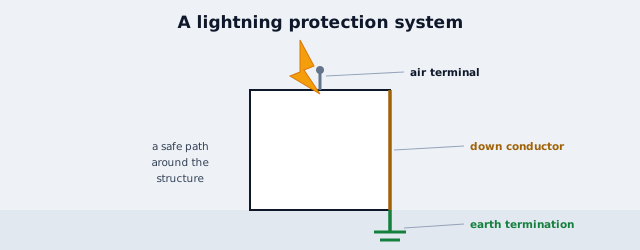
An LPS does not "attract" or "repel" lightning — it provides a preferred, low-resistance path so that if a strike occurs, its energy is safely conducted around the structure to earth rather than through it. It has three essential parts:
1. Air termination — the conductors at the top of the building (rods/finials, or a mesh/catenary system) designed to be the point the strike hits.
2. Down conductors — heavy conductors that carry the strike current from the air terminals down the outside of the structure to earth, by the shortest, straightest route.
3. Earth termination — a dedicated, low-resistance earthing system that discharges the enormous current safely into the ground.
Modern practice under IS/IEC 62305 also emphasises bonding and surge protection: a strike induces huge surges in the building's electrical and electronic systems, so a complete approach ties the LPS earthing to the electrical earthing and adds SPDs to protect the wiring and equipment. The strike protection and the surge protection are two halves of the same problem.
Who decides whether a building needs one — the risk assessment
Not every building needs a lightning protection system, and the decision is not made by guesswork or by how tall it "feels". IS/IEC 62305 Part 2 sets out a formal risk assessment that weighs:
- The frequency of lightning in the area (the local strike density).
- The building's height, size, location and isolation (a tall or isolated building on open ground is far more exposed than a low flat among taller neighbours).
- The construction and what is inside (occupancy, and critical or hazardous contents).
- The consequences of a strike — risk to life, to the structure, to services.
The assessment produces a risk figure that is compared against acceptable levels to decide whether protection is required and to what class/level of LPS. This is why the honest answer to "does my home need lightning protection?" is: it depends on a professional risk assessment for that specific building and location — not a rule of thumb.
When it typically matters — and when it usually doesn't
As a rough orientation (never a substitute for the assessment):
- Stronger case: tall or isolated buildings, structures on high or open ground, buildings in high-lightning regions, and buildings with critical or hazardous contents (and often a code or client requirement).
- Weaker case: an ordinary flat within a larger building — which relies on the building's own LPS, if the structure has one, rather than a flat-level system.
- For an individual house: it depends on height, exposure, local strike frequency and the risk assessment — worth asking a professional if you are on open/high ground or in a lightning-prone area.
What an owner should know
- Lightning protection is separate from the electrical protection inside the home, but its earthing is bonded with the electrical earthing to avoid dangerous voltage differences during a strike.
- It requires periodic inspection and testing — connections and earth resistance degrade over time, and an LPS that has corroded is not protecting anyone.
- It is complemented by surge protection (SPDs) for the electrical and electronic systems, because a strike's induced surges travel down the wiring.
- For an apartment, the relevant question is whether the building has a compliant, maintained LPS — a question for the builder or society.
The one-line answer
A lightning protection system gives a strike a deliberate, safe path — air terminals to intercept it, down conductors to carry it, and a dedicated earth termination to discharge it — protecting the structure and occupants, and it is paired with surge protection for the wiring and bonded to the electrical earthing. Whether a building needs one is decided by a formal risk assessment to IS/IEC 62305, weighing local lightning frequency, the building's height and exposure, and the consequences of a strike — a specialist engineering judgement, not a rule of thumb or a DIY job.
Where to go next
- The electrical side of a strike: Surge Protection & SPDs.
- The earth it discharges into: Home Earthing Guide.
- The whole safety picture: Layers of Electrical Protection.
- Bigger buildings: Building Electrical Services.
References
- IS/IEC 62305 : 2010 (Parts 1–4), Protection Against Lightning — Part 1 General Principles, Part 2 Risk Management, Part 3 Physical Damage, Part 4 Electrical & Electronic Systems, Bureau of Indian Standards.
- IS 3043 : 2018, Code of Practice for Earthing, BIS.
- National Building Code of India (fire and life safety context) — note SP 7 : 2016 is withdrawn, superseded by SP 7 : 2026; verify current provisions via the BIS catalogue.
- National Electrical Code of India, SP 30 : 2023, BIS: https://www.bis.gov.in/
Whether a building requires lightning protection, and its class, must be determined by a qualified professional through a formal risk assessment to IS/IEC 62305. Guidance here is orientation only. Verify any standard's status via the BIS catalogue before relying on it.
Export this guide
Related Guides — Deep-dive reading
Residential Electrical Systems: The Complete Guide for Indian Homes
How the electricity in an Indian home actually works — from the utility supply and meter through the distribution board, circuits, wiring, earthing and protection, to lighting, safety, energy efficiency, smart controls, solar and backup — written so a homeowner can understand, plan and judge it, and know exactly where a licensed electrician must take over.
Electrical & WiringElectrical Safety for Security Systems in India (2026): Powering It Without Peril
A homeowner's guide to the power side of home and RWA security systems, CCTV, alarms, gates, access control and NVRs, done so it protects you instead of quietly becoming a shock or fire hazard. What makes a supply safe, what to insist on, and why the mains work belongs to a licensed electrician.
SecurityFire Safety Audit in India (2026): The Independent Check That Proves You Are Actually Safe
A periodic, independent audit tests a building's whole fire provision against NBC Part 4 and the Fire NOC - and separates compliant-on-paper from safe-in-reality. This guide sets out what it covers, who does it, and why findings must be fixed, not filed.
SecurityRelated Tools — Try Free
Electrical Safety & Load Audit
Home electrical audit — 10 categories, 65+ checkpoints across earthing, RCCB, MCB, wiring, switchboards, appliance circuits, DG/inverter backup.
Safety AuditApartment Video Door System Planner
Enter flats, entrances, floors and guard desk for a first-pass building intercom plan — door stations, indoor monitors, guard station, the right architecture and an indicative cost band.
Building PlannerEarth Conductor Size Calculator
Find the minimum protective (earth) conductor size for a circuit from its phase conductor size, using the standard IS 732 / IEC 60364 rule.
Electrical