
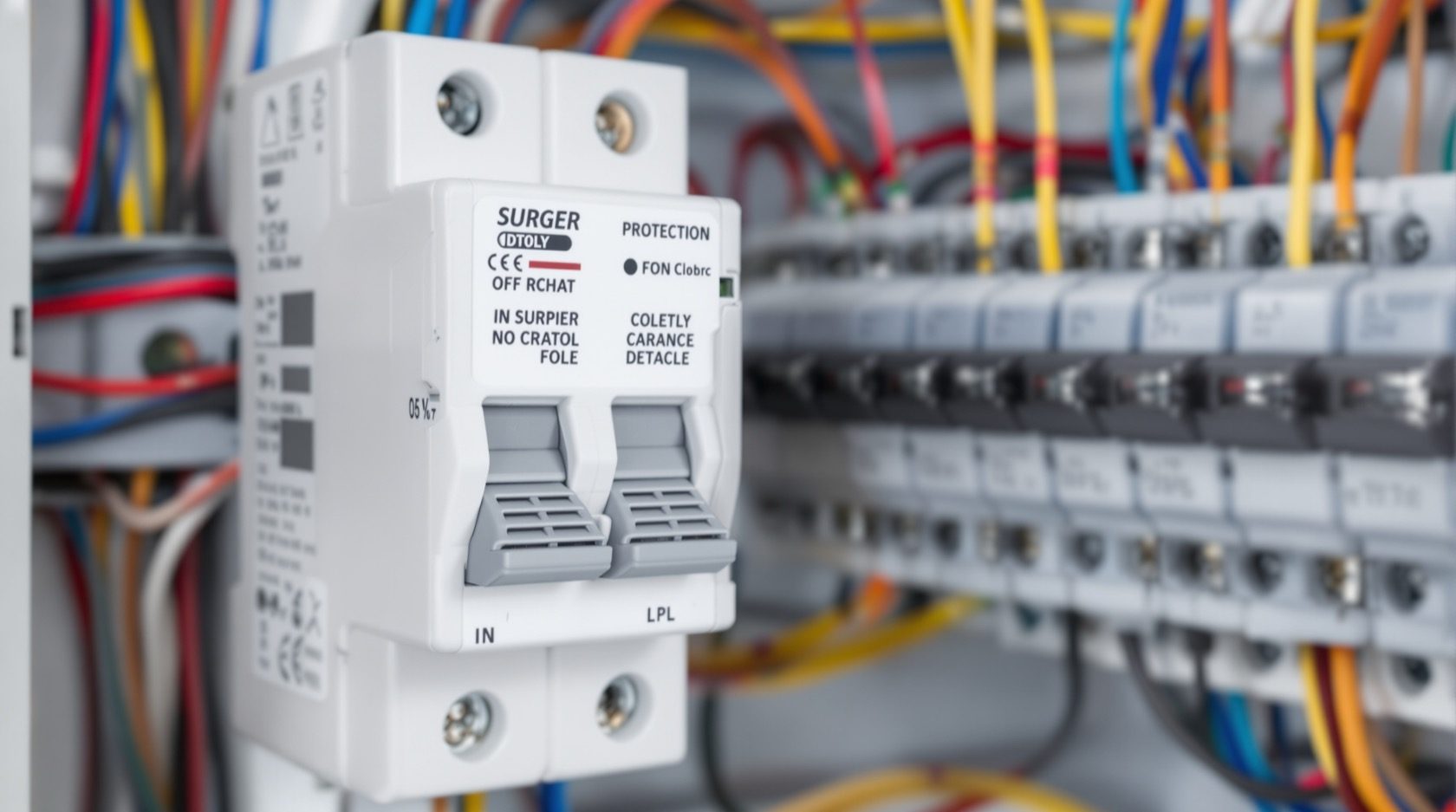
Surge Protection & SPDs: Guarding Your Home's Electronics
The device your MCB and RCCB cannot replace — a surge protective device clamps the sudden voltage spikes from grid switching and lightning that quietly kill TVs, computers, inverters and LED drivers. What SPDs are, the Type 1/2/3 system, where they go, and whether your home needs one.
Your MCBs protect the wiring and your RCCB protects you from shock — but neither does anything about a voltage surge: a sudden, brief spike in voltage that arrives down the mains from grid switching, faults, or a lightning strike nearby, and quietly destroys sensitive electronics. As homes fill with TVs, computers, inverters, routers and LED drivers, this once-ignored layer of protection has become genuinely worth understanding. This guide explains what a surge protective device (SPD) does, the Type 1/2/3 system, and whether your home needs one.
It sits under the protection layers guide and complements lightning protection.
The safety line. SPD selection and installation are part of a wiring design done by a licensed electrician. This guide helps you understand the protection and ask for it; it is not an installation guide. Internationally, SPDs are made to the IEC 61643 series; confirm the current BIS designation and any local requirement with your electrician.
What a surge is, and why an MCB ignores it
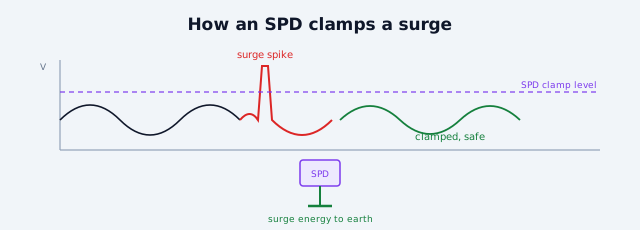
A surge (or transient) is a voltage spike lasting microseconds — the mains momentarily jumps far above its normal 230 V. It can come from the grid (switching, faults, supply issues) or from lightning striking a line or the ground nearby. That spike does not necessarily draw the sustained over-current an MCB reacts to; it is an over-voltage that flashes through and punches holes in the delicate semiconductors inside electronics. So an MCB, an RCCB and a fuse all sit there unmoved while a surge fries your TV's power board.
An SPD is built for exactly this: it sits across the supply and, the instant the voltage spikes, it diverts the surge energy safely to earth and clamps the voltage back down to a level the electronics can survive — then returns to doing nothing until the next spike.
The Type 1 / 2 / 3 system
SPDs come in classes that handle surges of different size, and they work in a coordinated cascade from the building's entrance inward:
| Type | Handles | Where it goes | Protects against |
|---|---|---|---|
| Type 1 | The largest surges (direct/partial lightning current) | At the origin / main panel, on buildings with a lightning protection system | Direct lightning energy |
| Type 2 | Residual and switching surges | In the main or sub distribution board | The bulk of everyday surges — the key home SPD |
| Type 3 | Small residual surges, close to equipment | At the socket / appliance (point-of-use) | Final fine protection for sensitive devices |
For a typical home, the workhorse is a Type 2 SPD in the distribution board. Homes with a lightning protection system add a Type 1 at the entrance; and a Type 3 (a good point-of-use surge protector strip) can add final protection right at an expensive device. They are meant to coordinate — a Type 2 in the board plus Type 3 at the equipment, not one or the other in isolation.
Does your home need one?
An honest answer, not a sales pitch:
- Strong case: you have significant electronics (computers, large TVs, home theatre, inverter/solar, home office gear), you are in an area with frequent lightning or an unstable grid, or your building has a lightning protection system. Here a Type 2 SPD in the board is a sensible, proportionate investment.
- Weaker case: a very simple installation with few electronics and a stable supply — still beneficial, but lower priority than the fundamentals.
- Always secondary to the fundamentals: an SPD protects equipment, not people. It never comes before earthing and an RCCB, which protect life. Fix those first; add surge protection as the next layer.
Note too that an SPD needs good earthing to work — it diverts the surge to earth, so without a sound earth path it cannot do its job. This is another reason earthing underpins everything.
What to check
- A Type 2 SPD in the distribution board as the baseline, correctly rated and installed by an electrician.
- Good earthing for the SPD to discharge into (see the earthing guide).
- Coordination if using multiple types (Type 1/2/3 in cascade).
- An SPD with a status indicator — they degrade after absorbing surges and eventually need replacement; the indicator shows when.
- Conformance to the IEC 61643 series (confirm the current BIS designation with your electrician).
The one-line answer
A surge protective device clamps the microsecond voltage spikes — from grid switching or nearby lightning — that MCBs and RCCBs completely ignore but that quietly destroy TVs, computers, inverters and LED drivers. For a typical home the key device is a Type 2 SPD in the distribution board, with Type 1 added where there is lightning protection and Type 3 at sensitive equipment, all needing good earthing to discharge into. It protects equipment, not people, so it comes after earthing and an RCCB — and its selection and install belong to a licensed electrician, to the IEC 61643 series.
Where to go next
- The whole safety picture: Layers of Electrical Protection.
- The structural side: Lightning Protection Guide.
- The earth it discharges into: Home Earthing Guide.
- The system it guards: Residential Electrical Systems.
References
- IEC 61643 series — international standard for low-voltage surge protective devices (confirm the current BIS/Indian designation before specifying).
- IS/IEC 62305 : 2010, Protection Against Lightning (surge relevance), Bureau of Indian Standards.
- IS 3043 : 2018, Code of Practice for Earthing, BIS.
- National Electrical Code of India, SP 30 : 2023, BIS: https://www.bis.gov.in/
SPD types and applications are indicative; selection, coordination and installation must be done by a licensed electrician, and the SPD depends on sound earthing. Confirm the current BIS designation for SPDs before specifying. Verify any standard's status via the BIS catalogue before relying on it.
Export this guide
Related Guides — Deep-dive reading
Electrical Safety for Security Systems in India (2026): Powering It Without Peril
A homeowner's guide to the power side of home and RWA security systems, CCTV, alarms, gates, access control and NVRs, done so it protects you instead of quietly becoming a shock or fire hazard. What makes a supply safe, what to insist on, and why the mains work belongs to a licensed electrician.
SecurityResidential Electrical Systems: The Complete Guide for Indian Homes
How the electricity in an Indian home actually works — from the utility supply and meter through the distribution board, circuits, wiring, earthing and protection, to lighting, safety, energy efficiency, smart controls, solar and backup — written so a homeowner can understand, plan and judge it, and know exactly where a licensed electrician must take over.
Electrical & WiringBathroom Planning for New Homes in India: Get It Right Before You Build
The bathroom decisions you cannot undo once the slab is cast — location and stacking, sunken vs non-sunken slabs, waterproofing, and the plumbing, electrical and ventilation you must coordinate with the civil work, stage by stage.
BathroomsRelated Tools — Try Free
Electrical Safety & Load Audit
Home electrical audit — 10 categories, 65+ checkpoints across earthing, RCCB, MCB, wiring, switchboards, appliance circuits, DG/inverter backup.
Safety AuditEarth Conductor Size Calculator
Find the minimum protective (earth) conductor size for a circuit from its phase conductor size, using the standard IS 732 / IEC 60364 rule.
ElectricalElectrical Load Calculator
Estimate a home's connected load and realistic maximum demand from its appliances, whether it needs single or three-phase supply, and a suggested main switch rating.
Electrical