
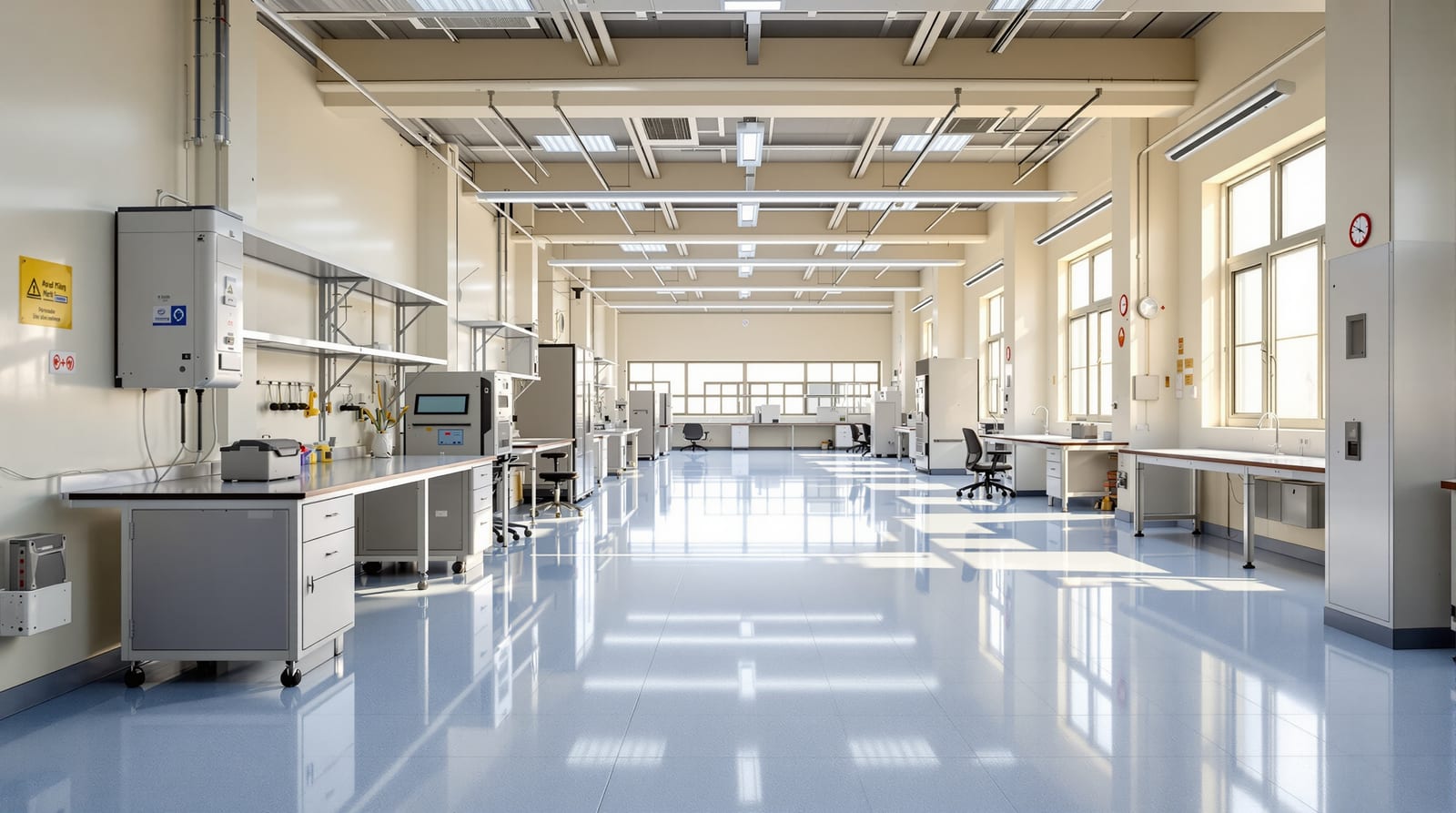
Laboratory Flooring India: Chemical-Resistant, Seamless and ESD Floors by Lab Type, with Costs and Standards
How to pick a lab floor that resists the chemicals you actually use — chemical-resistant epoxy or PU, ESD/conductive systems for electronics and solvent areas, antibacterial homogeneous vinyl for pharma and pathology, cleanroom-grade for sterile — with ₹/sq ft, IEC 61340, GMP and ISO 14644.
A laboratory floor is a working chemical surface, not a finish. It meets acids and solvents the moment a beaker tips, it has to be decontaminated to a standard a kitchen never dreams of, and in an electronics or solvent lab it must quietly drain static to earth so a spark never reaches a flammable vapour or a sensitive board. Pick the wrong floor and you get etched, stained, lifting material that becomes a contamination and safety liability within a year.
This guide ranks lab floors by what each lab type actually demands — chemical and research labs that need acid and solvent resistance, electronics labs that need anti-static (ESD) performance, pharma and pathology labs that need antibacterial decontaminable surfaces, and sterile cleanrooms — with Indian ₹/sq ft benchmarks and the IEC 61340 (ESD), GMP and ISO 14644 (cleanroom) standards that govern them.
Why laboratory floors are different: chemical, seamless, anti-static
Before any material, fix the four demands that separate a lab floor from any other commercial or industrial floor.
- Chemical resistance matched to the chemicals you actually use. There is no single "chemical-proof" floor — resistance is always against a specific list. An acid-digestion lab, an organic-solvent lab and a clinical pathology lab attack the floor in completely different ways. The cardinal rule: write down the reagents (acids, alkalis, solvents, oxidisers, stains) and their concentrations and frequency, then specify a resin system whose data sheet covers them. A novolac epoxy resists strong acids a standard epoxy cannot; a PU resin shrugs off solvents and thermal shock an epoxy struggles with.
- Seamless and coved so it can be decontaminated. Every joint, grout line and skirting gap is a place spills soak in and contaminants hide. The lab ideal is a poured or welded continuous skin, coved up the wall over a curved fillet so the wall-floor junction has no 90-degree corner to trap residue. A spill must wipe up and a wash-down must reach every square millimetre — impossible across a grouted tile floor.
- Anti-static (ESD) wherever there are flammable solvents or sensitive electronics. Static charge that builds on an insulating floor is two distinct hazards: a spark that can ignite solvent vapour or hydrogen, and an electrostatic discharge that destroys microelectronics. ESD floors — conductive or static-dissipative vinyl or resin laid over a copper earthing grid — drain that charge safely to ground. This is non-negotiable in electronics, semiconductor, solvent-handling and some QC labs.
- Anti-slip, durable and impervious. Lab floors get wet with spills and wash-down, carry rolling instrument trolleys and heavy benches, and must never absorb a drop. They need a genuine but cleanable anti-slip grade (DIN 51130 R10-R11 in wet zones), abrasion resistance, and zero porosity.
On top of these sit the standards: IEC 61340-5-1 governs ESD-protected areas and the resistance window an anti-static floor must hit; GMP and Schedule M apply to pharmaceutical labs and require impervious, crack-free, easily cleanable surfaces; ISO 14644 classifies cleanrooms and drives low-particulate, seamless, coved floors; and NBC 2016 with the RPwD anti-slip rules govern circulation and accessibility. For the broader sector context see the commercial flooring guide.
The lab floor families: epoxy, PU, ESD and homogeneous vinyl
Four material families cover almost every laboratory. Match the family to the dominant demand, then specify the grade.
A seamless epoxy floor is the workhorse for most chemical and research labs: poured, jointless, hard, impervious and available in chemical-resistant and novolac grades for strong acids. It is the default unless solvents, thermal shock or heavy abuse push you to PU.
A PU resin floor (polyurethane, often PU cement) wins where there are aggressive solvents, organic acids, thermal cycling (hot wash-down, autoclave spillage) or impact — common in pharma production-adjacent labs and food/chemical R&D. It is tougher and more flexible than epoxy and far more solvent- and heat-tolerant.
An anti-static / ESD floor is a conductive or static-dissipative version of either a resin or a vinyl, laid over a copper earthing grid and earthed to building ground. It is specified by its electrical resistance, not its looks, and is mandatory in electronics, semiconductor and flammable-solvent areas.
A homogeneous PVC roll or vinyl floor — colour-through sheet, heat-welded into a continuous skin, coved up the wall, with an antibacterial wear layer — is the clinical choice for pathology, microbiology and pharma QC labs where decontamination and a warmer, quieter surface matter more than poured seamlessness. Its ESD grades cover solvent and electronics zones too.
Flooring by laboratory type
Each lab type trades the same priorities differently. Match the floor to the work, not the building.
| Lab type | Recommended floor | Why this floor | ₹/sq ft (installed, 2026) |
|---|---|---|---|
| Chemical / research (acids, alkalis, reagents) | Chemical-resistant or novolac epoxy, seamless coved; PU where solvents/heat dominate | Resists the specific reagent list; impervious, jointless, decontaminable | 150-400 |
| Solvent / organic chemistry | PU resin (solvent + thermal-shock resistant), or ESD-PU if flammable | Shrugs off solvents and hot spillage; ESD grade kills spark risk | 200-500 |
| Electronics / semiconductor / instrumentation | ESD/conductive vinyl or conductive epoxy over earthing grid | Drains static to protect boards and prevent discharge damage | 200-450 |
| Pharma manufacturing & QC lab | PU resin or GMP-grade epoxy, seamless coved; antibacterial vinyl in QC | Schedule M / GMP impervious, crack-free, easily sanitised | 200-500 |
| Pathology / clinical / microbiology / bio | Homogeneous antibacterial vinyl (PVC roll), heat-welded coved | Antibacterial, decontaminable, warm and quiet; resists clinical chemicals | 150-300 |
| Cleanroom / sterile (ISO 14644) | Seamless PVC, epoxy or PU, coved, low-particulate, ESD where needed | Low particulation, fully cleanable, controlled static | 250-650 |
| Education / teaching lab | Chemical-resistant epoxy or anti-slip homogeneous vinyl, coved | Durable, spill-proof, low-maintenance, safe for students | 120-300 |
Pick the floor for the lab, not the campus. To narrow the chemical-resistance choice use the specialty flooring selector; for the slip side of any wet zone the anti-slip rating selector; and to size the budget across a whole facility the commercial flooring cost calculator.
Chemical and research labs: match the resin to the reagents
This is the largest category and where the "no single chemical-proof floor" rule bites hardest. Start from the reagent list. For general acids, alkalis and aqueous reagents, a chemical-resistant epoxy at 3-4 mm gives a seamless, impervious, jointless floor that wipes clean. For strong oxidising and concentrated acids (sulphuric, nitric, hydrofluoric handling areas), step up to a novolac epoxy grade designed for them. Where organic solvents, hot spillage or thermal cycling dominate — and especially near autoclaves and wash-down zones — a PU resin is the more solvent- and heat-tolerant choice. In every case the floor is coved up the wall and run seamless into wet benches and drains.
Electronics, semiconductor and solvent labs: anti-static first
Here the controlling demand is electrical, not chemical. An ESD / anti-static floor — conductive or static-dissipative vinyl, or conductive epoxy — is laid over a grid of self-adhesive copper tapes that are bonded to the building earth, so charge generated by people, trolleys and equipment drains continuously to ground rather than building up to a discharge. It is specified by its measured resistance to ground (the IEC 61340-5-1 window), not by appearance, and it only works if the earthing grid is installed and tested. Use it in semiconductor and PCB labs to protect components, and in flammable-solvent and hydrogen-handling labs to remove spark risk. The same grade can be a conductive epoxy where chemical resistance must accompany ESD.
Pharma, pathology and bio labs: antibacterial and decontaminable
Pharmaceutical QC, clinical pathology, microbiology and biotech labs put decontamination and hygiene first. For GMP / Schedule M production-adjacent labs, a seamless, coved PU resin or GMP-grade epoxy gives the impervious, crack-free, easily sanitised surface auditors expect. For clinical pathology, microbiology and bio-labs, a homogeneous antibacterial vinyl / PVC roll floor heat-welded into one continuous skin and coved up the wall is often the better fit — it carries an antibacterial treatment through its wear layer, resists hospital-grade disinfectants, and is warmer, quieter and kinder underfoot than poured resin during long bench shifts. Where these labs also handle solvents or sensitive electronics, specify the ESD grade of the same vinyl.
Cleanrooms and sterile suites: ISO 14644, low-particulate and coved
A cleanroom floor must shed almost no particles, withstand repeated aggressive cleaning and sporicidal agents, be fully coved into the wall, and — for solvent or electronics cleanrooms — be ESD. This is delivered as a seamless PVC sheet, epoxy or PU system classified to the room's ISO 14644 class, with the floor flowing up the wall over a cove former and integral coving throughout. Because the detailing is specialised, treat it as its own discipline — see the dedicated cleanroom flooring guide for the build-up, class-by-class.
How a lab floor is built: seamless, coved and earthed
The performance lives in three details — the seamless skin, the coved wall junction and (for ESD) the earthing grid. The section below shows all three.
Costs and what drives them
Lab flooring is a lifecycle and compliance decision, not a first-cost one — a floor that fails a chemical or GMP audit costs far more than the price difference. As an indicative 2026 installed guide: chemical-resistant epoxy ₹150-400/sq ft, PU resin ₹200-500, ESD/conductive systems ₹200-450, antibacterial homogeneous vinyl ₹150-300, and cleanroom-grade seamless systems ₹250-650. The big swings come from the resin grade (novolac and solvent-grade cost more), the thickness, the ESD specification and its earthing grid, the cleanroom class, and — critically — the subfloor preparation and the coving labour, which is exactly what you must not cut because the seamless coved skin is the decontamination performance. Benchmark against the flooring cost per square foot guide and, for the wider sector view, the commercial flooring guide.
Do and don't for laboratory floors
- Do write the reagent list first — chemicals, concentrations, frequency — and match the resin data sheet to it. There is no universal chemical-proof floor.
- Do pour or weld a seamless skin and cove every wall junction; an unjointed, coved floor is the decontamination performance.
- Do specify ESD with its earthing grid and test the resistance to IEC 61340 wherever there are flammable solvents or sensitive electronics — and never assume an ordinary floor is anti-static.
- Do prepare the subfloor properly: a dry, sound, primed screed is non-negotiable for resin, and moisture trapped below causes delamination and blistering.
- Don't use grouted tile in any chemical, GMP, pathology or sterile lab — joints harbour residue and acids attack the grout.
- Don't specify a standard epoxy where strong acids, solvents or thermal shock are present — use novolac epoxy or PU instead.
- Don't forget the earthing grid under a conductive floor, or it provides no static protection at all.
Care and maintenance
Seamless lab floors are low-maintenance by design: daily damp-mop with a neutral or specified cleaning agent, prompt clean-up of any spill to its compatible procedure, periodic machine scrub, and immediate repair of any chip or seam that lifts so the impervious skin stays intact. Avoid aggressive abrasives that dull the surface, and on ESD floors test the earth continuity and floor resistance periodically — the static protection is only real while the path to ground is intact. For general routines see the floor cleaning guide and the floor resealing guide.
Frequently asked questions
What is the best flooring for a laboratory in India?
It depends on the lab. For most chemical and research labs, a seamless chemical-resistant epoxy (or PU resin where solvents and heat dominate), coved up the wall, is the standard choice. Electronics and solvent labs add an ESD/conductive grade over an earthing grid; pharma and pathology labs use GMP-grade resin or antibacterial homogeneous vinyl; sterile cleanrooms use a low-particulate seamless system to ISO 14644. Match the floor to the lab type and to the chemicals you actually use.
Why do laboratories need anti-static (ESD) flooring?
Because static charge that builds on an ordinary insulating floor is two hazards at once: a spark that can ignite solvent vapour or hydrogen in a chemistry lab, and an electrostatic discharge that destroys microchips and sensitive instruments in an electronics lab. An ESD floor — conductive or static-dissipative vinyl or resin laid over a copper earthing grid bonded to building earth — drains that charge continuously to ground, within the resistance window set by IEC 61340-5-1.
Epoxy or PU resin for a lab floor?
Use chemical-resistant epoxy as the default for most acid, alkali and aqueous-reagent labs — it is hard, impervious and economical, with novolac grades for strong acids. Choose PU resin where organic solvents, thermal shock (hot wash-down, autoclave spillage) or heavy impact dominate, as in pharma production-adjacent and food/chemical R&D labs, because PU is tougher and far more solvent- and heat-tolerant than epoxy.
What flooring is used in a pharma or pathology lab?
Pharma manufacturing and QC labs use seamless, coved GMP-grade epoxy or PU resin to satisfy Schedule M / GMP requirements for impervious, crack-free, easily sanitised surfaces. Clinical pathology, microbiology and bio-labs often use a homogeneous antibacterial vinyl / PVC roll floor, heat-welded into one continuous skin and coved up the wall — antibacterial through its wear layer, decontaminable, and warmer and quieter underfoot for long bench shifts.
How much does laboratory flooring cost in India?
As a rough 2026 installed guide: chemical-resistant epoxy ₹150-400/sq ft, PU resin ₹200-500, ESD/conductive systems ₹200-450, antibacterial homogeneous vinyl ₹150-300, and cleanroom-grade seamless systems ₹250-650. The resin grade, thickness, ESD earthing, cleanroom class and the coving and subfloor-preparation labour drive the price — and the coving and prep are exactly what you should not cut.
Export this guide
Related Guides — Deep-dive reading
Cleanroom Flooring India: Seamless, Coved, Non-Shedding ESD Floors by ISO 14644 Class, with Costs and Standards
How to choose a cleanroom floor that holds an ISO 14644 / GMP class — seamless self-levelling epoxy or PU with integral coving, welded homogeneous PVC sheet vinyl, ESD/conductive grades for electronics and solvent zones, and raised-access ESD panels in some semiconductor fabs — with ₹/sq ft, IEC 61340, GMP and ISO 14644.
Flooring & SurfacesAnti-Static & ESD Flooring in India: Conductive vs Dissipative Floors, Resistance Ranges, IEC 61340, Cost & Earthing
Anti-static and ESD flooring — conductive or static-dissipative vinyl, epoxy/PU, rubber and raised-access panels that drain electrostatic charge safely to earth — is mandatory in electronics and semiconductor plants, data centres, telecom, labs, operation theatres, cleanrooms and explosive-risk areas. Here are the types, resistance ranges, IEC 61340 standards, install and earthing, testing, costs of ₹150–600 per sq ft and care.
Flooring & SurfacesHospital Flooring India: Infection-Control Floors by Zone, with Costs and NABH Codes
Why Indian hospitals choose seamless, coved, antibacterial PVC and vinyl sheet over tiles — a zone-by-zone guide to OT and ICU, wards, corridors, labs, lobby and wet areas, with anti-slip and anti-static grades, ₹/sq ft and NABH/IS compliance.
Flooring & SurfacesRelated Tools — Try Free
Window Cleaning Cost Calculator
Estimate professional window cleaning cost per visit and per year by access and frequency.
Window CalculatorFlooring Cost Calculator
Estimate the all-in cost of a floor — material, laying, wastage, skirting and GST — by area and material.
Flooring CalculatorMaterial Schedule Generator
Generate a room-wise finish schedule — walls, floors, ceilings, trim, and joinery by location.
Material Schedule