
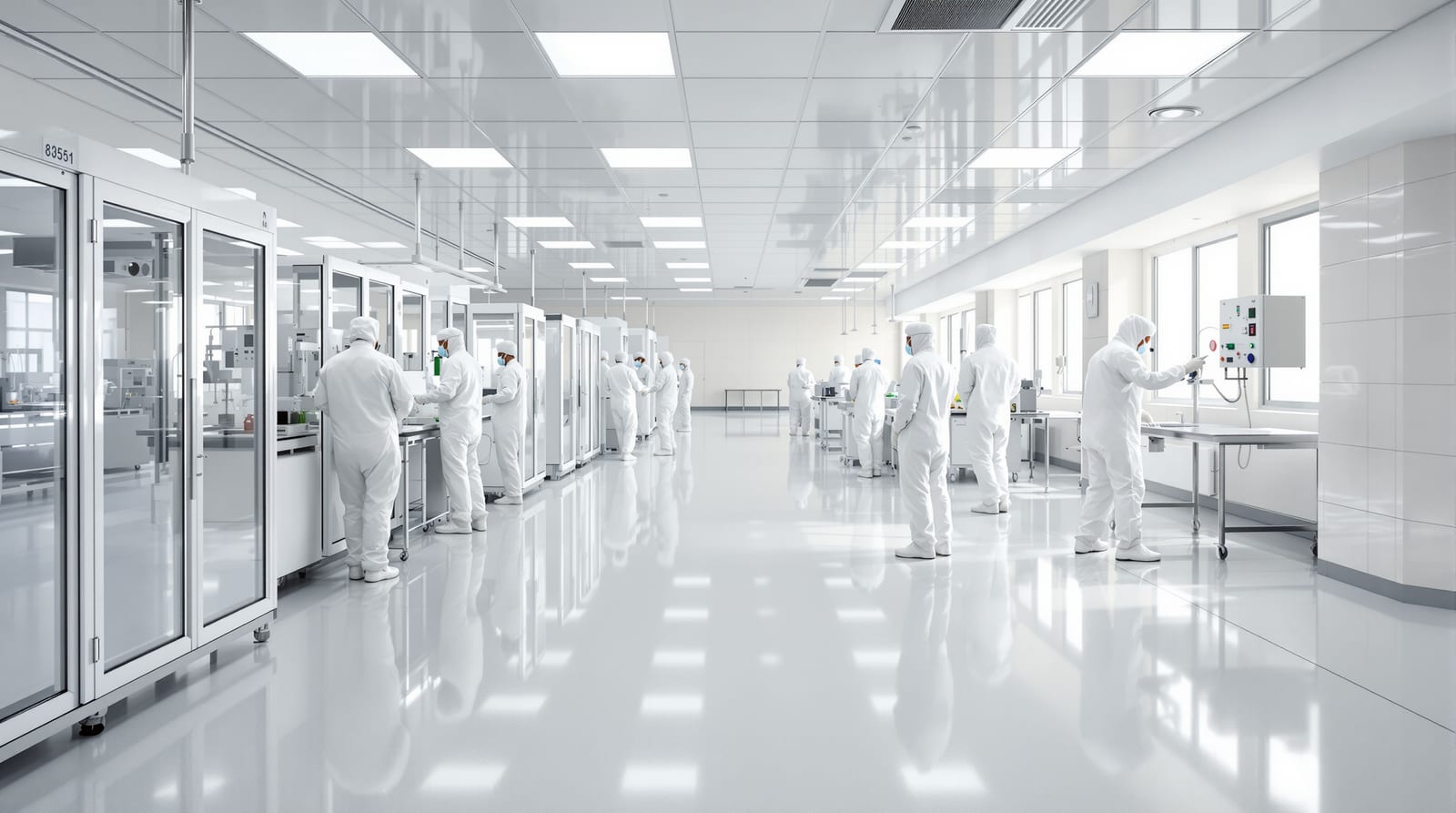
Cleanroom Flooring India: Seamless, Coved, Non-Shedding ESD Floors by ISO 14644 Class, with Costs and Standards
How to choose a cleanroom floor that holds an ISO 14644 / GMP class — seamless self-levelling epoxy or PU with integral coving, welded homogeneous PVC sheet vinyl, ESD/conductive grades for electronics and solvent zones, and raised-access ESD panels in some semiconductor fabs — with ₹/sq ft, IEC 61340, GMP and ISO 14644.
A cleanroom floor is held to a standard almost no other floor in India ever faces: it is part of the air. In a space engineered to limit airborne particles to a few thousand — or a few hundred — per cubic metre, every square metre of floor is a potential particle source, a chemical sink, a static hazard and a decontamination surface all at once. A joint that sheds, a corner that traps dust, a coating that out-gasses or a surface that holds a static charge can quietly fail an ISO 14644 classification or a GMP audit that the building's HVAC, gowning and protocols were all built to pass. This guide is for the people specifying floors in pharma, biotech, medical-device, semiconductor and electronics, and aerospace cleanrooms in India — it walks the demands a cleanroom puts on a floor, the systems that actually meet them, the coving and ESD detailing that decides pass or fail, and the 2026 rate per square foot for each.
What makes a cleanroom floor different
A cleanroom floor answers to five demands at once, and a material that wins on four of them but loses the fifth is the wrong floor.
Seamless and non-shedding (low particulate). The whole point of a cleanroom is to limit particles in the air. A floor with open joints, grout lines, gaps or a friable surface is a continuous particle generator under foot traffic and trolley wheels. Cleanroom floors are therefore seamless — poured resin with no joints, or sheet vinyl heat-welded into a single membrane — and built from materials that do not chalk, abrade into dust or release fibres.
Coved, with no dust-trapping corners. Dust and contamination collect where the floor meets the wall. A cleanroom floor is coved — curved continuously up the wall into an integral skirting (typically 100-150mm) — so there is no sharp internal angle for particles to lodge in and no edge a mop cannot reach. The cove is not cosmetic; it is the single most audited floor detail in a GMP cleanroom.
Easy and aggressive to decontaminate. Cleanroom floors are cleaned constantly and disinfected with sporicidal and chemical agents — hydrogen peroxide, quaternary ammonium, sodium hypochlorite, IPA, and in some pharma rooms vaporised hydrogen peroxide (VHP) fumigation. The floor must take that chemistry day after day for years without discolouring, softening or breaking down, and must wipe and dry clean with no residue.
Chemical-resistant to the process, not just the cleaner. Beyond disinfectants, the floor must resist whatever the room actually handles — solvents and APIs in pharma, acids and etchants in semiconductor, reagents in biotech. The chemical exposure drives the resin choice as much as the class does; see chemical resistance by floor type in the laboratory guide.
Anti-static / ESD — usually mandatory. Most cleanrooms — and effectively all electronics, semiconductor and many pharma and medical-device rooms — require an electrostatic-dissipative (ESD) or conductive floor to drain static safely to earth, protecting sensitive devices and, in solvent or oxygen-rich areas, preventing a spark ignition. ESD is engineered into the floor system and earthed with copper grounding tabs; see anti-static ESD flooring for the resistance bands and earthing detail.
Sitting over all of this is classification. Cleanrooms in India are designed to ISO 14644-1 (ISO Class 1 cleanest to Class 9) and, in pharma, to EU/WHO/Schedule M GMP Grades A-D. The floor is part of the qualification package — its smoothness, cleanability, coving and ESD performance are checked at validation and re-audited for the life of the room.
The cleanroom floor systems that win in India
Three families do almost all cleanroom flooring in India, plus a raised-access option for specific fabs.
Seamless self-levelling epoxy or PU resin — the pharma and biotech default. A poured, trowel- or self-levelled resin floor gives a truly jointless, non-shedding, chemically robust membrane that coves up the wall in the same material. Epoxy is the workhorse — hard, chemical-resistant and economical; PU (polyurethane) resin is chosen where the room sees thermal shock, steam cleaning or aggressive cleaning chemistry, because it is tougher and more flexible. Both come in ESD/conductive grades with a conductive primer and earthing grid. This is the go-to for pharmaceutical, biotech and medical-device cleanrooms. Read the material depth in epoxy flooring and PU resin flooring, and complement it with the lab guide rather than re-specifying here.
Homogeneous PVC sheet vinyl — welded and coved, the validated favourite. Homogeneous (single-layer, colour-through) PVC sheet is laid in large sheets, the joints heat-welded with a matching rod into a continuous membrane, and the sheet coursed up the wall over a cove former into a seamless skirting. It is non-porous, easy to decontaminate, comes in ISO-classified, antibacterial and ESD/conductive grades, and — crucially — is fast to install and easy to repair or replace a section without demolishing a screed, which suits pharma and hospital cleanrooms on tight shutdown windows. See PVC roll flooring for the welding and grade detail. Loose-lay it is not — cleanroom vinyl is fully bonded and welded.
Raised-access ESD panels — for specific semiconductor fabs and sub-fab. Some semiconductor and electronics cleanrooms run on a raised-access floor — perforated or solid ESD/conductive panels on a grounded grid — to deliver downflow air through the floor (return-air plenum) and route process services and cabling below. The panels are anti-static and earthed; the system is specialised and costly. Most Indian cleanrooms outside large fabs use poured resin or welded vinyl on slab, not raised-access. See raised-access flooring and anti-static ESD flooring.
What does NOT belong in a cleanroom: tiles or stone (grout joints shed and trap), laminate or wood (porous, particulate, joints), carpet (a fibre and particle reservoir), or any loose-lay floor. Cleanroom flooring is seamless, bonded, coved and ESD by definition.
Class and use to recommended floor: the decision table
The right cleanroom floor is set by what the room makes, the ISO/GMP class it must hold, and the static and chemical exposure. The table pairs typical Indian cleanroom uses with the floor systems that win, the indicative installed cost in 2026, and the dominant driver. Costs are broad ranges and depend heavily on ESD grade, coving extent and finish; confirm with current quotes and the flooring cost per square foot guide.
| Cleanroom use / class | Recommended floor system | ₹/sq ft (installed) | Key driver |
|---|---|---|---|
| Pharma GMP Grade C-D / ISO 7-8 (oral solids, packing) | Seamless ESD epoxy, or welded ESD/antibacterial homogeneous PVC | 180-400 | Seamless + coved + GMP cleanability |
| Pharma GMP Grade A-B / ISO 5 (sterile fill, aseptic) | Welded homogeneous PVC (ESD) or seamless PU/epoxy, full cove | 220-500 | Decontamination + VHP/chemical resistance |
| Biotech / cell-culture cleanroom | Seamless PU or epoxy (ESD), antibacterial PVC | 200-480 | Chemical + steam + bio-decontamination |
| Medical-device assembly cleanroom | Seamless ESD epoxy or welded ESD PVC | 180-420 | ESD + particle-free + cleanability |
| Electronics / SMT cleanroom (ISO 7-8) | Conductive/ESD epoxy or ESD PVC sheet | 180-450 | ESD earthing + low particulate |
| Semiconductor fab (ISO 3-5) | Raised-access ESD panels (downflow) + ESD resin in sub-areas | 350-650+ | Downflow plenum + conductive earthing |
| Aerospace / precision cleanroom | Seamless ESD epoxy or PU | 200-480 | ESD + chemical + dimensional cleanliness |
To shortlist by your exact room and class, run the specialty flooring selector; to size a cleanroom budget, use the commercial flooring cost calculator.
The two details that decide pass or fail: coving and ESD earthing
Two construction details — not the headline material — are where cleanroom floors usually pass or fail an audit. The diagram below shows both: the integral cove at the wall, and the conductive layer earthed to the building ground.
Coving. The floor must turn up the wall in a continuous cove — same material, no separate skirting board, no sharp internal angle. In resin floors the cove is formed over a cove fillet and coated in; in vinyl it is dressed over a cove former and welded to the upstand. A 100-150mm coved skirting is standard for GMP; without it, the wall-floor junction becomes the dirtiest, least-cleanable line in the room and an audit finding waiting to happen.
ESD earthing. An ESD floor is only as good as its earth. A conductive layer (carbon-loaded primer, copper grounding strips on a grid) sits under the finish and is bonded to the building ground at defined points, giving a measured resistance-to-earth inside the IEC 61340-5-1 ESD band. Specify the target — dissipative (typically 10^6 to 10^9 ohms) or conductive (below 10^6 ohms) — and require commissioning measurements; an ESD floor that is not actually earthed and tested is just an expensive ordinary floor. The earthing and resistance bands are covered in anti-static ESD flooring.
Design and specification tips for a cleanroom floor
A few decisions separate a cleanroom floor that holds its class for a decade from one that fails its first re-audit.
Pick the resin to the chemistry and the cleaning, not the brochure. Epoxy suits most pharma and electronics rooms; switch to PU where there is thermal shock, steam, hot-water washdown or aggressive sporicidal cycles. Always map the actual process chemicals and disinfectants against the system's resistance chart before you specify.
Make ESD a measured requirement, not a label. State the IEC 61340-5-1 target band, demand a conductive primer and earthing grid, and require resistance-to-earth measurements at commissioning and periodically thereafter. Walking-test and point-to-ground values belong in the validation file.
Cove everything, and detail the door thresholds. Specify a continuous integral cove to the wall, and resolve how the floor meets door frames, drains and equipment plinths cleanly — these junctions are where seamless floors quietly stop being seamless.
Match the system to your shutdown window. Poured resin needs curing time and a dry, controlled environment; welded homogeneous PVC installs and returns to service faster and lets you replace a damaged section without demolishing a screed. On a live pharma site with short shutdowns, that speed often decides the system.
Validate the floor as part of the room. The floor's smoothness, cleanability, coving and ESD performance are part of ISO 14644 / GMP qualification. Build floor commissioning data into the room's validation package from the start, not as an afterthought.
For the wider sterile-space picture, see the laboratory flooring guide; for how a cleanroom sits among other specialised and commercial floors, the commercial flooring guide.
Do and don't for cleanroom flooring
Do specify a seamless system — poured ESD resin or welded homogeneous PVC — with a continuous integral cove to the wall. Do match the resin (epoxy vs PU) to the actual process chemicals and cleaning regime. Do engineer ESD as an earthed, measured system and require commissioning resistance tests. Do validate the floor as part of the ISO 14644 / GMP qualification of the room.
Don't use tiles, stone, laminate, wood or carpet in a cleanroom — joints shed and trap, and porous surfaces hold particles. Don't treat coving as cosmetic; the wall-floor junction is the most audited line in the room. Don't assume an ESD-labelled floor is earthed — without the copper grid, bonding and test data it is not ESD. Don't improvise a semiconductor fab downflow floor with a slab system when the design calls for raised-access ESD panels.
To shortlist by your room and class, run the specialty flooring selector; to size the budget, use the commercial flooring cost calculator.
Frequently asked questions
What is the best flooring for a cleanroom in India?
For most pharma, biotech and medical-device cleanrooms it is a choice between a seamless self-levelling ESD epoxy or PU resin floor, and a welded, coved homogeneous PVC sheet vinyl in an ESD/antibacterial grade. Both give a jointless, non-shedding, coved, decontaminable surface. Resin wins on chemical robustness and a fully monolithic feel; welded PVC wins on installation speed and easy section replacement. Some semiconductor fabs use raised-access ESD panels instead.
Why does a cleanroom floor have to be coved?
Dust and contamination collect where the floor meets the wall. A coved floor curves continuously up the wall into an integral 100-150mm skirting, removing the sharp internal corner that traps particles and leaving no edge a mop or cleaning protocol cannot reach. Coving is the single most audited floor detail in a GMP cleanroom — a sharp, uncoved wall-floor junction is a common audit finding.
Does a cleanroom floor need to be anti-static (ESD)?
Almost always. Effectively all electronics, semiconductor and medical-device cleanrooms, and many pharma and biotech rooms, require an electrostatic-dissipative or conductive floor that drains static safely to earth — protecting sensitive devices and preventing spark ignition in solvent or oxygen-rich areas. ESD is engineered with a conductive primer and copper earthing grid and measured against the IEC 61340-5-1 band; see anti-static ESD flooring.
How much does cleanroom flooring cost per square foot in India in 2026?
Indicatively, ₹180-400/sq ft for ESD epoxy or welded ESD PVC in pharma Grade C-D and electronics rooms, ₹220-500/sq ft for sterile Grade A-B and biotech rooms with full coving and aggressive chemical resistance, and ₹350-650/sq ft and up for raised-access ESD panels in semiconductor fabs. Cost is driven mainly by ESD grade, coving extent and finish. Model a room budget in the commercial flooring cost calculator.
Which standards govern cleanroom flooring in India?
Cleanrooms are classified to ISO 14644-1 (ISO Class 1-9 by airborne particle count) and, in pharma, to GMP Grades A-D (EU/WHO/Schedule M). The floor's smoothness, seamlessness, coving, cleanability and ESD performance form part of the room's qualification and validation. ESD floors are specified and tested to IEC 61340-5-1. The floor is checked at validation and re-audited for the life of the cleanroom.
Export this guide
Related Guides — Deep-dive reading
Laboratory Flooring India: Chemical-Resistant, Seamless and ESD Floors by Lab Type, with Costs and Standards
How to pick a lab floor that resists the chemicals you actually use — chemical-resistant epoxy or PU, ESD/conductive systems for electronics and solvent areas, antibacterial homogeneous vinyl for pharma and pathology, cleanroom-grade for sterile — with ₹/sq ft, IEC 61340, GMP and ISO 14644.
Flooring & SurfacesAnti-Static & ESD Flooring in India: Conductive vs Dissipative Floors, Resistance Ranges, IEC 61340, Cost & Earthing
Anti-static and ESD flooring — conductive or static-dissipative vinyl, epoxy/PU, rubber and raised-access panels that drain electrostatic charge safely to earth — is mandatory in electronics and semiconductor plants, data centres, telecom, labs, operation theatres, cleanrooms and explosive-risk areas. Here are the types, resistance ranges, IEC 61340 standards, install and earthing, testing, costs of ₹150–600 per sq ft and care.
Flooring & SurfacesHospital Flooring India: Infection-Control Floors by Zone, with Costs and NABH Codes
Why Indian hospitals choose seamless, coved, antibacterial PVC and vinyl sheet over tiles — a zone-by-zone guide to OT and ICU, wards, corridors, labs, lobby and wet areas, with anti-slip and anti-static grades, ₹/sq ft and NABH/IS compliance.
Flooring & SurfacesRelated Tools — Try Free
Flooring Cost Calculator
Estimate the all-in cost of a floor — material, laying, wastage, skirting and GST — by area and material.
Flooring CalculatorMaterial Schedule Generator
Generate a room-wise finish schedule — walls, floors, ceilings, trim, and joinery by location.
Material ScheduleAccess-Control Schedule Generator
Build the time schedules that decide when each access group can enter — an editable list for your integrator.
Time Schedules