
Petra: The Architecture of the Rose-Red City
How a desert people carved a city from living rock — the Treasury, the royal tombs, and the hidden water engineering that made it all possible — and what a modern architect can still learn from it.
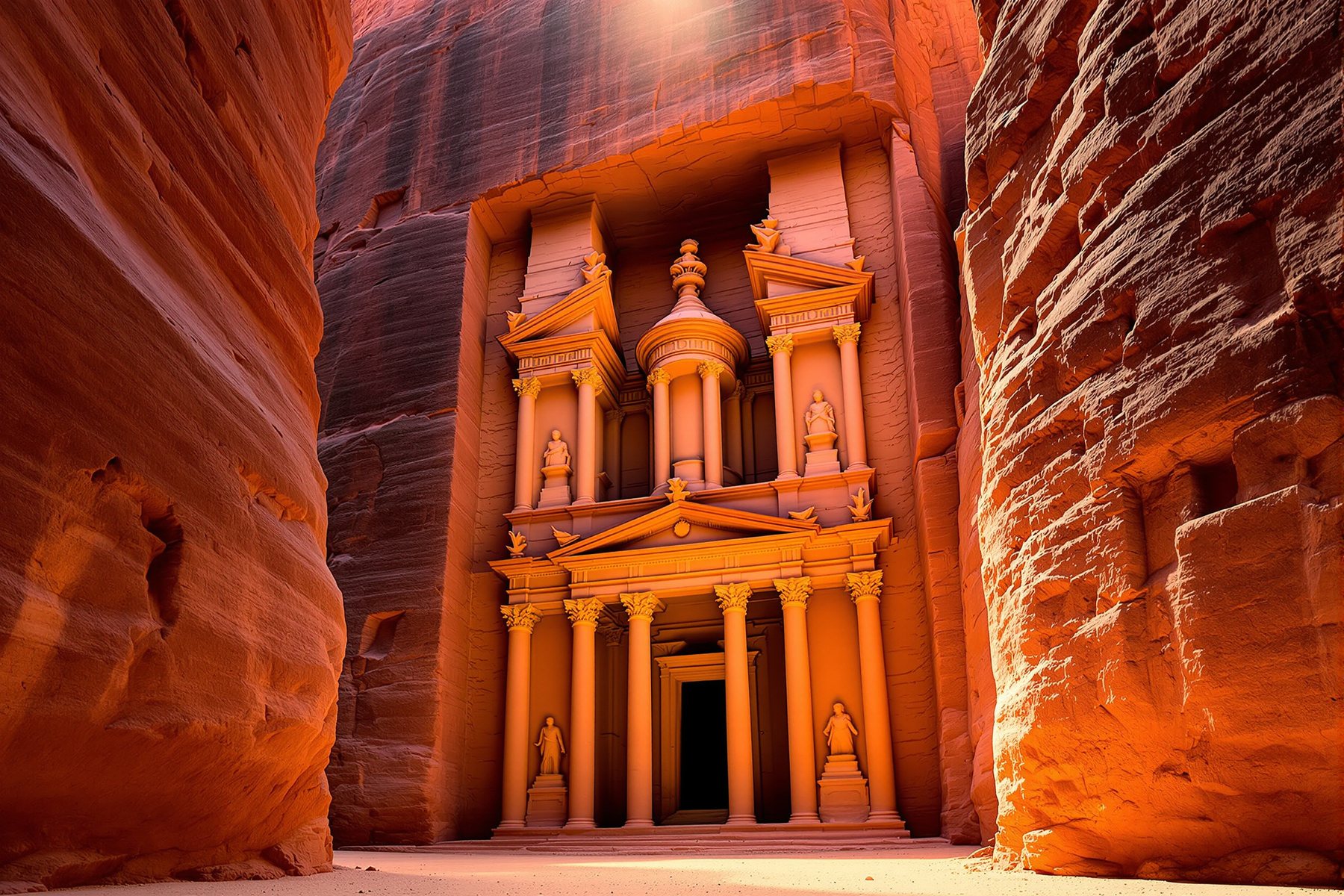
You walk for the better part of a kilometre through a crack in the earth. The walls of the Siq rise on either side — sometimes three metres apart, sometimes a little more — and climb so high that the sky becomes a ribbon and the light turns to dusk at midday. The path bends, and bends again, and gives you nothing. And then, on the final turn, a slot of brilliance opens in the dark, and framed inside it, impossibly, is a forty-metre temple front carved straight out of a rose-coloured cliff. This is Al-Khazneh, the Treasury, and the moment of its arrival is one of the most deliberate pieces of architectural theatre ever staged. Two thousand years after it was made, it still works on everyone who walks that gorge.
This guide opens our Architectural Wonders series — the world's great ancient and historic buildings, read the way an architect reads them: not as postcards, but as problems brilliantly solved. We start with Petra because it is the purest example of an idea most of us never question — that to make a building, you _add_ material. The Nabataeans did the opposite. And we start here for a reason closer to home.
_A note. Studio Matrx exists in memory of Amogh N P, and it is in his name that these articles are written. Of all the world's great buildings we could have opened this series with, we chose Petra because Amogh walked this gorge himself — he stood where that slot of light falls on the Treasury, as travellers have for two millennia. It feels right that the first wonder we write about is one he saw with his own eyes. A photograph of Amogh at Petra, with his family, closes this article._
1. A city the desert should never have allowed
Petra sits in a waterless fold of the mountains of southern Jordan — a place, as one 19th-century traveller put it, "destitute of all that is necessary for the sustenance of man." Nothing about the site says _city_. And yet for a few centuries it was one of the richest places on earth.
The reason was incense. Frankincense and myrrh, grown in southern Arabia more than 1,600 kilometres away, were burned on every altar from Persia to Rome, and the only way north was by camel caravan across the desert. The Nabataeans — a people who began as nomads and became master traders — controlled the stretch of that route where the caravans turned west toward Gaza and the Mediterranean. Incense was indispensable, so the merchants could charge almost anything; and the tax-collectors whose territory they crossed could charge almost as much again. Between roughly 400 BC and AD 100, the rulers of Petra grew phenomenally wealthy. Carving magnificent buildings from the cliffs was one of the ways they spent it.
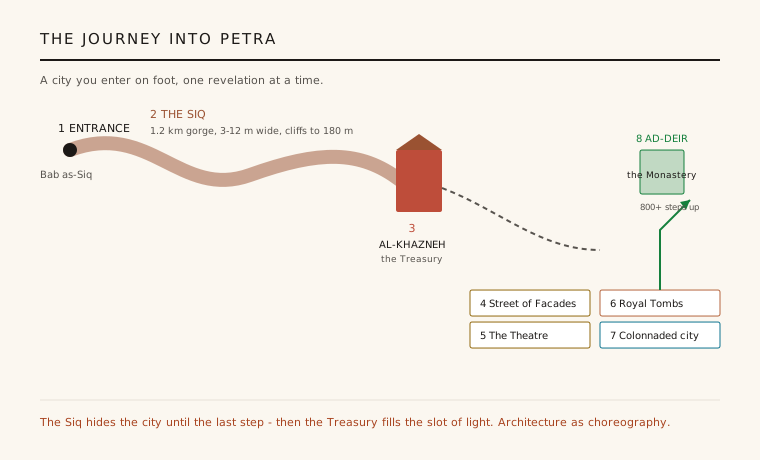
The approach is the architecture. The Siq conceals the entire city until the final step — so the Treasury does not appear, it is_ revealed.
2. Architecture in reverse
Here is the single most important thing to understand about Petra, and the easiest to miss.
A normal building is additive. You lay a foundation, raise walls course by course, set columns, span beams, place a roof. Effort goes into _putting material up_, and the whole assembly is only as sound as its lowest, earliest course — a mistake near the ground can doom everything above it.
Petra's great monuments are subtractive. The columns, pediments and chambers were not assembled; they were _released_ from rock that already stood there as a solid cliff. The mason's labour went not into building walls but into excavating the empty space around them — cutting away the many tons of stone that were not the building.
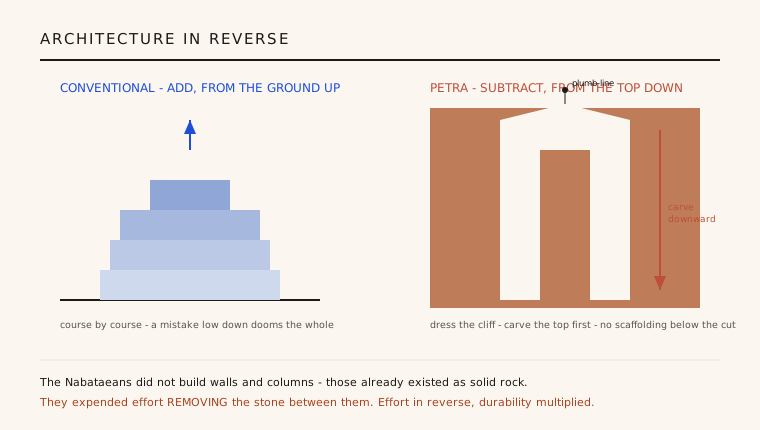
The method this forced is the opposite of a building site. First a suitable cliff face was dressed smooth. Then the facade was carved from the top down — the highest cornice first, working downward — so that the finished stone below was never used to support workers above, and a slip of the chisel could not topple a half-built wall onto the crew. Regularity over a forty-metre face, with no way to step back and check, was held by free-hanging plumb-lines and by narrow guide-channels later cut away; rows of small holes beside some tombs mark where scaffolding was pegged. Accurate calculation was not a nicety but a matter of life — a misjudged cut high on the face could bring down a rock-fall with no second attempt possible.
The reward for all that discipline is permanence. A free-standing temple can be pushed over; a temple that _is_ the cliff cannot. This is why the facades of Petra — through earthquakes, sixteen centuries of neglect, erosion and casual vandalism — still stand essentially complete to their highest cornices, giving us a more honest picture of first-century architecture than anything surviving in the great cosmopolitan cities the Nabataeans were imitating.
3. Al-Khazneh — the Treasury
The Treasury is the masterpiece, and it is a fascinating piece of cultural borrowing. Its style — paired columns, a deep porch, and above all a broken pediment split open to hold a round pavilion (a _tholos_) crowned by a great stone urn — is a confident, theatrical, almost _baroque_ composition. The astonishing thing is its date: the Nabataean masons were carving this kind of dramatic, rule-breaking classicism around the turn of the first century AD, roughly three hundred years before European architects would rediscover the same moves. The vocabulary is borrowed from the Hellenistic world — the cosmopolitan ports like Alexandria — but the result is an eclectic blend of Greek order and eastern ornament that belongs to no one but the Nabataeans.
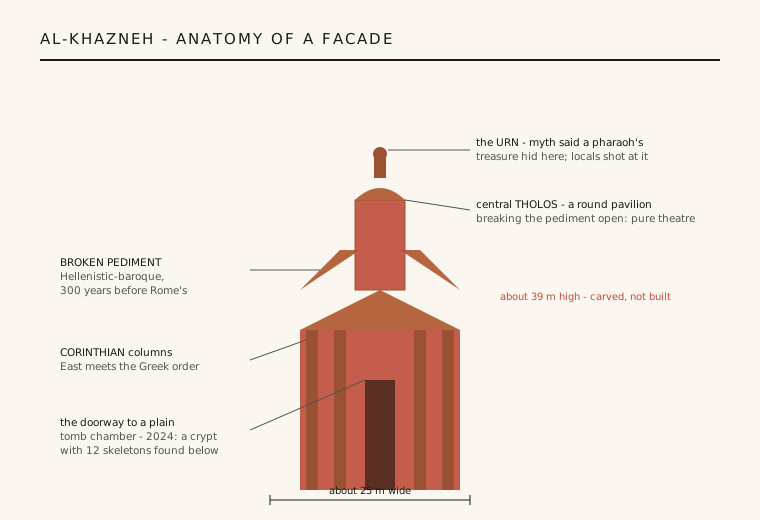
Its name is a myth. _Al-Khazneh_ means "the Treasury" because a local legend held that a pharaoh had hidden gold in the stone urn at its summit — a story that earned the urn centuries of bullet scars from people trying to break it open and spill the treasure out. There was never any treasure. The building is a tomb. For a long time that was an educated guess; in 2003, and again dramatically in 2024, excavation _beneath_ the Treasury floor uncovered burial chambers — the later dig revealing a hidden crypt with the remarkably complete skeletons of around a dozen people, dated to roughly the time of the facade itself. The Treasury was, almost certainly, a royal mausoleum — most likely connected to King Aretas IV (who ruled from about 9 BC to AD 40) — and the eagles and goddess-figures carved on its face are funerary symbols, not decoration for a bank.
4. The royal tombs and the Monastery
The Treasury is the most refined of Petra's monuments, but it is not the largest. The cliffs around the city hold hundreds of tombs — most of them plain rock-cut chambers, but a handful scaled up into vast architectural set-pieces. Tradition calls them "royal," though no ancient names survive attached to them.
| Monument | Height | Width | Likely associated ruler |
|---|---|---|---|
| Urn Tomb | ~26 m | ~16.5 m | Aretas IV (9 BC–c. AD 40) |
| Corinthian Tomb | ~28 m | ~27.5 m | Malichus II (c. AD 40–70) |
| Treasury (Al-Khazneh) | ~39 m | ~25 m | Aretas IV / Obodas (1st c. BC–AD) |
| Palace Tomb | over 46 m | ~49 m | Rabbel II (c. AD 70–106) |
| The Monastery (Ad-Deir) | ~48 m | ~47 m | a royal prince (c. AD 70–90) |
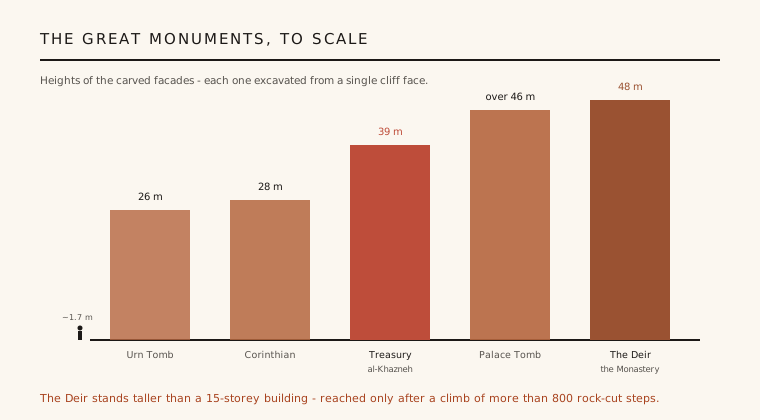
The largest of all, Ad-Deir — the Monastery — stands roughly forty-eight metres tall, the height of a fifteen-storey building, reached only after a climb of more than eight hundred rock-cut steps into the hills above the city. Standing before it, the subtractive idea reaches its limit: a facade the size of a tower block, with not one joint in it, because it was never assembled — only revealed. The chambers behind these giant fronts are, by contrast, surprisingly modest: an outer room, sometimes with rock-cut benches, and a burial chamber cut into the wall behind. At Petra the _facade_ was the architecture; the interior was almost an afterthought.
5. The hidden genius — water in the desert
Here is the part the postcards never show, and the part an engineer will find most moving. The carved facades are extraordinary; but the real wonder of Petra is that anyone could live there at all.
A desert city faces two opposite water problems at once. For most of the year there is far too little — and then, a few times a year, a sudden storm in the surrounding hills sends a flash flood roaring down the wadis, and the Siq, that narrow one-way slot, becomes a lethal funnel. The Nabataeans solved both with a hydraulic system of genuine sophistication.
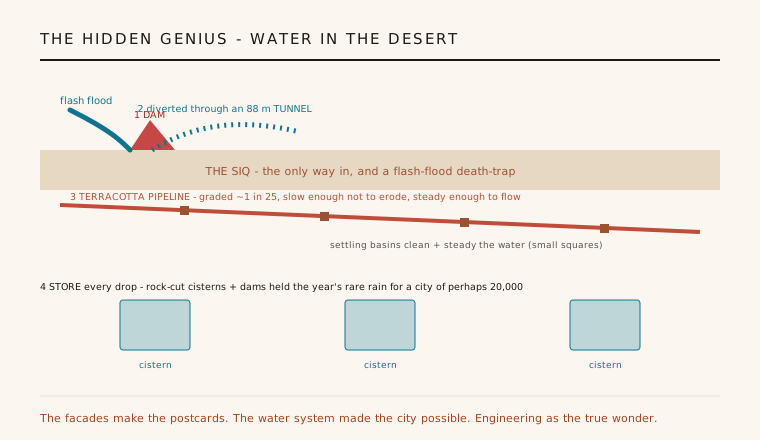
At the mouth of the Siq they built a diversion dam and cut an 88-metre tunnel through the rock, so that floodwater was thrown sideways into a neighbouring wadi instead of down the only path into the city. Along the gorge wall they ran a pipeline of short, interlocking terracotta pipes, sealed at the joints, laid at a gradient calculated with remarkable care — gentle enough that the water would not run fast and erode the system, steep enough that it would never stall — and punctuated by settling basins that cleaned the flow and damped the surges. Studies of these channels (notably the hydraulic analyses by Charles Ortloff) show the Nabataeans were managing flow velocity and partial-flow stability in ways that imply a genuine, repeatable _design methodology_, not lucky guesswork. Every drop that could be caught was stored, in dams and rock-cut cisterns, to carry a population of perhaps twenty thousand people through the dry months.
The lesson is one architects forget at their peril: the visible building is rarely the hard part. The Treasury is the photograph; the water system is the reason there was ever a city to photograph.
6. Why "rose-red"
The poet John William Burgon famously called Petra "a rose-red city half as old as time" — and he had never been there when he wrote it. The colour is real, but it was an accident.
When they were new, these facades did not glow with bare stone at all. They were finished in plaster — crushed limestone and sand — and painted in strong colours, the way the classical world painted all its architecture. Wind and sand have since stripped the plaster away, exposing the raw sandstone beneath, and that stone happens to be banded with an extraordinary range of mineral colour that shifts with the angle of the sun. One writer ran out of architectural words and reached for the kitchen: "fresh blackcurrant, blackcurrant ice-cream, peach, apricot, mulberry, saffron, raw steak, buttermilk and caramel." The effect that makes Petra unforgettable today is therefore the _opposite_ of what its builders intended — they meant it to be smooth and brightly painted, and time has given us something stranger and more beautiful instead.
7. Fall, silence, and rediscovery
Petra's wealth was tied to a single thread — the overland incense road — and when that thread was cut, the city had no other reason to exist. As the Romans shifted trade to maritime routes down the Red Sea, the caravans thinned. Rome annexed the kingdom in AD 106. Then, in AD 363, a massive earthquake wrecked much of the city and, critically, much of the water system that made desert life possible. Urban life slowly became untenable; the statues were defaced, the tombs decayed, and the great carved chambers for the dead became, in the end, rock-shelters for shepherds. For more than a thousand years Petra was known to the Bedouin who lived among its ruins and to almost no one else — a rumour in the West, half-believed to be a myth.
It re-entered history in 1812, when a young Swiss explorer, Johann Ludwig Burckhardt, travelling in disguise and claiming he wished to sacrifice at the nearby tomb of Aaron, persuaded a local guide to lead him through the Siq — and became the first outsider in centuries to see the Treasury. Petra was inscribed as a UNESCO World Heritage Site in 1985, voted one of the New 7 Wonders of the World in 2007, and remains under active excavation: the 2024 discovery of an intact tomb beneath the Treasury is a reminder that the rose-red city is still giving up its secrets.
8. What a modern architect can learn from Petra
This is the question we ask of every building in this series. Petra answers it generously.
- Design with the site, not against it. Petra is not placed _on_ its landscape; it is carved _into_ it. The architecture and the geology are the same material. The most powerful contemporary buildings still come from architects who treat the ground, the rock, the climate and the light as collaborators rather than obstacles.
- The approach is part of the building. The Treasury would be a fine facade in a museum and a transcendent one at the end of the Siq. Petra teaches that _sequence_ — what you conceal, what you reveal, and when — can be as much a part of architecture as the object itself.
- Subtractive thinking. We are trained to add. Petra is a standing argument for the power of taking away — of carving, void, and the shaping of empty space. Some of the finest modern architecture is, in spirit, subtractive.
- The engineering _is_ the architecture. The facades are famous; the water system is why they exist. A building that looks magnificent but cannot manage its water, its structure, its heat and its services is, like a Petra with no cisterns, a beautiful thing that cannot live. (It is the same lesson our Facade Engineering course makes for the modern envelope.)
- Build for time. The Nabataeans chose a method that traded enormous up-front effort for near-permanence. Two thousand years later, their decision looks very wise.
In Amogh's frame
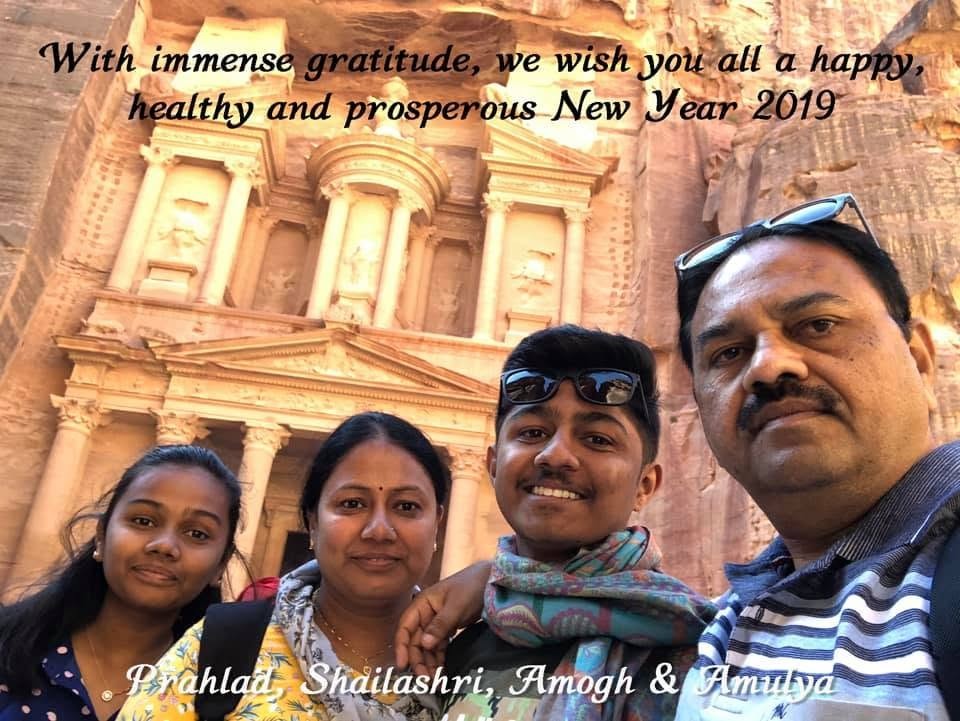
Amogh — centre, smiling — with his family before the Treasury at Petra, the very monument this article opens with. The photograph was the family's New Year greeting for 2019. Two thousand years of carved stone, and on one ordinary morning a family stood before it and smiled into a phone. Studio Matrx is built in Amogh's memory; it felt right that the first of the world's great buildings we wrote about is one he stood before himself, with the people who loved him. More about Amogh.
References & further reading
1. Ortloff, C. R. — The Water Supply and Distribution System of the Nabataean City of Petra (Jordan), 300 BC–AD 300. Cambridge Archaeological Journal (2005).
2. Ortloff, C. R. — Hydraulic Engineering at 100 BC–AD 300 Nabataean Petra (Jordan). Water (MDPI), 12(12): 3498 (2020). https://www.mdpi.com/2073-4441/12/12/3498
3. UNESCO World Heritage Centre — Petra (inscribed 1985). https://whc.unesco.org/en/list/326
4. Smithsonian Magazine / NPR — Hidden tomb with twelve skeletons discovered beneath the Treasury at Petra (2024).
5. A. H. Layard (1887) and J. W. Burgon's poem Petra (1845) — period descriptions of the rose-red city.
Last verified 2026-06-29. Dimensions and attributions for the rock-cut monuments follow standard archaeological reference works and are given as widely accepted approximations.
Export this guide
Related Guides — Deep-dive reading
The Royal Tombs of Petra: Palaces for the Dead, Carved From a Cliff
How the Nabataeans — Arab traders grown rich on frankincense and myrrh — carved a whole city of tombs into the multicoloured sandstone of Jordan, cutting monumental facades from the top down out of the living rock, crowning the desert with the Treasury and the Monastery, and keeping it all alive with a water genius that made a great city bloom where there was no river.
Architectural WondersChan Chan: The Vast City of Mud Where Every King Built His Own Palace
On the desert coast of Peru sprawl the ruins of the largest city ever built of mud — a thousand-year-old capital of adobe walls three storeys high, carved with fish and seabirds, that survived only because it almost never rains. It was a city of ten royal palaces, one for each king, driven by a strange rule of inheritance; and today, an earthen city in a warming world, it is racing the rain to survive. The ninth article in our chapter on the palaces and pleasures of worldly power.
Architectural WondersGreat Zimbabwe: The Stone City Europe Refused to Believe Africans Built
In the hills of southern Africa stand the largest ancient stone ruins south of the Sahara — a whole city of massive granite walls built without a drop of mortar, the wealthy capital of a gold-trading kingdom. For a century, colonists refused to accept that Africans had raised it, and invented every other builder they could. This is the story of that architecture, and of the lie it outlived. The article that closes our chapter on the palaces and pleasures of worldly power.
Architectural WondersRelated Tools — Try Free
Design Style Finder Quiz
Answer 10 visual questions to discover your Indian interior style profile with materials and colours.
Interactive QuizHealing View Impact Calculator
Evidence-Based Design dashboard quantifying the recovery impact of nature view + daylight factor on analgesic use, length of stay, and HCAHPS patient-experience uplift. Calibrated against Ulrich 1984 (Science), Park & Mattson 2008, and the CHD EBD evidence base.
EBD CalculatorHome Colour Studio
Colour every room — living, bedroom, dining, kitchen, bathroom — surface by surface in any HEX/RGB/CMYK colour, or from 80+ curated Indian shades.
Colour Studio