
Japandi & Scandinavian Curtain Styles (India 2026)
The two calm-minimalist styles that share one idea — light-filtering linen, floor-length restraint and warm-neutral palettes — and exactly how to adapt their soft daylight look to bright, glaring Indian light.
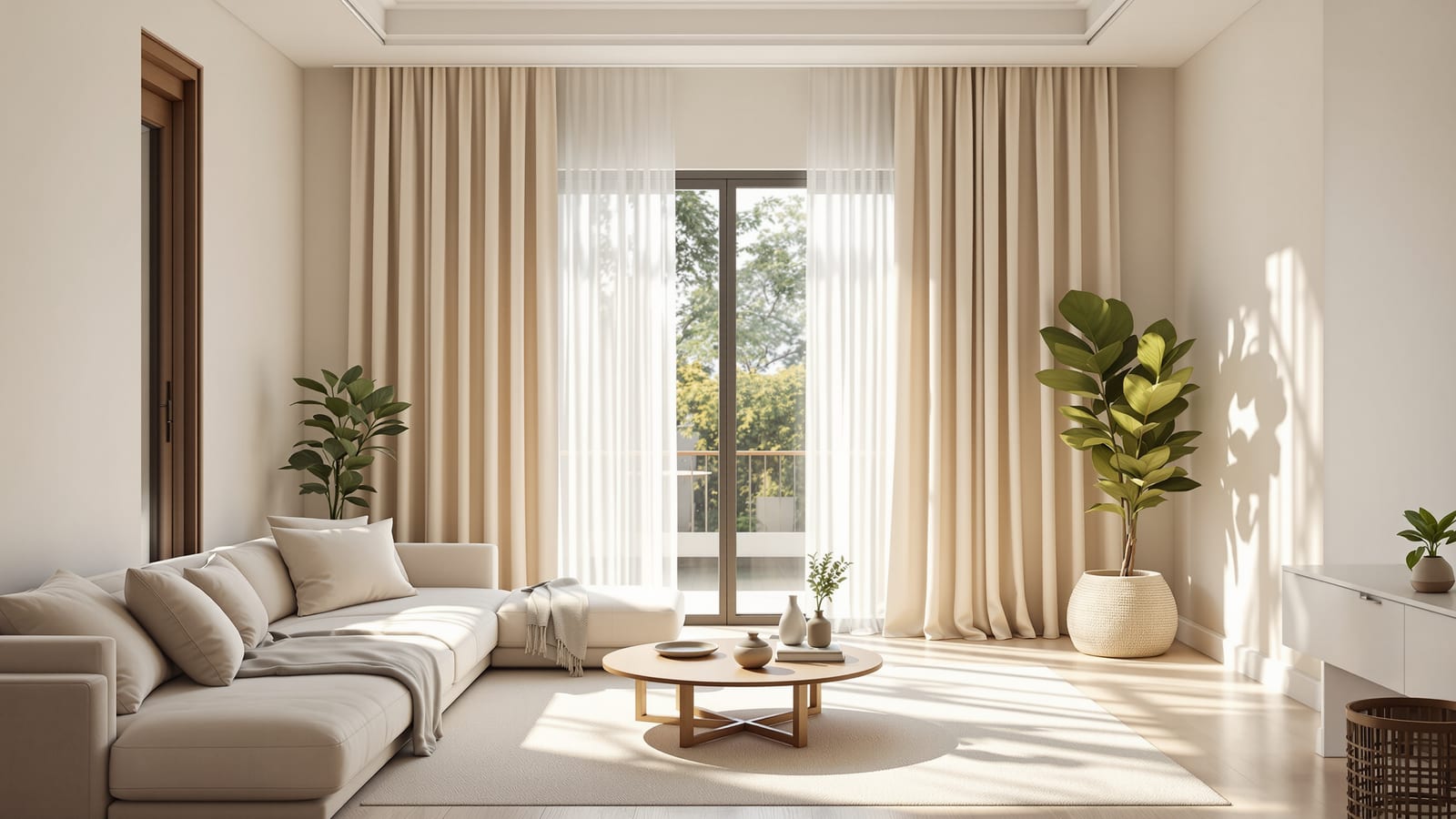
There is a particular kind of window that stops you in a photograph: a tall, pale curtain of natural linen, falling all the way to the floor, with daylight pouring softly through it as though the room itself were breathing light. That look has a name now — two names, really. Scandinavian and Japandi are the two related calm-minimalist styles behind almost every serene, light-filled interior you have saved to a mood board. They share the same instinct — muted naturals, soft daylight, floor-length restraint, no fuss — and they differ in warmth. This guide explains both, shows how they relate, and is honest about the one thing that trips them up in an Indian home: our light is not soft Nordic daylight. It is bright, direct and often harsh, and these styles need a small adaptation to work here.
Scandinavian and Japandi curtains are not about a fabric or a colour. They are about a feeling — a room that is calm, light and uncluttered — and the curtain is simply the quietest way to achieve it.
Two styles, one family
Both styles grew from the same minimalist root, so they look like cousins. Knowing what each prizes helps you lean the palette the right way.
Scandinavian design grew up in countries starved of winter sun, so it worships light. Its curtains are pale and deliberately translucent — white, ivory or the palest grey — kept airy so every scrap of daylight floods in. The mood is bright, crisp and fresh. A Scandi window almost wants to disappear so the light can do the work.
Japandi is the marriage of Japanese restraint and Scandinavian warmth. It keeps the calm and the natural fibres but pulls the palette warmer and more grounded — oatmeal, clay, mushroom, sand and soft charcoal — in matte weaves with a visible texture. The mood is quieter, earthier and a little more enveloping. Where Scandi is bright and open, Japandi is warm and still.
The shared DNA is what matters most: light-filtering natural fabric, floor-length panels, warm or cool neutrals, and almost no decoration. Both belong to the broader minimalist curtain family, and both reward the same discipline — take away until only the curtain and its fall remain.
The palette and fabric, side by side
The whole effect lives in two choices: the colour and the cloth. Get these right and the rest follows.
| Style | Typical palette | Fabric & weave | Mood |
|---|---|---|---|
| Scandinavian | White, ivory, palest grey | Light linen-sheer, airy cotton-linen | Bright, crisp, light-flooded |
| Japandi | Oatmeal, clay, mushroom, sand, charcoal | Matte natural linen, visible weave | Warm, grounded, calm |
| Soft hybrid | Greige, putty, warm stone | Cotton-linen blend, gentle texture | Tonal, tone-on-tone, recessive |
A few rules hold across all three columns:
- Natural fibres, matte finish. Linen, cotton, and cotton-linen blends in a daylight-filtering weight. No sheen, no shimmer, no print. Texture is allowed — in fact a visible weave is the whole charm — but pattern is not.
- Tone-on-tone. The curtain should sit within a shade or two of the wall behind it, so it merges into the room rather than announcing itself. Our curtain colour selection guide explains how to read undertones so an oatmeal stays warm and does not drift pink or green in evening light.
- Floor length, always. These styles never stop at the sill. The panel runs to the floor — just kissing it or with a small break — and ideally from as high as possible, so the eye reads a tall plane of soft cloth.
For most Indian homes, where light is abundant and warmth reads as comfort, the Japandi end of this spectrum tends to sit more naturally than stark Nordic white — a warm oatmeal feels intentional, while a pure white sheer can read as thin or unfinished in our strong light.
The Indian-light problem — and the fix
Here is the honest caveat these styles rarely mention. Scandinavian curtains were designed for a sky that is grey and gentle for months on end. A loose, pale, translucent sheer in Stockholm filters a soft, weak daylight into something lovely. Hang that same fabric on a south or west window in Chennai, Pune or Delhi and it does something different: it lets through a fierce, glaring light that bleaches the room, heats it up, and washes out everything you own.
So the adaptation is not to abandon the look — it is to choose the fabric for our light:
- Filter, do not just admit. Pick a slightly denser, more textured linen or cotton-linen weave rather than the airiest possible sheer. It still glows with daylight, but it tames glare instead of waving it through. Our linen curtains guide covers the weights that filter well in Indian sun, and the sheer curtains guide explains how a tighter weave cuts glare without going dark.
- Choose fade-resistant fabric on bright windows. Pale naturals show UV yellowing and sun damage faster than deep colours, and Indian sun is relentless. Ask specifically for fade-resistant or sun-tolerant linen on south and west faces.
- Mind the heat. A single light-filtering layer looks beautiful but does little against the genuine heat gain of a west window. The calm-minimalist fix is to hide a second capability rather than stack a visible one: a slim, fully recessed roller blind or honeycomb shade inside the window reveal handles heat and night privacy, and disappears by day so the room still reads as one quiet linen curtain.
- Solve night privacy quietly. A pale Scandi sheer that hides you perfectly by day becomes a brightly lit stage to the street after dark. In a dense Indian neighbourhood, plan that hidden second layer, or choose a Japandi dim-out weight as your single working layer in rooms that matter at night.
Done this way, you keep the soft-daylight look you fell for and lose the glare, heat and yellowing that would otherwise spoil it.
Hardware and hang: keep it invisible
These styles collapse the moment a chunky decorative rod with finials appears. The hardware has to vanish so the cloth is the only event.
- A slim ceiling-mounted or recessed track so the curtain drops straight from the ceiling line, making the wall read taller and the curtain read as architecture.
- A simple wave (ripple) fold or a modest pencil pleat — calm, even vertical lines, never an ornate gathered heading. Keep fullness around 2× the track width: full enough to drape softly, restrained enough to stay quiet.
- Wall to wall where you can, so the eye reads a plane of fabric rather than a framed window.
- Nothing else. No tiebacks, no tassels, no valance, no contrast border. The fabric and its fall carry the whole look.
The one timing rule that matters: a hidden or recessed track must be designed before the false ceiling is built. Retrofitting one afterwards is the most common avoidable regret in this category, so decide it at the ceiling-design stage.
Is this style right for your room?
Japandi and Scandinavian curtains shine in living rooms, bedrooms and studies in apartments and contemporary homes — anywhere the architecture is already fairly clean. They struggle in rooms busy with pattern, carved furniture and ornament, where a plain linen panel reads as unfinished rather than serene. The restraint only looks intentional when the rest of the room is restrained too.
A last honest note on upkeep: pale naturals show dust, monsoon damp marks and UV yellowing more than dark, busy fabrics, so this look asks for a little more care — regular vacuuming and occasional cleaning — to keep feeling effortless. The calm is real, but it is maintained, not free.
To pull it together, work through it in order: decide the room's night job, pick a warm or cool neutral within a shade of your wall, choose a fade-resistant natural weave that filters rather than merely admits Indian light, commit to a hidden track, and run the panel floor to ceiling at about 2× fullness. Then add nothing.
Design your calm windows with Studio Matrx. Get a tailored recommendation on whether a single light-filtering layer or a hidden two-layer setup suits your room and orientation with the Window Treatment Selector, and find your perfect muted neutral with the Curtain Colour Selector. For the full system — types, fabrics, tracks and room-by-room logic — start with the Complete Curtain Guide for Indian Homes and explore the wider Window Treatments cluster.
Export this guide
Related Guides — Deep-dive reading
Minimalist Curtain Design: Quiet, Clean Windows (India 2026)
Restraint as the whole look — one clean layer, wave folds, hidden tracks and tonal neutrals — plus the two things minimalism quietly trades away and how to solve them without spoiling the calm.
Window TreatmentsModern Curtain Design Ideas for Indian Homes (2026)
The contemporary look decoded — wave fold, floor-to-ceiling drops, hidden ceiling tracks, restrained neutral palettes, sheer-plus-dim-out layering, motorisation and the 2026 trend directions from Japandi calm to contemporary Indian.
Window TreatmentsCurtain & Window Treatment Trends 2026 (India)
Wave-fold clean lines, ceiling tracks and floor-to-ceiling drops, natural textured fabrics, earthy and jewel tones, mainstream motorisation, layered sheers and considered Indian craft — what's in for 2026, with honest trend-versus-timeless guidance.
Window TreatmentsRelated Tools — Try Free
Cross-Ventilation Analyzer
Estimate airflow and air changes per hour (ACH) from room size, window areas, layout, and local wind — with NBC 2016 Part 8 compliance check.
Ventilation CalculatorWindow Treatment Selector
Curtains, blinds or a layered system? Answer five questions about your room and get a specific recommendation.
SelectorCurtain Colour Selector
Get curtain colours that suit your wall colour, style and goal — with real swatches and the reasoning.
Selector