
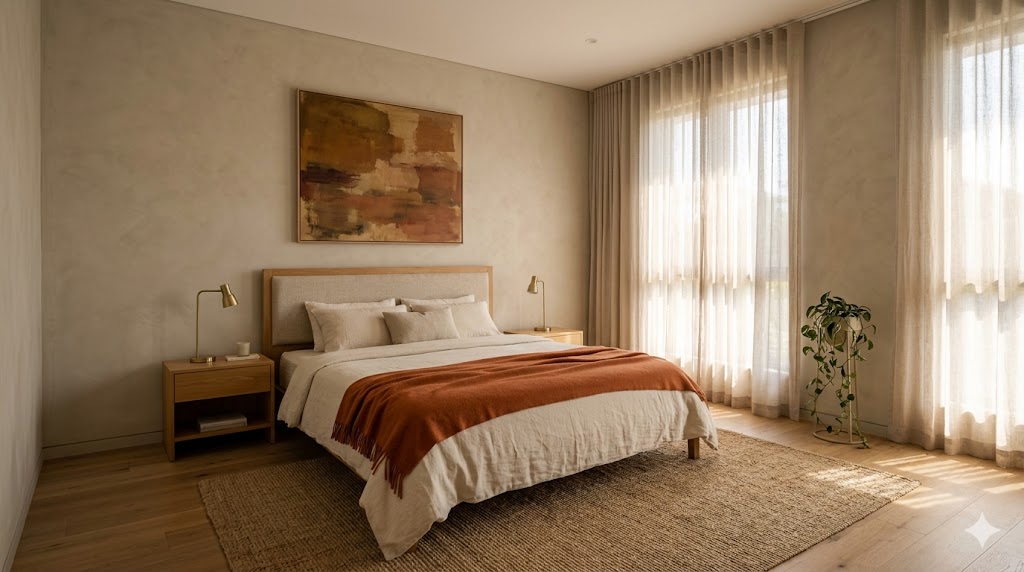
Warm Minimal Bedroom Inspirations for Indian Homes
Oat, terracotta, mushroom, olive and espresso palettes — five pillars, lighting layers, dimensions, and 20 numbered ideas
Warm minimalism is what happens when a bedroom decides that the discipline of "less" should not also mean the discipline of "cold". It keeps the empty floor, the single piece of art, the matching side tables, the disciplined material list — but it picks oat instead of pure white, oak instead of grey laminate, brass instead of chrome, linen instead of synthetic. The result is a bedroom that looks restrained at first glance and feels warm at every glance after.
This guide is a reference for warm-minimal bedrooms in Indian apartments. It covers palette temperature, the five pillars, bedroom layout proportions, the three-layer lighting that defines the genre, and twenty numbered ideas across five palette directions. The intent is not Pinterest — it is a working brief you can hand to a carpenter, an electrician, and an upholsterer.
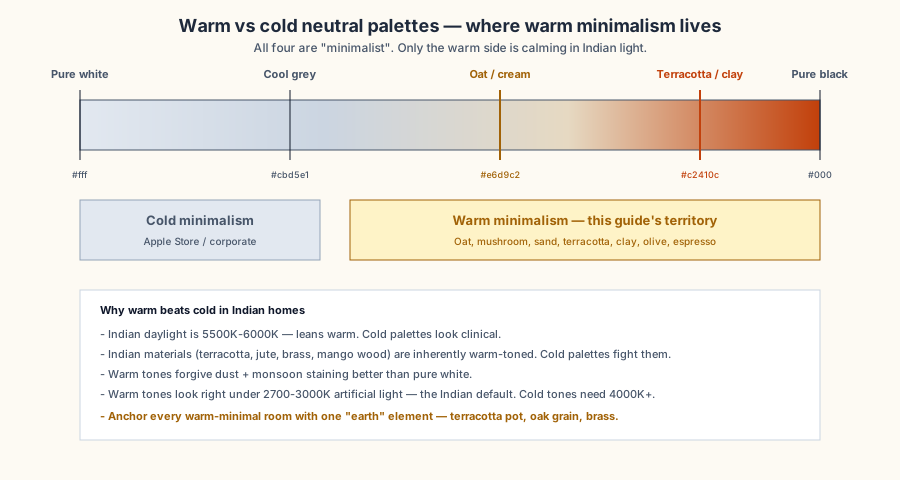
Why Warm, Not Cold
Indian daylight is warm. Direct sunlight in India measures around 5500-6000 K — Indian apartments are flooded with warmer light than Nordic homes. A pure white wall that looks crisp in Stockholm looks clinical in Mumbai. A grey-toned veneer that feels modern in Copenhagen feels dead in Bengaluru.
Warm minimalism is the same minimalist discipline, with the palette shifted one notch warmer to meet Indian light, materials, and culture. Pure white becomes warm white or ivory. Cool grey becomes mushroom. Pale birch becomes honey oak. Synthetic chrome becomes brass. Wool becomes linen + jute + cotton. Stark becomes calm.
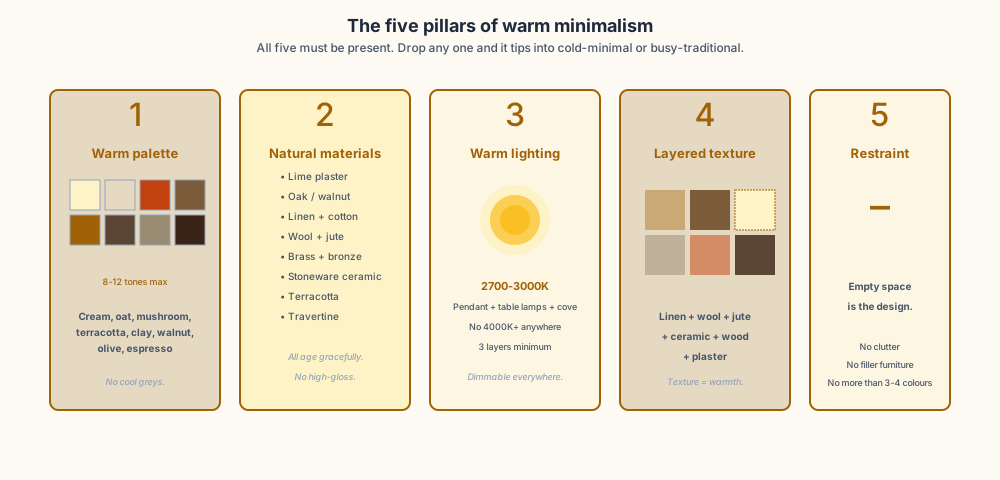
The Five Pillars
Warm minimalism is not a colour palette — it is five pillars, and you must hit all five for the room to actually feel warm-minimal rather than beige-cluttered or cold-minimal.
1. Palette — 8 to 12 tones maximum, all warm-spectrum. Cream, oat, mushroom, terracotta, clay, walnut, olive, espresso are the eight building blocks. No cool greys, no jewel tones, no primary colours.
2. Materials — natural and matte. Lime plaster, oak / walnut veneer, linen, cotton, wool, jute, brass, stoneware ceramic, terracotta, travertine. All age gracefully. No high-gloss, no plastic, no chrome.
3. Lighting — warm and layered. 2700-3000 K everywhere, dimmable everywhere, minimum three layers (ambient + task + accent). Never a single overhead source.
4. Texture — layered to the point of richness. Linen + wool throw + jute rug + ceramic vase + plaster wall + oak side table is six textures in one corner. Texture is where warmth comes from when colour is restrained.
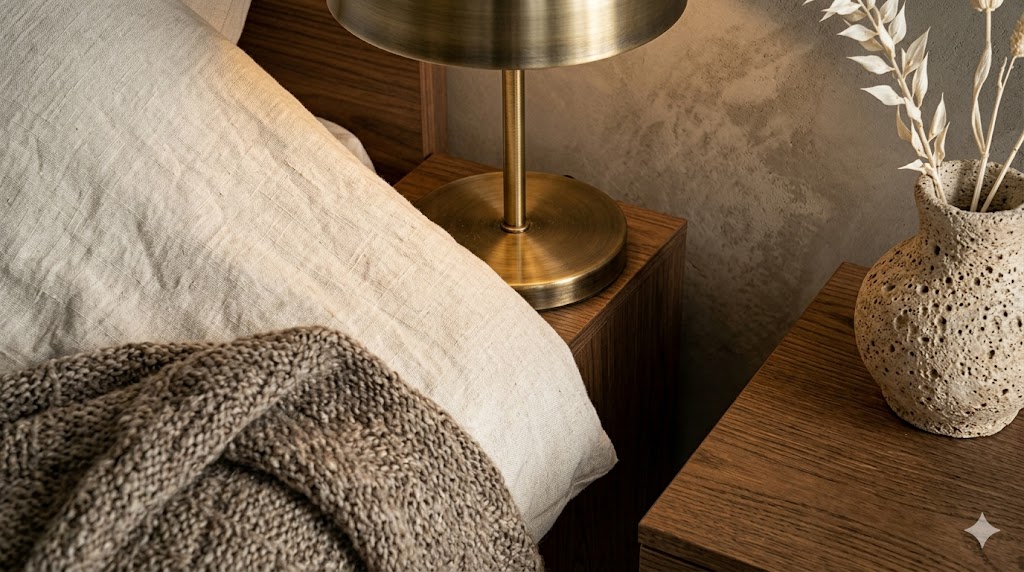
5. Restraint — empty space is the design. 60-70% of floor area visible at any time. No filler furniture, no decorative clutter, no more than three or four colours.
Drop any pillar and the room slides into a different style. Drop palette and it becomes cold minimalism. Drop materials and it becomes "Pinterest minimalism" (looks right in photos, feels off in life). Drop lighting and it becomes a showroom. Drop texture and it becomes flat. Drop restraint and it becomes warm-traditional Indian.
Bedroom Layout Fundamentals
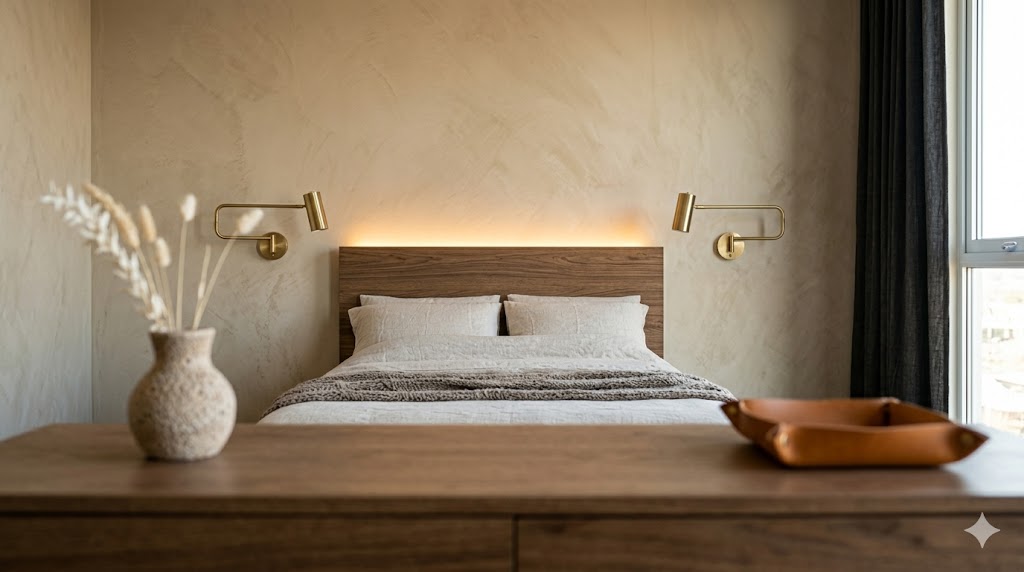
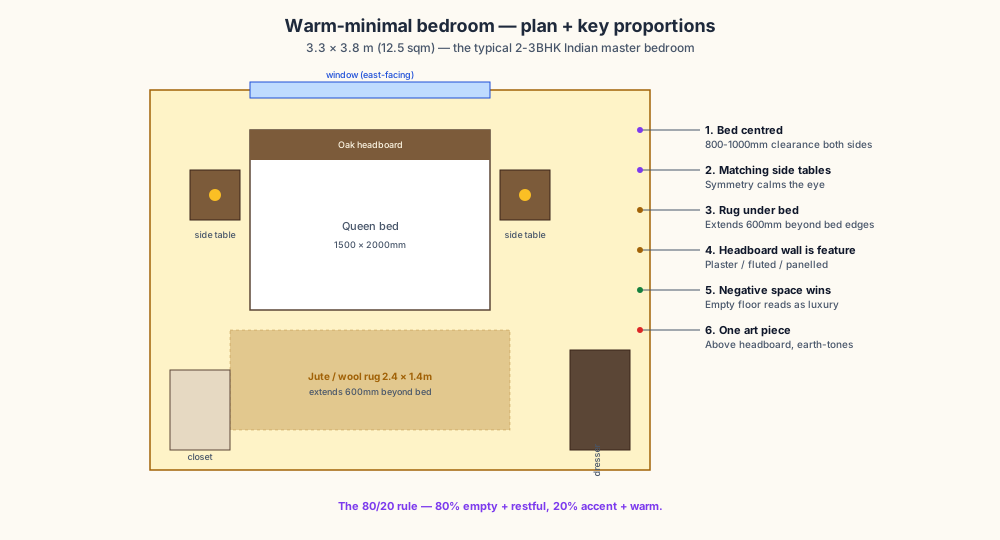
A warm-minimal bedroom is built on six layout rules. Most Indian master bedrooms (3.0-3.5 m × 3.5-4.0 m) can satisfy all six without compromise:
1. Bed centred against the longest wall — typically the wall opposite the door. 800-1000 mm clearance on both sides for matching side tables and air.
2. Matching side tables — symmetry calms the eye. Identical wood, identical lamps, identical proportions. Do not mismatch.
3. Rug under the bed — wool, jute, or wool-jute blend. Extends 600 mm beyond the bed edges on the three exposed sides. A small rug under a big bed is the single most common mistake.
4. Headboard wall is the feature — soft lime plaster, fluted MDF, panelled veneer, or a single large abstract painting in earth-tones. Everything else in the room is supporting cast.
5. Negative space wins — leave the floor empty. A full bedroom does not look luxurious; an empty bedroom does.
6. One art piece — above the headboard or on the wall opposite the bed. One. Never two, never three, never a "gallery wall".
The Three-Layer Lighting Scheme
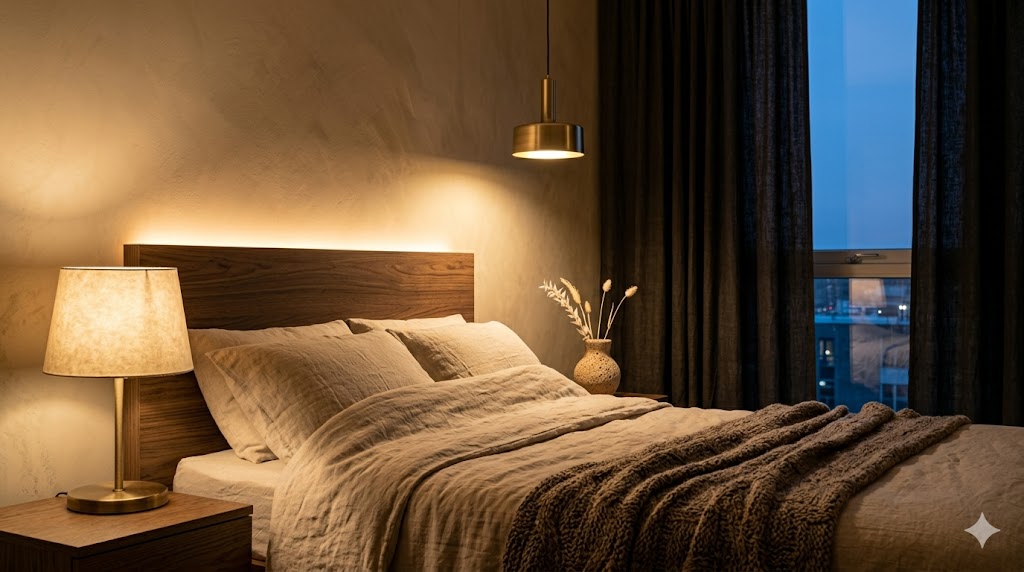
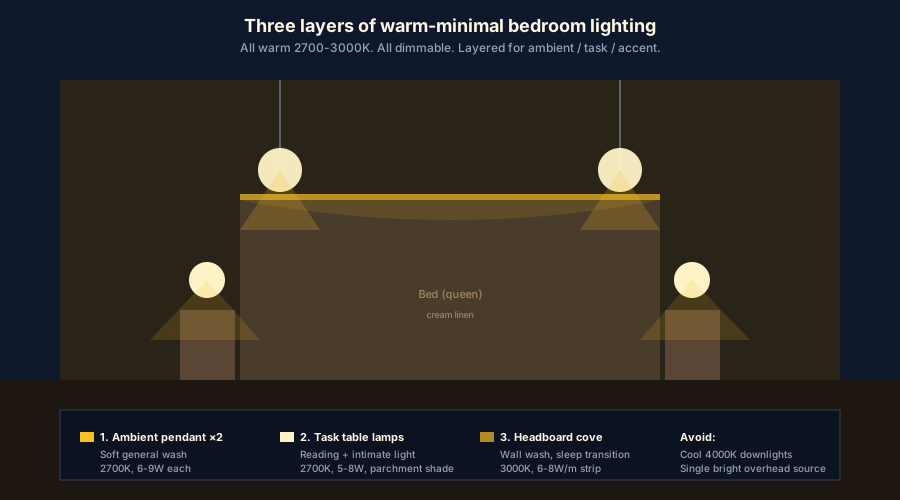
Lighting is what separates warm minimalism from beige minimalism. The scheme is non-negotiable:
| Layer | Fixture | Colour temp | Wattage | Function |
|---|---|---|---|---|
| 1. Ambient | 2 small ceiling pendants OR a single dimmable downlight | 2700 K | 6-9 W each | General soft wash |
| 2. Task | 2 matching bedside table lamps OR wall-mounted swing-arm | 2700 K | 5-8 W | Reading + intimate light |
| 3. Accent | LED strip behind headboard / above wardrobe | 3000 K | 6-8 W per metre | Sleep transition + wall wash |
Every fixture is dimmable. A single non-dimmable light in a warm-minimal bedroom is a project failure. The room needs to slide from morning energy (full ambient + open curtain) to bedtime calm (just cove + one lamp) without any harsh state in between.
Twenty Warm-Minimal Bedroom Ideas
The twenty ideas below are organised by the five palette directions. Each is a tight brief — adapt the dimensions to your room and the materials to your budget.
Oat + Cream (Ideas 1-4)
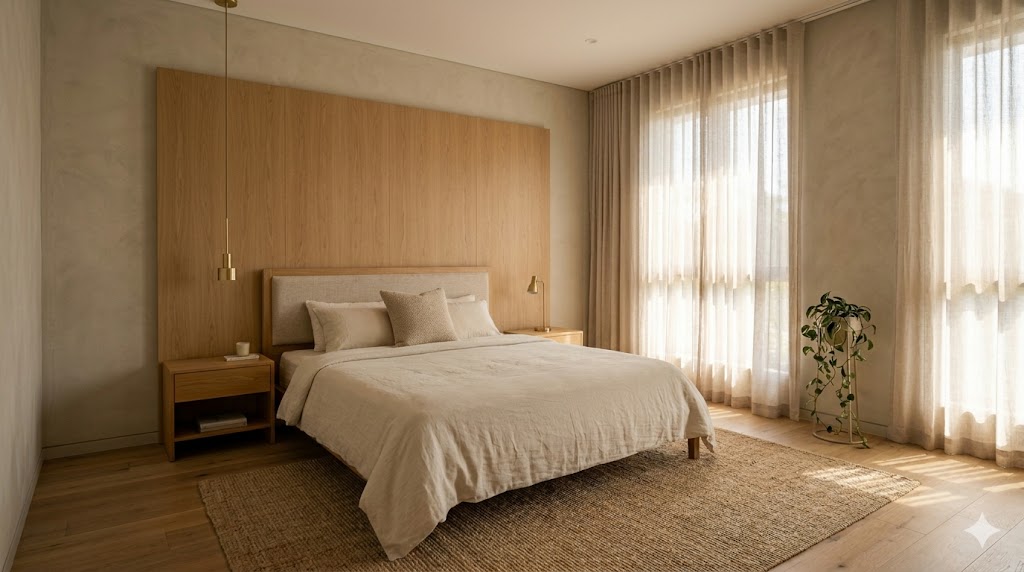
1. The calmest possible bedroom — Oat plaster walls, oak headboard, cream linen bed with no contrast colour, two matching oak side tables, two parchment-shade table lamps, light oak floor with a jute rug. No art, no clutter, no fight.
2. Soft-curve oat bedroom — Same palette, but with curved arches replacing rectangular openings and a curved upholstered linen headboard. Adds softness without breaking restraint.
3. Brass-accented oat — Pure oat palette with a single brass swing-arm wall lamp replacing one of the bedside tables. Adds a single warm metallic note.
4. Linen-curtain oat — Same oat palette, but with sheer cream linen drapes from floor to ceiling on the window wall. The drapes become a fifth pillar of the room.
Terracotta + Clay (Ideas 5-8)
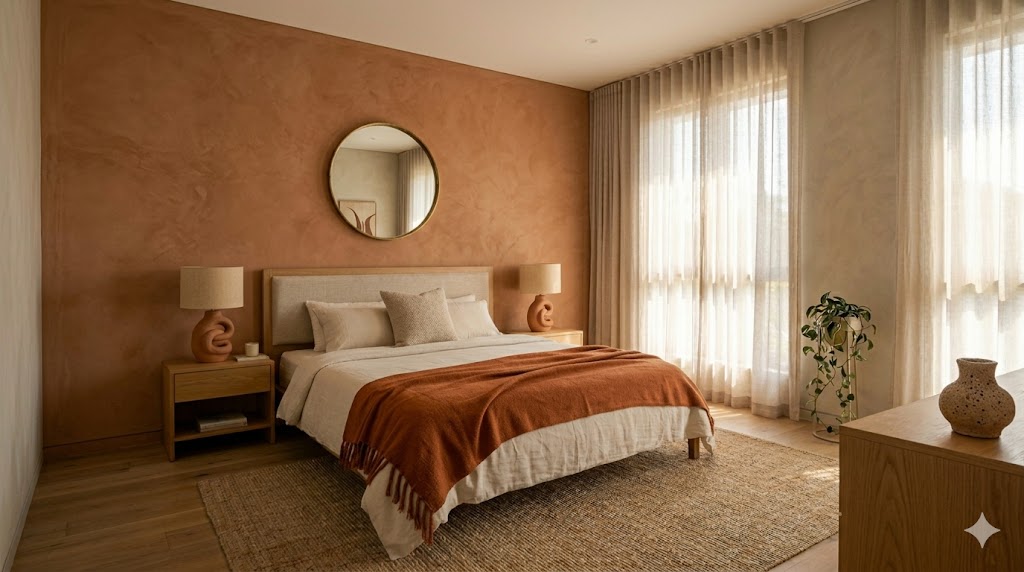
5. Terracotta accent on cream — Cream walls and bedlinen with one deep terracotta throw blanket and an unglazed terracotta vase on the dresser. The most adoptable warm-minimal palette for Indian homes.
6. Clay plaster headboard wall — Lime plaster in a clay tone (#c2410c-adjacent) on the headboard wall, cream walls elsewhere, oak headboard sitting flush against the clay panel.
7. Terracotta ceramic lamps — Cream walls, oak bed, cream linen — and two large unglazed terracotta table lamps on the bedside tables. The lamps are the room.
8. Earth-tone art over terracotta — Cream-and-clay palette anchored by a single large abstract painting above the headboard in muted earth tones (terracotta, ochre, sand). One painting, one personality.
Mushroom + Walnut (Ideas 9-12)
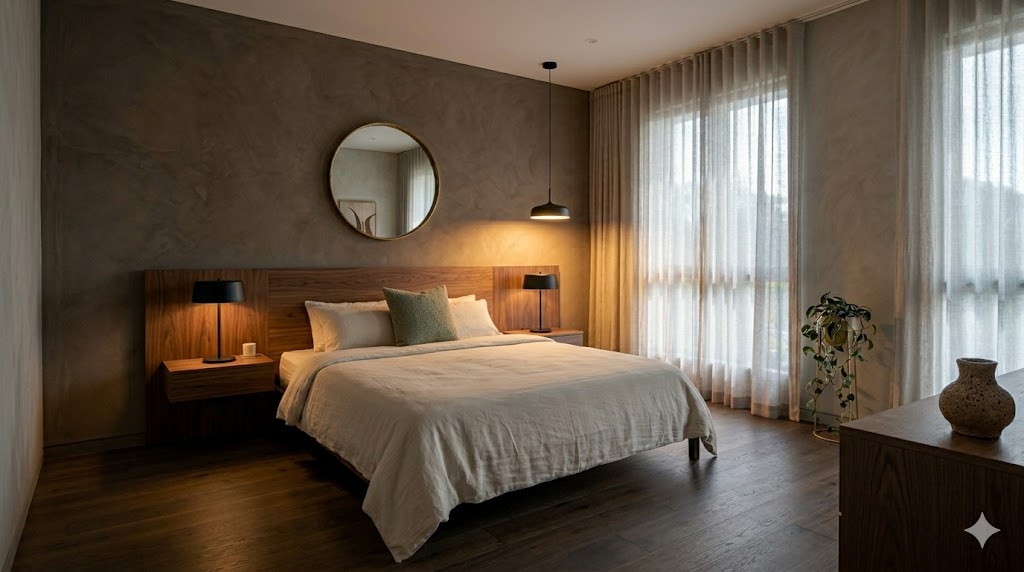
9. Mushroom plaster bedroom — Deep mushroom-grey lime plaster on all walls, walnut headboard panel, cream linen with one sage cushion. Mature and sophisticated.
10. Walnut panelled feature wall — Mushroom walls everywhere except a single fluted walnut panel behind the bed. Cream linen, matte-black sconces.
11. Espresso-and-mushroom — Mushroom walls, espresso-stained oak bed, cream linen, matte-black wall sconces. The grown-up bedroom.
12. Mushroom with brass-bronze — Mushroom walls, walnut bed, brushed bronze table lamps, cream linen with single olive throw. Layered material story.
Olive + Sage (Ideas 13-16)
13. Sage accent on cream — Cream walls, oak bed, cream linen with one sage-green throw and a sage-glazed ceramic vase. The quietest plant-adjacent palette.
14. Olive plaster headboard wall — Lime plaster in a soft olive tone behind the bed, cream walls elsewhere, oak headboard, cream linen. Biophilic without being literal.
15. Sage-glazed lamps — Cream walls, oak bed, two sage-glazed ceramic table lamps as the visual anchors. Strong and quiet at once.
16. Plant-feature olive — Cream-and-sage palette with one large tall houseplant (fiddle-leaf fig or olive tree) in a stoneware planter as the second visual anchor opposite the bed.
Espresso + Ivory (Ideas 17-20)
17. Espresso headboard wall — Ivory walls everywhere except a single espresso-stained oak panel behind the bed (full headboard wall). Cream linen, single warm pendant.
18. Espresso bed on ivory — Ivory walls, dark walnut bed, cream linen with one espresso throw. The bed is the anchor.
19. Dark-floor espresso — Ivory walls and bed, dark walnut floor everywhere, light oak side tables to bridge. Strong but airy.
20. High-contrast warm minimal — Ivory walls, espresso headboard, cream linen with a single black-edged throw, matte-black pendant. Disciplined contrast.
Common Mistakes
1. Too much beige — every shade similar = no depth. Always include at least one dark anchor (espresso or walnut).
2. Cool grey infiltration — one cool grey cushion contaminates the entire scheme. Audit the palette honestly.
3. Single-source overhead light — kills the room. Always three layers, always dimmable.
4. Synthetic textures — polyester throw, faux-leather headboard, vinyl plank floor. All three undo warm minimalism instantly.
5. Too many objects — three vases, four throw cushions, two paintings. The room should look like it could host a serious meditation.
6. Symmetry abandoned — mismatched side tables, lamps, art placement. Symmetry is a cheap calm.
Vastu Notes
Vastu Shastra recommends:
- Bed head in the south or east — south for stability, east for energy. Avoid north (associated with restlessness during sleep).
- Avoid mirrors facing the bed — including dresser mirrors that catch the bed.
- Master bedroom in the south-west of the house — the most stable corner.
- No water features or fountains in the bedroom — water symbolises restlessness.
Warm-minimal bedrooms accommodate these rules naturally. The single mirror typically goes on the wardrobe shutter (which is perpendicular to the bed, not facing it). Water features are absent by default. Bed direction is the only call to make consciously.
References:
1. Council of Architecture (India). Interior Design Scope of Services.
2. Bureau of Indian Standards. IS 3646 — Illumination Requirements for Residential Buildings.
3. Bureau of Indian Standards. IS 1328 — Decorative Veneers.
4. International Living Future Institute. Living Building Challenge — Materials Petal (natural materials guidance).
5. CIBSE LG07. Lighting Guide — Bedrooms and Dormitories.
6. Vastu Vidya Pratisthan. Bedroom Vastu for Modern Indian Apartments, 2024.
7. Bureau of Energy Efficiency. Eco-Niwas Samhita 2018 — Residential Lighting Power Density.
8. Royal Institute of British Architects (RIBA). Plan of Work — Stage 4 Technical Design (interior specification format).
9. Indian Concrete Institute. Lime Plaster — Specification + Application Practice (heritage technique guide).
10. Interior Designers' Association of India. Material + Finish Cost Schedule — 2025 update.
Related Guides
- /guides/wardrobe-finish-ideas — material reference for bedroom wardrobes; finishes that pair with each warm-minimal palette
- /guides/architectural-lighting-design-india — deeper lighting reference covering fixture types, circuiting, dimming controls
- /guides/modern-tv-unit-ideas-india — TV unit composition reference if a bedroom TV is part of the brief
- /guides/japandi-apartment-ideas-india — adjacent style with shared restraint and natural materials, lower furniture proportions
- /guides/scandinavian-indian-home-ideas — adjacent style with shared discipline, cooler default palette
Interactive · Warm minimal palette explorer
Oat + cream · #a08560
Bedroom preview
The calmest possible bedroom palette — everything tonal, nothing fighting.
Materials
- ▸Lime plaster walls in oat
- ▸Cream linen bed
- ▸Light oak floor + bedside tables
- ▸Brass-finish lamp
Lighting scheme
2700K everywhere, single warm pendant + 2 small table lamps + cove
Best for
Small bedrooms where you want maximum sense of space and rest
Every palette uses 8-12 tones max. The accent gets ~10-15% of the room. Empty space wins; texture earns the warmth.
Export this guide
Related Guides — Deep-dive reading
Warm Minimal Interiors — A 2026 Style Guide for Indian Homes
Restraint with warmth · Oat & oak & linen · Curated negative space
Design StylesJapandi Apartment — A 2026 Style Guide for Compact Indian Homes
Japanese restraint × Scandinavian function · Low furniture · Two-wood discipline
Design StylesEarthy Interior Palette — A 2026 Style Guide for Indian Homes
Rooted · Regional · Biophilic · Indian craft-anchored
Design StylesRelated Tools — Try Free
Cross-Ventilation Analyzer
Estimate airflow and air changes per hour (ACH) from room size, window areas, layout, and local wind — with NBC 2016 Part 8 compliance check.
Ventilation CalculatorCircadian Light Meter
Patient-centric circadian lighting visualizer for Indian healthcare design — time-of-day × intensity → CCT, melanopic lux (EML / mEDI), melatonin suppression, and an alertness curve. Calibrated against WELL v2 L03 Circadian Lighting Design, CIE S 026:2018, Brainard 2001, and Lucas et al. 2014.
Circadian ToolMaterial Schedule Generator
Generate a room-wise finish schedule — walls, floors, ceilings, trim, and joinery by location.
Material Schedule