
Scandinavian Indian Home Ideas — Adapted for Indian Climate
Where pure Scandi fails in India and what to change — palette swap, room-by-room adaptations, material durability matrix, and 20 numbered ideas
Scandinavian design was born in countries where winter daylight is precious and scarce, where homes are insulated boxes against minus-20 winters, and where pure white walls reflect every photon back into a darkened January living room. India is not Scandinavia. Indian daylight is abundant and warm. Indian apartments are not insulated boxes but porous concrete shells that exchange air, humidity, and dust with the outside. Indian winters in most cities are 18-25°C, not minus 20.
Pure Scandinavian design therefore does not survive an Indian climate well. Sheepskin grows mites in monsoon. Pale birch veneer warps at 80% humidity. Pure white walls look clinical under warm Indian daylight. Chunky wool throws are unusable for seven months a year. Open kitchen shelves get oil-coated within six months in any Indian household that cooks.
This guide is the adaptation manual — what specifically shifts when you bring Scandinavian discipline to an Indian home, how to keep the spirit while changing the materials, and how to add 10-15% Indian craft accent to bridge the cultural gap. It covers the five attribute shifts, the room-by-room adaptations, the material durability matrix, and twenty numbered ideas across the apartment.
Five Attribute Shifts
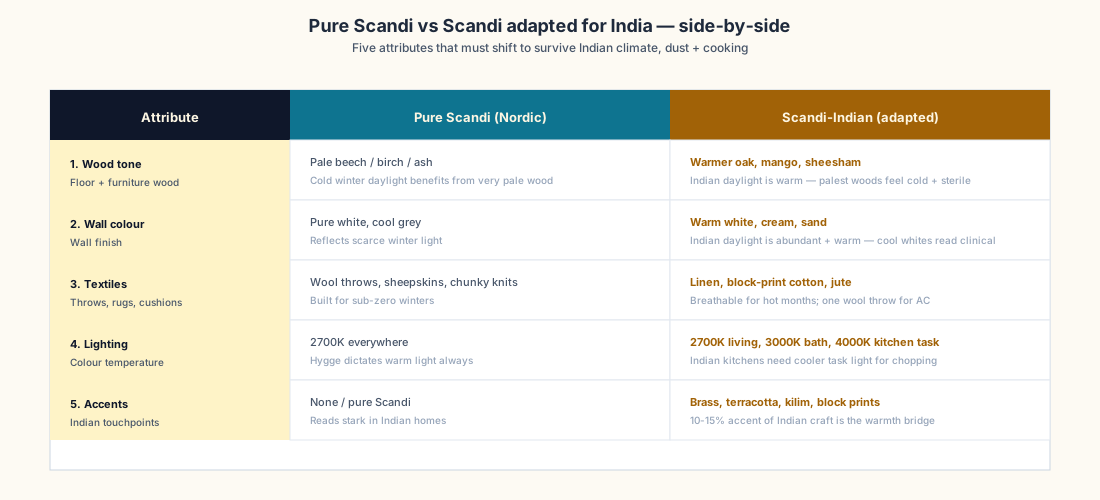
Five attributes must shift between pure Scandi and Scandi adapted for India:
1. Wood tone — pale birch / beech (cold-winter daylight friendly) shifts to honey oak, mango wood, or sheesham (warmer Indian daylight friendly).
2. Wall colour — pure white or cool grey shifts to warm white, cream, or sand. Indian daylight is 5500 K+ — pure whites read clinical, cream reads calm.
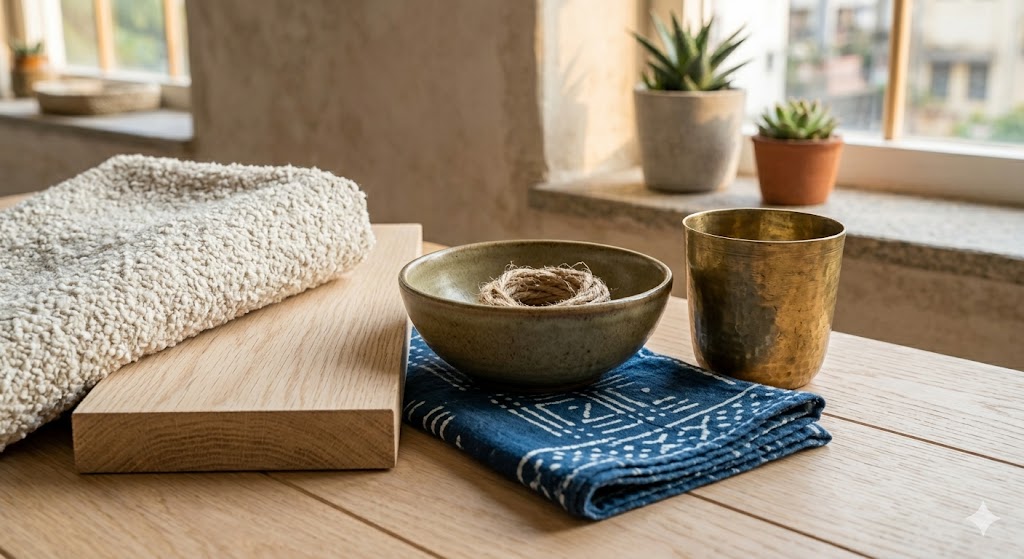
3. Textiles — wool, sheepskin, chunky knits shift to linen, block-print cotton, jute. Breathable, washable, monsoon-tolerant. Keep one wool throw for AC.
4. Lighting — uniform 2700 K everywhere shifts to 2700 K in living + bedroom, 3000 K in bathroom, 4000 K task light in kitchen (Indian kitchens need cooler light for chopping accuracy).
5. Accents — pure Scandi with no decorative accents shifts to 10-15% Indian craft accent (brass, terracotta, kilim, block-print cotton, wood-block prints, stoneware).
After these five shifts, the room remains disciplined, restrained, minimal, and recognisably Scandinavian in spirit — but it now actually works in Mumbai monsoon, Bengaluru dust, and Delhi summer.
The Palette Swap
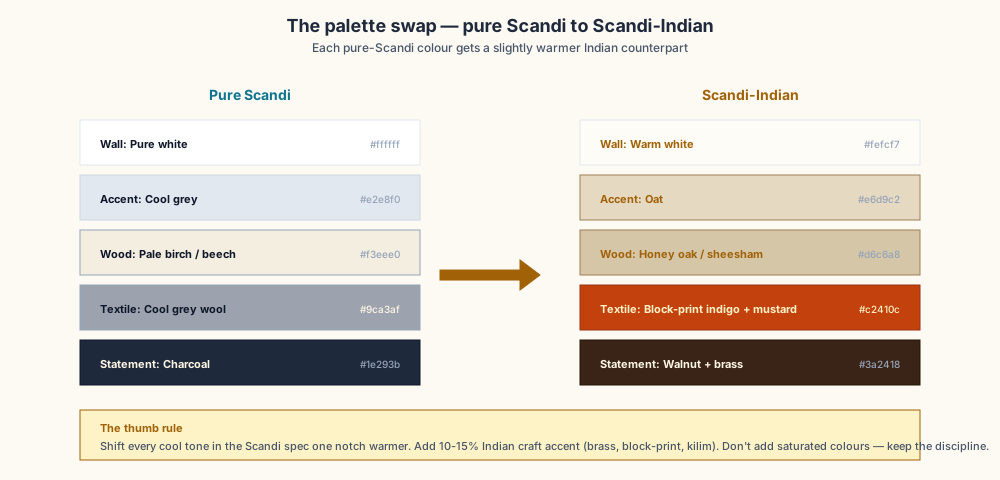
The palette shift, codified:
| Element | Pure Scandi | Scandi-Indian | Why |
|---|---|---|---|
| Wall | Pure white #ffffff | Warm white #fefcf7 | Reads less clinical under warm Indian daylight |
| Accent | Cool grey #e2e8f0 | Oat #e6d9c2 | Warmer tone bridges to Indian craft |
| Wood | Pale birch #f3eee0 | Honey oak / sheesham #d6c6a8 | Warm wood works with Indian materials |
| Textile | Cool grey wool #9ca3af | Block-print indigo / mustard #c2410c | Breathable + culturally connected |
| Statement | Charcoal #1e293b | Walnut + brass #3a2418 | Warmer, less industrial |
The thumb rule: shift every cool tone one notch warmer. Add 10-15% Indian craft accent. Do not add saturated colours — Scandinavian discipline of muted palettes must be kept.
Room-by-Room Adaptations
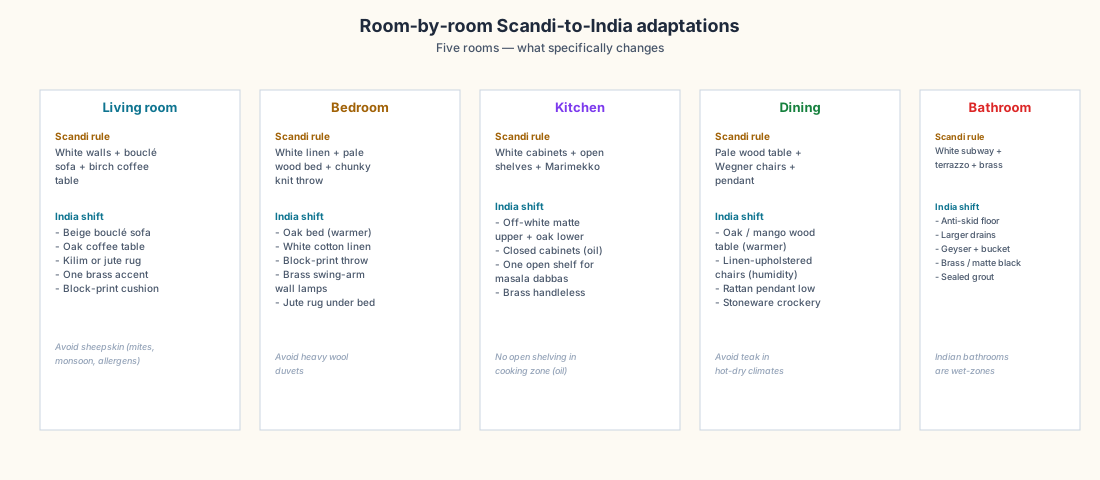
The room-by-room adaptations are specific. The pattern is the same across rooms — warmer wood, warmer wall, breathable textiles, brass accent, Indian craft anchor.
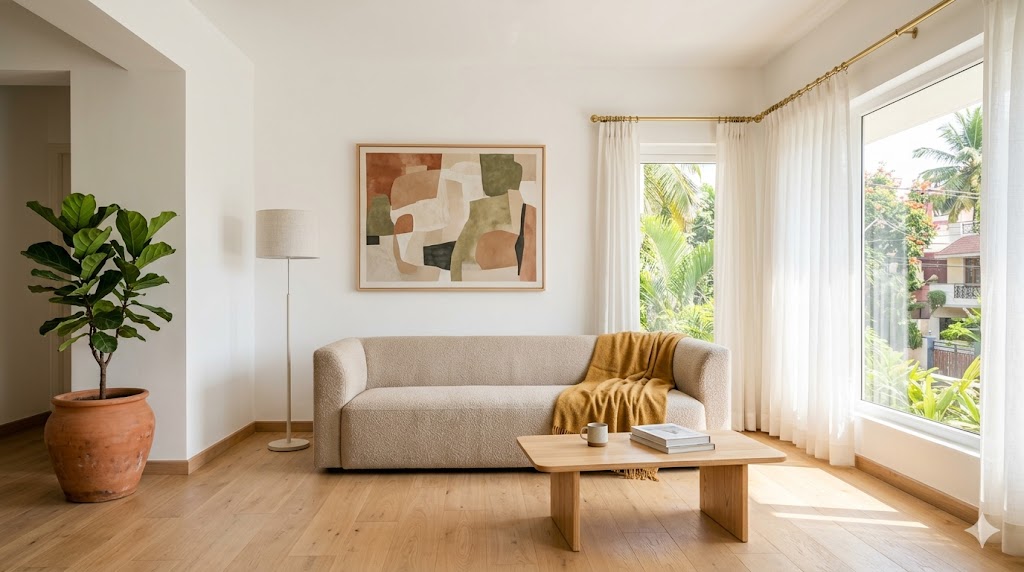
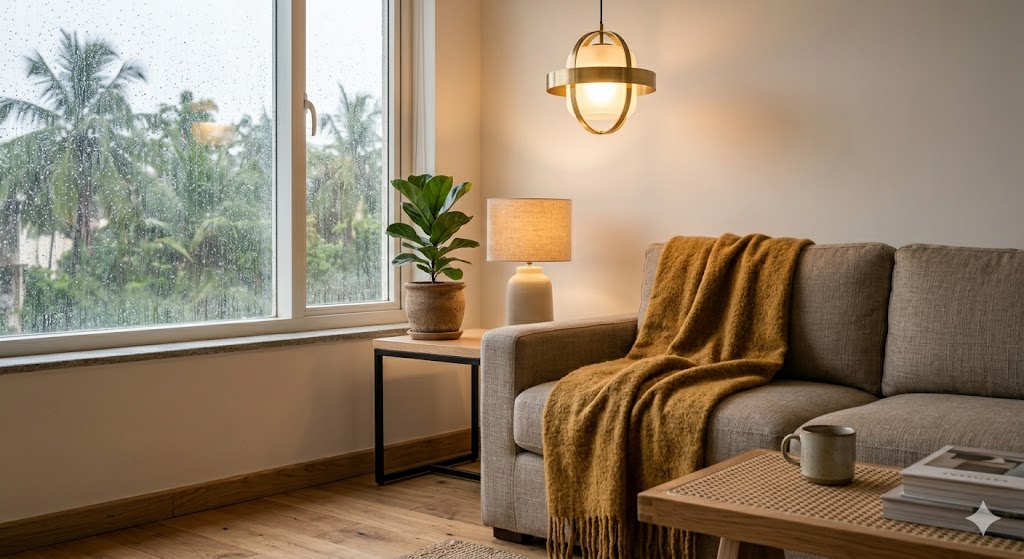
Living room — beige bouclé sofa (not pure white), oak coffee table (not birch), kilim or jute rug (not sheepskin), block-print cushion as accent, single brass accent. Avoid sheepskin (allergen + mildew).
Bedroom — oak bed (warmer than pale birch), white cotton linen (washable), block-print indigo throw, brass swing-arm wall lamps, jute rug under bed. Avoid heavy wool duvets — unbearable seven months / year.
Kitchen — off-white matte upper cabinets (not pure white), oak lower drawers (not birch), brass handleless pulls, closed cabinets in cooking zone (not open Scandi shelving — Indian oil coats everything), one open shelf for masala dabbas away from the stove.
Dining — oak or mango wood round table (not pale birch), linen-upholstered chairs (humidity-tolerant), rattan pendant low, stoneware crockery. Avoid teak in hot-dry climates (cracks).
Bathroom — anti-skid stone floor (mandatory for Indian bucket-bath), warm subway tile, matte-black fittings with brass accent, sealed grout, larger drain. Pure Scandi terrazzo can stay; brass fittings need more polish in Indian humidity.
Material Durability Matrix
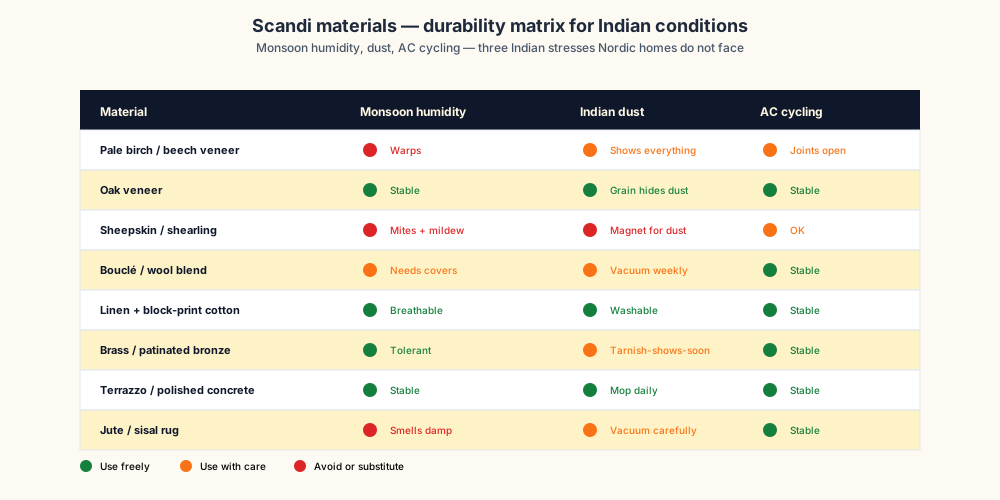
The single most useful piece of decision-making for a Scandi-Indian home is the material durability matrix. Eight common Scandi materials evaluated against three Indian stresses:
| Material | Monsoon humidity | Indian dust | AC cycling |
|---|---|---|---|
| Pale birch / beech veneer | Warps | Shows everything | Joints open |
| Oak veneer | Stable | Grain hides dust | Stable |
| Sheepskin / shearling | Mites + mildew | Dust magnet | OK |
| Bouclé / wool blend | Needs covers | Vacuum weekly | Stable |
| Linen + block-print cotton | Breathable | Washable | Stable |
| Brass / patinated bronze | Tolerant | Tarnish shows | Stable |
| Terrazzo / polished concrete | Stable | Mop daily | Stable |
| Jute / sisal rug | Smells damp | Vacuum carefully | Stable |
The five Scandi materials that work freely in India — oak veneer, linen + block-print cotton, brass, terrazzo / polished concrete (with sealer), and seasoned mango wood. The three to use with care or substitute — pale birch (use oak), sheepskin (use bouclé or kilim), jute (use only in dry climates or AC rooms).
Twenty Scandi-Indian Apartment Ideas
The twenty ideas below are organised by room across living, bedroom, kitchen, dining, and bathroom.
Living Room (Ideas 1-4)
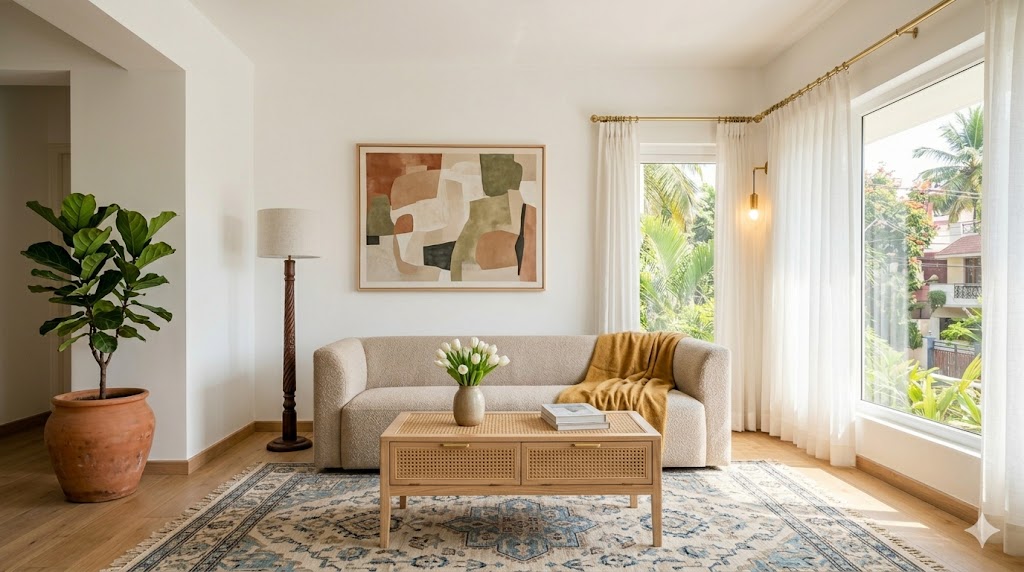
1. Bouclé-and-brass living — Beige bouclé sofa, oak coffee table with brass handles, kilim rug in muted blues + creams over pale oak floor, single ceramic vase with white tulips.
2. Block-print accent Scandi — Pure Scandi base — bouclé sofa, oak table, white walls — but with one block-print indigo cushion and one mustard wool throw. The two Indian accents anchor the room.
3. Open-plan Scandi-Indian — Single open-plan living-dining with oak floor running through, beige sofa, oak dining table, brass pendants, one large abstract painting in muted earth tones.
4. Hygge winter Scandi — Living room set up for winter (December-February) with mustard wool throw, a thick textured cushion, a single beeswax candle, low warm pendants. Scandi adapted to India's mild winter.
Bedroom (Ideas 5-8)
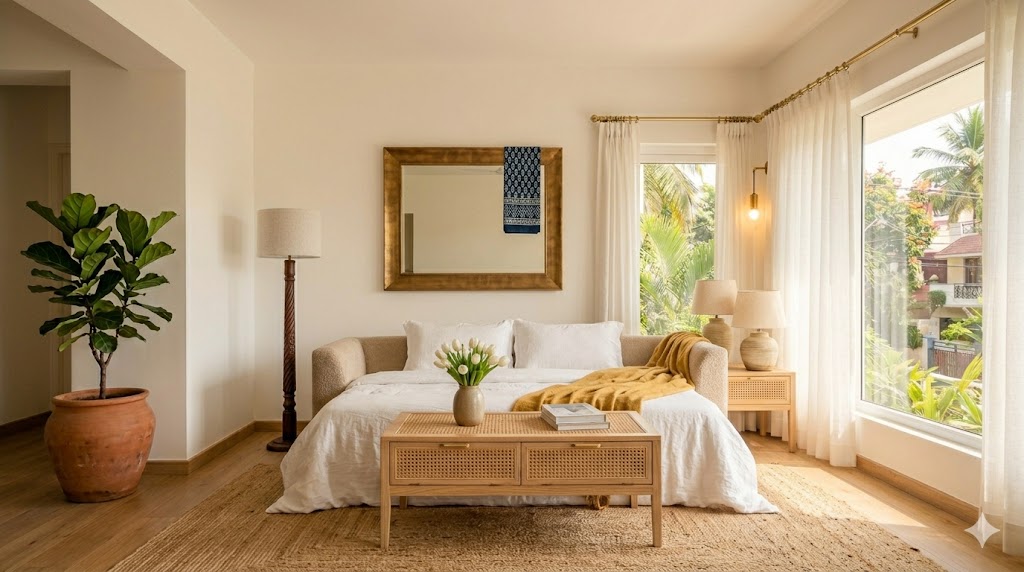
5. Indigo block-print Scandi bedroom — Oak bed, white cotton linen, single block-print indigo throw, two matching ceramic table lamps, jute rug under bed.
6. Sheesham-and-cream bedroom — Sheesham (Indian rosewood) bed, cream walls, white linen, single sage cushion, brass swing-arm wall lamps. Sheesham adds the Indian-craft anchor.
7. Kantha-quilt accent — Cream walls + oak bed + white linen, with a single hand-stitched kantha quilt folded at the foot of the bed. One craft anchor, one personality.
8. Brass-pendant Scandi bedroom — Pure Scandi bedroom with a single brass pendant replacing standard ceiling light + brass-finish wardrobe handles. Brass is the warmth bridge.
Kitchen (Ideas 9-12)
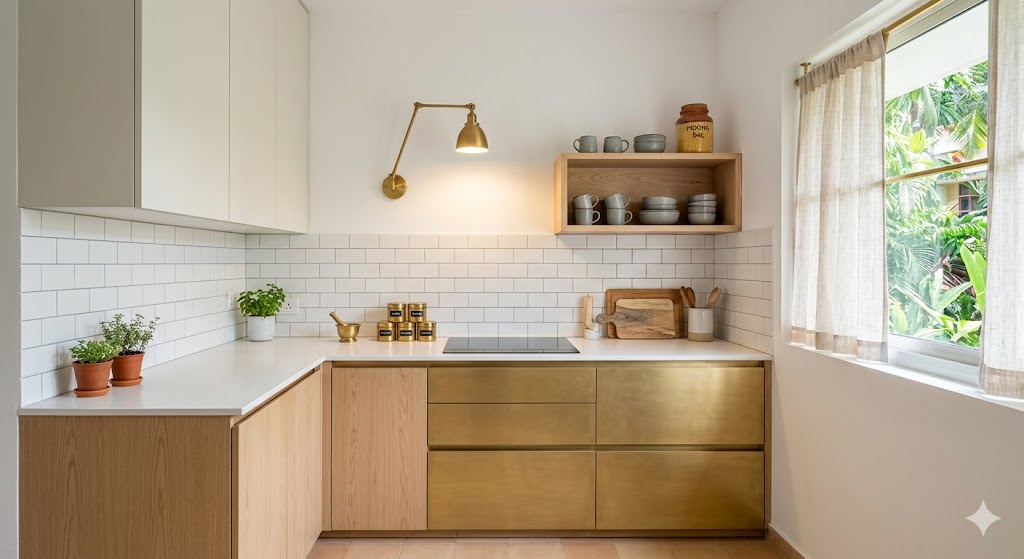
9. Off-white-and-oak Scandi kitchen — Matte off-white upper cabinets, oak lower drawers, brass handleless pulls, white subway tile backsplash, single open shelf with stoneware crockery.
10. Pantry-as-feature — Closed Scandi-style cabinet doors with a single open pantry shelf housing stoneware jars of dal, rice, atta in beige labels. Functional craft.
11. Brass-tap kitchen — Pure Scandi white-and-oak kitchen with a single statement piece — a brass kitchen tap and matching brass cabinet handles. Brass as warmth.
12. Wood-blade fan kitchen — Scandi-style kitchen anchored by a single wood-blade ceiling fan in oak finish. Replaces the standard aluminium kitchen fan with a Scandi vocabulary element.
Dining (Ideas 13-16)
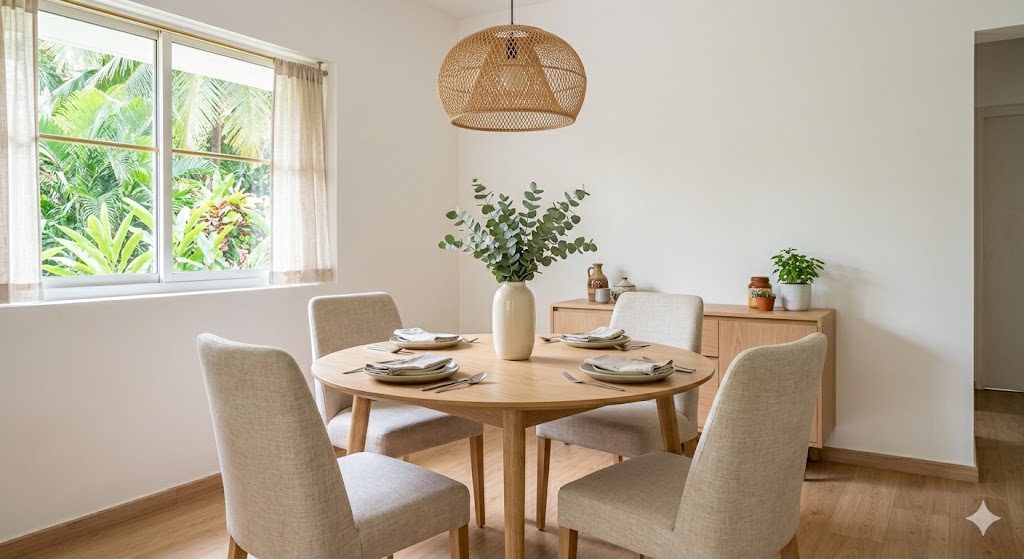
13. Oak round table + linen chairs — Oak round table for four, four pale linen-upholstered chairs, single rattan pendant, white walls, one tall ceramic vase with eucalyptus.
14. Mango-wood Scandi dining — Mango wood (Indian) dining table replacing oak, four bentwood chairs in oak, brass pendant. The mango wood is the Indian craft anchor.
15. Block-print runner — Oak dining table with a single block-print indigo or terracotta table runner, simple stoneware plates, white walls. One textile, full personality.
16. Stoneware-and-linen — Stoneware crockery, linen napkins, oak table, single dried-grass arrangement. The dining set is the design.
Bathroom (Ideas 17-20)
17. Warm subway tile bathroom — Warm-tone subway tile (not pure white), anti-skid stone floor, matte-black fittings, sealed grout, single brass accessory line.
18. Terrazzo-and-brass — Indian terrazzo floor (locally manufactured at a fraction of imported cost), warm white walls, brass tap + shower, single wooden bath stool (sealed teak only).
19. Concrete-and-brass minimalist — Polished concrete floor and walls, single brass shower, single matte-black fitting line, anti-skid mat. Industrial-Scandi adapted for Indian wet bathroom.
20. Plaster-and-brass spa — Lime plaster walls, anti-skid stone floor, brass fittings, single matte-black accent line, a small wooden footboard. Boutique-hotel-grade Scandi-Indian bathroom.
Common Scandi-Indian Mistakes
1. Pure white walls — under Indian daylight they read clinical. Always shift to warm white.
2. Pale birch furniture — warps in monsoon. Switch to oak or sheesham.
3. Open kitchen shelves above stove — coated in oil within 6 months. Closed cabinets in the cooking zone, open shelf only in the prep zone.
4. Sheepskin or chunky wool — allergen and mildew risk. Use bouclé, linen, or kilim.
5. No Indian accent — the room reads imported. Always include 10-15% craft accent (brass, block-print, kilim).
6. All 2700 K lighting — Indian kitchens specifically need 4000 K task light for chopping accuracy. Layer the temperatures by function.
Vastu Compatibility
Scandinavian principles are largely Vastu-neutral — direction is less central to Scandi than function. The main Vastu adaptations:
- Master bedroom in south-west (Vastu) is compatible with Scandi (any position works).
- Pooja corner in north-east (Vastu) — easily integrated as a Scandi-style oak shelf with brass diya.
- Bed head south / east (Vastu) — works in any Scandi bedroom.
- No mirrors facing bed (Vastu) — Scandi traditionally avoids them anyway.
- Avoid placing the kitchen in north-east (Vastu) — Scandi has no preference here, so follow Vastu freely.
References:
1. Wiking, Meik. The Little Book of Hygge — The Danish Way to Live Well, 2016.
2. Council of Industrial Design Denmark. The Scandinavian Design Tradition — Origins and Principles, accessed 2026.
3. Bureau of Indian Standards. IS 3646 — Illumination Requirements for Residential Buildings.
4. India Meteorological Department (IMD). Regional Humidity Atlas 2024 (for material durability planning).
5. Bureau of Indian Standards. IS 1328 — Decorative Veneers.
6. Bureau of Indian Standards. IS 2046 — High Pressure Decorative Laminates.
7. Indian Council of Agricultural Research (ICAR). Indoor Plant Suitability for Indian Apartments.
8. Vastu Vidya Pratisthan. Scandi-Vastu Compatibility Guidelines for Modern Apartments, 2024.
9. Council of Architecture (India). Interior Design Scope of Services.
10. International Living Future Institute. Living Building Challenge — Materials Petal.
Related Guides
- /guides/warm-minimal-bedroom-ideas-india — adjacent warm-minimal palette guidance; shared discipline of restraint and natural materials
- /guides/japandi-apartment-ideas-india — sister style; Japanese + Scandi intersection, more wabi-sabi influence
- /guides/modular-kitchen-guide — kitchen specifications and material choices for Scandi-Indian kitchens
- /guides/wardrobe-finish-ideas — Scandi-Indian-compatible finish picks (oak veneer, suede laminate, matte PU)
- /guides/architectural-lighting-design-india — deeper lighting reference including colour-temperature zoning by room
Interactive · Scandi adaptation toggle
Living room · Adapted for India
Palette
Wall
#fefcf7
Wood
#d6c6a8
Textile
#c2410c
Warm white walls, oak coffee table, kilim rug, beige bouclé sofa with a block-print cushion.
✓ Wins in Indian climate
- ▸Oak survives 80% humidity
- ▸Kilim breathes + cleans easily
- ▸Block-print bridges minimal to Indian craft
The adaptation rule
Shift every cool Scandi tone one notch warmer. Add 10-15% Indian craft accent (brass, block-print, kilim, terracotta). Keep the discipline of empty space.
Export this guide
Related Guides — Deep-dive reading
Japandi Apartment Ideas for Indian Homes
Japanese restraint meets Scandinavian warmth — seven principles, low-furniture proportions, material palette, and 20 numbered ideas across the apartment
Design StylesEarthy Interior Palette — A 2026 Style Guide for Indian Homes
Rooted · Regional · Biophilic · Indian craft-anchored
Design StylesJapandi Apartment — A 2026 Style Guide for Compact Indian Homes
Japanese restraint × Scandinavian function · Low furniture · Two-wood discipline
Design StylesRelated Tools — Try Free
Cross-Ventilation Analyzer
Estimate airflow and air changes per hour (ACH) from room size, window areas, layout, and local wind — with NBC 2016 Part 8 compliance check.
Ventilation CalculatorVastu Window Planner
Vastu guidance for window placement and size by wall direction and room — rating and remedies.
VastuApartment Interior Planning Checklist
51-item checklist across structural, ceiling, lighting, furniture, storage, electrical, kitchen, bathroom.
Checklist