
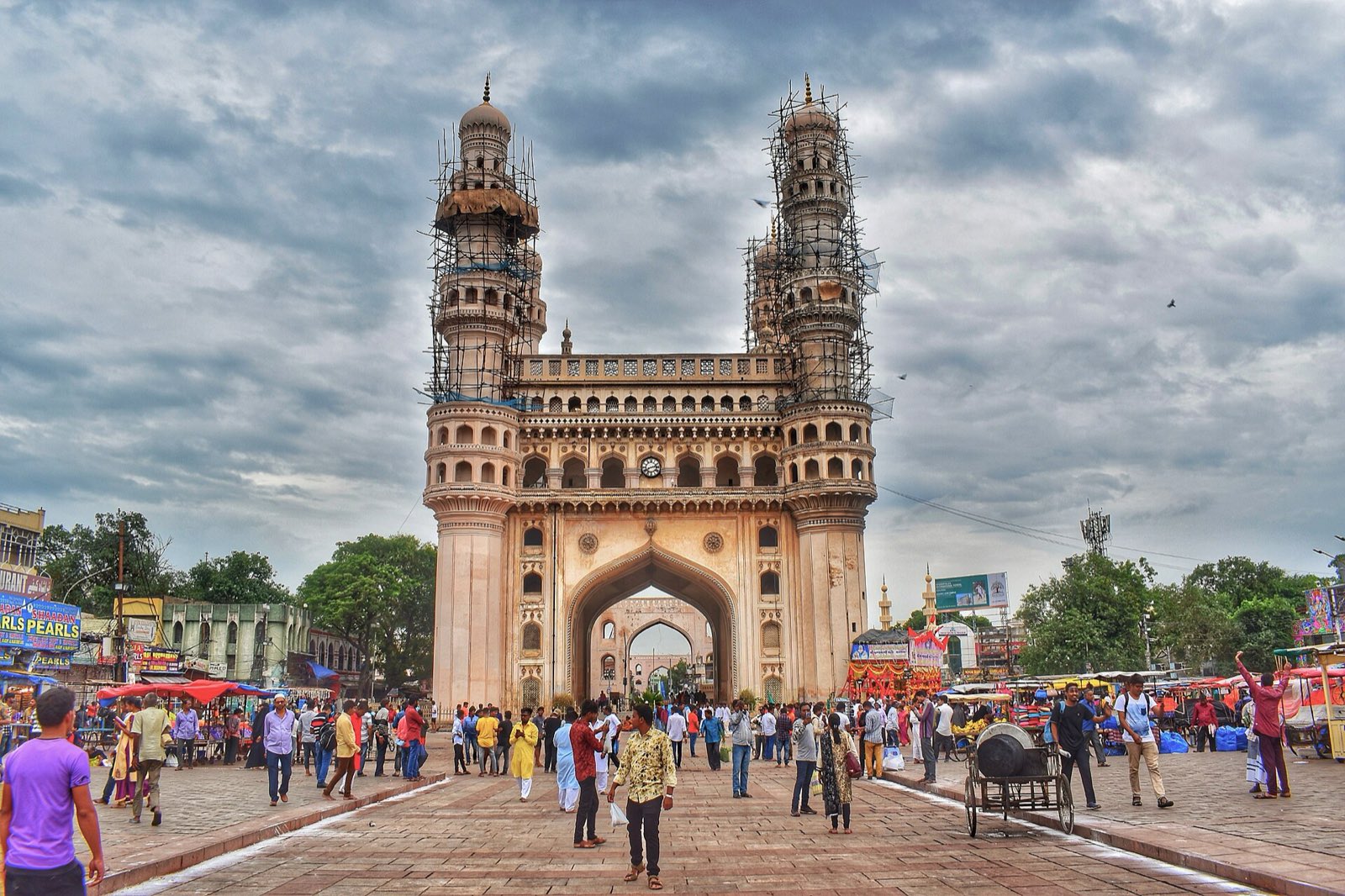
The Charminar, Hyderabad: A City Founded on a Crossroads
How the Qutb Shahi sultans marked the birth of a new capital with a four-faced arch you drive straight through — part triumphal gateway, part mosque, part the still point at the centre of a planned city
Most of the monuments in this series are things you go to and enter — a temple, a tomb, a palace. The Charminar is different. It is a monument you drive through. It straddles the crossing of two main streets in the heart of old Hyderabad, open on all four sides, so that traffic and pilgrims and shoppers pass straight beneath it as they have for over four centuries. It is not a destination sitting at the end of an axis; it is the axis itself, the pivot on which a whole city was laid out. To understand the Charminar is to understand a building conceived not as an object but as the centre of a plan.
Its name tells you its most obvious feature: char minar, "four minarets". Four slender towers rise from the four corners of a square block, and between them, on each face, opens a great pointed arch. It is one of the most recognisable structures in India and the defining emblem of the Deccan city it was built to crown.
A monument to a new capital
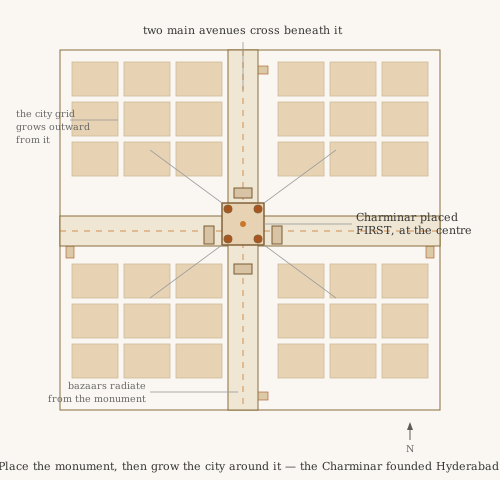
The Charminar was built in 1591 by Muhammad Quli Qutb Shah, the fifth ruler of the Qutb Shahi dynasty — one of the independent Deccan sultanates that, like Bijapur with its Gol Gumbaz, rose from the break-up of the older Bahmani kingdom. The Qutb Shahs had ruled from the great hill-fortress of Golconda nearby, but Golconda was crowded and short of water, and Muhammad Quli decided to found an entirely new city on the open plain beside the river — the city of Hyderabad.
The Charminar was the very first structure of that new city, built at the exact point where its two principal avenues would cross, and the whole grid of Hyderabad was laid out around it. In this it belongs with the other great act of Indian city-founding in this series — Chandigarh, planned around its Capitol nearly four centuries later — and with the Rajput city of Jaipur. A monument placed first, and a city grown around it: that is a particular and deliberate kind of urbanism, and the Charminar is its most elegant Indian expression. Tradition adds that Muhammad Quli raised it in gratitude for the ending of a deadly plague, so that it stands as a thanksgiving as well as a foundation stone.
The plan: a building that is all thresholds
The genius of the Charminar is legible the moment you look at its plan, because it inverts the usual logic of a monument.
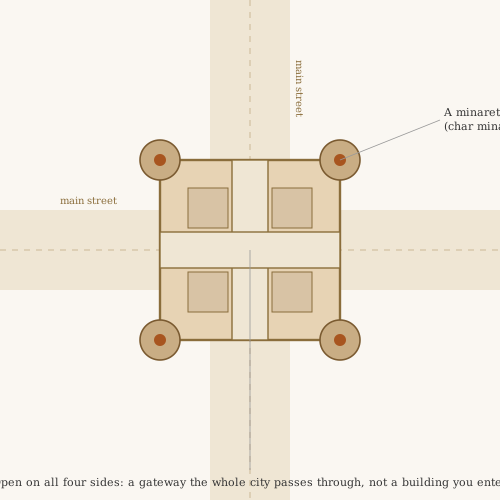
It is a square, and on each of its four sides a tall arch opens straight through to the one opposite, so that the two streets run uninterrupted beneath it in the form of a cross. The structure has, in effect, no front and no back and no inside in the ordinary sense — it is a vaulted crossing, a chowk, held up on four great piers, with a minaret anchoring each corner. Where a triumphal arch in the Roman world marked a single direction of passage, the Charminar faces all four at once, blessing every road that leaves the city centre. It is architecture as punctuation: the full stop, or rather the crossing-point, at the heart of a sentence of streets.
The elevation: gateway, minaret and mosque in one
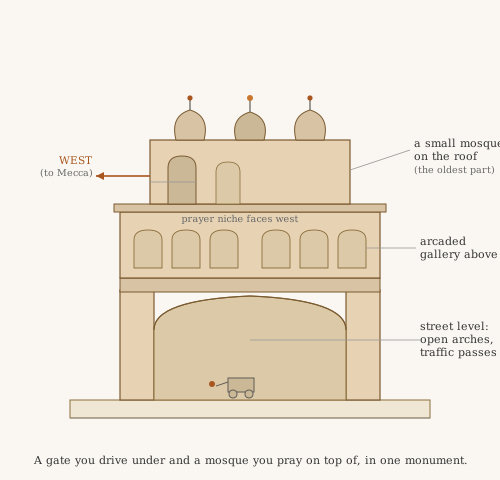
Raise your eyes from the plan to the elevation, and the Charminar reveals that it is quietly three buildings folded into one.
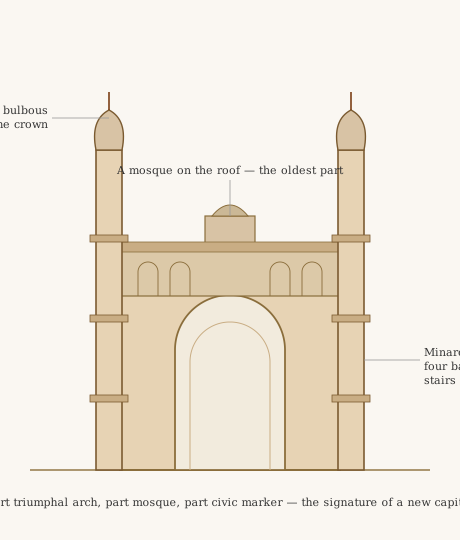
At street level it is a gateway — the four soaring arches, each framed by delicate stucco ornament, springing from massive piers. Above the arches runs an arcaded upper gallery, reached by a staircase winding up inside one of the minarets, from which the ruler and citizens could look out over the new city. And on the roof, tucked above the gallery, sits a small mosque — the oldest part of the structure, its row of prayer niches facing west toward Mecca, so that the civic crossing is also, at its summit, a place of worship.
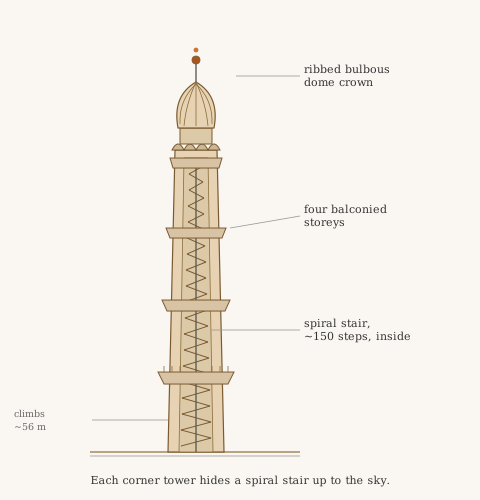
Then there are the four minarets themselves, rising about fifty-six metres, each divided into four storeys by projecting balconies and crowned by a ribbed, bulbous dome on a ring of petal-like leaves — the signature Qutb Shahi dome-form, the same family of shapes you see across Deccan architecture. Inside each minaret a spiral stair of nearly 150 steps climbs to the galleries. The material is the local granite, faced and softened with lime plaster and fine stucco decoration, which lets the whole monument carry a delicacy of ornament that the hard grey stone alone never could.
The combination is unusual and clever. A minaret normally belongs to a mosque and calls the faithful to prayer; here the four minarets crown a civic gateway and frame a small mosque all at once, so that religious and civic functions are braided into a single symmetrical form. The Charminar is a mosque you can drive under and a city gate you can pray on top of.
The Deccan's decorative voice
Set beside the Mughal architecture of the north, the Charminar shows how distinct the Deccan sultanates' taste really was. The Mughals prized clarity, symmetry and, increasingly, the cool restraint of white marble. The Qutb Shahs, like their Bijapur rivals, loved a busier, more plastic surface — stucco ornament worked into arches and cornices, bulbous ribbed domes, rows of little arched niches, a delight in outline and silhouette against the sky. The Charminar's charm lies in that decorative exuberance held within a perfectly disciplined symmetrical frame: rigorous geometry, richly dressed.
It also belongs to a wider Deccan urban culture that was strikingly cosmopolitan — Hyderabad grew rich on diamonds and trade, its bazaars radiating from the Charminar filled with pearls, textiles and merchants from across the Indian Ocean world, and the monument has stood at the centre of that commerce ever since. Around it the old city still crowds, the famous bangle and pearl markets pressing right up to its piers, so that unlike a tomb or a temple set apart in a garden, the Charminar has never stopped being part of the daily, noisy, living fabric of the city it founded.
Why the Charminar matters
The Charminar earns its place among the wonders not by size — it is far smaller than the Gol Gumbaz or the great Mughal tombs — but by the perfection and originality of its idea. It is the clearest surviving statement of a building conceived as the generative centre of a city: place the monument, then grow the streets from it. It fuses gateway, minaret and mosque into a single four-square form of complete symmetry. And it remains, more than four centuries on, exactly what it was built to be — the beating heart of Hyderabad, the point every road returns to, a monument that is not visited so much as lived through.
Stand beneath its central vault, with four streets running away from you to four horizons and the call to prayer drifting down from the little mosque overhead, and you feel the essential Charminar idea: architecture placed not to be looked at from outside, but to stand at the very centre of everything and let a whole city turn around it.
Part of the Architectural Wonders series. For the neighbouring Deccan sultanate and its colossal dome, read about the Gol Gumbaz at Bijapur; for another city built around a monument, see Chandigarh; and for the Mughal architecture of the north, Humayun's Tomb.
Hero photograph: “The Charminar on a cloudy day” by Santosh Kumar Velamala, via Wikimedia Commons, licensed under CC BY-SA 4.0.
Export this guide
Related Guides — Deep-dive reading
Gol Gumbaz, Bijapur: The Deccan Tomb That Roofed a Whole Hall with One Dome
How the sultans of Bijapur raised one of the largest domes in the world over a single vast room, balanced on a net of intersecting arches, with a gallery where a whisper travels right around the sky
Architectural WondersThe Jama Masjid, Delhi: A Courtyard for Twenty-Five Thousand, Facing Mecca
How Shah Jahan built the great congregational mosque of his new capital — a vast raised courtyard, three marble domes and two soaring minarets — and why a mosque is a building defined not by a centre but by a direction
Architectural WondersThe Qutb Minar: The Tower That Announced a New Architecture
How a 73-metre victory tower and India's first great mosque, raised in Delhi around 1200, marked the arrival of the arch, the dome and the minaret — and the first, halting meeting of Islamic form with Indian craft.
Architectural WondersRelated Tools — Try Free
Circadian Light Meter
Patient-centric circadian lighting visualizer for Indian healthcare design — time-of-day × intensity → CCT, melanopic lux (EML / mEDI), melatonin suppression, and an alertness curve. Calibrated against WELL v2 L03 Circadian Lighting Design, CIE S 026:2018, Brainard 2001, and Lucas et al. 2014.
Circadian ToolCross-Ventilation Analyzer
Estimate airflow and air changes per hour (ACH) from room size, window areas, layout, and local wind — with NBC 2016 Part 8 compliance check.
Ventilation CalculatorMaterial Compare — Side by Side
Compare materials side-by-side: granite vs quartz vs marble, laminate vs acrylic vs PU, and more.
Comparison