
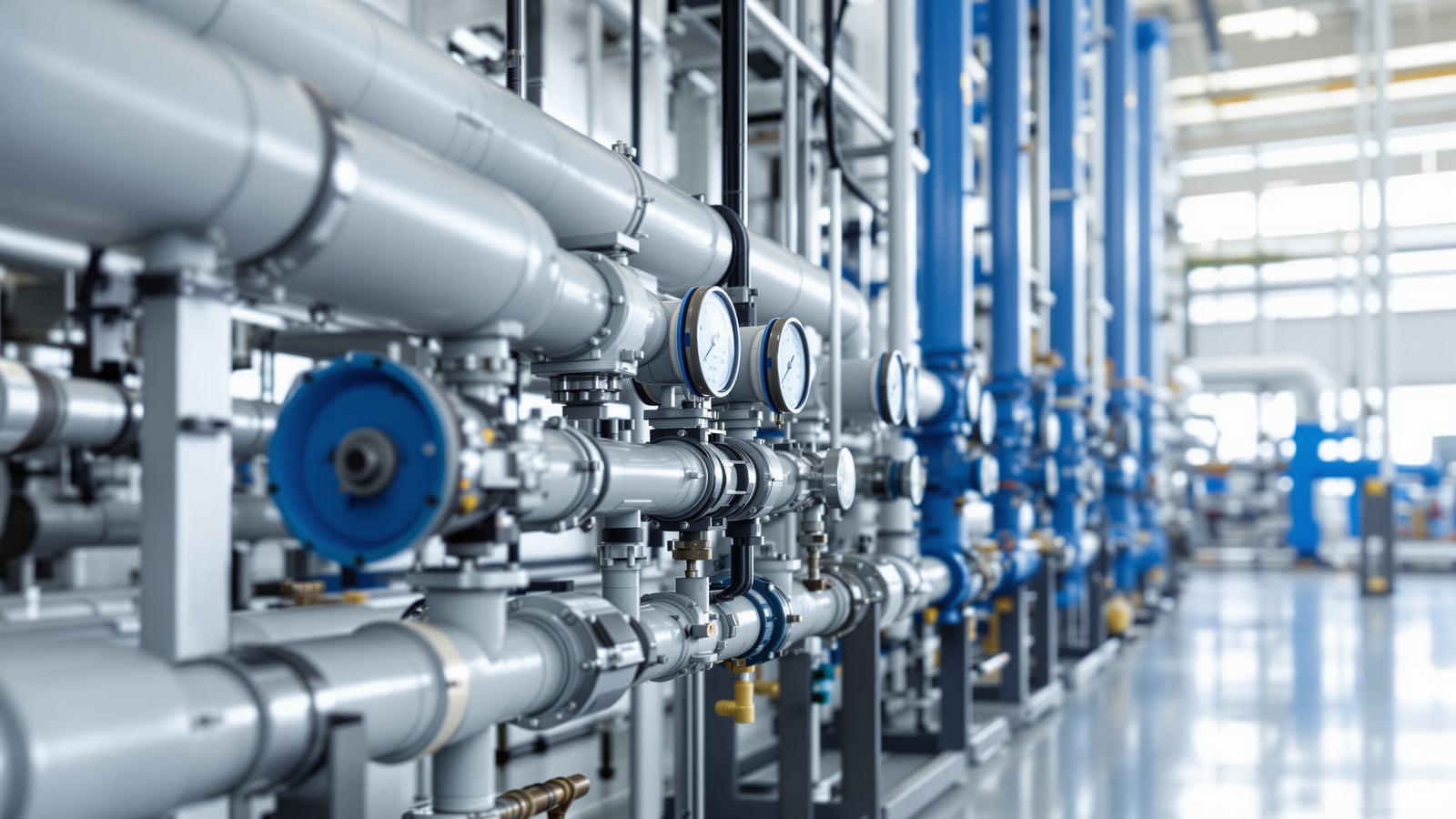
Industrial Plumbing Systems in India: Process, Utility & Effluent Water Design
A professional, India-first reference to plumbing for factories, process plants and warehouses — separating process, potable and utility water, sizing large-diameter piping, and keeping industrial drainage segregated from stormwater and effluent.
Industrial plumbing is a different discipline from building plumbing. In a factory or process plant, water is a raw material and a utility, not just a fixture supply — and the single most important design decision is not pipe size but water segregation: keeping process water, potable water, utility water and effluent in separate, clearly identified networks that never cross-connect. Get segregation, storage and drainage separation right and the plant runs clean and compliant; get them wrong and you contaminate product, foul a boiler, or push untreated effluent into a stormwater drain and invite a Pollution Control Board notice.
This Studio Matrx guide is the industrial companion to our Plumbing Systems Guide and Commercial Plumbing Systems. It covers the supply, storage, piping and drainage-separation architecture of industrial sites. It deliberately does not cover effluent or ETP treatment — for that, hand off to the STP hub: STPs vs ETPs, STP for industrial parks and STP for warehouses.
The four water streams of an industrial site
The defining feature of industrial plumbing is that a single site carries multiple, functionally distinct water networks. Treating them as one system is the classic mistake. At minimum, plan for four:
- Potable water — for drinking, canteens, washrooms, safety showers and eyewash stations. This stream must meet IS 10500 drinking-water quality and be fully protected from backflow. It is the smallest volume but the highest quality obligation.
- Process water — water that enters the product or the process: dyeing, washing, mixing, food and beverage, pharma, chemical reactions. Quality is dictated by the process, not by a drinking standard — it may need softening, RO, DM (demineralised) or ultra-pure polishing well beyond potable grade.
- Utility water — cooling-tower make-up, boiler feed, floor washing, gardening, dust suppression and fire reserve. Quality requirements sit between potable and process, and volumes are often the largest.
- Effluent / waste — spent process water and trade effluent that must be collected separately and routed to treatment. Plumbing owns the collection and conveyance; treatment belongs to the ETP and is covered in the STP hub.
The golden rule of industrial plumbing: no cross-connection between networks, ever. Potable and process lines must be physically separated and unmistakably identified, with backflow prevention wherever a lower-quality stream could contaminate a higher one.
Identification and cross-connection control
Because several water qualities coexist on one site, pipe identification is a safety system, not a nicety. Colour-code and label every line per IS 2379 (colour code for identification of pipelines), tag valves, and provide an air gap or reduced-pressure-zone (RPZ) backflow preventer at every point where process, utility or effluent water could siphon back into potable. Never take potable make-up into a process tank through a submerged inlet.
Water demand and storage
Industrial demand is dominated by process and utility loads, so the domestic (lpcd-based) figure is a rounding error. A workforce might consume domestic water at the familiar ~45 lpcd (factory, no bathing) to 135 lpcd band, but a single cooling tower or dye-house can dwarf the entire staff demand. Size storage on the process and utility duty, then add domestic and fire reserve.
| Water stream | Typical quality target | Indicative demand driver | Storage basis |
|---|---|---|---|
| Potable | IS 10500 drinking standard | Staff at ~45 lpcd (no bathing) | 1 day domestic + safety showers |
| Process | Process-specific (soft / RO / DM) | Litres per unit of product | Buffer + treated-water day tank |
| Utility (cooling) | Low hardness, controlled cycles | Evaporation + drift + blowdown | Make-up hours at peak load |
| Utility (boiler) | DM / softened, low TDS | Steam demand + blowdown | Feed-water day tank |
| Fire reserve | Raw / utility grade | NBC Part 4 fire duty | Static reserve, ring-fenced |
Storage strategy on an industrial site is usually a staged one: a raw-water reservoir or underground tank feeds treatment (softener / RO / DM plant, owned by the process team), and each treated stream then has its own day tank sized to buffer the process against a supply interruption. Keep the fire reserve ring-fenced inside the raw or utility tank so routine draw-off can never deplete it below the NBC-mandated static volume. All specific capacities here are indicative — size against your actual process consumption logs and local bye-laws.
Large-diameter piping and materials
Industrial mains carry high flows at industrial pressures, so pipe sizing and material selection are engineering decisions with real cost and safety weight. Diameters jump well beyond the 15–50 mm of building work into 80 mm, 100 mm, 150 mm, 200 mm and larger headers. Velocity is the discipline: keep flow roughly in the 1.0–2.5 m/s band to control friction loss and water hammer, and slow it further on suction lines.
Material choice follows the stream. There is no universal industrial pipe — you match the material to fluid, temperature, pressure and chemistry.
| Material | Best-fit industrial use | Strengths | Watch-outs |
|---|---|---|---|
| HDPE (PE100) | Buried raw / utility mains, effluent conveyance | Corrosion-proof, fused joints, long buried runs | UV / temperature limits; needs fusion skill |
| MS (mild steel) | Utility headers, fire mains, higher-pressure lines | High strength, large diameters, cheap per metre | Corrodes — needs lining / coating / painting |
| GI (galvanised iron) | Legacy potable / utility, compressed-air lines | Robust, familiar | Internal scaling; being displaced by HDPE/CPVC |
| SS 304 / 316 | Process, pharma, food, DM and chemical water | Hygienic, corrosion-resistant, high-purity safe | High cost; 316 for chloride / aggressive media |
| uPVC / CPVC | Chemical dosing, mild-chemistry, hot process lines | Chemically resistant, light, non-corroding | Pressure/temperature de-rating; UV; support spacing |
- HDPE is the default for buried utility and effluent mains — butt-fused or electrofused joints give a leak-free, corrosion-free line for long yard runs.
- MS dominates above-ground utility and fire headers where strength and large diameter matter, but it must be lined, coated or painted and inspected, because bare MS corrodes.
- Stainless steel (SS 304, and SS 316 for chloride-rich or aggressive media) is the process-and-hygiene material — food, beverage, pharma and DM water where purity cannot be compromised.
Support, anchoring and thermal expansion matter far more than in building plumbing: large steel headers need calculated supports, expansion loops or bellows on hot lines, and thrust blocks on buried mains at bends. Size and select with a licensed engineer against the governing IS code for each material.
Cooling and boiler make-up water at a glance
Two utility loads deserve a note because they drive much of the make-up demand — though their internal chemistry belongs to the process/mechanical team, not the plumber. The plumbing scope is to deliver the right quantity of the right-quality water to the tie-in point and to collect the blowdown.
- Cooling-tower make-up replaces water lost to evaporation, drift and blowdown. As water evaporates, dissolved solids concentrate (measured as cycles of concentration), so blowdown is bled off and fresh, low-hardness make-up added. Plumbing supplies softened make-up and routes blowdown to the effluent drain.
- Boiler feed water must be low-TDS, softened or demineralised — raw water would scale and corrode the boiler. The plumber feeds the DM/softener plant and the feed-water day tank, and conveys boiler blowdown (hot, high-TDS) to a cooled effluent line.
Both make-up streams tie into treatment equipment owned by others; the plumbing deliverable is clean segregation, adequate flow, and separate blowdown drainage. Actual chemistry and cycles are process-specific and indicative here.
Industrial drainage: segregate everything
If supply segregation is rule one, drainage segregation is rule two — and it is where compliance is won or lost. An industrial site must keep at least three drainage systems physically separate:
- Stormwater / rainwater — clean roof and yard runoff, discharged to storm drains or harvested. It must never carry process contamination.
- Domestic sewage — from washrooms and canteens, routed to the sewer or an STP.
- Trade effluent — spent process water, floor washings from process areas, and blowdown, collected in a dedicated, chemically-appropriate drain and routed to the ETP for treatment.
Mixing trade effluent into a stormwater drain is the single most common — and most penalised — industrial plumbing failure. It dilutes nothing, contaminates the storm network, and breaches consent conditions. Keep the three drains separate from the very first floor gully.
Practical segregation measures include: bunded, graded process-area floors that drain only to the effluent network; chemical-resistant drainage (HDPE, SS or lined channels) for aggressive effluent instead of ordinary SW/CI; interceptors and catch pits (oil / grease / solids) ahead of the effluent main; and clearly labelled, separately-routed underground lines with distinct manholes. Where hot blowdown is involved, cool it before it meets plastic drainage.
Effluent treatment is a hand-off, not a scope
Plumbing conveys effluent to the treatment plant; it does not treat it. Effluent Treatment Plant (ETP) design, unit processes, sludge handling and discharge norms are a separate discipline covered in the Studio Matrx STP hub. For the treatment side, go to:
- STPs vs ETPs — how effluent (industrial) treatment differs from sewage treatment, and when you need which.
- STP for industrial parks — shared / common treatment for multi-unit estates and industrial parks.
- STP for warehouses — the lighter treatment case for warehousing and logistics.
Your plumbing deliverable stops at the treatment inlet: a segregated, correctly-sized, chemically-appropriate effluent collection network with interceptors, sampling points and metering where the Pollution Control Board consent requires them.
Where this sits in the plumbing hub
Industrial plumbing is one of several building-type architectures. Read it alongside:
- The flagship overview → Plumbing Systems Guide.
- Commercial buildings (offices, malls, hospitals) → Commercial Plumbing Systems.
- Treatment and reuse → the STP hub links above.
Professional checklist
- [ ] Water streams segregated: potable, process, utility, effluent — no cross-connections.
- [ ] Backflow prevention (air gap / RPZ) at every stream interface; pipes colour-coded per IS 2379.
- [ ] Storage staged (raw → treatment → day tanks); fire reserve ring-fenced.
- [ ] Large-diameter mains sized for 1.0–2.5 m/s; material matched to each fluid (HDPE / MS / SS).
- [ ] Supports, expansion loops and thrust blocks calculated for large headers and buried bends.
- [ ] Cooling / boiler make-up delivered at correct quality and quantity; blowdown drained separately.
- [ ] Three drains segregated: stormwater, domestic sewage, trade effluent — with interceptors.
- [ ] Effluent conveyed to ETP (STP-hub scope); consent sampling / metering points provided.
- [ ] All indicative figures verified with a licensed engineer and the local Pollution Control Board.
Every diameter, velocity band, lpcd figure and storage basis above is indicative and simplified for orientation. Industrial plumbing is a licensed, calculation-driven discipline that intersects with statutory pollution control: size against real process consumption, confirm your state Pollution Control Board consent conditions, and have a chartered/licensed engineer stamp the design.
References
- National Building Code of India (NBC) 2016, Part 9 — Plumbing Services (Bureau of Indian Standards).
- NBC 2016, Part 4 — Fire and Life Safety (for the fire water reserve interface).
- CPHEEO Manual on Water Supply and Treatment and CPHEEO Manual on Sewerage and Sewage Treatment (Ministry of Housing and Urban Affairs).
- IS 10500 — Drinking Water Specification (potable stream quality).
- IS 2379 — Colour Code for the Identification of Pipelines and Services (verify current edition).
- Relevant Bureau of Indian Standards codes for the pipe material selected — including IS 4984 (HDPE / PE pipes), IS 1239 and IS 3589 (steel tubes and pipes), IS 4985 (uPVC), IS 15778 (CPVC) — verify the current edition for your material and application.
- Your State Pollution Control Board consent-to-operate conditions and effluent discharge standards (binding, and site-specific).
Export this guide
Related Guides — Deep-dive reading
Bathroom Plumbing Code India: NBC 2016 Part 9, UPC-I & the IS Standards That Govern Pipework
A professional reference to the codes and standards that govern bathroom plumbing in India — the National Building Code (NBC 2016) Part 9 on Plumbing Services, the Uniform Plumbing Code India (UPC-I), the CPHEEO Manual, and the IS standards for water supply, drainage, trap seals, pipe sizing, slopes and venting — with a caveat to always verify the current code and your local authority.
BathroomsDual Water Supply for Indian Buildings: Dual Plumbing, Colour-Coded Networks & Cross-Connection Control
How a dual water supply splits a building into two independent lines — fresh potable water for drinking and bathing, treated/recycled water for WC flushing, gardening and washdown — with colour-coded piping, separate storage, and the backflow protection that keeps the two from ever mixing.
PlumbingBuilding Plumbing Services Guide (India): MEP-Grade Water, Drainage & Riser Design
A professional, India-first reference to plumbing engineering for larger and commercial buildings — integrated design with MEP, multi-storey water distribution, and drainage and venting stacks.
PlumbingRelated Tools — Try Free
Rainwater Tank Sizer
How big should your rainwater tank be? Computes annual harvest, recommended tank capacity in litres, water-bill savings, and payback — for 10 Indian cities.
RWH CalculatorPlumbing Pressure-Test & Leak Checklist
Pre-closure pressure and leak test — 9 categories, 60+ checkpoints across water supply, drainage, fixtures, waterproofing, hot water, tanks.
Pre-Closure TestArchitect Fee Calculator
Estimate architect fees based on COA guidelines, project scope, and city.
ArchitectAI