

How to Compare Security Quotations in India (2026): Read Three Quotes Like an Expert
Three quotes for the same home security job will name different amounts, different equipment and different scope. This homeowner guide shows how to make them truly like-for-like first, read every line item, spot what a cheap quote hides, and pick on total value rather than the lowest number.
You have done the hard part. You worked out roughly what your home needs, you called three vendors, and three quotations have landed in your inbox. One is startlingly cheap, one is in the middle, one is dear. The temptation is to circle the smallest number and be done. Resist it, because that number is almost certainly not comparing what you think it is comparing.
The uncomfortable truth about security quotes is that vendors are rarely quoting the same job. One priced four cameras, another six. One included the cabling and conduit, another assumed it is "site work" you will pay for later. One quoted a weatherproof camera fit for your gate, another a cheaper indoor-grade unit that will fog and fail in the first monsoon. One folded in a year of support and an annual maintenance contract; another quoted only the box and will bill you every time it needs a look. Put those three sheets side by side as they arrive and you are not comparing prices. You are comparing three different projects that happen to share a heading.
This guide is about the one skill that turns a confusing pile of paper into a clear decision: making the quotes comparable before you compare them, then reading each line the way a professional would. Do that, and the cheapest quote often stops looking cheap and the "expensive" one often turns out to be the honest one. The goal is not the lowest number. It is the best value over the years you will actually own the system.
Scope and how to use this. This is a guide to evaluating the deal, not a price list and not an install manual. It will not tell you what a camera should cost in rupees; for the money, see the security cost planning guide and the security lifecycle cost guide. It assumes you have already decided roughly what you need (start from the how to choose a security system pillar) and are now choosing between vendors who have quoted it. Life-safety items, such as anything touching fire detection or escape-door locking, are never chosen on price alone; certification and fitness for purpose come first. Specify, compare, then hand the work to a licensed installer.
First, make the quotes speak the same language
You cannot compare three quotes that describe three different scopes. So the first move is not to read the numbers at all. It is to force all three quotes onto the same scope, the same specification and the same quantities before a single price is weighed. This is the entire game, and most people skip it.
The cleanest way to do this is to insist that every vendor quotes against the same written brief and returns an itemised Bill of Quantities (BoQ): a line for every item, stating make and model, grade or rating, quantity, unit, and the price for that line. A quote that reads "CCTV system, complete, Rs XX,XXX" is not comparable to anything, because you cannot see what is inside it. A quote that lists "6 x dome camera, Brand-X model, IP66, 4MP, at Rs Y each" can be lined up against another vendor's equivalent, item for item.
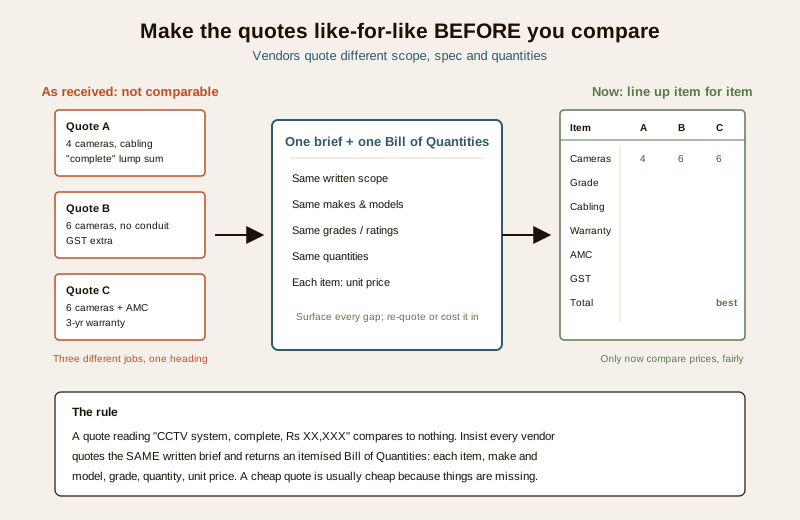
When a quote is missing an item that the others include, you have two choices, and both are useful: ask that vendor to add the item and re-quote, or note the gap and mentally add its likely cost to their total. Either way, you have surfaced the difference instead of being ambushed by it later. A cheap quote is very often cheap precisely because things are missing from it, not because that vendor is more efficient.
The line items to check on every quote
Once the quotes are itemised, read each one against a fixed checklist of line items. A complete, honest security quotation accounts for all of the following. If a line is absent, that is not a saving; it is a question.
| Line item | What to check | Why it matters |
|---|---|---|
| Equipment: make, model and grade | Exact brand and model number, plus rating (IP for weather, IK for impact, resolution, storage size) | "A camera" is not a spec. An outdoor gate needs a weather-rated unit; a cheaper indoor-grade unit quoted for it will fail early |
| Cabling: type and length | Cable grade, whether conduit is included, and metres run | Thin, unshielded or under-run cable is a common hidden downgrade that causes faults later |
| Recording and storage | Recorder model, number of channels, and days of storage retained | Too few days of footage or too few channels quietly limits the system you thought you bought |
| Installation labour | Mounting, cabling, conduit, drilling, making good | Often the line a cheap quote pushes into vague "extra site work" to be billed later |
| Configuration and handover | Setup, remote-view app, testing, and showing you how to use it | A system installed but not configured or explained is half a system |
| Power and protection | Power supply, backup or UPS where relevant, and surge protection | Missing surge protection is a frequent omission in India that shortens equipment life |
| Warranty | Duration, what it covers (parts, labour, both), and who honours it | A one-year and a three-year warranty are very different value even at the same price |
| Annual Maintenance Contract (AMC) | Whether it is included or priced separately, what it covers, response time | This is the largest recurring cost of ownership and belongs in the comparison from day one |
| Taxes (GST) | Whether prices are inclusive or exclusive of GST | An exclusive quote is not cheaper; it just moved the tax off the headline |
| Exclusions | Everything explicitly not included | The exclusions list is where a low headline hides the real bill |
Read the exclusions clause of each quote as carefully as the priced lines. It is where an artfully low total is engineered: civil work "by client", cabling "extra", scaffolding "at actuals", GST "as applicable". By the time these land, the cheap quote and the dear one have often met in the middle, and the dear one gave you better equipment for it.
What a cheap quote hides
A suspiciously low quote is rarely a gift. It is usually a different, smaller job dressed as the one you asked for. These are the classic ways the number is made small, and each is something to look for line by line.
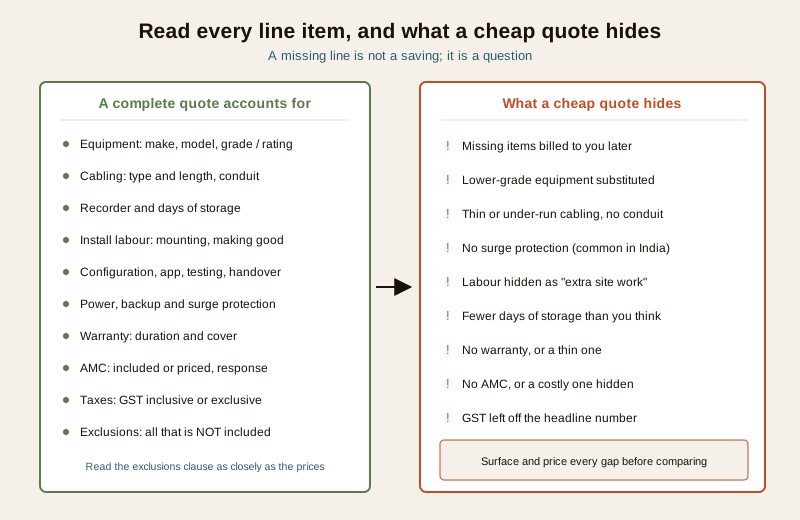
- Missing items you will pay for later. The recorder, the hard disk, the power supply, the conduit, the surge protector, the making-good after drilling: any of these left off the sheet becomes a "small extra" once the job is underway and you are committed.
- Lower-grade equipment. A model number one rung down, an indoor camera where an outdoor one belongs, a smaller hard disk that keeps fewer days of footage, a lock without the rating the door needs. Same category on paper, less product in fact.
- Thin or under-run cabling. Cheaper, thinner or unshielded cable, or shorter runs that skip conduit, save money now and cause faults, interference and callouts later.
- No surge protection. Common in India and quietly omitted; the first bad spike then takes out equipment the warranty may not cover.
- "Extra" work. Labour, civil work, scaffolding and cabling pushed off the headline into vague at-actuals extras, so the quoted total is not the total you will pay.
- No warranty, or a thin one. A short warranty, or one honoured by the installer rather than the manufacturer, shifts risk onto you.
- No AMC, or a costly one hidden. A quote with no maintenance plan looks cheaper today and costs more every year after, because someone has to keep the system alive.
None of these mean a vendor is dishonest. Some are genuine scope choices. But every one of them must be surfaced and priced before you compare, or the comparison is a fiction.
Compare on total cost of ownership, not the upfront number
The headline price is the cost of buying the system. It is not the cost of owning it. Over the years you will run a security system, the recurring costs, the maintenance, the storage subscriptions, the eventual repairs and replacements, routinely add up to as much as the original install or more. A quote that is a little dearer upfront but includes a solid warranty, a fair AMC and better equipment that lasts is often the cheaper system by the third year.
So compare total cost of ownership, not the day-one number. Line up each quote as: upfront equipment and install, plus warranty terms, plus the annual AMC and any subscription, plus the likely lifespan before major replacement. The security lifecycle cost guide sets out how to think about a system across its whole life, and the security cost planning guide helps you frame the budget the quotes are answering. The vendor who quotes an honest AMC is not the expensive one; the vendor who omitted it just hid a cost you will pay anyway.
Score the vendor, not just the price
Two quotes at the same number are not the same offer, because the vendor behind each is different. Price is one column on the scorecard, not the whole card. A cheap install from someone who vanishes after payment is dearer than a fair install from someone who answers the phone in year three.
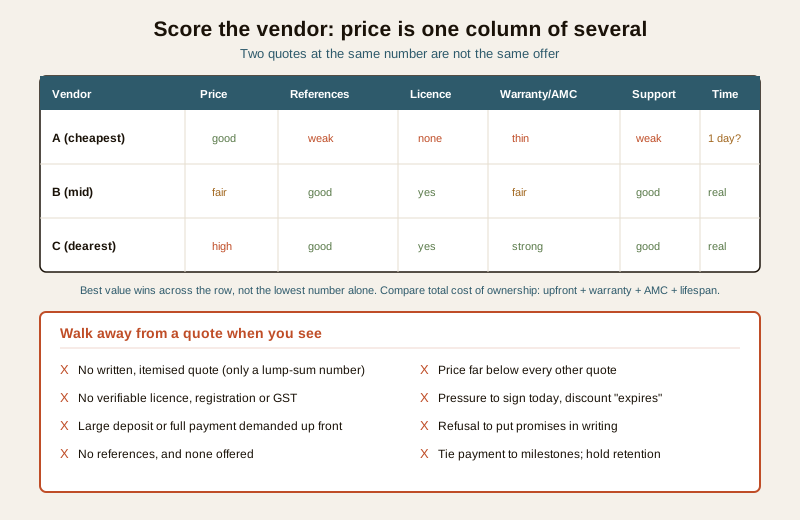
Score each vendor across columns that matter as much as price:
- References and reviews. Ask for recent installs like yours and actually call one or two. A vendor proud of their work will share references; a reluctant one is telling you something.
- Licence and registration. A registered business with GST, and, where guards or a monitored service are part of the deal, a PSARA 2005-registered agency for the manpower. Verify it rather than take it on trust.
- Warranty and AMC on offer. Longer, manufacturer-backed warranty and a clear, fair maintenance plan are real value, not paperwork.
- Support and response. Who fixes a fault, how fast, and how you reach them. A named support line and a stated response time beat a friendly promise.
- Timeline, honestly stated. A realistic schedule with milestones, not a too-good-to-be-true "done in a day" that slips for weeks.
For the deeper questions to put to each vendor before you score them, use the questions to ask a security contractor guide, and for a fuller method of checking a vendor and installer, the security vendor and installer evaluation guide.
Payment terms and milestones
The quote also proposes how you pay, and that clause deserves the same scrutiny as the equipment lines. A fair arrangement ties payment to progress: a modest advance, a stage payment on delivery or installation, and a meaningful final payment held back until you have tested the system and signed off the handover. That final retention is your only real leverage to get snags fixed, so do not give it away early.
Be wary of any quote that demands most or all of the money up front. A large advance before work begins shifts all the risk onto you and removes your ability to hold the vendor to the promise. Tie the money to milestones, keep a retention against a working, demonstrated, handed-over system, and get the payment schedule in writing alongside the scope.
Red flags: when to walk away from a quote
Some quotes are not just weaker; they are warnings. Walk away, or at least do not sign, when you see these:
Walk-away red flags. No written, itemised quote (only a verbal number or a one-line total). No verifiable licence, registration or GST. A demand for a large deposit or full payment before work starts. A price dramatically below every other quote for the same brief, which almost always means missing scope or lower-grade kit. Pressure to sign today, a discount that expires this evening, or refusal to put promises in writing. No references and no willingness to provide any.
A single flag may have an innocent explanation worth asking about. Two or more together, especially the unrealistically low price plus pressure to sign, is your signal to step back. The best defence is the boring one: everything itemised, everything in writing, nothing paid in full before it works.
A comparison checklist you can use
Before you choose, run all three quotes through this:
- Same brief. Every vendor quoted the same written scope, so you are comparing one job.
- Itemised BoQ. Each quote lists every item with make, model, grade, quantity and unit price, not a lump sum.
- Line items present. Equipment grade, cabling type and length, labour, configuration, power and surge protection, warranty, AMC, GST and exclusions all accounted for on every quote.
- Gaps surfaced. Every missing item is either added and re-quoted or costed and added to that vendor's total.
- Total cost of ownership. You compared upfront plus warranty plus AMC plus lifespan, not just the day-one number.
- Vendor scored. References checked, licence and registration verified, support and timeline assessed, not price alone.
- Payment tied to milestones. Fair schedule, retention held until tested handover, all in writing.
- No unresolved red flags. No unitemised total, no big upfront demand, no suspiciously low outlier, no pressure to sign.
If all three quotes clear the checklist, you are finally comparing like with like, and you can choose the one that offers the best value, which will only sometimes be the cheapest and will never be a mystery.
Key takeaways
- Vendors quote different jobs. Three security quotes for the same home rarely describe the same scope, specification or quantities, so never compare them as they arrive.
- Make them comparable first. Insist on one written brief and an itemised Bill of Quantities from every vendor, with make, model, grade, quantity and unit price per line.
- Read every line item. Equipment grade, cabling, labour, configuration, power and surge protection, warranty, AMC, GST and, above all, the exclusions clause.
- A cheap quote usually hides scope. Missing items, lower-grade kit, thin cabling, no surge protection, no warranty or AMC, and "extras" billed later are how a low number is engineered.
- Compare total cost of ownership. Upfront plus warranty plus AMC plus lifespan, using the lifecycle and cost planning guides, not the headline alone.
- Score the vendor, not just the price. References, licence, warranty, support and a realistic timeline are columns that matter as much as cost.
- Tie payment to milestones and hold a retention until a tested handover; walk away from unitemised quotes, big upfront demands, suspiciously low outliers and pressure to sign.
Where to go next
- Start with the how to choose a security system pillar if you have not yet settled what your home actually needs.
- Use the questions to ask a security contractor guide and the security vendor and installer evaluation guide to interrogate and score each vendor.
- For the money the quotes are answering, see the security cost planning guide and the security lifecycle cost guide.
- Browse the buying and selection sub-hub, the security costs sub-hub and the main security hub for the wider picture.
References
- Digital Personal Data Protection Act, 2023 (DPDP) — a home CCTV or access system captures personal data, so any monitoring or storage service in a quotation should state, in writing, who holds footage, for how long, and on what terms. Read it as a buying criterion, not an afterthought.
- Private Security Agencies (Regulation) Act, 2005 (PSARA) — where a quotation includes guards or a manned monitoring service, the manpower must come through a PSARA-registered agency; verify the registration before contracting.
- Goods and Services Tax (GST) — confirm on every quote whether prices are inclusive or exclusive of GST so the headline numbers are genuinely comparable.
This is an educational buying guide for homeowners, not legal, financial or installation advice. It does not quote rupee prices; for the numbers, see the linked cost guides. Verify any vendor licence, registration and warranty terms in writing, keep life-safety and certification requirements non-negotiable, and engage a licensed installer for the work itself.
Export this guide
Related Guides — Deep-dive reading
Security Vendor Evaluation: Choosing a Security Installer in India
How to judge and choose the vendor, installer or guarding agency who will build your home security — the procurement decision that makes or breaks everything. Credentials, references, a clear itemised quote, AMC terms, data-handling clauses, and the red flags that tell you to walk away.
SecuritySecurity AMC Buying Guide (2026): How to Buy a Maintenance Contract That Keeps the System Working
A decision guide to buying an Annual Maintenance Contract for a home or building security system in India — the types of AMC and how to choose, what a good scope must include, the clauses that decide whether you are covered, how to compare quotes like-for-like, and the red flags that hide a dead camera you only discover the night you need it.
SecurityElectrical Safety for Security Systems in India (2026): Powering It Without Peril
A homeowner's guide to the power side of home and RWA security systems, CCTV, alarms, gates, access control and NVRs, done so it protects you instead of quietly becoming a shock or fire hazard. What makes a supply safe, what to insist on, and why the mains work belongs to a licensed electrician.
SecurityRelated Tools — Try Free
Interior Contract Clause Checklist
16 sections and 98 checkboxes covering scope, BOQ, milestones, penalties, warranty, and disputes.
Contract ChecklistSecurity Vendor Evaluation Scorecard
Rate a CCTV/security installer or guarding agency across eight weighted criteria for a hire / negotiate / walk-away verdict.
Vendor ScorecardInterior Red Flag Checklist — Before Signing
54 red flags across 8 categories with a live risk score and personalised PDF.
Red Flag Checklist