
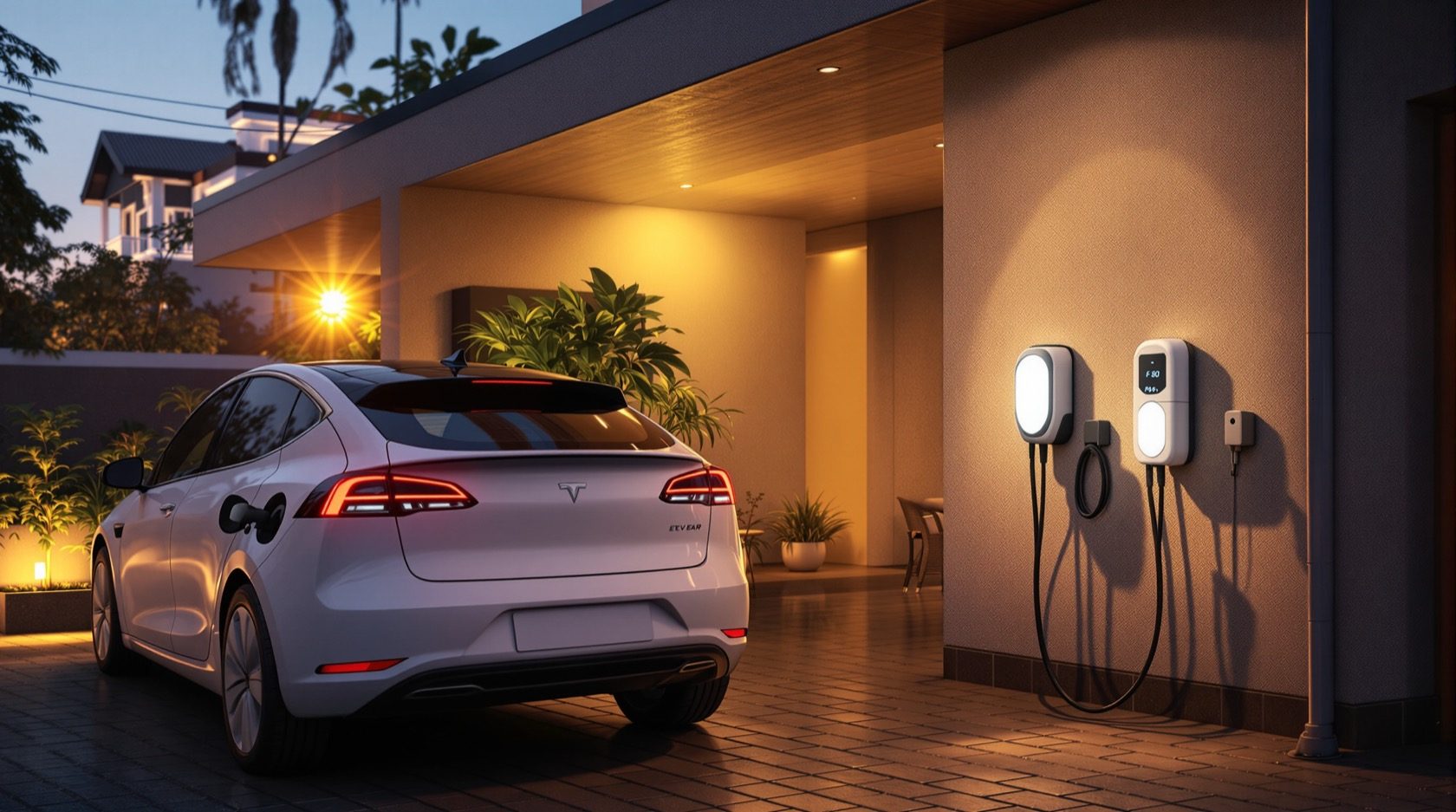
Home EV Charging: The Complete Guide for Indian Homes
Everything a homeowner needs to charge an electric car at home — how EV charging works, the AC vs DC and slow vs fast reality, the dedicated circuit and load your home needs, safety and the standards, and how to make a home EV-ready from the start.
Charging an electric car at home is, for most EV owners, how the car gets 90% of its energy — plug in overnight, wake up full, and rarely visit a public charger. But a home EV charger is also the single biggest new load most homes will ever add, and getting the circuit, the load and the safety right matters. This guide is the complete homeowner's picture: how home charging works, what your home's wiring needs, the safety and standards, and how to be EV-ready even before you buy the car.
It sits under the residential electrical systems pillar and leads into the EV charger types guide and, for flats, the apartment EV charging guide.
The safety line. An EV charger is a heavy, dedicated appliance whose installation — a dedicated circuit, the right cable, an RCCB, earthing and the charger mounting — is a licensed electrician's job. EV charging equipment follows IS 17017 and the Ministry of Power EV charging guidelines. This guide helps you plan and specify; the wiring is professional work.
How home EV charging works
An EV has a large battery (measured in kWh), and charging simply refills it. At home, you almost always use AC charging:
- A home AC charger (also called a wall box or EVSE — electric vehicle supply equipment) mounts near the parking spot and connects the car to your home's AC supply, safely.
- The car's onboard charger converts that AC to DC to fill the battery; the speed is limited by the charger's power and the car's onboard charger.
- You plug in (usually overnight), and the car charges to full while you sleep — cheaply, on your home tariff.
DC fast charging (the very fast public chargers) is a different, much higher-power technology used at public stations, not typically at home. For home, AC charging overnight is the norm — covered in detail in the charger types guide.
The load your home needs
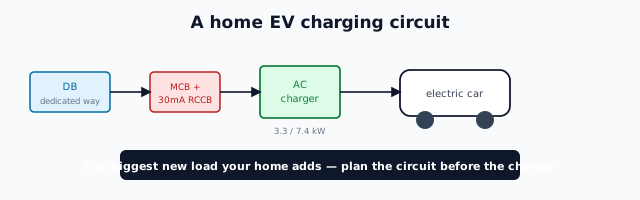
This is the crucial homeowner point: a home charger is a big, sustained load. Common home AC chargers are around 3.3 kW or 7.4 kW (single-phase), drawing roughly 16 A or 32 A continuously for hours. That's comparable to running several geysers at once, all night.
So a home charger needs:
- A dedicated circuit from the distribution board — never shared with sockets or other loads.
- A suitably sized cable for the charger's current (a 7.4 kW charger needs heavier wire than a socket circuit) — see the wire size calculator.
- A dedicated MCB and a 30 mA RCCB (some EV chargers need a specific RCD type — your electrician will advise) for shock protection.
- Adequate sanctioned load from your DISCOM — adding a 7 kW charger may push your home past its approved load, requiring an enhancement (and possibly a three-phase supply for bigger/faster charging).
- Proper earthing — an EV charger is outdoors/semi-outdoors and connects to a metal car; earthing and RCD protection are life-critical here.
Because of the load, planning the circuit is as important as choosing the charger — this is exactly why an EV-ready home leaves a cable route and a spare DB way for it.
Charging time, roughly
How long a charge takes depends on the battery size and the charger power (limited by the car's onboard charger):
- Time ≈ battery kWh ÷ charger kW (plus efficiency losses).
- A ~30 kWh car on a 3.3 kW charger is an overnight charge (~9–10 hours); on a 7.4 kW charger, roughly half that.
- Most owners charge overnight, so even a slower charger is usually fine — you have all night. A faster charger matters if you drive far daily or need quick top-ups.
Use the EV charging time calculator to estimate it for your car and charger.
Safety and standards
- Dedicated circuit, correct cable, MCB and RCCB — non-negotiable for a load this size near a metal vehicle, often outdoors.
- A proper EV charger (EVSE) to IS 17017, not an improvised socket — the EVSE has safety and communication features a plain socket lacks. (Slow "portable" charging from a socket exists but is limited and must still be on a proper, protected circuit.)
- Weatherproofing if the charger is outdoors (an IP-rated unit).
- Installation to the Ministry of Power EV charging guidelines and by a licensed electrician.
Making a home EV-ready
Whether or not you own an EV yet, a few near-free decisions when building or rewiring make future charging painless:
- A cable route (or conduit) to the parking spot, sized for a 7.4 kW charger.
- A reserved DB way and headroom in your sanctioned load.
- Consider three-phase if you might want faster charging or have other heavy loads.
Retrofitting a charger circuit into a finished home is disruptive; leaving the provision costs little. See the new-home design guide.
The one-line answer
Home EV charging — how most owners refill their car — uses a wall-mounted AC charger (typically 3.3 or 7.4 kW) that you plug in overnight, and its defining feature for a homeowner is that it is the biggest new load your home will add, needing a dedicated circuit, correctly-sized cable, a dedicated MCB and 30 mA RCCB, proper earthing and adequate sanctioned load — installed by a licensed electrician to IS 17017 and the Ministry of Power guidelines. Charging time is roughly battery-kWh ÷ charger-kW (usually fine overnight). Plan the circuit before the charger, and make a new home EV-ready with a cable route and spare DB way.
Where to go next
- The charger technology: EV Charger Types (AC vs DC).
- Charging in a flat/society: Apartment EV Charging.
- Making a home ready: Electrical Design for New Homes.
- Estimate charge time: EV Charging Time Calculator.
References
- IS 17017 (Parts 1, 2, 21–31), Electric Vehicle Conductive Charging System, Bureau of Indian Standards.
- Ministry of Power, Guidelines for Electric Vehicle Charging Infrastructure (verify current revision): https://powermin.gov.in/
- IS 732 : 2019, Code of Practice for Electrical Wiring Installations; National Electrical Code SP 30 : 2023, BIS: https://www.bis.gov.in/
- Central Electricity Authority (Measures relating to Safety and Electric Supply) Regulations, CEA: https://cea.nic.in/
Charger powers, loads and charging times are indicative and vary by car and charger; the circuit, cable, protection and any load enhancement must be designed and installed by a licensed electrician to the current standards and guidelines. Verify any standard's status via the BIS catalogue before relying on it.
Export this guide
Related Guides — Deep-dive reading
Residential Electrical Systems: The Complete Guide for Indian Homes
How the electricity in an Indian home actually works — from the utility supply and meter through the distribution board, circuits, wiring, earthing and protection, to lighting, safety, energy efficiency, smart controls, solar and backup — written so a homeowner can understand, plan and judge it, and know exactly where a licensed electrician must take over.
Electrical & WiringEV-Ready Home Design in India
Wire your home today to charge an electric car tomorrow, without breaking a single wall.
Future-Ready HomesFuture-Proof Wiring Systems for Indian Homes
Build electrical headroom now so tomorrow's loads are plug-and-play, not demolition.
Future-Ready HomesRelated Tools — Try Free
Electrical Safety & Load Audit
Home electrical audit — 10 categories, 65+ checkpoints across earthing, RCCB, MCB, wiring, switchboards, appliance circuits, DG/inverter backup.
Safety AuditEV Charging Time Calculator
Estimate how long an electric car takes to charge from its battery size, the charger power and the start and target charge levels.
EV ChargingApartment Video Door System Planner
Enter flats, entrances, floors and guard desk for a first-pass building intercom plan — door stations, indoor monitors, guard station, the right architecture and an indicative cost band.
Building Planner