
EV Charger Types: AC vs DC, Connectors & Charging Speeds
The confusing world of EV charging made clear — AC vs DC, the power levels from a 3 kW home wall box to a 100+ kW public fast charger, the connectors (Type 2, CCS2, CHAdeMO, GB/T), and how each decides how fast your car charges.
Ask about EV charging and you're quickly buried in jargon: AC and DC, Type 2 and CCS2, kilowatts and "levels". But it all reduces to two simple questions — is the charger AC or DC, and how many kilowatts — which together decide how fast your car charges and where you'd use it. This guide clears the confusion, so you understand your home charger, know what public fast chargers offer, and can read a connector.
It sits under the home EV charging guide.
The safety line. Home AC chargers are installed by a licensed electrician on a dedicated circuit to IS 17017; DC fast chargers are commercial infrastructure installed by specialists. This guide explains the types to help you choose and understand; installation is professional work.
AC vs DC: the core difference
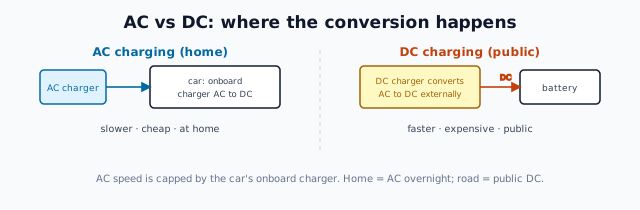
The battery in an EV stores DC, but the grid supplies AC — so somewhere, AC must be converted to DC to charge the battery. Where that conversion happens is the whole AC-vs-DC distinction:
- AC charging — the charger delivers AC to the car, and the car's onboard charger converts it to DC. Because the onboard charger is compact and limited (commonly up to ~7–11 kW), AC charging is slower — but the equipment is cheap and simple, so it's what you have at home and many workplaces.
- DC charging — the charger itself is a big, powerful unit that converts AC to DC externally and feeds DC straight into the battery, bypassing the car's small onboard charger. This allows very high power (tens to hundreds of kW) and fast charging — but the equipment is large and expensive, so it lives at public fast-charging stations, not homes.
So the rule of thumb: AC = home, slower, cheap; DC = public, fast, expensive. Most owners do the bulk of charging on home AC overnight and use public DC for quick top-ups on long journeys.
The power levels
Charging power (kW) decides speed. Roughly:
| Type | Power | Where | Typical use |
|---|---|---|---|
| Slow AC (portable) | ~2–3 kW | Home socket-based | Overnight trickle, small EVs |
| Home AC wall box | 3.3 / 7.4 kW | Home, single-phase | Overnight home charging |
| Fast AC | 11 / 22 kW | Workplace, some public, three-phase | Top-up over hours |
| DC fast | 25–60 kW | Public stations | Fast top-up in ~1 hour |
| DC ultra-fast | 100+ kW | Highway stations | Rapid top-up in minutes |
Remember: AC speed is capped by the car's onboard charger — a 22 kW AC charger charges a car whose onboard charger is only 7 kW at 7 kW, not 22. DC bypasses that limit, so DC speed is capped by the car's and charger's DC capability.
The connectors
The physical plug matters, and India uses a few standards (aligned with global ones):
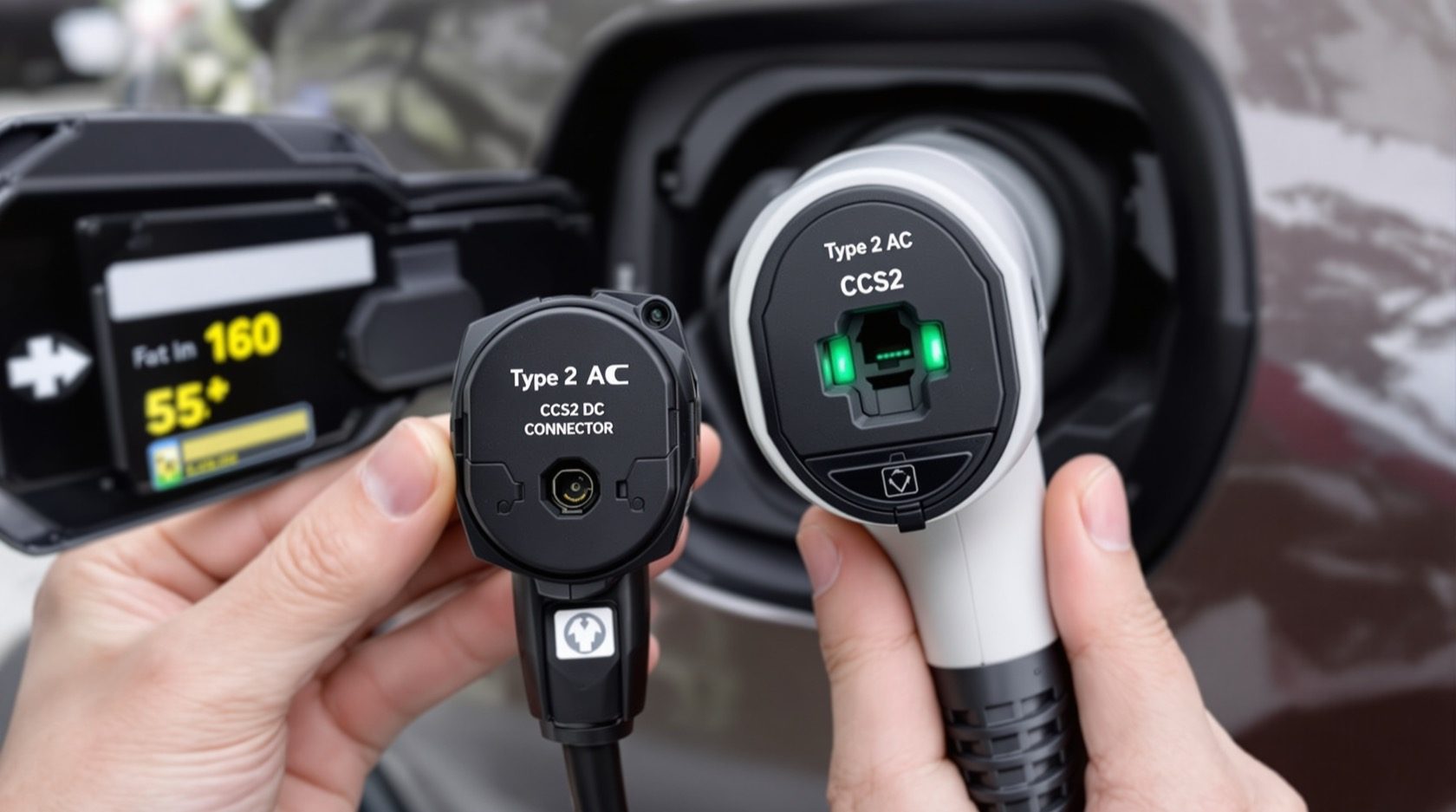
- Type 2 (Mennekes) — the common AC connector for cars, used on home and public AC chargers.
- CCS2 (Combined Charging System) — the dominant DC fast-charging connector for cars in India, combining Type 2 with two DC pins.
- CHAdeMO — an older DC standard, less common now.
- GB/T — used by some vehicles (originally Chinese standard), in both AC and DC forms.
- Bharat AC-001 / DC-001 — earlier India-specific charging specifications, being superseded by the above for cars.
For two- and three-wheelers, lighter connectors and standards apply. The practical point: check your car's inlet and match the charger's connector — a public station is useful to you only if it has a connector your car accepts. Indian EV charging is standardised under IS 17017, which covers the connectors and systems.
Which do you actually need?
- At home: a home AC wall box (3.3 or 7.4 kW) with the Type 2 connector — the right, affordable home solution for overnight charging. See the home EV charging guide.
- On the road: public DC fast chargers (CCS2 for most cars) for quick top-ups on long trips — you don't own these, you use them.
- At a workplace or society: fast AC (11/22 kW, three-phase) is a common shared solution — relevant to apartment charging.
Match the charger to the job: cheap, slow AC at home where you have all night; fast, expensive DC in public where you need speed.
The one-line answer
The whole EV-charging maze reduces to two things: AC or DC, and how many kilowatts. AC charging (home wall boxes, ~3.3–7.4 kW, Type 2 connector) lets the car's onboard charger convert AC to DC — cheap, simple, and slower, which is fine overnight at home; DC charging (public stations, tens-to-hundreds of kW, CCS2 connector) converts externally and feeds DC straight to the battery for fast top-ups on the road. AC speed is capped by the car's onboard charger; match the connector to your car; and for a home, a Type-2 AC wall box is the right, affordable choice.
Where to go next
- Charging at home: Home EV Charging Guide.
- Charging in a flat: Apartment EV Charging.
- The load it adds: Residential Electrical Systems.
- Estimate charge time: EV Charging Time Calculator.
References
- IS 17017 (Parts 1, 2, 21–31), Electric Vehicle Conductive Charging System — including connectors and AC/DC EVSE, Bureau of Indian Standards.
- Ministry of Power, Guidelines for Electric Vehicle Charging Infrastructure (verify current revision): https://powermin.gov.in/
- National Electrical Code of India, SP 30 : 2023; IS 732 : 2019, BIS: https://www.bis.gov.in/
Charger types, powers, connectors and speeds are indicative and evolving; verify current standards and your vehicle's compatibility. Home charger installation must be by a licensed electrician. Verify any standard's status via the BIS catalogue before relying on it.
Export this guide
Related Guides — Deep-dive reading
EV-Ready Home Design in India
Wire your home today to charge an electric car tomorrow, without breaking a single wall.
Future-Ready HomesHome EV Charging: The Complete Guide for Indian Homes
Everything a homeowner needs to charge an electric car at home — how EV charging works, the AC vs DC and slow vs fast reality, the dedicated circuit and load your home needs, safety and the standards, and how to make a home EV-ready from the start.
Electrical & WiringResidential Electrical Systems: The Complete Guide for Indian Homes
How the electricity in an Indian home actually works — from the utility supply and meter through the distribution board, circuits, wiring, earthing and protection, to lighting, safety, energy efficiency, smart controls, solar and backup — written so a homeowner can understand, plan and judge it, and know exactly where a licensed electrician must take over.
Electrical & WiringRelated Tools — Try Free
EV Charging Time Calculator
Estimate how long an electric car takes to charge from its battery size, the charger power and the start and target charge levels.
EV ChargingElectrical Safety & Load Audit
Home electrical audit — 10 categories, 65+ checkpoints across earthing, RCCB, MCB, wiring, switchboards, appliance circuits, DG/inverter backup.
Safety AuditAccess-Control Power Calculator
Total current and power an access system draws, to size the power supply — locks, readers and controllers.
AC Power