
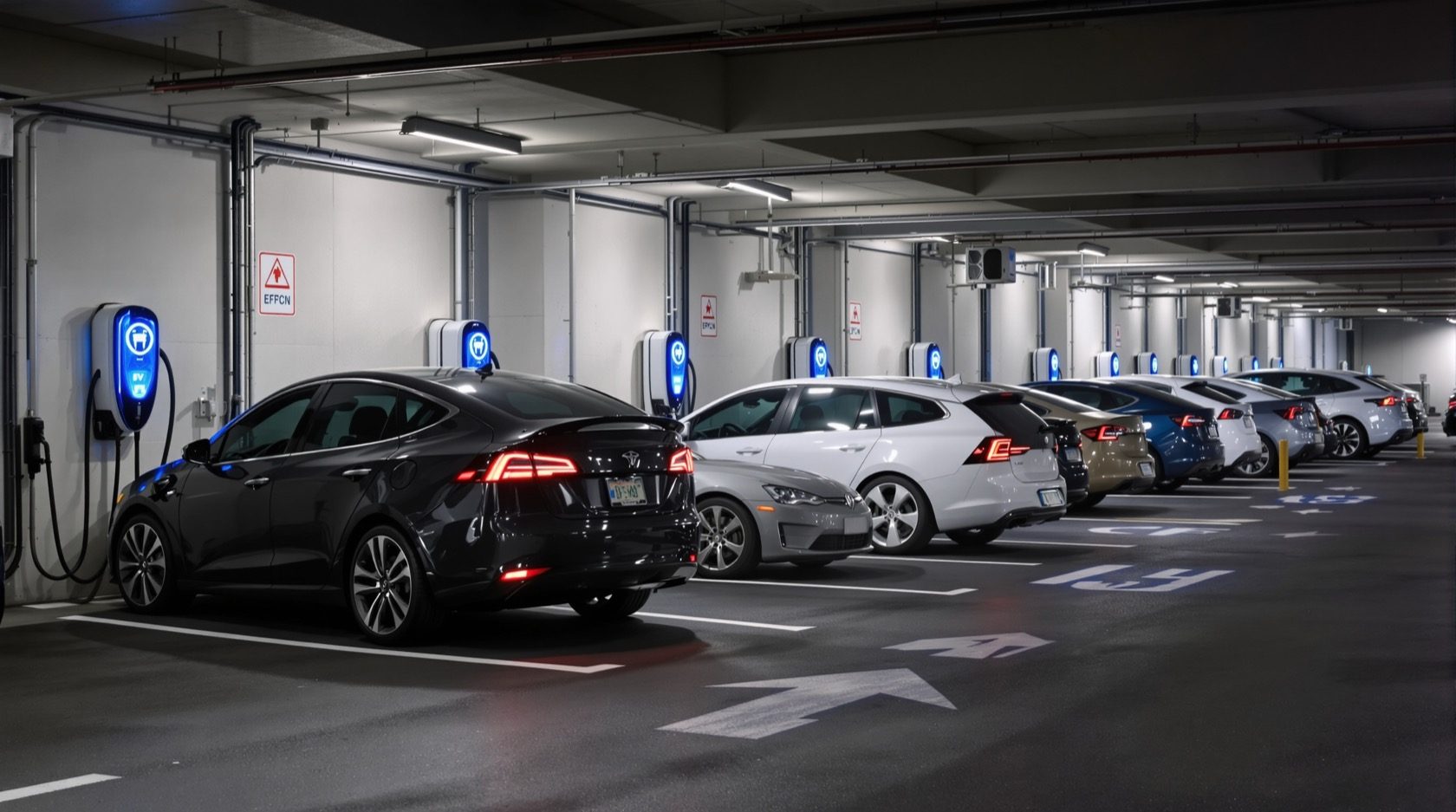
Apartment & Society EV Charging: Solving the Hard Case
Charging an electric car in a flat is harder than in a house — shared parking, shared wiring, and a housing society to convince. How apartment EV charging actually works, the metering and billing options, what the rules say, and how to get a charging point approved.
Charging an EV in an independent house is simple — your parking, your wiring, your decision. In an apartment, it is genuinely harder: the parking is shared or assigned but not "yours" electrically, the wiring belongs to the building, and installing a charger means convincing a housing society (RWA) and sorting out who pays for the electricity. These are solvable problems, and the rules increasingly support EV owners, but they need the right approach. This guide is the practical playbook for apartment and society EV charging.
It sits under the home EV charging guide and the EV charger types guide.
The safety line. Apartment charging installations — tapping into the building's supply, running cables through common areas, metering — are licensed-electrician and society-approved work to IS 17017 and the Ministry of Power EV charging guidelines. Never run an unauthorised cable from your flat across common parking. This guide helps you plan and negotiate; the installation is professional and needs society consent.
Why apartments are the hard case
Three things make flat charging harder than a house:
1. The parking isn't electrically yours — your assigned spot may be far from your flat's meter, and running a long cable from your flat across common areas is usually not allowed (and often unsafe).
2. The wiring is the society's — tapping into the building's supply needs the society's permission and proper design so it doesn't overload shared infrastructure.
3. Billing — the electricity for charging has to be measured and paid for by the right person, not lumped into common-area bills.
So apartment charging is as much a governance and metering problem as an electrical one — which is why the approach matters as much as the hardware.
The metering and billing options
How the charging electricity is measured and billed is the crux. Common models:
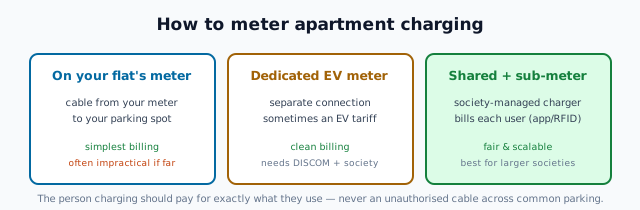
- Charger on your flat's connection — a cable from your flat's meter to your parking spot (if feasible and permitted). Simplest billing (it's on your bill), but often impractical if the spot is far.
- A dedicated EV meter — a separate DISCOM connection/meter for the charging point, sometimes on a special EV tariff. Clean billing, but needs the DISCOM and society to arrange it.
- A shared/managed charger with sub-metering — a society-installed charger (or bank of chargers) with smart metering that measures each user's consumption and bills them individually (often via an app/RFID). Increasingly the model for larger societies.
- Common-area supply with recovery — charging drawn from common supply and the cost recovered from users by the society; needs fair sub-metering to avoid disputes.
The right model depends on the building, but the principle is the same: the person charging should pay for exactly what they use, measured fairly — which needs proper metering, not guesswork.
What the rules say
The regulatory direction favours EV owners:
- The Ministry of Power EV charging guidelines and several state EV policies encourage and, in places, require charging provision in residential buildings, and support setting up charging infrastructure in societies.
- Model building bye-laws and newer construction norms increasingly mandate EV-ready provision (conduits, capacity) in new residential buildings.
- A society generally cannot unreasonably refuse a resident's right to charge, though it can require it be done safely, properly metered, and to a sanctioned design — which is reasonable.
Because these rules are evolving and state-specific, verify the current central guidelines and your state's EV policy and building bye-laws before proceeding — they may strengthen your case considerably.
Getting a charging point approved
A practical path through the society:
1. Propose it properly — a written proposal to the RWA/management with a licensed electrician's design: where the charger goes, how it's fed, how it's metered and billed, and the safety measures (dedicated circuit, RCCB, earthing).
2. Address the society's real concerns — load on the building's supply, safety, fair billing, and fire safety of batteries/charging in the basement (a legitimate concern that good design and placement address).
3. Propose a scalable solution — societies increasingly prefer a managed shared-charging setup with sub-metering over many individual ad-hoc cables, because it's safer, fairer and future-proof as more residents go electric.
4. Cite the supportive rules — the central guidelines and state policy that back residents' charging rights.
5. Use empanelled installers and get the DISCOM's involvement for any new meter/tariff.
Framing it as a safe, metered, scalable building amenity — not a personal cable across common parking — is what gets societies to yes.
The one-line answer
Apartment EV charging is harder than a house because the parking isn't electrically yours, the wiring is the society's, and the electricity must be fairly metered and billed — so it's a governance-and-metering problem as much as an electrical one. Solve the billing (charger on your flat's meter, a dedicated EV meter, or a society-managed shared charger with per-user sub-metering), lean on the supportive-and-evolving Ministry of Power guidelines and state EV policy, and win the society over with a proper licensed-electrician design that's safe, fairly metered and scalable — never an unauthorised cable across common parking.
Where to go next
- Home charging basics: Home EV Charging Guide.
- The charger technology: EV Charger Types (AC vs DC).
- Building-scale power: Building Electrical Services.
- Estimate charge time: EV Charging Time Calculator.
References
- Ministry of Power, Guidelines for Electric Vehicle Charging Infrastructure (verify current revision): https://powermin.gov.in/
- IS 17017 (Parts 1, 2, 21–31), Electric Vehicle Conductive Charging System, Bureau of Indian Standards.
- Your State EV Policy and State/City building bye-laws (state-specific, evolving).
- National Electrical Code of India, SP 30 : 2023; IS 732 : 2019, BIS: https://www.bis.gov.in/
EV-charging rules for residential buildings are evolving and state-specific; verify current central guidelines and your state policy and bye-laws. All installation must be by a licensed electrician with society approval and proper metering. Verify any standard's status via the BIS catalogue before relying on it.
Export this guide
Related Guides — Deep-dive reading
Residential Electrical Systems: The Complete Guide for Indian Homes
How the electricity in an Indian home actually works — from the utility supply and meter through the distribution board, circuits, wiring, earthing and protection, to lighting, safety, energy efficiency, smart controls, solar and backup — written so a homeowner can understand, plan and judge it, and know exactly where a licensed electrician must take over.
Electrical & WiringEV-Ready Home Design in India
Wire your home today to charge an electric car tomorrow, without breaking a single wall.
Future-Ready HomesEV-Ready Parking Design in India: Future-Proofing Bays and Load (2026)
The parking-side playbook for making bays charger-ready — the three tiers (EV-installed, EV-ready, EV-capable), why laying conduit and reserving electrical capacity now costs a fraction of retrofitting later, how many bays to future-proof, where to locate EV bays, the load and metering implications, fire-safety awareness, and the society-retrofit reality.
ParkingRelated Tools — Try Free
Electrical Safety & Load Audit
Home electrical audit — 10 categories, 65+ checkpoints across earthing, RCCB, MCB, wiring, switchboards, appliance circuits, DG/inverter backup.
Safety AuditEV Charging Time Calculator
Estimate how long an electric car takes to charge from its battery size, the charger power and the start and target charge levels.
EV ChargingApartment Video Door System Planner
Enter flats, entrances, floors and guard desk for a first-pass building intercom plan — door stations, indoor monitors, guard station, the right architecture and an indicative cost band.
Building Planner