

Society Security Budget Planning in India (2026)
How a housing society plans, funds and controls its collective-security budget fairly and transparently: the recurring OPEX and one-time CAPEX to fund, a fair per-flat levy, AGM approval and open books, a small reserve for replacements, and the honesty that every rupee figure is indicative.
Collective security is one of the larger lines in a housing society's budget, and one of the easiest to get wrong — either by underspending until the gate barely works, or by overspending on equipment that impresses at the annual general meeting but does little for real safety. Good society security budget planning is simply the discipline of deciding, in the open, what the community will fund, how much each flat pays, and how the money is controlled year to year. It is a governance task as much as a security one, and it belongs to the managing committee and the residents together, not to a vendor's quotation.
This guide is about the money and the process, not the hardware choices. It sits alongside the work of the security committee that runs the planning, the guard agency you hire and manage, and the broader security plan for a gated community. For the arithmetic of splitting shared costs fairly, see the companion piece on security cost per apartment.
Scope & how to read this. This explains how a society plans, funds and approves its collective-security budget; the rupee figures are indicative only, so get local quotes and have the numbers approved at the AGM. A managing committee acts within its bye-laws and the law — the state Apartment Ownership or Cooperative Societies Act, the Model Bye-laws, PSARA 2005 for guards and the DPDP Act 2023 for resident and visitor data. Verify the current rules with the society's legal advisor, auditor or the registrar.
Two buckets: what a security budget actually funds
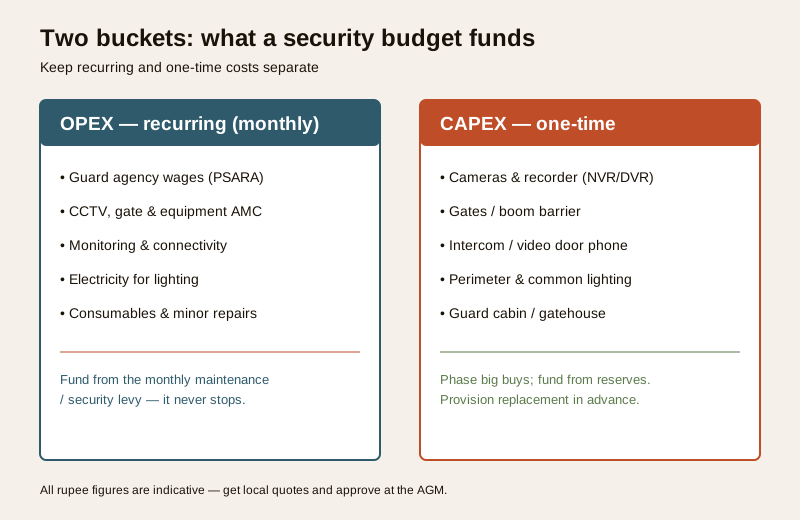
Every security rupee falls into one of two buckets, and keeping them separate is the single most useful habit in the whole exercise.
OPEX — recurring operating cost. This is what the society pays every month to keep security running. It is the bulk of the spend over any few years and it never stops, so it must be funded from regular income, not from one-off collections.
CAPEX — one-time capital cost. This is what the society pays occasionally to buy or build an asset — cameras, a boom barrier, a guard cabin. It is lumpy, it can often be phased, and its eventual replacement should be provisioned for in advance rather than sprung on residents as a surprise levy.
What sits in OPEX
- Guard agency wages — the largest recurring line for most societies. A PSARA-licensed agency invoices for guard deployment, and the invoice must genuinely cover statutory minimum wages, ESI, PF and relief cover. This is not a line to squeeze (more on that below).
- CCTV, gate and equipment AMC — annual maintenance contracts that keep cameras, the recorder, boom barriers, intercoms and access controls working.
- Monitoring and connectivity — any central-monitoring or remote-view subscription, SIM or broadband for the system.
- Electricity — power for perimeter and common-area lighting, cameras, the recorder and the gate.
- Consumables and sundries — registers, printer rolls, visitor passes, torches, batteries, minor repairs.
What sits in CAPEX
- Cameras and the recorder (NVR/DVR) and their cabling and power supplies.
- Gates, a boom barrier, or a bollard and their controllers.
- Intercom or video-door-phone infrastructure.
- Perimeter and common-area lighting as an installed system.
- A guard cabin or gatehouse and its fit-out.
How it is paid: the levy and cost per flat
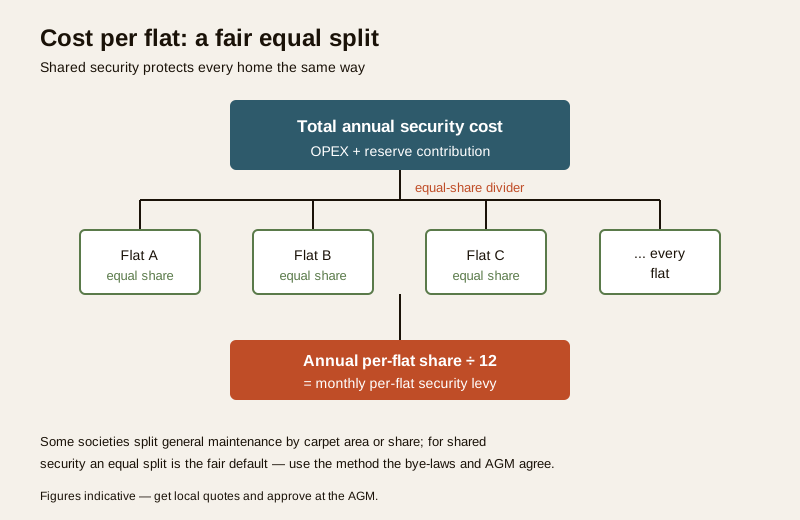
Recurring security OPEX is funded from the society's regular income — the monthly maintenance charge, sometimes shown as a separate "security" line on the bill. One-time CAPEX is funded from accumulated reserves, a planned special contribution approved at the AGM, or a phased draw from the sinking fund.
The fair default in most Indian societies is an equal per-flat apportionment of shared security: the gate, the guards, the cameras and the lighting protect every home the same way, regardless of flat size, so every flat pays the same security share. Some societies apportion general maintenance by carpet area or by share, and the bye-laws may specify the method; but for shared security specifically, an equal split is the easiest to defend as fair because the benefit is genuinely common. Whatever method the society uses, it should be the method the bye-laws and the AGM have agreed — not an ad-hoc decision.
A worked example (indicative figures only)
Illustrative only — not a quote. Numbers are round placeholders to show the method. Your real costs depend on your city, guard count, shifts, equipment and vendor. Get local quotes and approve the actual figures at the AGM.
| Line item | Bucket | Example annual cost | Notes |
|---|---|---|---|
| Guard agency (multiple guards, three shifts) | OPEX | specify | Largest line; must cover statutory wages and welfare |
| CCTV and gate AMC | OPEX | specify | Annual contract, all devices |
| Monitoring / connectivity subscription | OPEX | specify | If used |
| Electricity for security lighting and equipment | OPEX | specify | Share of common-area power |
| Consumables and minor repairs | OPEX | specify | Registers, passes, batteries |
| Total recurring OPEX | specify | Funded by the monthly levy | |
| Reserve contribution for future replacement | Reserve | specify | Provisions CAPEX before it is needed |
| Amount to recover from flats per year | specify | OPEX + reserve |
To turn that into a per-flat monthly levy, divide the amount to recover by the number of flats and by twelve:
| Step | Value |
|---|---|
| Annual amount to recover (OPEX + reserve) | specify |
| Number of flats | specify |
| Annual security levy per flat | amount / flats |
| Monthly security levy per flat | annual per flat / 12 |
Approval and transparency: how the number gets agreed
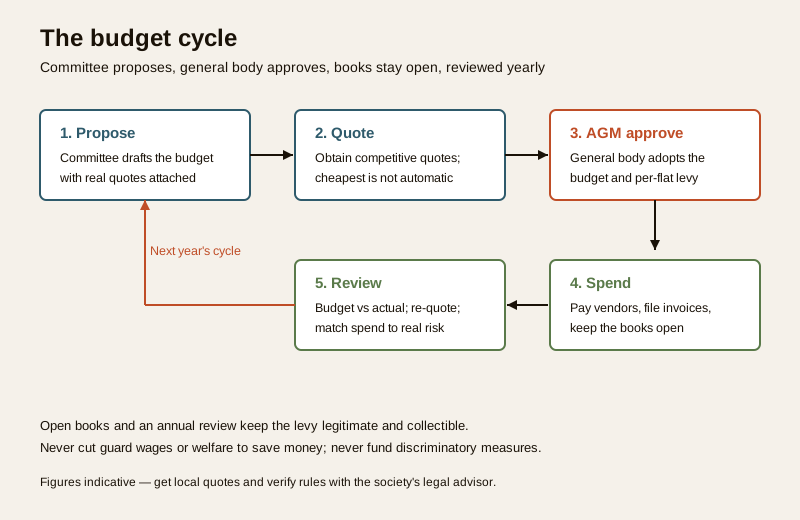
A security budget that residents have not seen and approved is a dispute waiting to happen. The committee proposes; the general body approves; the books stay open. That sequence is not bureaucracy — it is what makes the levy legitimate and collectible.
The proper sequence
- The committee drafts the budget — the security committee or treasurer prepares the OPEX and CAPEX lines with real quotes attached.
- Competitive quotes — for the guard agency, the AMC and any capital purchase, obtain more than one quote so the choice is on record and defensible. Cheapest is not automatically best, and a quote that undercuts the statutory wage bill should be treated as a warning, not a bargain.
- AGM approval — the budget, the resulting levy and any special contribution for CAPEX are placed before the annual general meeting (or a special general meeting) and adopted by resolution, per the bye-laws.
- Open books — actuals are recorded, vendor invoices are filed, and the accounts are available to members and audited as the bye-laws require.
- An annual review — each year the committee compares budget to actual, reviews whether the spend still matches the risk, and re-quotes contracts periodically rather than rolling them over unexamined.
What to put in front of the AGM
| Document | Purpose |
|---|---|
| OPEX schedule with line items | Shows recurring cost and the monthly levy it drives |
| CAPEX plan (this year and phased) | Shows one-time buys and how they are funded |
| Competing quotes for major lines | Demonstrates the choice was tested on price and terms |
| Reserve / sinking-fund statement | Shows what is set aside for replacements |
| Prior-year budget vs actual | Accountability for last year's spend |
| Proposed levy per flat | The number residents are being asked to approve |
Getting value without cutting corners
Right-sizing beats both underspending and gold-plating. The goal is a budget matched to the society's real risk and layout, not to the most impressive brochure.
- Right-size to the real risk. A small, low-footfall society does not need the camera count of a large gated township. Base the plan on the actual entry points, footfall and incidents, and keep security a service to residents rather than a status project.
- Phase big CAPEX. A full camera refresh or a new boom barrier can often be split across two or three years so no single year's levy spikes. Phase by priority — cover the main gate and perimeter first.
- Keep a small reserve or sinking fund. Equipment wears out and needs replacing. Setting aside a modest amount each year means the next NVR or barrier is already provisioned, so residents are not hit with an emergency collection.
- Re-quote periodically. Contracts drift above market when they roll over unchecked. A periodic re-quote of the guard agency and AMC keeps pricing honest — without using it as an excuse to chase the cheapest bid past the point of fairness.
Fairness is part of the budget, not separate from it
Two rules sit above every cost saving:
- Never cut guard wages or welfare to save money. The guards are people doing a demanding job, and a PSARA-licensed agency's invoice is largely statutory minimum wage, ESI and PF. Squeezing the agency to a number that cannot cover these either pushes the shortfall onto the guards illegally, or buys under-trained, high-turnover cover that makes the society less safe. Budget for fair wages, reasonable shifts, a clean rest space, drinking water and relief — it is both the right thing and, for statutory dues, the law.
- Never fund discriminatory or unlawful measures. Money must not pay for blanket bans on tenants or "bachelors", humiliating searches of domestic workers or delivery staff, or any profiling by caste, religion or region. Domestic workers, drivers, delivery and gig workers and tenants are residents and visitors with rights, not suspects. Security is applied equally and respectfully, and a committee cannot override individual rights by resolution.
DPDP note. A society that collects visitor logs, domestic-worker details, resident phone numbers, vehicle numbers, photos, biometrics or gate-app data is a data fiduciary under the Digital Personal Data Protection Act, 2023. Budget for doing this properly: collect the least data needed for a clear purpose, secure it, set a sensible retention period and delete on schedule, and take extra care with biometrics and workers' personal data. "We store everything forever" is not a saving — it is a liability.
Common budgeting mistakes
- Funding CAPEX from this month's maintenance — a big one-time buy drains the operating account and leaves guards or bills unpaid; fund capital from reserves or an approved contribution instead.
- No reserve at all — every replacement becomes a crisis levy, and the society lurches from one emergency collection to the next.
- Approving a vendor's quote as the budget — the vendor optimises for their sale, not the society's risk; the committee must build the budget and test it against competing quotes.
- Rolling contracts over unexamined — prices drift and service slips when nobody re-quotes for years.
- Squeezing the guard bill to the headline-cheapest agency — this usually means someone is not being paid their statutory due, and it is a false economy that the society may answer for.
How it connects
Budget planning is the money layer under the whole society-security effort. The people who prepare and steward it are covered in the society security committee; the largest recurring line is shaped by how you hire and manage the guard agency; the wider plan the budget pays for is the security guide for gated communities; and the fair-split arithmetic is worked through in security cost per apartment. All of these sit in the Community & RWA Security library.
Key takeaways
- Split every security cost into OPEX (recurring — guards, AMC, monitoring, power, consumables) and CAPEX (one-time — cameras, gates, intercom, lighting, cabin); fund OPEX from the monthly levy and CAPEX from reserves.
- The fair default for shared security is an equal per-flat apportionment, because the gate and guards protect every home the same way; use the method the bye-laws and AGM have agreed.
- Follow the sequence — committee proposes, competitive quotes, AGM approves, books stay open, annual review — so the levy is legitimate and collectible.
- Right-size to real risk, phase big CAPEX, and keep a small reserve so replacements never become an emergency levy.
- Never save money by cutting guard wages or welfare, or by funding discriminatory measures — fairness and lawful, equal treatment come before any saving.
- Treat resident and visitor data as a DPDP responsibility: collect the least, secure it, retain briefly, delete on schedule.
- Every rupee figure here is indicative — get local quotes and approve the real numbers at the AGM.
References
- The Digital Personal Data Protection Act, 2023 — the society is a data fiduciary for visitor, worker and resident data; budget to collect the least, secure it and limit retention. Verify current rules with the society's legal advisor.
- The Private Security Agencies (Regulation) Act, 2005 (PSARA) — engage a licensed agency; the invoice must cover statutory wages and welfare. Confirm the agency's licence and compliance.
- The relevant state Apartment Ownership or Cooperative Societies Act and the Model Bye-laws — govern how budgets, levies and reserves are proposed, approved and audited; verify the current provisions with the registrar or the society's auditor.
- The society's own registered bye-laws and audited accounts — the authoritative source for apportionment method, approval thresholds and reserve rules; follow them over any generic guidance.
- Competing vendor quotations for the guard agency, AMC and any capital purchase — the real basis for the numbers; get local quotes.
This is educational guidance, not legal, financial or contractual advice. All rupee figures are indicative — get local quotes and approve the actual budget and levy at the AGM. Apply security fairly and lawfully, never fund discriminatory measures, never cut guard wages or welfare to save money, and handle resident and visitor data under the DPDP Act; verify the current rules with the society's legal advisor, auditor or the registrar, and have professionals do the installation and licensed work.
Export this guide
Related Guides — Deep-dive reading
Fair and Lawful Community Security in India (2026): Dignity, Data and Governance Done Right
How a housing society can run security that is fair, dignified and within the law — rejecting discriminatory practices, respecting domestic, delivery and gig workers, honouring the DPDP Act as a data fiduciary, and governing within its bye-laws and residents' rights — and why that makes it better security, not weaker.
SecurityThe Housing Society Security Committee in India (2026): How to Form and Run One That Works
A practical, India-grounded guide to setting up a housing society or RWA security committee that assesses risk, plans and budgets shared security, oversees guards, CCTV and gates, reviews incidents and sets fair policy — deciding properly through the managing committee and AGM, within the bye-laws and the law.
SecuritySecurity Cost Per Apartment in India (2026): The Per-Flat Budgeting Metric
How a housing society, RWA, builder or apartment buyer works out the security cost per apartment — dividing shared perimeter, gate, guard, CCTV and access infrastructure across the number of flats, adding each flat's own door security, and separating one-time capex from the recurring guarding and AMC opex that maintenance charges actually fund.
SecurityRelated Tools — Try Free
Apartment Video Door System Planner
Enter flats, entrances, floors and guard desk for a first-pass building intercom plan — door stations, indoor monitors, guard station, the right architecture and an indicative cost band.
Building PlannerCCTV Camera Coverage & Count Calculator
Estimate how many CCTV cameras you need, the NVR channels, storage in TB for your retention period, and an indicative all-in cost with GST.
CCTV CalculatorAccess-Control Schedule Generator
Build the time schedules that decide when each access group can enter — an editable list for your integrator.
Time Schedules