
Herzog & de Meuron's Façade Signature: The Architects Who Made the Building Skin Their Life's Experiment
From gabion stone baskets to screen-printed concrete, perforated copper and glowing ETFE cushions, Herzog & de Meuron turned the façade into a laboratory — and their breathing stone-basket wall is one of the most India-ready skins in modern architecture.
Most great architects can be summarised by a look. You can sketch a Corbusier, a Mies, a Zaha from memory. Try to do that with Herzog & de Meuron and you fail — because there is no single Herzog & de Meuron look. There is a winery in Napa whose walls are wire baskets stuffed with black basalt. There is a museum in San Francisco wrapped in three-quarters of a million pounds of dimpled, perforated copper. There is a German library tattooed all over, concrete and glass alike, with grainy black-and-white photographs. There is a Munich stadium that glows like a giant inflatable lantern and changes colour, and a Beijing stadium woven from steel like a nest. None of them look related. That is the point.
The two Basel architects, Jacques Herzog and Pierre de Meuron, built one of the most influential careers in modern architecture on a single radical bet: that the most interesting thing about a building is its skin, and that every new building deserves a brand-new investigation into what a skin can be made of and made to do. They won the Pritzker Prize in 2001 — the first time it had ever gone to a partnership rather than a lone genius — and the RIBA Royal Gold Medal in 2007. The Pritzker jury praised them for "transforming materials and surfaces through the exploration of new treatments and techniques." That sentence is, more or less, the whole story.
For a country like India — with no single climate, no single building culture, and a deep, living tradition of patterned and perforated walls — the Herzog & de Meuron way of thinking about the façade is unusually liberating. They give us permission not to copy a style, but to interrogate a material. And buried in their portfolio is one idea, the gabion stone wall, that is almost embarrassingly well-suited to hot Indian sites: local, low-tech, thermally massive, breathing, and beautiful.
This is part of our Building Façades series — specifically our Masters of the Façade set, where we study how individual architects treated the building skin. To go deeper on the techniques below, read alongside our guide to stone & masonry façades (for gabions and stone skins), metal & ACP façades (for perforated, embossed, Corten and copper), jaali & traditional Indian façades (for perforated patterned screens), and the broader types of building façades overview.
1. The façade as the primary experiment
Start with the mindset, because everything else follows from it. For Herzog & de Meuron, the façade is not the last thing you decorate after the building is designed. It is frequently the first question — sometimes the only question — and the rest of the building organises itself around the answer.
This is why their work refuses to settle into a signature shape. The signature is a method, not a look: take a material — often a cheap, ordinary, even ugly one — and obsess over it until it does something nobody expected. Plywood, polycarbonate, raw concrete, plain copper sheet, loose stone, plastic cushions: in their hands these become the entire architectural event. The form stays calm, often a simple box; the drama is entirely in the surface.
For an Indian architect or homeowner, this is the most portable lesson of all, and it costs nothing. It says: stop asking "which famous style should this house look like?" and start asking "what can this one local material — this Kota stone, this terracotta, this exposed concrete, this perforated steel — be pushed to do that I haven't seen before?" That question produces buildings that belong to their place, instead of buildings that look like they were downloaded.
2. Screen-printing on glass and concrete: the photographic skin
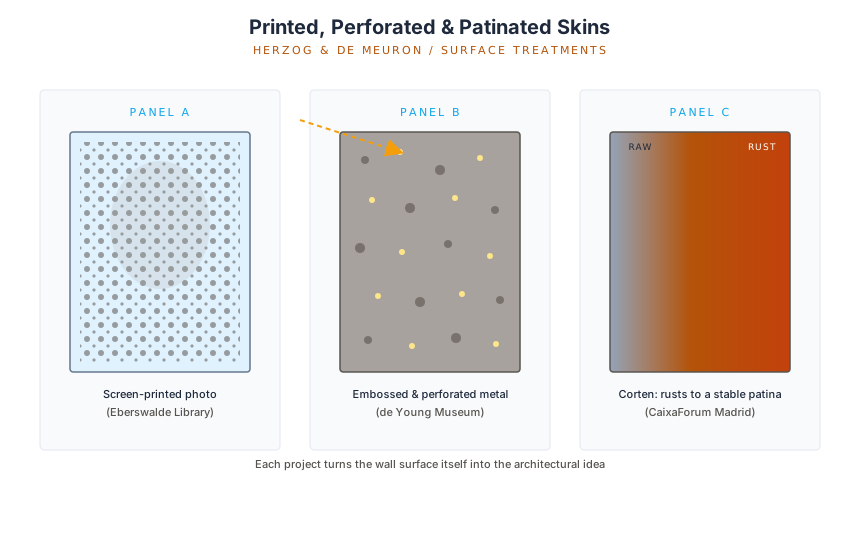
One recurring Herzog & de Meuron experiment is the photo-engraved or screen-printed façade — putting an actual image onto the building's surface. Screen-printing (also called silkscreen) pushes ink or a surface treatment through a fine stencil mesh; the architects adapted it to architectural scale, printing photographs onto glass, concrete and plastic.
The clearest example is the Eberswalde Technical School Library (Germany, 1999), made with the photographer Thomas Ruff. Ruff selected grainy press and historical photographs from his own collection, and these images were reproduced across the building's horizontal bands. Crucially, the same image runs across both the concrete panels and the glass strips that wrap the building, so the difference between solid wall and window dissolves. The building reads as one continuous printed surface, like a Warhol canvas you can walk into.
The same idea, gentler, appears at the Ricola storage building in Mulhouse, France (1993), where a single leaf photograph by Karl Blossfeldt was silkscreened, repeated like wallpaper, onto translucent polycarbonate (a tough, lightweight plastic glazing) panels. By day the printed plant pattern reads as a textile curtain that echoes the surrounding trees; in low light the pattern fades and the panels go smooth and quiet.
For India, the lesson is not to copy German press photos. It is that printing is a modern, non-kitsch route to culturally specific ornament — a way to put a regional textile motif, a temple-carving rhythm or an abstracted jaali pattern onto a contemporary skin without resorting to stuck-on "ethnic" decoration.
3. Perforated, etched and embossed metal: the de Young skin
Their second great surface investigation is metal worked like a textile. The landmark is the de Young Museum in San Francisco (2005), the largest copper-clad building in the world, wrapped in 7,602 copper panels weighing roughly 950,000 pounds. Each panel is embossed (pressed into raised three-dimensional bumps and dimples) and perforated (pierced with holes), in a pattern abstracted from dappled light falling through a tree canopy — effectively a photograph of the surrounding park translated into a relief of bumps and holes, "printed" in metal.
Two things make this a façade-craft masterclass. First, patina: the panels went up bright penny-copper and were always designed to weather — fading to cinnamon and eventually to a green oxide that blends into Golden Gate Park. The architects treated the chemical ageing of the material as part of the design, not a defect to be sealed against. Second, the perforation turns a solid metal wall into a light-modulating screen — conceptually a high-tech cousin of the Indian jaali.
Closely related is Corten (also written COR-TEN), or weathering steel — an alloy engineered to rust on purpose. Its outer rust layer is stable and protective, so the metal stops corroding and holds a deep orange-brown for decades without paint. Herzog & de Meuron used it to wrap the top of CaixaForum Madrid (2008), a former power station lifted off the ground and crowned in rusted steel.
4. The wrapper, the second skin, the veil
A thread running through all of this is the idea of the wrapper (also called a second skin or veil): an outer layer that is visually and often structurally separate from the building behind it. The structure does the holding-up; the wrapper does the seeing, the shading, the weathering, the meaning. Sometimes the wrapper is stone gabions, sometimes printed polycarbonate, sometimes copper mesh, sometimes — at CaixaForum — a four-storey vertical garden of nearly 15,000 plants designed with botanist Patrick Blanc, a living green skin pressed against the rusted steel.
Decoupling the skin from the structure is enormously useful in India. It lets you put a robust, climate-tuned outer layer — a perforated screen, a stone basket wall, a planted trellis — in front of an ordinary, cheap structural frame. The frame keeps out rain and holds the slabs; the wrapper handles the sun, the privacy, the dust and the character. You get performance and identity without making the expensive structural shell do double duty.
The gabion façade: Dominus Winery
This is the technical heart of the article, and the single most India-transferable idea Herzog & de Meuron ever produced.
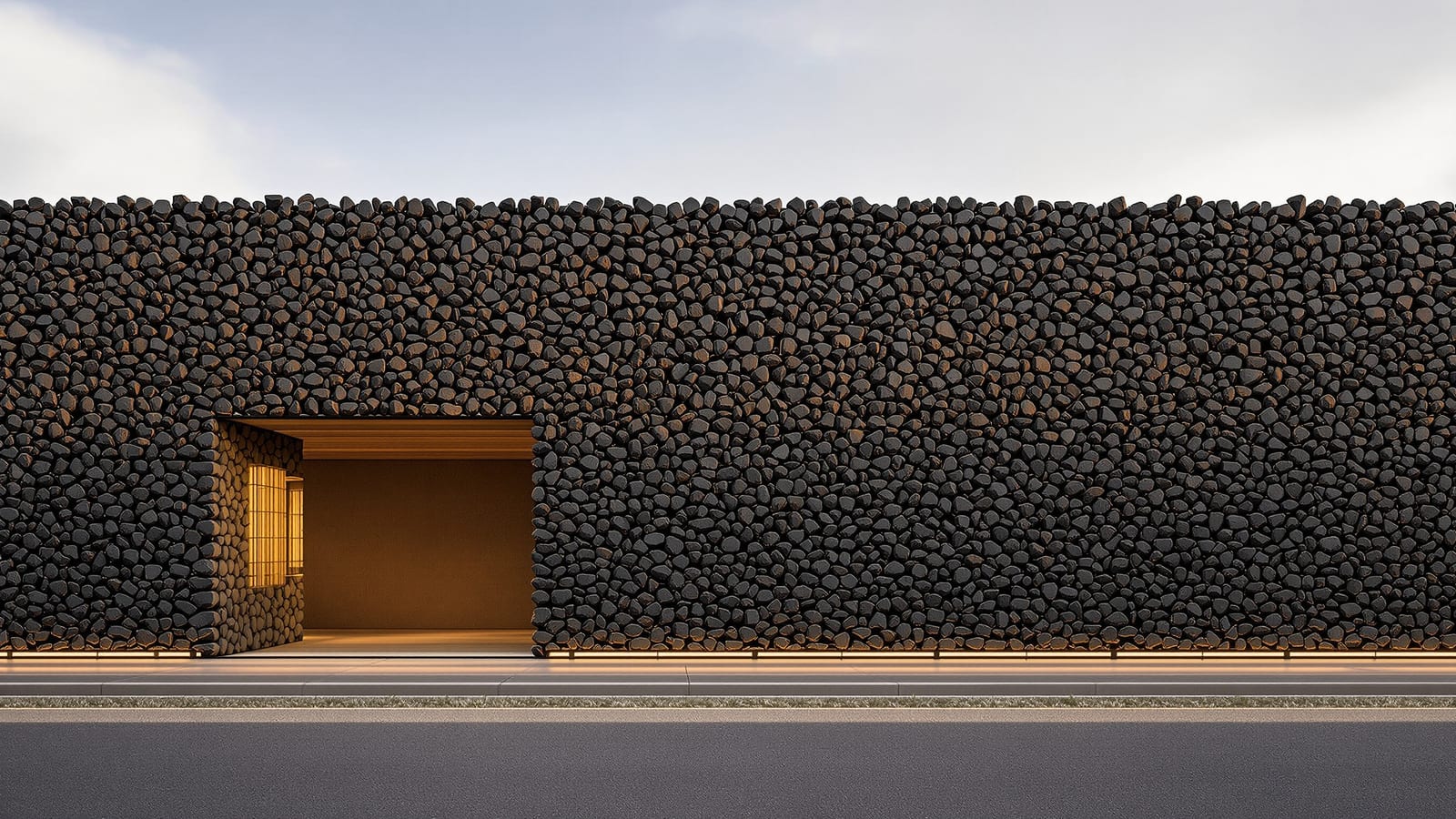
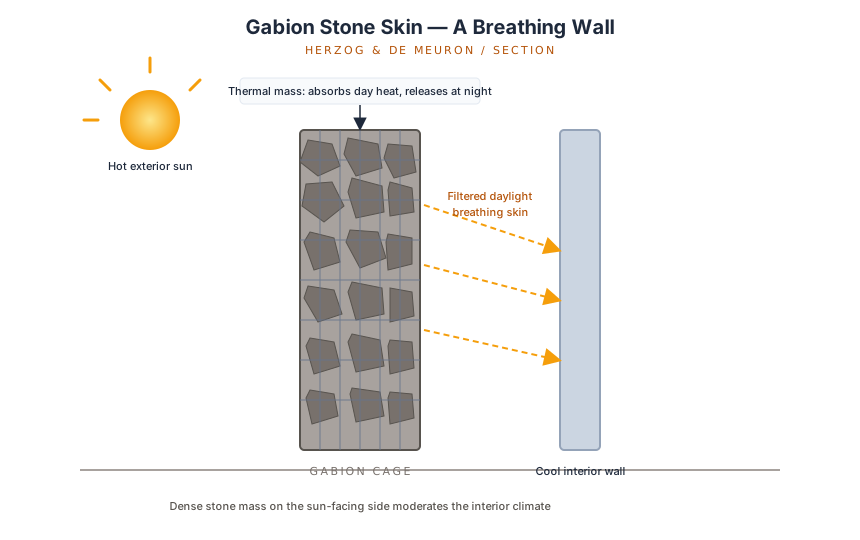
At the Dominus Winery in Yountville, Napa Valley (1997) — their first major building in America — the architects faced a problem familiar to half of India: a site with a brutal swing between hot days and cold nights, and a desire for a calm, stable interior without burning energy on air-conditioning. Their answer was the gabion. A gabion is simply a cage of galvanised steel wire mesh filled with loose stone — a system normally used for retaining walls and erosion control, dirt-cheap and utterly ordinary. Herzog & de Meuron promoted it to architecture and used it as the building's entire outer wall, filling the cages with local basalt quarried nearby, dark green-to-black stone that sinks the long, low building into its landscape.
Why this works is worth spelling out, because every part of it transfers to India:
- Thermal mass. Stone is dense and slow. Thermal mass is a material's ability to soak up heat and release it slowly, smoothing out the day–night temperature swing. The thick stone-filled walls absorb the day's heat and release it after dark, keeping the interior cool when the sun is fiercest and buffering the cold at night. This is exactly the physics behind a traditional thick-walled haveli or fort.
- A breathing, porous skin. The gabions are packed at varying densities — tight where the architects wanted solid mass and shade; loose where they wanted air and light. Where the stones are loose, daylight filters through the gaps and air moves through the wall. It is, functionally, a breathing skin — a wall that is permeable to light and air, behaving like a heavy stone jaali.
- Low-tech and local. No exotic technology, no imported panels, no fragile coating. Galvanised wire baskets and stone from down the road, assembled by ordinary labour.
Read that list again with an Indian hot-dry site in Rajasthan, Gujarat or the Deccan in mind. Local stone is abundant and cheap. Labour for hand-filling baskets is available. The thermal-mass behaviour is precisely what a hot-dry climate craves. The porosity gives shaded, filtered light and ventilation. The aesthetic is rugged, contemporary and unmistakably of-its-place. Of every idea in this guide, the gabion wall is the one an Indian practice could build, robustly, next year.
5. The building as a giant glowing object
At the largest scale, Herzog & de Meuron let the skin become the entire identity of the building — the façade as billboard, lantern and object all at once.
The Allianz Arena in Munich (2005) is wrapped in 2,760 diamond-shaped ETFE cushions, the largest membrane cladding in the world. An ETFE cushion is a pillow of thin transparent plastic film (ethylene tetrafluoroethylene) kept inflated by a low-pressure air system — a pneumatic façade. Each cushion can be lit individually in white, red or blue, so the whole stadium glows after dark and changes colour to signal which club is playing. The skin is the building's face, voice and signage in one.
The Beijing National Stadium, the "Bird's Nest" (2008), built with the artist Ai Weiwei for the Olympics, takes the opposite tack: instead of separating skin and structure, it fuses them completely. Roughly 110,000 tonnes of steel are woven into a lattice of interlaced members so that façade, structure and ornament become a single thing — there is no cladding, the structure is the look, with translucent ETFE membranes tucked into the gaps for weatherproofing, like the soft stuffing in a real nest. It is the most extreme statement of the firm's belief that the skin and the meaning of a building can be one and the same.
These are spectacular, but be honest about them: they are bespoke, enormous-budget, highly specialised buildings. The idea — let the skin carry the building's identity — is portable. The exact technology mostly is not.
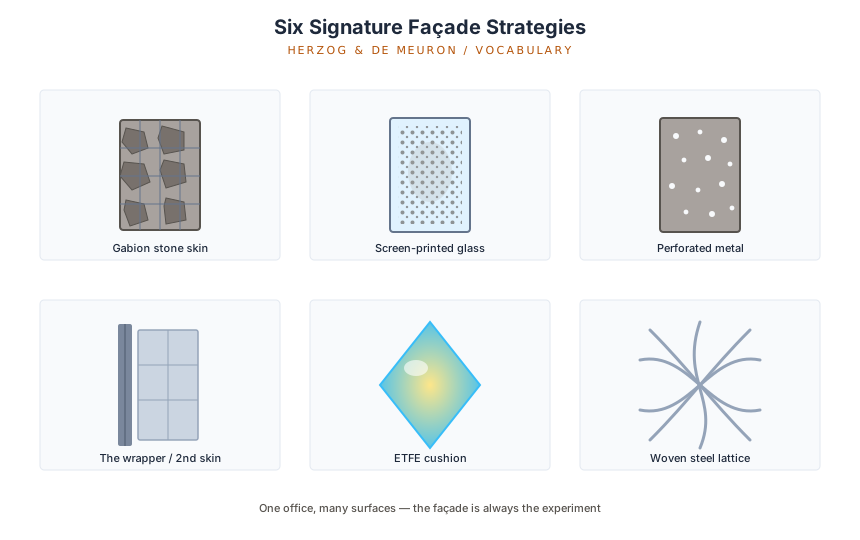
6. Signature façade strategies at a glance
| Strategy | What it is | Building | Why it matters | India relevance |
|---|---|---|---|---|
| Gabion stone skin | Wire baskets filled with local stone; thermally massive, porous, breathing | Dominus Winery, Napa (1997) | Cheap, local, low-tech mass that cools by day and filters light | Outstanding — local stone + labour, ideal for hot-dry sites |
| Screen-printed concrete & glass | Photographs silkscreened across solid and glazed surfaces alike | Eberswalde Library (1999) | Dissolves window vs wall; turns the skin into one image | A non-kitsch route to culturally specific pattern |
| Printed polycarbonate | Repeated plant photo silkscreened on translucent plastic | Ricola, Mulhouse (1993) | Cheap plastic reads as a glowing patterned curtain | Pattern + filtered light at low cost; check UV/heat ageing |
| Embossed & perforated copper | Dimpled, pierced metal abstracting dappled light; designed to patinate | de Young Museum (2005) | Solid metal becomes a light-screen that ages gracefully | Like a metal jaali; robust if detailed for monsoon |
| Corten / weathering steel | Steel that rusts to a stable protective skin, no paint | CaixaForum Madrid (2008) | Rich colour and zero repainting; honest weathering | Good, but needs runoff-staining control on adjacent surfaces |
| ETFE pneumatic cushions | Inflated plastic pillows, lit and colour-changing | Allianz Arena (2005) | Lightweight glowing skin = the building's identity | Bespoke, high-tech; maintenance/dust questions in India |
| Woven structural lattice | Steel woven so structure = skin = ornament | Bird's Nest, Beijing (2008) | One element does everything; no separate cladding | Inspirational, not directly transferable at house scale |
7. Texture, pattern and ornament, rehabilitated
There is one more reason Herzog & de Meuron matter to India specifically. For most of the twentieth century, modernist orthodoxy treated ornament as a crime — pattern and decoration were things serious architects were supposed to strip away. Herzog & de Meuron quietly put it back, but on modernist terms.
The distinction worth holding onto is ornament versus decoration. Decoration is applied on top — a stuck-on motif that could be peeled off without changing the building. Ornament, in their hands, is integral: the de Young's pattern is the perforation of the actual structural skin; Eberswalde's images are cast into the concrete itself; the gabion's "pattern" is the real, load-relevant arrangement of stones. The richness is built into the material, not glued onto it.
For Indian designers this is the bridge between a deep ornamental heritage — jaali, jharokha, carved stone, woven textile — and a contemporary idiom. It says you can have pattern, richness and cultural specificity in a modern building, as long as the pattern is made into the skin rather than pasted onto it.
Real buildings, not renders
Five verified Herzog & de Meuron façades and exactly how each skin works:
- Dominus Winery, Yountville (1997) — Walls of gabion wire cages filled with local basalt. Packed densely for mass and shade, loosely for filtered light and air. A thermally massive, breathing stone skin that holds the interior steady through Napa's big day-night swing. The single most India-relevant façade in this guide.
- de Young Museum, San Francisco (2005) — 7,602 embossed and perforated copper panels (the world's largest copper-clad building), patterned from dappled tree-canopy light. Installed bright copper, designed to patinate through cinnamon to green. A solid metal wall that behaves like a light-screen.
- Eberswalde Technical School Library (1999) — Grainy photographs chosen by Thomas Ruff, screen-printed across both concrete panels and glass strips, so wall and window merge into one continuous printed image. The photographic façade pushed to its limit.
- Allianz Arena, Munich (2005) — 2,760 inflated ETFE cushions, the world's largest membrane cladding, individually lit and colour-changing (white/red/blue). The skin is the stadium's glowing identity.
- Beijing National Stadium / "Bird's Nest" (2008) — A woven steel lattice (~110,000 tonnes), built with Ai Weiwei, where structure, façade and ornament are a single element, with ETFE infill for weatherproofing. The ultimate fusion of skin and structure.
- CaixaForum Madrid (2008) — A power station crowned in rusted Corten steel, paired with a four-storey vertical garden of nearly 15,000 plants by Patrick Blanc — a wrapper that is half rust, half living wall.
What it teaches India
Let me be honest about what is and isn't transferable, because uncritical hero-worship helps nobody.
Borrow the gabion, without hesitation. The Dominus wall is the standout lesson. Local stone, wire cages, ordinary labour; massive thermal performance for a hot climate; porosity that filters light and air like a stone jaali; a rugged, contemporary, of-the-soil aesthetic; and a cost that is closer to a retaining wall than to a luxury façade. For hot-dry India especially — Rajasthan, Gujarat, the Deccan — this is close to an ideal climate-responsive skin, and it sidesteps the import-and-imitate trap entirely. Detail it for India: hot-dip galvanised or coated mesh against humidity, stainless ties at exposed faces, and provision for replacing rusted cages over a long life.
Borrow the mindset. Their defining trait — no fixed style, only relentless experimentation with the façade material — is profoundly freeing for a country with no single architectural look to default to. Instead of debating "modern vs traditional vs Indian," ask what one robust local material can be pushed to do.
Borrow the pattern logic, carefully. Printed and perforated skins offer a modern, non-kitsch way to put culturally rooted — even explicitly Indian — pattern and ornament back on a façade, as long as it is built into the skin (like a perforated metal jaali) rather than pasted on.
But be clear-eyed about the limits. Much of Herzog & de Meuron's work is bespoke museum-and-stadium budget, executed by specialist fabricators. And several of their signature skins raise real maintenance and longevity questions in Indian conditions: screen-printed glass and printed polycarbonate can fade, yellow and craze under intense UV; ETFE cushions and fine perforated metal collect dust and need cleaning regimes that don't exist on most Indian sites; Corten runoff can stain whatever sits below it during monsoon. So the rule is simple: borrow the gabion and the experimental, ornament-friendly attitude, but execute them in robust, locally repairable materials — and treat the printed-glass and ETFE spectaculars as inspiration, not specification.
What this means for you
If you take one thing from Herzog & de Meuron, make it the gabion wall — and the deeper habit behind it. They did not invent a style for others to copy; they invented a way of asking questions about the skin, and answered it freshly every time, usually with humble materials pushed to do extraordinary work.
For an Indian project, that translates into three concrete moves. First, on a hot-dry site, seriously cost a gabion stone façade against conventional cladding — you may find a cheaper wall that performs dramatically better and looks like nowhere else. Second, treat your façade as a separate wrapper from your structure, so an ordinary frame can carry an extraordinary, climate-tuned skin. Third, if you want pattern and cultural identity, build it into the material — perforate it, cast it, weave it — rather than sticking it on.
When you brief a designer, you can hand them this entire philosophy in one line: don't tell me which famous building this should resemble — tell me what one local material can be made to do that I have never seen before. To take the next step, revisit the types of building façades overview and the full Building Façades series to test these ideas against your own site, budget and climate.
Sources
- The Pritzker Architecture Prize — Jacques Herzog and Pierre de Meuron, 2001 Laureates (pritzkerprize.com) — first Pritzker awarded to a partnership; "transforming materials and surfaces."
- Herzog & de Meuron — official project pages for Dominus Winery, Ricola-Europe, Eberswalde Library and Allianz Arena (herzogdemeuron.com).
- Dominus Estate architecture pages and Dezeen, "Dominus Winery by Herzog & de Meuron" — gabion cages, local basalt, thermal mass, variable density.
- Zahner and Copper.org — de Young Museum: 7,602 embossed and perforated copper panels, dappled-light pattern, designed patina; largest copper-clad building.
- MoMA collection — Ricola-Europe façade panel, Karl Blossfeldt leaf photograph silkscreened on polycarbonate.
- Herzog & de Meuron — Eberswalde Library, Thomas Ruff screen-printed concrete and glass.
- Arup and Herzog & de Meuron — Allianz Arena, 2,760 ETFE cushions, pneumatic colour-changing membrane.
- Encyclopaedia Britannica and ArchEyes — Beijing National Stadium "Bird's Nest," woven steel lattice, ~110,000 tonnes, Ai Weiwei, ETFE infill, structure-as-façade.
- ICON Magazine and Inhabitat — CaixaForum Madrid, Corten weathering steel, Patrick Blanc vertical garden (~15,000 plants).
- RIBA — Royal Gold Medal 2007 awarded to Herzog & de Meuron.
Export this guide
Related Guides — Deep-dive reading
Louis Kahn's Façade Signature: Wrapping Ruins, Brick Arches, and Monumental Light
How Louis Kahn shaded the glass behind giant geometric screen walls, asked the brick to be an arch, and built monumental façades of fair-faced concrete and light — and what that hot-climate logic teaches Indian builders today.
Building FacadesJaali & Traditional Indian Façades: India's Original Climate-Smart Screen
Guide to the jaali and traditional Indian façades: history from Mughal and Rajasthani stone screens to Hawa Mahal and Sidi Saiyyed, the building physics of daylight, heat, privacy and breeze, materials from sandstone to GRC and metal, the parametric revival at Pearl Academy Jaipur, and how a homeowner can use a jaali.
Building FacadesZaha Hadid's Façade Signature: The Seamless Parametric Skin (And What It Teaches India)
How Zaha Hadid turned façades into single flowing surfaces built from thousands of unique GFRC panels — a spectacular, mega-budget, climate-poor icon whose real gift to India is the parametric method, not the smooth swooping look.
Building FacadesRelated Tools — Try Free
Brise-Soleil Visualizer
Interactive horizontal-louvre cut-off angle calculator — sun altitude, louvre depth, and spacing inputs with a live shadow preview. Computes θ = arctan(spacing/depth) for façade shading, ECBC envelope compliance, hospital daylight design, and tropical sun-control detailing.
Sun Shading ToolCross-Ventilation Analyzer
Estimate airflow and air changes per hour (ACH) from room size, window areas, layout, and local wind — with NBC 2016 Part 8 compliance check.
Ventilation CalculatorWindow Cleaning Cost Calculator
Estimate professional window cleaning cost per visit and per year by access and frequency.
Window Calculator