
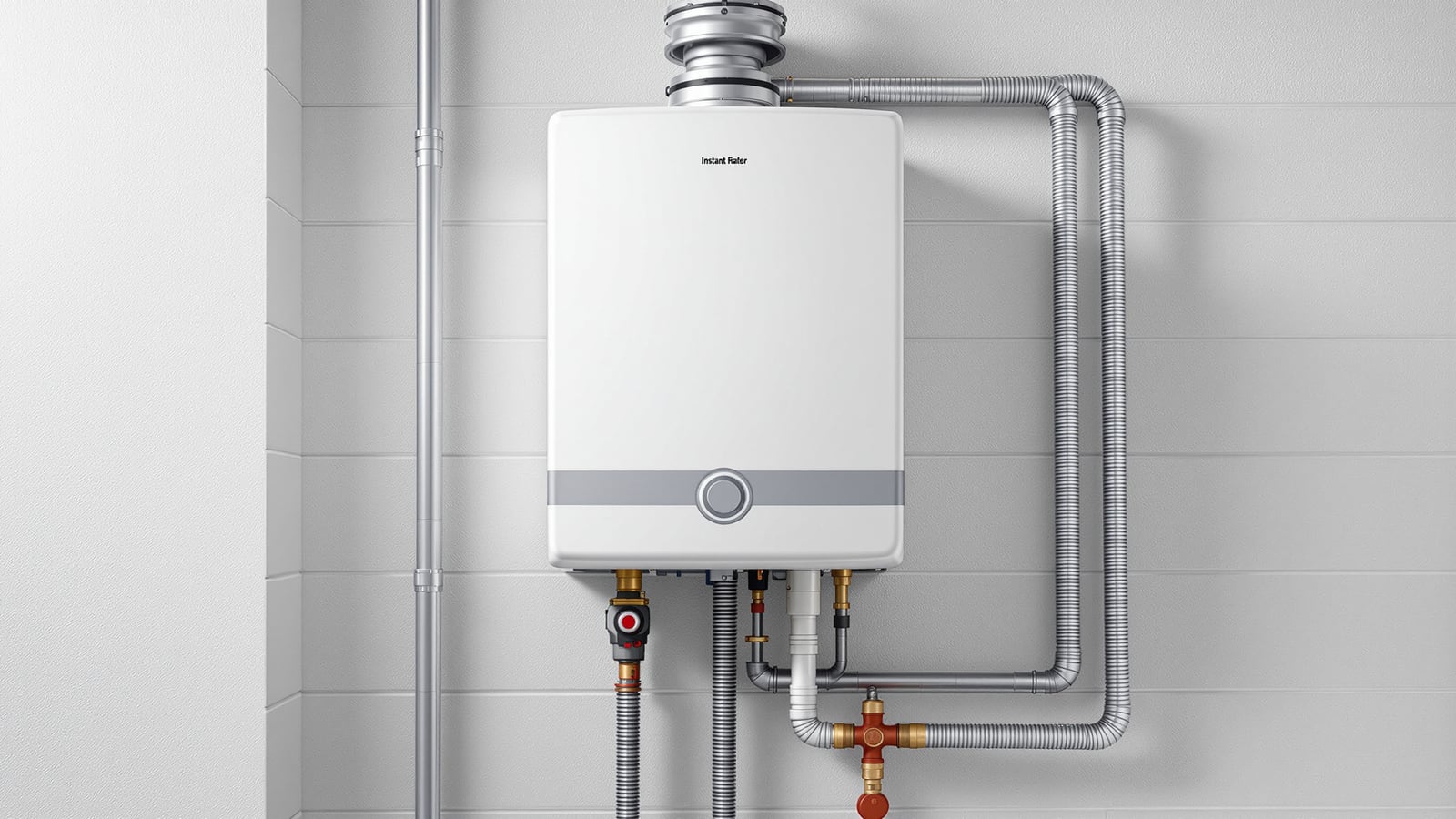
Gas Water Heaters (LPG & PNG Geysers) in India: Instant Hot Water — Done Safely
How instant gas geysers make endless hot water on demand, LPG cylinder versus piped natural gas, sizing by litres-per-minute and temperature rise, and the ventilation and flue rules that keep carbon monoxide out of your bathroom.
A gas water heater heats water by burning gas — LPG from a cylinder or piped natural gas — instead of using electricity. The most common type in India is the instant or tankless gas geyser: it has no storage tank, fires up the moment you open a hot tap, and delivers an endless stream of hot water for as long as you keep it running. Where gas is cheaper than electricity, it is one of the most economical ways to get hot water in a home.
This guide sits in the Studio Matrx Hot Water Systems hub alongside the solar water heater guide. It covers the gas appliance itself — how it works, how to size it, what it costs to run, and above all how to install it safely. The electric alternatives — storage and instant electric geysers — belong to the Bathrooms hub; compare them with the geyser running-cost calculator and the storage vs instant geyser guide. For the piping that carries the hot water onward, see hot water distribution.
One warning above all others: a gas geyser burns a flame and consumes air. Installed in a closed bathroom without ventilation and a flue, it can quietly fill the room with carbon monoxide. This is not a rare risk — it kills people in India every winter. Read the safety section before you buy.
How an instant gas geyser works
There is no tank. Cold water enters the unit and flows through a coiled heat exchanger — a finned copper tube sitting directly above a gas burner. When you open a hot tap, the flow of water is sensed and the burner ignites; the flame heats the copper coil, and water leaves the other side hot. Close the tap and the flow stops, the burner shuts off, and nothing is kept warm. This is why gas geysers are called on-demand or tankless.
Because the water is heated in a single pass, output is limited not by tank size but by flow rate — how many litres per minute the burner can raise to a comfortable temperature. Open the tap wide and the water passes the flame too fast to get hot; throttle it down and it comes out hotter. Every instant gas geyser trades flow against temperature.
LPG cylinder or piped natural gas?
Gas geysers run on two fuels, and the choice is usually made for you by what your building already has.
- LPG (liquefied petroleum gas) — the familiar red domestic cylinder. Almost every Indian home has one. An LPG geyser plugs into a cylinder via a regulator and a rubber/steel hose. It works anywhere, but you share the cylinder with your kitchen stove and must watch that it does not run out mid-shower.
- PNG (piped natural gas) — supplied through a metered pipe by a city gas distributor in many metros and towns. If your home already has a PNG connection for cooking, a PNG geyser is fed continuously, never runs out, and is usually the cheapest hot water of all.
The appliance is built for one fuel or the other; the burner jets differ. A geyser sold as "LPG" cannot simply be connected to PNG without a conversion kit fitted by an authorised technician. Never improvise the fuel connection. Buy the version that matches your supply.
Sizing: litres per minute and temperature rise
Forget litres of storage — an instant heater has none. You size it by flow rate at a given temperature rise. Temperature rise is how many degrees the heater must add: incoming tap water in an Indian summer might be 28-30 °C, but in a North-Indian winter it can drop to 12-15 °C, so the same geyser delivers less hot flow in winter because it has more heating to do.
Instant gas geysers are rated in litres per minute (LPM), typically at a nominal rise. A rough guide:
| Rated flow | Suits | Roughly serves | Winter reality |
|---|---|---|---|
| 5-6 LPM | One bathroom, a single tap or a small shower | 1 person at a time | Fine in most of India; slower in the far north |
| 7-8 LPM | A large rain shower, or a basin plus shower | 1 bathroom comfortably | Good all year in most cities |
| 10-11 LPM | Two outlets at once, or a big bathtub fill | 2 taps sharing | Best for cold climates and multi-bath use |
For a deeper walk-through of matching capacity to household size, the geyser size calculator in the Bathrooms hub applies the same flow-and-rise logic. A practical rule: a normal Indian bucket bath draws 4-6 LPM, so a 6 LPM unit suits most single bathrooms, while a large overhead shower wants 7-8 LPM or more.
Undersize and the water runs lukewarm when the tap is fully open. The fix people reach for — opening the tap wider — makes it worse, because faster flow gets less time over the flame.
The safety rules — this is the part that matters
A gas geyser is the only water heater in the house with an open flame, and combustion is where all the danger lives. Burning gas consumes oxygen and produces water vapour, carbon dioxide, and — if the flame is starved of air — carbon monoxide (CO), a gas you cannot see or smell that is lethal in minutes. Every safe installation obeys two non-negotiable rules.
1. Never in a closed, unventilated bathroom. The single most common cause of death is an indoor natural-draught geyser fitted inside a small, sealed bathroom. The flame eats the room's oxygen, the flue cannot clear the fumes, and CO builds up while the occupant showers. The standard, safe location for a natural-draught unit is a well-ventilated space — a kitchen, a utility area or a balcony — with the water piped to the bathroom, never the geyser itself inside a shut bathroom.
2. Give it air and a flue. Combustion needs a permanent supply of fresh air (a window or louvre that is never sealed) and a flue — a pipe that carries the exhaust gases outside the building, not into the room or a false ceiling.
Gas geysers come in three draught types, and the type decides where it may legally and safely go:
| Type | How exhaust leaves | Where it may go | Notes |
|---|---|---|---|
| Natural draught (open flue) | Rises by its own heat up a flue | Ventilated kitchen/balcony only — never a closed bathroom | Cheapest; most misused; needs a proper flue and open air |
| Forced draught | A fan pushes exhaust out through a flue | Wider range of rooms with an outside wall | Fan clears fumes reliably; needs power for the fan |
| Room-sealed (balanced flue) | Draws air from outside and expels outside through a sealed twin duct | Safest for enclosed spaces | Combustion is fully isolated from room air; costliest |
A few more rules that save lives and property:
- Fit an auto-cut-off / flame-failure device — most branded units shut the gas if the flame goes out. Avoid unbranded geysers that skip this.
- Consider a cheap carbon-monoxide alarm in any room with a gas appliance.
- Use only an ISI-marked LPG regulator and hose, and replace the hose before it perishes.
- Get it installed by a competent gas fitter, and for PNG follow your city gas distributor's mandated fittings. See the plumbing ventilation guide for how to size the air openings.
- Never enclose a running gas geyser in a cabinet or box.
Ignition: battery or hydro
Instant gas geysers need a spark to light the burner each time. Two common systems:
- Battery ignition — two torch cells create the spark. Simple and cheap; you just replace the cells occasionally. Works when there is no power.
- Hydro (hydro-power) ignition — the flow of water itself spins a tiny turbine that generates the spark, so there are no batteries to change. Slightly costlier, very low maintenance.
Neither needs mains electricity, which is part of the appeal in areas with unreliable power — though forced-draught and room-sealed units do need power for their fan.
Running cost versus electric
This is where gas earns its place. Per unit of heat delivered, gas is often cheaper than electricity in India — especially PNG. The exact comparison swings with your local LPG cylinder price, PNG tariff and electricity slab, so treat these as indicative and check your own bills. To model electric running cost precisely and compare, use the geyser running-cost calculator.
| Point | Gas (LPG/PNG) | Electric geyser |
|---|---|---|
| Energy cost per bath | Usually lower, PNG lowest | Higher in most tariff slabs |
| Hot water available | Endless, instant, no wait to reheat | Limited to tank; instant electric limited by flow |
| Upfront appliance ₹ | ₹4,000-₹12,000 (6-8 LPM); room-sealed more | ₹8,000-₹20,000 storage; instant electric ₹3,000-₹8,000 |
| Power needed | None (or only for the fan) | Full heating load on your wiring |
| Big caveat | Combustion safety, flue, ventilation | No CO risk; needs a heavy electrical circuit |
- Gas wins on running cost and endless supply, and it needs no heavy electrical circuit.
- Electric wins on safety and simplicity: no flame, no flue, no CO — which is why closed bathrooms use electric geysers.
- Where gas is affordable and a safe, ventilated location exists, an instant gas geyser is excellent value; where it does not, choose electric or solar.
Pros and cons at a glance
Pros
- Cheapest running cost in most of India, PNG especially.
- Endless on-demand hot water — never runs cold mid-shower.
- No standby heat loss (no tank kept hot 24×7).
- Compact, wall-mounted, works without mains power (battery/hydro ignition).
Cons
- Combustion safety is unforgiving — needs ventilation and a flue, never a closed bathroom.
- Carbon-monoxide risk if installed or maintained badly.
- LPG cylinder can run out; shared with the kitchen.
- Output drops in cold-water winters; hard water can scale the heat exchanger.
Indicative costs
Treat every figure as indicative — brand, capacity and city change it:
- 5-6 LPM instant LPG geyser: about ₹3,500-₹7,000.
- 7-8 LPM instant gas geyser: about ₹6,000-₹12,000.
- Room-sealed / forced-draught models: a clear step up, often ₹15,000 and beyond.
- Installation, flue, regulator and hose: budget a few thousand rupees extra, and do not skimp on the safety fittings.
References
- Bureau of Energy Efficiency (BEE) — energy-efficiency guidance for water heating appliances.
- Bureau of Indian Standards — Indian Standards for gas geysers and LPG regulators/hoses (look for the ISI mark on the appliance and fittings).
- Your city gas distributor's mandated fitting norms for PNG appliances.
- Studio Matrx: hot water systems hub, solar water heaters, hot water distribution, plumbing ventilation.
Export this guide
Related Guides — Deep-dive reading
Bathroom Fire Safety India: NBC 2016 Part 4, Fire-Rated Materials & Electrical Ignition
The bathroom is rarely thought of as a fire risk, yet it hides several: a leaky geyser element, an over-run exhaust-fan motor, cheap flammable PVC panels overhead, and aerosol cans stored beside a heat source. This is an honest, practical reference to fire and life safety in the Indian bathroom — the NBC 2016 Part 4 context that actually applies to homes, the real ignition sources, self-extinguishing false-ceiling and PVC materials, earth-leakage protection as fire prevention, escape considerations, and the carbon-monoxide danger of gas geysers.
BathroomsGeyser for Bathroom India: Water Heater Types, Sizing, Star Rating & Safe Wiring (2026)
How to choose a bathroom water heater in India — storage vs instant vs gas vs solar, the right litres for a bucket bath or shower, BEE star rating and running cost, why hard water needs an anode and descaling, pressure rating for showers, and the dedicated electrical point and safety it must have.
BathroomsBathroom Planning for New Homes in India: Get It Right Before You Build
The bathroom decisions you cannot undo once the slab is cast — location and stacking, sunken vs non-sunken slabs, waterproofing, and the plumbing, electrical and ventilation you must coordinate with the civil work, stage by stage.
BathroomsRelated Tools — Try Free
Geyser Size Calculator
Find the right water-heater capacity (litres) or instant kW for your bathroom and household, with an indicative running-cost note.
Bathroom CalculatorCross-Ventilation Analyzer
Estimate airflow and air changes per hour (ACH) from room size, window areas, layout, and local wind — with NBC 2016 Part 8 compliance check.
Ventilation CalculatorGeyser Running Cost Calculator
Work out a water heater's electricity use and running cost per day, month and year — and compare electric, gas, heat-pump and solar.
Bathroom Calculator