
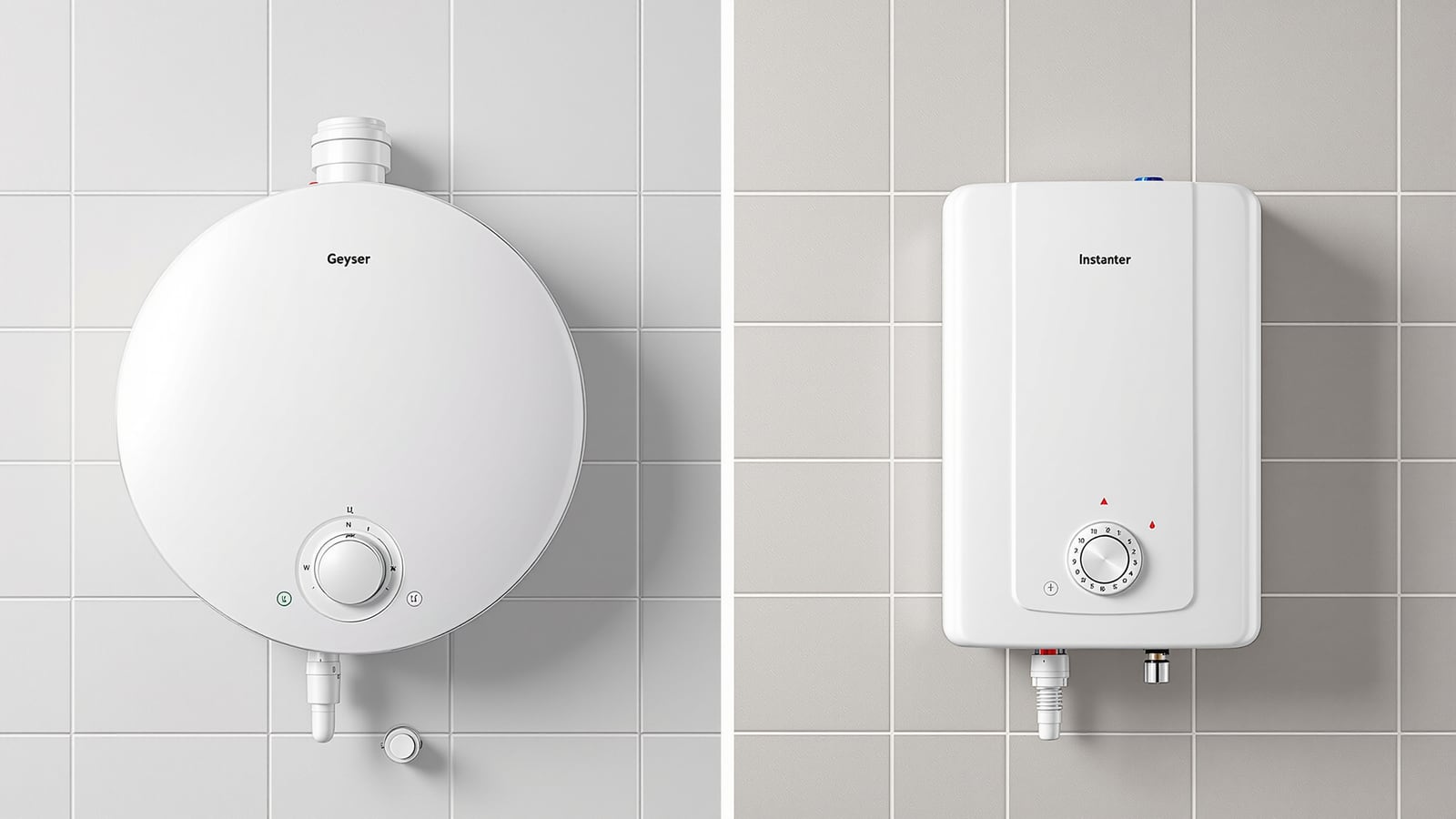
Storage vs Instant Geyser: Which Is Better for Indian Bathrooms? (India)
A fair head-to-head between a storage (tank) water heater and an instant (tankless) geyser for the Indian bathroom — hot-water quantity, wait time, wiring load, running cost, size, shower pressure and price — with a clear verdict by family size and use.
Walk into any showroom and the two boxes on the shelf look almost interchangeable — both heat water, both bolt to the wall, both carry a familiar brand. But a storage geyser and an instant geyser are built for completely different jobs, and buying the wrong one is the most common water-heater regret in Indian homes. Fit an instant to a shower and you shiver through a January bath; fit a 25-litre storage tank to a single handwash and you pay to keep water hot all day for nothing.
This is a fair, side-by-side comparison — not a sales pitch for either. A storage geyser holds a tankful of water (6–50 litres) warm and ready; an instant, or tankless, unit holds barely 1–3 litres and heats water only as it flows. That single difference drives everything else: how much hot water you get, how long you wait, how heavy your wiring must be, what it costs to run, how big it is, whether it can push a shower, and what you pay upfront. We will score each on all seven, then give you an honest verdict by use and family size. For the full technical picture read the bathroom water heater guide for India, and for sizing by household see how to choose a geyser in India.
Bottom line: for showers and full bucket baths — the real Indian bathroom — a right-sized storage geyser wins. An instant geyser is a specialist tool for a quick wash, a basin or a second point, not the main heater for a family.
The seven-round verdict table
| Attribute | Storage (tank) | Instant (tankless) | Winner |
|---|---|---|---|
| Hot-water quantity | A full tank; enough for a shower or 1–3 bucket baths | 1–3 L held; endless trickle but never a big warm reserve | Storage |
| Wait time | 5–15 min to heat, then instant on tap | Warm in seconds, no pre-heating | Instant |
| Power draw & wiring | 2–3 kW, but cycles on/off; runs on a normal 16 A line | 3–4.5 kW drawn continuously; needs heavier wiring | Storage |
| Running cost / efficiency | Standing heat loss, but heats in bulk off-peak | No standby loss; only heats what you use | Toss-up |
| Size & footprint | Bulky 6–50 L cylinder needs wall space | Slim, compact box fits a tight corner | Instant |
| Pressure for showers | Holds volume to feed an overhead shower well | Flow drops as it struggles to heat at full rate | Storage |
| Price (unit) | Higher upfront for the tank and lining | Cheaper entry unit | Instant |
Read the rows below before you trust the winners — each option genuinely takes some.
Round 1 — Hot-water quantity
This is the round that decides most purchases. A warm bucket bath needs roughly 15 litres of bath-temperature water, made by mixing hot output with cold. A storage tank holds that reserve; a 15-litre storage geyser comfortably runs a bucket bath or a short shower, and a 25 L unit stretches to back-to-back baths.
An instant heater holds only 1–3 litres. It heats water endlessly as it flows, but at a rate limited by its element — a 3 kW instant lifts water by only so many degrees per litre. In a Delhi or Pune winter, when incoming water is coldest, it gives you either warm water at a trickle or a cold gush at full flow. For real bathing volume, storage wins clearly.
Round 2 — Wait time
Here the instant hits back. Switch it on and warm water arrives in seconds — no advance planning, no waiting for a tank. A storage geyser needs 5–15 minutes to bring a cold tank up to temperature, so you learn to flip it on before you need it (a timer makes this painless).
Once hot, though, the storage tank delivers on demand, so the wait is a one-time cost per session, not per tap. For a household that bathes on a routine it barely matters; for an unpredictable quick wash, instant is genuinely more convenient.
Round 3 — Power draw and wiring
Both are hungry appliances, but they behave differently. A storage geyser is typically 2–3 kW and, crucially, cycles: it heats the tank, clicks off on the thermostat, and only sips power to hold temperature. It runs happily on a standard 16 A geyser point with the usual dedicated circuit and MCB.
An instant heats on demand, so to warm flowing water it draws its full 3–4.5 kW continuously for the whole time the tap is open. That sustained load often needs heavier-gauge wiring and a properly rated MCB, and a beefy 4.5 kW instant can strain an older bathroom circuit. Whatever you fit, the point must be earthed and RCD/RCCB-protected — see bathroom electrical safety in India before you connect anything. On wiring simplicity, storage takes the round.
Round 4 — Running cost and efficiency
This one is closer than the ads suggest, and it is an honest toss-up. Physics is stubborn: heating a litre of water by a given number of degrees takes the same energy in either unit. An instant has zero standby loss — it heats only what leaves the tap — which sounds like a clear win.
But a modern storage geyser is well-insulated, so standby loss is small, and it heats in bulk (you can run it off-peak or on a timer). An instant's advantage shrinks the moment you leave the tap running while soaping. In practice both, on a good BEE star rating, cost similar amounts for the same litres of bath. Efficiency is a wash; let quantity and pressure decide instead.
Round 5 — Size, pressure and price
- Size: the instant wins hands down. It is a slim box that tucks above a basin or into a tight corner, ideal for a compact or second bathroom's water supply. A 15–25 L storage cylinder is bulky and demands real wall space.
- Pressure for showers: storage wins. A tank holds the volume to feed an overhead or rain shower steadily; an instant's flow sags as it fights to heat water at full rate, giving a weak, temperature-swinging shower.
- Price: the instant is the cheaper unit to buy, though heavier wiring can erode that saving. A storage geyser costs more upfront for the larger tank and its glass or steel lining, but is the one that actually runs a family bathroom.
Which should you choose?
| Pick STORAGE if… | Pick INSTANT if… |
|---|---|
| You take showers or full bucket baths | You only need a quick handwash or basin wash |
| It is the main bathroom for a family | It is a kitchen, utility or maid's toilet point |
| You have an overhead / rain shower | Wall space is very tight |
| 3+ people share the bathroom | 1 person, low hot-water demand |
| You want steady shower pressure | You want the cheapest entry unit and instant warmth |
The honest recommendation for the common Indian home
For the typical family bathroom — a shower or full bucket baths, three or more people — a 15-litre storage geyser on a good BEE star rating is the right buy, stepping to 25 L for an overhead shower or a joint family. It gives you the volume and steady pressure that an instant physically cannot, on ordinary wiring, for a running cost that is effectively the same.
Reserve the instant for what it is genuinely good at: a quick handwash, a basin point, a kitchen tap, a maid's or utility toilet, or a very tight corner where a solo user just needs warm water fast and cheap. Buying an instant "to save money" for a family shower is the classic false economy — you save on the box and pay for it every cold morning. When in doubt, size for the bath you actually take, not the price tag on the shelf.
References
- IS 302-2-201 (Safety of household electric water heaters / geysers), Bureau of Indian Standards
- Bureau of Energy Efficiency (BEE) star-rating programme for storage water heaters
- National Building Code of India (NBC), Part 8 — electrical and plumbing installations
- National Electrical Code of India (SP 30), earthing and RCD protection for bathroom circuits
Export this guide
Related Guides — Deep-dive reading
Geyser for Bathroom India: Water Heater Types, Sizing, Star Rating & Safe Wiring (2026)
How to choose a bathroom water heater in India — storage vs instant vs gas vs solar, the right litres for a bucket bath or shower, BEE star rating and running cost, why hard water needs an anode and descaling, pressure rating for showers, and the dedicated electrical point and safety it must have.
BathroomsHow to Choose a Geyser in India: Buyer's Guide to Size, Type, Star Rating & Price (2026)
A buyer's decision guide to picking a bathroom geyser in India — sizing instant vs storage by family and use, storage vs instant vs gas vs solar, BEE star rating and running-cost maths, glass-lined vs stainless tank for hard water, pressure rating, warranty, good-better-best price tiers, the IS 302 safety mark, and how to spot a refurbished unit.
BathroomsBathroom Water Supply India: Cold & Hot Feed, Pipe Sizing, Pressure & Booster Pumps (2026)
How water actually reaches your fixtures in an Indian home — gravity-fed cold from the overhead tank, hot from the geyser, the pipe sizes that decide whether your shower gushes or dribbles, isolation valves at every fixture, booster pumps and hard-water protection, all mapped to IS 1172.
BathroomsRelated Tools — Try Free
Electrical Safety & Load Audit
Home electrical audit — 10 categories, 65+ checkpoints across earthing, RCCB, MCB, wiring, switchboards, appliance circuits, DG/inverter backup.
Safety AuditGeyser Size Calculator
Find the right water-heater capacity (litres) or instant kW for your bathroom and household, with an indicative running-cost note.
Bathroom CalculatorGeyser Running Cost Calculator
Work out a water heater's electricity use and running cost per day, month and year — and compare electric, gas, heat-pump and solar.
Bathroom Calculator