
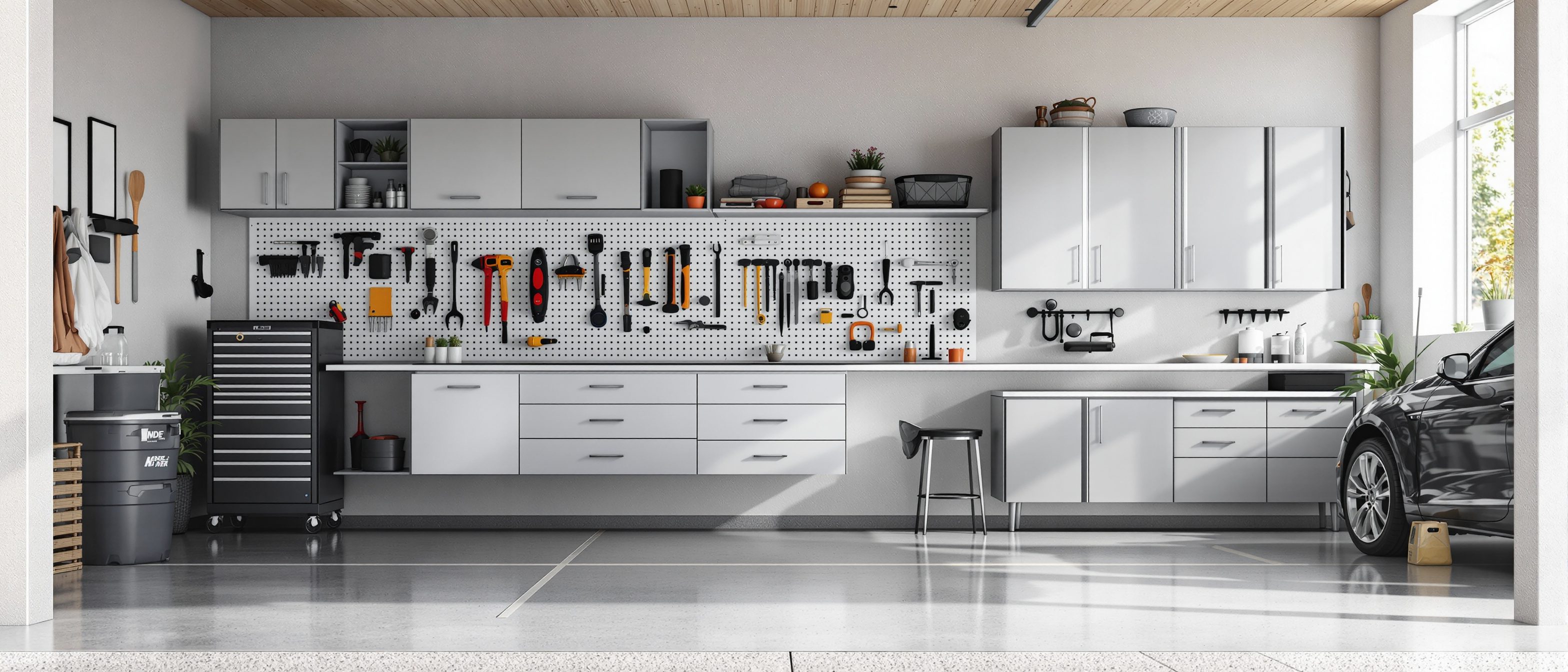
Garage & Parking Storage Planning
How to get tools, cycles, ladders and seasonal overflow out of the car park in an Indian independent house, villa or stilt parking — and keep the car bay clear.
In most Indian independent houses, the car park is where the house quietly loses the war with its own belongings. The stilt or the gated porch begins life as a clean rectangle for one car. Within a year it is also home to two cycles, a stepladder, a broken cooler, four tins of leftover wall paint, a cricket kit, the previous tenant's curtain rods, and a growing colony of cardboard boxes. The car gets parked at an angle to dodge it all, and reversing out becomes a daily negotiation.
Take a typical Bengaluru or Pune villa with a single stilt bay of about 2.5 m by 5 m. The family bought a second two-wheeler when the daughter started college, the festival decorations outgrew the loft, and the husband took up weekend gardening — so spades, a hosepipe and bags of potting mix joined the pile. Nobody planned for any of it. The result is a parking space you cannot fully park in, and a heap of dusty, half-damaged things nobody can find when they need them.
The fix is not a bigger garage. It is treating the parking bay like any other room in the house: a place with a storage plan, where the floor is reserved for the car and the walls and ceiling do the storing.
The single rule that solves a chaotic Indian car park is this: nothing valuable or useful lives on the floor of the bay — every item is mounted on a wall, sits on a shelf, or hangs from the ceiling, leaving the full car footprint and a clear walking aisle untouched.
1. Why the floor is the enemy
A car needs its full footprint plus swing room for doors and a person walking around it. The National Building Code of India recommends an equivalent of roughly 2.5 m by 5 m for a car parking space, and in practice you want a clear aisle of at least 600–750 mm down at least one side so you can open a door and carry things past. The moment storage spills onto the floor, it eats that aisle, forces the car to park crooked, and turns every item into something you trip over or run over.
Floor-stored things in an Indian parking bay also suffer the most. Dust from the road films over everything. Monsoon splash and the water you use to wash the car creep across the slab and rot cardboard, rust tools and bloom mildew on fabric. Rodents treat floor-level boxes as a buffet. Lifting storage onto walls and ceilings solves all four problems at once — and frees the floor for its one real job.
"Things which are used at the same time should be stored near each other, and things which are used together should be stored together." — Christopher Alexander, A Pattern Language
That principle — grouping by use and frequency — is what turns a wall of random hooks into a system. Map it before you buy a single bracket. The free storage calculator gives you a quick volume target for the gear you are trying to home, and the broader discipline of doing this room by room is laid out in our storage planning before interior design pillar.
2. What actually needs storing in an Indian car park
Before you buy anything, list what really lives here. Most of it falls into seven groups, and each has a natural home that keeps it off the floor.
| Garage item | Best storage method | Why keep it off the floor |
|---|---|---|
| Hand tools (spanners, screwdrivers, tape) | Pegboard or magnetic strip at 1200–1700 mm | Visible, grabbed daily; floor invites rust and loss |
| Power tools, drills, sanders | Lockable cabinet shelf | Theft-prone, dangerous to kids; needs dry storage |
| Car-care & cleaning (polish, microfibre, bucket) | Sealed plastic caddy on a low shelf | Splash and dust ruin cloths; chemicals must stay sealed |
| Cycles & two-wheeler helmets | Vertical wall hook + helmet shelf | Floor-parked cycles eat the aisle and fall over |
| Sports & outdoor gear (cricket, badminton, bats) | Rail with long hooks or a tall open bin | Long items sprawl; bins keep balls from rolling under the car |
| Ladders & brooms | Horizontal wall brackets or ceiling rack | Leaning ladders slide and scratch the car |
| Paints, thinners, pesticide, fertiliser | High lockable cabinet, away from heat | Toxic, flammable; must be child- and pet-proof |
| Bulk & seasonal overflow (decor, trunks, spare tyre) | Overhead ceiling rack above the bonnet | Rarely needed; belongs in the dead zone above the car |
A spare tyre, a folding table for parties, the Diwali lantern box — these are classic "store high, reach twice a year" items. Send them to the ceiling. The day-to-day tools come down to chest height. This frequency-to-reach mapping is the same logic that drives our seasonal storage solutions guide; the car park is simply where a lot of a home's seasonal overflow naturally ends up.
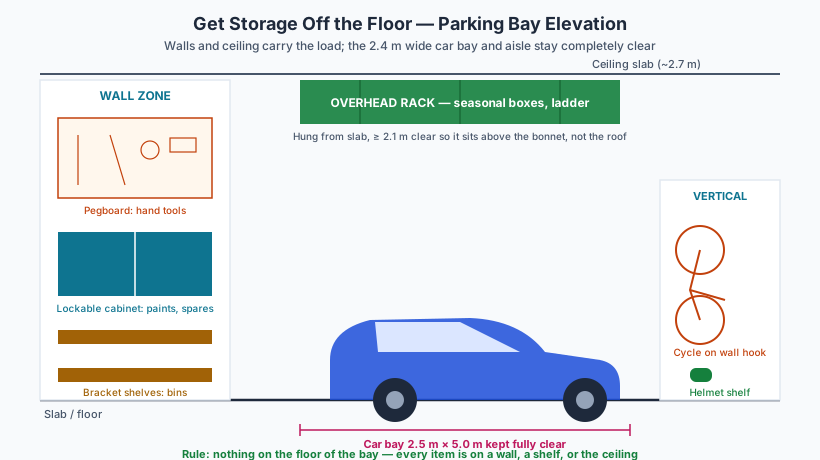
Figure 1: A worked parking-bay elevation. The walls carry tools and a cycle, the ceiling carries seasonal boxes above the bonnet, and the 2.5 m × 5 m car bay plus its aisle stay completely clear.
3. The three wall systems — and which job each one does
A bare wall is wasted vertical real estate. There are three families of wall storage, and the trick is to use the right one for the right thing rather than covering everything in the cheapest hooks.
Pegboards and slatted panels are the workhorse for things you use weekly and want to see at a glance — hand tools, garden secateurs, tape, torches. A 600 × 900 mm pegboard mounted with its centre around 1300–1500 mm sits squarely in the easy-reach "golden zone". They are cheap, endlessly reconfigurable, and honest: an empty hook tells you something is missing. They are wrong for heavy or theft-prone items.
Rails and bracket systems carry weight and length. A proper wall rail with adjustable hooks will take 20–40 kg per bracket and is how you hang cycles, ladders, hosepipes, brooms and cricket bats. The non-negotiable is the fixing: anchor into RCC or solid brick with the right plug, never into a hollow block partition with a flimsy screw — a loaded bracket pulling out of a block wall onto a car bonnet is a real failure.
Lockable cabinets are for everything that must be hidden, dry, or out of a child's reach: paints, thinners, pesticides, power tools, sharp blades and valuable spares. A 350–400 mm deep wall cabinet keeps chemicals off the floor and behind a door, which matters doubly in homes where domestic helpers, drivers or children pass through the parking area unsupervised.
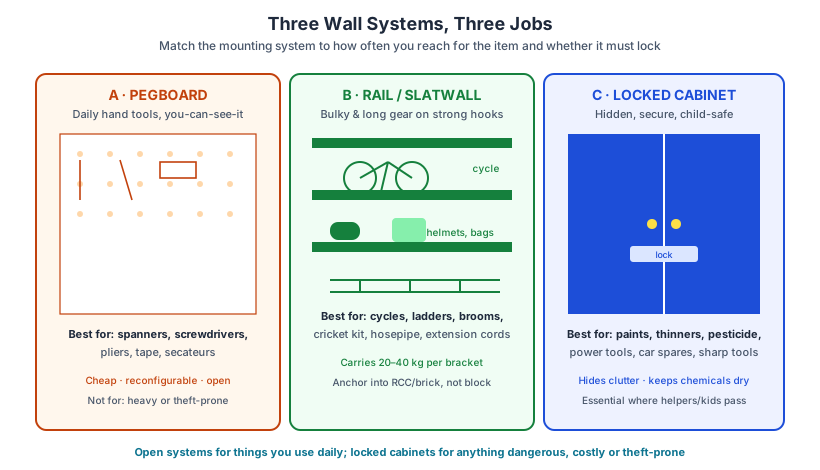
Figure 2: Match the mounting system to the job — open and visible for daily tools, strong rails for bulky gear, locked cabinets for anything dangerous, costly or theft-prone.
4. Cabinets versus open shelving — the dust-and-security trade-off
In a sealed garage abroad, open shelving wins on cost and access. In India, the calculus shifts because of dust, monsoon and security. Open systems are cheaper and faster to grab from, but everything on them gathers a film of road dust and is on display to anyone passing.
| Decision | Open shelving / pegboard | Closed lockable cabinet |
|---|---|---|
| Cost | ₹800–3,000 per panel/shelf | ₹6,000–25,000 per cabinet |
| Dust protection | Poor — wipe weekly | Good — doors keep grit out |
| Security | None — fully visible | High — lock keeps tools & chemicals safe |
| Access speed | Fastest — grab and go | One extra step (open door) |
| Best for | Daily tools, frequently used gear | Chemicals, power tools, valuables, anything child-unsafe |
| Monsoon resilience | Low if near an open edge | High if powder-coated and sealed |
The practical answer in most Indian car parks is a hybrid: a strip of open pegboard and shelving for the things you touch most days, plus one good lockable steel or powder-coated cabinet for chemicals and expensive tools. Put the cabinet on a low plinth or feet so monsoon splash never reaches its base, and keep paints and thinners out of direct afternoon sun, which can be fierce on a west-facing stilt. For a deeper treatment of how enclosed versus open storage changes a whole home, our home organization through design guide is a useful companion.
5. Overhead and ceiling racks — the forgotten cubic metres
The single most under-used space in an Indian parking bay is the volume directly above the bonnet. A car's bonnet sits far lower than its roof, so the airspace over the front third of the bay is dead — perfect for a ceiling-suspended rack.
A platform hung from your own RCC slab, with its underside kept at least 2.1 m above the floor (and clear of the car's roofline when parked), will swallow the spare tyre, a folding table, suitcases, trunks of festival decor and the woollens you only need for two months. The rules are simple: only hang from a slab you own (never a society's common soffit), use proper through-bolts or expansion anchors rated for the load, keep heavy items toward the wall side, and store only sealed, weatherproof boxes up there because dust settles on top of everything in an open bay.
Anthropometric standards used in interior design typically treat the comfortable overhead reach for an average adult as around 1900–2000 mm, with anything above needing a stool. That is exactly why the ceiling is reserved for low-frequency, store-twice-a-year goods — you should not be climbing for things you need every week.
This is also where the parking bay quietly relieves the rest of the house. A well-loaded ceiling rack here can take the overflow that would otherwise jam your bedroom lofts and storeroom — the same overflow problem we tackle indoors in seasonal storage solutions.
6. When the "garage" is really a stilt or a shared society bay
A great many Indian homes do not have an enclosing garage at all. They have a stilt floor with pillars but no walls, or a numbered bay in a society's common parking with explicit rules against fixing anything to shared structure. Here the wall-and-ceiling playbook needs a defensive rewrite, because you are storing in semi-public, weather-exposed space.
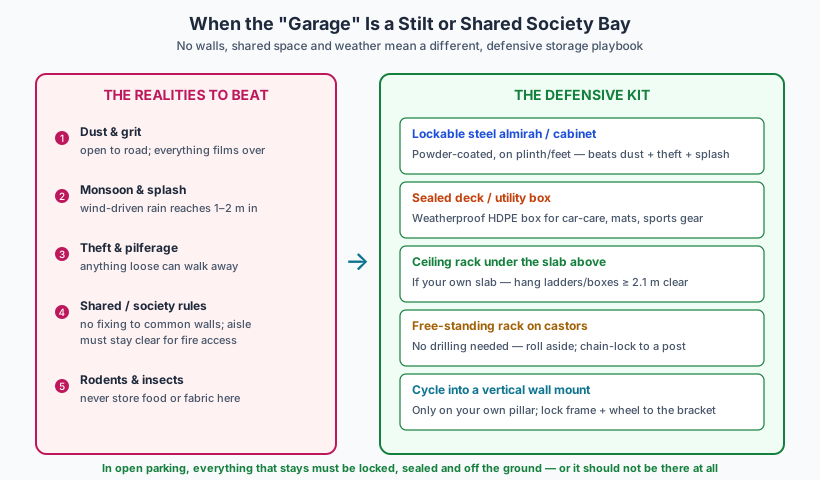
Figure 3: In open or shared parking, every item that stays must be locked, sealed and off the ground — or it should not be stored there at all.
The defensive kit is short and deliberate:
- One lockable steel or powder-coated almirah, on feet or a plinth, against your own pillar if society rules allow. It beats dust, theft and splash in one move and becomes your single secure point.
- A sealed weatherproof HDPE deck box for car-care supplies, mats and sports gear — gasketed lids keep monsoon and grit out far better than open bins.
- A free-standing rack on castors where you cannot drill into anything: it needs no fixing, rolls aside for sweeping, and can be chain-locked to a post overnight.
- A vertical cycle mount only on your own pillar, with the frame and wheel locked to the bracket — an unlocked cycle in shared parking is simply a gift to a thief.
- Ceiling racks only under a slab you own, never the common soffit, and only for sealed boxes.
Two hard rules for open parking: never store food, grain or fabric here — rodents and damp will find them within weeks — and never block the aisle, because society parking aisles double as fire-tender and emergency access. Anything that cannot be locked, sealed and lifted off the ground simply does not belong in an open bay; it should go back into the house, to a utility area or built-in store.
7. A buildable plan and a quick budget
You do not need to fit out the whole bay at once. Work in the order the storage calculator suggests: audit what must live here, measure your clear wall and ceiling using the room measurement tool, then buy in the sequence below.
| Stage | What to add | Indicative cost | Frees up |
|---|---|---|---|
| 1 | Pegboard + hooks for daily hand tools | ₹1,500–4,000 | The workbench-corner clutter |
| 2 | Wall rail + brackets for cycle, ladder, broom | ₹3,000–8,000 | The leaning-against-the-wall pile |
| 3 | One lockable cabinet for chemicals & power tools | ₹8,000–25,000 | Floor tins and child hazards |
| 4 | Overhead ceiling rack for seasonal/bulk goods | ₹6,000–18,000 | Bedroom lofts and the storeroom |
| 5 | Sealed deck box for car-care & sports gear | ₹2,000–6,000 | The damp cardboard boxes |
For a single-car independent house, a full fit-out of all five stages typically lands between ₹25,000 and ₹60,000 depending on whether you use steel or modular systems — a fraction of what a clean, usable parking bay returns in daily ease and protected belongings. Phase it over a few months if the budget is tight; even Stage 1 and 2 alone transform the space. If your wider home storage is also straining, the hidden storage solutions and smart storage ideas guides will help you stop sending overflow to the car park in the first place.
Sources & further reading
- Bureau of Indian Standards, National Building Code of India 2016 — parking dimensions, vehicular access and means-of-escape clearances.
- Christopher Alexander, Sara Ishikawa & Murray Silverstein, A Pattern Language: Towns, Buildings, Construction (Oxford University Press) — patterns on storage and "things from your life".
- Julie Morgenstern, Organizing from the Inside Out — frequency-of-use zoning and the audit-before-buy method.
- Marie Kondo, The Life-Changing Magic of Tidying Up — keeping only what earns its place before you build storage for it.
- Julius Panero & Martin Zelnik, Human Dimension & Interior Space — anthropometric reach zones underpinning shelf and rail heights.
- Studio Matrx utilities — Storage Calculator and Room Measurement tools for sizing your bay.
If you are putting a whole home in order, read this alongside our seasonal storage solutions guide for the festival and woollens overflow that ends up in the car park, the storage planning before interior design pillar for the room-by-room discipline, and home organization through design for keeping it all from creeping back.
Export this guide
Related Guides — Deep-dive reading
Storage Planning Before Interior Design
Why storage must be planned first — audited, budgeted and given its floor area — before a single layout, colour or sofa is chosen. The homeowner's plan-it-first master guide for Indian homes.
StorageHow to Plan a Home for Multi-Generational Living
Designing for grandparents, parents and children under one roof — privacy, accessibility and harmony
Home PlanningSeasonal Storage Solutions
Razais in June, the cooler in December, Diwali décor for eleven months a year — a practical plan for storing everything your Indian home uses for only one season, and keeping it safe from the monsoon.
StorageRelated Tools — Try Free
Apartment vs Villa Interior Planning Guide
Compare ceiling height, structural flexibility, lighting, storage, and services between apartments and villas.
Planning GuideMonsoon-Readiness Checklist
Pre-rain home audit across 9 categories — terrace, drains, waterproofing, electrical, HVAC, pest, vehicles, documents.
Seasonal AuditAcoustic Privacy (STC) Visualizer
Indian healthcare acoustic visualizer — compare wall assemblies and noise sources, see received SPL after STC attenuation, and check FGI 2018 / IS 1950 / NABH speech-privacy compliance with live dual-canvas waveform.
Acoustic Tool