
Flooring for Humid Conditions in India: Best Floors for Ground Floors, Basements and Chronically Damp Rooms
Why moisture, rising damp and condensation wreck the wrong floor — and how to pick moisture-stable flooring, lay a 200-micron damp-proof membrane, run the moisture test before laying, and keep humid Indian rooms dry.
Some rooms are simply wetter than the rest of the house — the ground-floor bedroom that smells musty every monsoon, the basement that never quite dries, the north-facing room where the floor feels cold and clammy underfoot. Put the wrong flooring in those rooms and it does not just look bad; it cups, swells, lifts and grows mould from underneath, often within a single rainy season. The fix is not a fancier floor. It is understanding where the moisture comes from, stopping it at the slab, and choosing a floor that does not care how humid the air is.
This guide is about chronically humid interiors specifically — ground floors and plinth-level rooms, basements, coastal and monsoon-belt homes, and any poorly ventilated room that stays damp. It explains the three ways moisture attacks a floor, why a 200-micron damp-proof membrane (DPM) under wood and laminate is non-negotiable, how to rank floors by moisture tolerance, the simple moisture test to run before you lay anything, and how ventilation and dehumidifying finish the job.
Where the moisture actually comes from
Before you choose a floor, you have to know what you are fighting. In humid Indian rooms, three different mechanisms are usually at work — and they need different answers.
Rising damp. Ground water and soil moisture wick upward through the concrete slab and plinth by capillary action, the same way a sponge draws up water. If the building's plinth-level damp-proof course (DPC) is missing, broken or bridged, that moisture arrives at the underside of your floor finish continuously. This is the classic ground-floor and basement problem, worst in the monsoon when the water table rises.
Condensation. Warm, humid air meets a cooler surface and the water vapour in it condenses into liquid — exactly like the outside of a cold glass of nimbu paani sweats in summer. A stone or tile floor over a cool slab, or a room that is shut up and unventilated, collects condensation on and under the floor. This is why a sealed, air-conditioned room can still grow mould along its edges.
Spills, washing and wet feet. Indian homes wash floors with water, and humid rooms dry slowly. Standing water finds every gap in a grout line, every plank joint, every skirting edge — and in a slow-drying room it stays long enough to do damage.
The mistake most homeowners make is treating only the symptom they can see (a swollen plank, a black patch of mould) instead of the source. A floor change that ignores rising damp will fail again.
What humidity does to each kind of floor
Not all flooring fears moisture equally. Some materials are effectively waterproof; some are destroyed by it; and a few create their own trap.
- Solid hardwood and engineered wood are the most vulnerable. Wood is hygroscopic — it absorbs moisture from humid air and the slab, then swells. The result is cupping (board edges rise higher than the centre), crowning, gaps in the dry season, and eventually delamination of engineered veneers. Solid wood on a ground floor in Mumbai or Kochi without a moisture barrier is a near-guaranteed failure.
- Laminate has a high-density fibreboard (HDF) core. Once moisture reaches that core through joints or from below, it swells irreversibly — the edges puff up, the click joints peak, and there is no sanding it back. Laminate is the single most common "why did my new floor ruin itself" story in humid Indian rooms.
- Impervious floors laid over a wet slab — vitrified tiles, dense stone, epoxy — do not themselves absorb water, but they can trap rising damp underneath. The moisture has nowhere to escape, so it migrates sideways to the cement grout and the wall base, where it shows up as efflorescence (white salt bloom), debonded hollow tiles, and mould in the grout. The floor survives; the system around it suffers.
- SPC (stone-plastic composite) vinyl is mineral-and-PVC based and 100% waterproof as a material. Its weak point is the slab below and the joints, but it tolerates humid air far better than wood or laminate.
- Stone (granite, vitrified, Kota), epoxy and microcement are moisture-stable materials, but their performance in a humid room still depends entirely on a dry, sealed slab and the right grout and sealer.
The lesson: in a chronically humid room, material choice and slab preparation matter together. The best floor on a wet, unbarriered slab will still cause trouble.
Why a 200-micron DPM is non-negotiable under wood and laminate
A concrete slab is never truly dry. It holds residual construction water for months, and on a ground floor it keeps wicking ground moisture for the life of the building. In humid air that vapour is relentless. A damp-proof membrane is a continuous 200-micron (200-gauge) polyethylene (PE) sheet laid over the slab, under the underlay, that stops that vapour reaching a moisture-sensitive floor.
It is cheap insurance — roughly ₹8-20 per sq ft for the sheet — against a floor that costs ten to thirty times that to replace. Laid properly it must be one unbroken plane: overlap sheets by at least 200 mm, tape every seam with a vapour-tight tape, and run it up the wall behind the skirting by 50-75 mm so moisture cannot creep around the edge. A torn or gapped DPM is almost worse than none, because it channels vapour to one spot.
Some floating-floor underlays come with a PE film already bonded on (combo underlay). That is acceptable on an upper floor in a dry climate, but for a ground-floor or basement room in a humid zone, fitters in India often lay a full separate 200-micron DPM and then the underlay on top, for certainty. Note one thing clearly: a DPM protects wood, laminate, SPC and floating floors. Under fully bonded systems such as tile, stone, epoxy or microcement, you do not lay a loose PE sheet — there the protection is a proper waterproofing membrane and a dry slab, applied per IS 2645 practice, not a vapour film.
How rising damp is stopped — section view
Moisture-tolerance ranking — what to choose for a humid room
This is the heart of the decision. The table ranks common Indian floors by how well they cope with chronic humidity, what they need to succeed, and indicative laid cost (material + basic labour, indicative and varies by city and vendor; add 18% GST).
| Flooring | Moisture tolerance | Needs to survive humidity | Best humid-room use | Indicative laid cost (₹/sq ft) |
|---|---|---|---|---|
| Vitrified / porcelain tile | Excellent (water absorption <0.5%, IS 15622) | Dry slab, epoxy or sealed grout, anti-skid finish in wet areas | Ground floor, basement, utility, whole house | ₹70-180 |
| Granite / dense natural stone | Excellent | Sealed surface, dry slab, sealed grout | Ground floor, high-traffic, wet-prone | ₹120-300 |
| Epoxy floor | Excellent (seamless) | Dry slab (<4% moisture), proper prep | Basement, utility, garage, industrial-look | ₹90-250 |
| SPC vinyl (click) | Very good (100% waterproof material) | DPM over slab, sealed perimeter | Ground-floor bedrooms, damp rooms wanting a soft look | ₹90-200 |
| Microcement | Good | Sealed topcoat, dry stable base | Modern damp-tolerant rooms (with care) | ₹150-350 |
| Kota / cement tile (IPS) | Good | Sealing, periodic polishing | Ground floor, traditional damp-tolerant | ₹60-150 |
| Engineered wood | Poor-to-fair | DPM mandatory, never in basements | Upper floors only; avoid on humid ground floor | ₹180-450 |
| Laminate | Poor | DPM + sealed joints; still risky | Avoid in chronically damp rooms | ₹80-200 |
| Solid hardwood | Worst | Not recommended in humid ground-floor rooms | Avoid | ₹250-600 |
The short version: for a genuinely humid room, lead with vitrified or porcelain tile, dense stone, or epoxy. If you want the warmth and softness of a plank floor, choose SPC over a proper DPM rather than laminate or wood. Reserve real and engineered wood for dry upper floors.
Run the moisture test before you lay anything
The most expensive flooring mistakes in humid rooms come from laying on a slab that was not actually dry. Before any wood, laminate, SPC or epoxy goes down, test the slab — fitters routinely skip this, so insist on it.
- The plastic sheet test (free, do it yourself). Tape a 1 m x 1 m square of clear plastic sheet tightly to the slab on all four edges and leave it 24-72 hours. If droplets, fogging or a dark damp patch appear under it, the slab is still releasing moisture — do not lay a sensitive floor yet. This is the cheapest, most useful check any homeowner can run.
- Calcium chloride / RH probe (professional). For epoxy and premium wood, fitters use a moisture meter or relative-humidity in-slab probe. Epoxy needs a slab below roughly 4% moisture; wood and laminate suppliers usually specify a maximum slab RH (commonly around 75-80%) before laying.
- Smell and look. A persistent musty smell, white efflorescence (salt bloom) on the slab, or peeling old paint at the wall base all signal active rising damp that no membrane alone will fully cure — the plinth DPC may need attention first.
If the slab fails, the answer is not to lay anyway. It is to let new concrete cure fully (a fresh slab can take weeks per inch of thickness to dry), fix the source of rising damp, and only then proceed. Laying on a green or damp slab guarantees the floor will fail.
Ventilation, dehumidifying and keeping the room dry
A moisture-stable floor over a dry slab is most of the battle — but in a chronically humid room, the air matters too, because condensation forms regardless of the floor.
- Cross-ventilation. A room that can air out dries fast. Open opposite windows daily, even briefly, especially in the monsoon. Exhaust fans in bathrooms and kitchens pull humid air out before it condenses on cool floors.
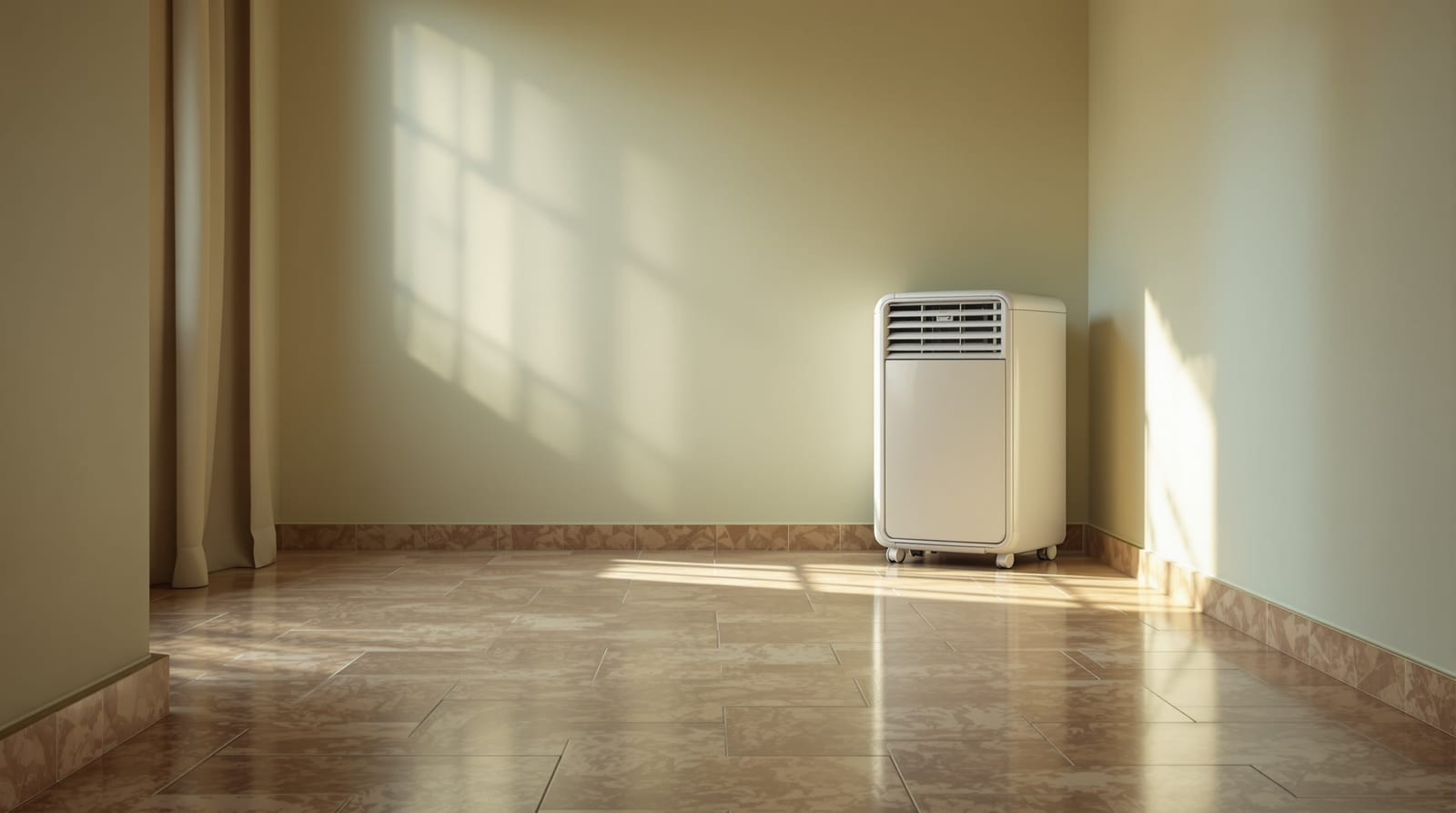
- Dehumidifier. In basements and shut-up coastal rooms, a domestic dehumidifier (roughly ₹12,000-30,000 for a home unit) pulls litres of water out of the air daily and is the single most effective tool against condensation and mould. Run it in the rainy months.
- Keep furniture off the wall slightly so air moves behind it; trapped, still air against a cool surface is where mould starts.
- Mop damp, not wet. In a slow-drying room, never leave standing wash water; wring the mop and let the floor dry.
- Mind the grout. In humid rooms, choose epoxy grout for tile (it is stain-proof and non-porous) or at least seal cement grout, because damp cement grout is where mould and efflorescence first appear.
Get all three layers right — a moisture-stable floor, a dry sealed slab with a proper barrier, and a room that can breathe and stay dry — and even Mumbai's worst monsoon leaves your floor untouched.
Where to go next
If you are choosing the floor itself, the flooring material selector helps you match a material to a humid room. For the barrier layer in detail, see underlayment and moisture barrier, and for getting the slab right before you lay, subfloor preparation. If you have settled on a waterproof plank, read SPC flooring; if you want the lowest-maintenance tile, vitrified tile flooring. For salt-air and seaside specifics, see flooring for coastal and humid homes.
Frequently asked questions
Can I lay laminate flooring on a humid ground floor in India?
You can, but it is risky and not what we would recommend. Laminate's fibreboard core swells permanently once moisture reaches it. If you must, lay a continuous 200-micron DPM, seal every joint and the perimeter, and accept the risk. In a genuinely damp room, SPC vinyl over a DPM, or vitrified tile, is a far safer choice for almost the same look.
What is the best flooring for a basement in India?
For a basement, choose a moisture-stable material that does not fear a damp slab: vitrified or porcelain tile, epoxy, or SPC vinyl over a proper damp-proof membrane. Avoid solid wood, engineered wood and laminate entirely. First fix any active rising damp and confirm the slab is dry with a plastic-sheet test before laying.
How do I know if my floor problem is rising damp or condensation?
Tape a square of clear plastic to the slab for a day or two. If moisture appears under the sheet (between plastic and slab), it is rising damp from below. If moisture forms on top of the sheet, it is condensation from humid room air. Rising damp needs a barrier and a DPC fix; condensation needs ventilation and dehumidifying.
Do vitrified tiles need a moisture barrier in humid rooms?
Vitrified tiles do not absorb water themselves, so they do not need a loose DPM the way wood does. But the slab beneath them must be dry, and in ground-floor and wet rooms you want a proper waterproofing membrane under the bed plus sealed or epoxy grout — otherwise rising damp escapes through the grout lines as mould and efflorescence even though the tiles are fine.
Will a dehumidifier protect my floor?
A dehumidifier protects against condensation and mould by drying the room air, which is a big help in basements and shut-up coastal homes during the monsoon. But it does nothing about rising damp coming up through the slab — that still needs a damp-proof membrane under sensitive floors and a sound plinth DPC. Use both together for a truly dry humid room.
Export this guide
Related Guides — Deep-dive reading
Moisture-Resistant Building Materials in India: The Right Material for Every Wet Zone (2026)
Moisture is the biggest enemy of Indian buildings - monsoon, rising damp, condensation, leaks and coastal humidity. This guide separates waterproofing (a system) from choosing inherently moisture-tolerant materials, then names the right material for bathrooms, exteriors, roofs, basements and finishes - with a zone-by-zone selector table. A specify-and-select guide.
Building MaterialsCoastal Flooring India: Best Floors for Salt Air, Humidity and Monsoon Damp in Mumbai, Goa, Chennai, Kochi and Vizag
What to choose and what to avoid for coastal and high-humidity Indian homes: why solid wood warps and carbon-steel fixings rust, why vitrified and porcelain tiles, anti-skid natural stone and SPC win, plus matte finishes for wet grip, moisture barriers, ventilation and mould-proof grout.
Flooring & SurfacesEpoxy Grout vs Cement Grout for Tiles in India: Which to Specify (2026)
A plain-English guide to tile grouts for Indian homes: what grout does, how cementitious grout compares with epoxy grout on cost, stain and water resistance, hygiene and durability, and exactly where each one belongs - kitchens, bathrooms, pools, dry rooms and more.
Building MaterialsRelated Tools — Try Free
Cross-Ventilation Analyzer
Estimate airflow and air changes per hour (ACH) from room size, window areas, layout, and local wind — with NBC 2016 Part 8 compliance check.
Ventilation CalculatorHome Building & Interior Cost Calculator — 20 Cities
Construction + interior costs for 20 Indian cities across kitchen, wardrobes, flooring, painting, ceiling.
Cost CalculatorFlooring Material Selector
Get the best flooring material for your room, budget and climate, with anti-slip checks for wet areas.
Flooring Tool