
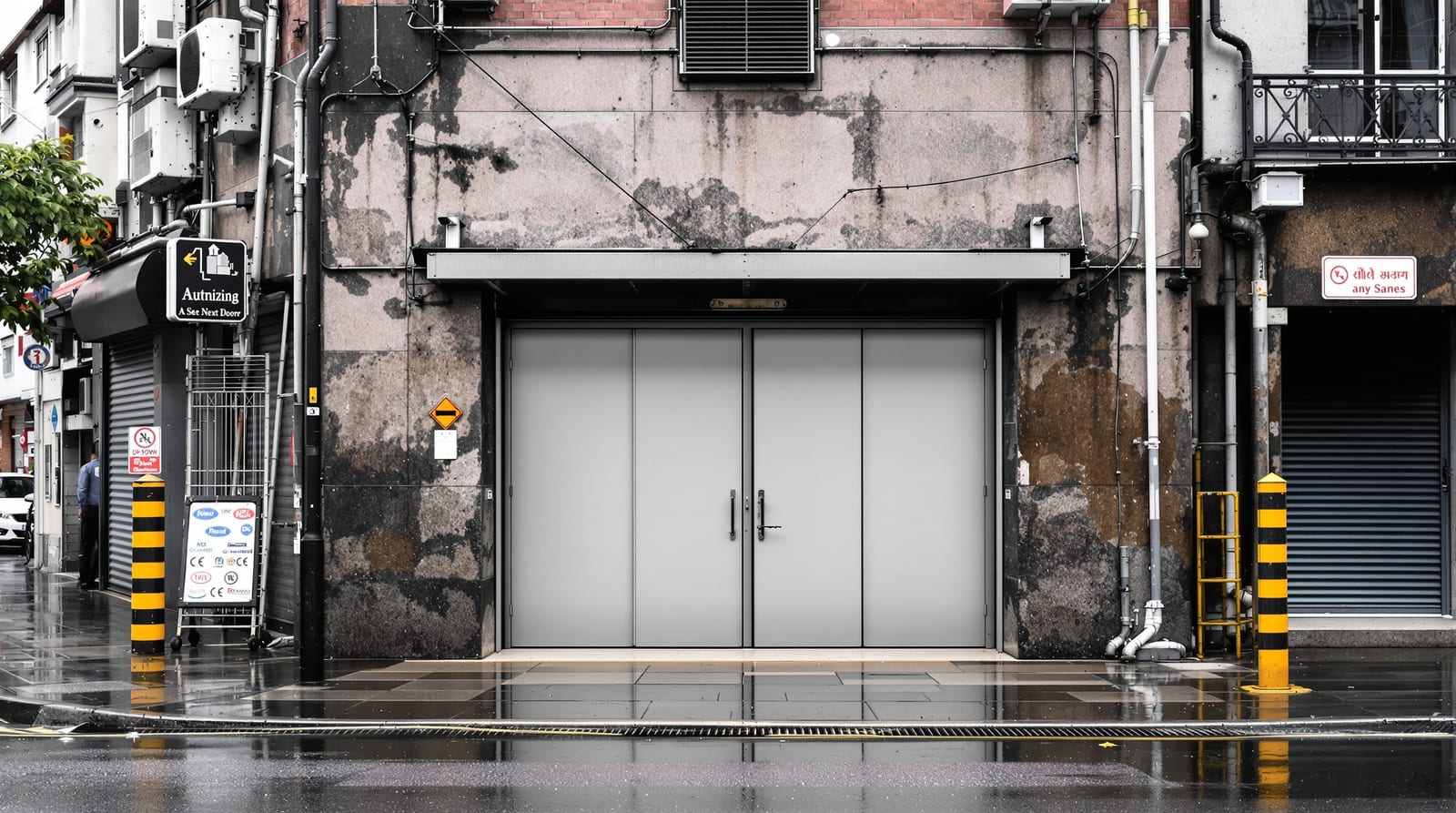
Flood-Barrier Doors & Flood Gates: Specifier Guide India 2026
How demountable, drop and automatic flood barriers protect Indian basements, substations and metro entries — rated by head of water.
When a Mumbai cloudburst dumps 200 mm in three hours or a Chennai monsoon surge backs up the storm drains, the difference between a flooded basement and a dry one is often a single threshold. Flood-barrier doors — and their demountable cousins, flood gates — are engineered openings that hold back a defined head of water at vulnerable entries: ramp-down basements, electrical substations, lift pits, metro and Metro-station entrances, and ground-floor data halls. Unlike a normal door with a weatherstrip, a flood barrier is project-engineered to a specific water head, sealed on all four sides, and verified against a hydrostatic load. This Studio Matrx specifier guide explains how flood-barrier doors are rated, where they beat permanent watertight doors, and what to budget in Indian rupees.
Why Indian flood zones need engineered barriers
India's fastest-growing cities sit on flood-prone ground. Mumbai's reclaimed low-lying wards, Chennai's flat coastal plain, Bengaluru's silted-over tank beds and Hyderabad's nala encroachments all push storm water toward the lowest opening it can find — and that is almost always a basement ramp or a service entry. The National Disaster Management Authority (NDMA) urban-flooding guidelines and municipal development control rules increasingly expect critical infrastructure to demonstrate flood resilience at openings below the design flood level.
The physics is simple and unforgiving. Water exerts a hydrostatic pressure that rises with depth: a 1 m head presses roughly 9.8 kPa at the base, and the total force on a 1 m-wide barrier with 1 m of water behind it is about 4.9 kN — and it scales with the square of the head. Double the water depth and the force quadruples. That is why a flood barrier is a structural element, not a draught excluder, and why the head of water (in metres) is the single most important number on the spec sheet.
How flood-barrier doors are rated
There is no single Indian standard that governs flood barriers the way IS 3614 governs fire doors; most products are tested to international benchmarks such as the British/European flood-protection test methods (the PAS 1188 family for demountable and free-standing barriers) and rated by manufacturers on head of water, leakage rate and debris/impact resistance. As a specifier you pin down four numbers: the design head (m), the allowable seepage (litres per hour per metre of seal), the opening size, and the substrate the seals will clamp against.
| Rating parameter | What it means | Typical specifier target |
|---|---|---|
| Head of water | Max water depth the barrier holds | 0.3–2.0 m (urban); higher = custom |
| Seepage / leakage | Controlled seal weep behind barrier | Low — backed by a sump pump |
| Impact / debris | Resistance to waterborne debris | Per site (vehicles, logs) |
| Wave / surge | Dynamic load above static head | Coastal sites only (NDMA) |
| IP / watertightness | For permanent gasketed doors | IP rating for marine/utility leaf |
A realistic rule of thumb for urban Indian deployments: most basement and substation entries need 0.6–1.2 m of protection, because once water tops a metre at a single ramp the surrounding ground is usually inundated and a whole-building strategy takes over. Always confirm the design flood level with a drainage consultant — the barrier rating must exceed it with margin.
The barrier families: demountable, drop, automatic
Flood barriers split into three operating types, each suited to a different throughput and staffing reality.
Demountable barriers (flood gates / stop-logs)
Aluminium or composite planks ("stop-logs") or a single panel that staff slot into permanently fixed side channels when a warning is issued, sealed top and bottom with compression gaskets. Cheapest and most flexible — one set of channels can be re-used across several openings — but they depend on people, lead time and storage. Ideal for predictable monsoon warnings at vehicle ramps and wide service doors where a hinged leaf is impractical.
Drop / hinged flood barriers
A gasketed leaf — bottom-hinged (drop-down) or side-hinged — that swings or drops into a sealed frame and is dogged shut with multi-point latches against the head of water. Faster to deploy than stop-logs and good for pedestrian-width openings, lift lobbies and substation doors. The leaf can double as the everyday door if detailed as a watertight door.
Automatic flood barriers
Float-actuated or sensor-actuated barriers that rise or rotate into place without human intervention — the answer for unmanned substations, metro entrances and basement ramps where a flash flood gives no warning. Highest cost and the most maintenance, but they remove the human-response risk that defeats most demountable systems.
Seals, drainage and the details that decide success
A flood barrier is only as good as its perimeter. Compression seals (EPDM or silicone) clamp against a clean, true substrate; if the sill is cracked, the wall finish is uneven, or the side channels are corroded, water finds the path. Three detailing rules separate a working installation from an expensive prop:
- Plan for controlled seepage, not zero. Even rated barriers weep a little under load. Specify a small sump and an automatic pump on the dry side so the trickle never accumulates. This is the most common omission in Indian retrofits.
- Protect the substrate. Stainless or hot-dip galvanised channels, a smooth render around the opening, and a flat sill. Coastal sites need marine-grade (IP-rated) hardware to survive salt.
- Mind backflow elsewhere. A perfect door is pointless if water enters through floor drains, cable trenches or the ventilation shaft. Pair barriers with non-return valves on drains and seal service penetrations — the barrier is one part of a flood-proofing line.
For permanent, always-sealed openings — a substation cable room, a marine bulkhead, a utility tunnel — a gasketed watertight door is the better choice than a demountable gate. See watertight doors for the dogged, IP-rated leaf, and marine doors for the salt-exposed coastal version.
Where each type is used
| Application | Recommended type | Typical head |
|---|---|---|
| Basement vehicle ramp | Demountable stop-logs / automatic | 0.6–1.2 m |
| Pedestrian basement entry | Drop / hinged barrier | 0.6–1.0 m |
| Unmanned substation | Automatic flood barrier | 0.6–1.5 m |
| Metro / station entrance | Automatic + demountable backup | per design flood level |
| Data hall ground entry | Watertight door + automatic barrier | 0.6–1.2 m |
| Lift pit / cable trench | Watertight door / sealed cover | as required |
| Coastal site (surge) | Watertight + wave-rated, per NDMA | site-specific |
Data centres and substations should be read alongside data-centre door and the broader industrial door types selection, because flood protection sits within a wider envelope of fire, security and access requirements.
Cost in India (2026)
Flood barriers are project-engineered, custom-sized and low-volume, so prices are bands, not catalogue figures, and all attract 18% GST. As a rule of thumb, expect:
| Type | Indicative band (supply) | Notes |
|---|---|---|
| Demountable stop-log set (per opening) | ₹35,000–1,50,000 | Cheapest; needs staff + storage |
| Drop / hinged flood barrier | ₹80,000–3,00,000 | Pedestrian to vehicle widths |
| Automatic flood barrier | ₹3,00,000–15,00,000+ | Unmanned, sensor/float actuated |
| Permanent watertight door | ₹60,000–2,50,000+ | IP-rated, marine for coastal |
| Sump + pump + drain NRVs | ₹40,000–2,00,000 | Essential supporting works |
Always treat these as supply-only vs installed: civil works (channel embedment, sill levelling, sump construction) can match or exceed the barrier cost, and large or coastal barriers carry long lead times. Get a vendor specification against your design flood level and a drainage consultant's sign-off before you commit. To scope a head-rated barrier and its seepage allowance, run the flood-barrier door calculator, and for a whole-package figure use the specialty door cost estimator.
Indian and global suppliers in this space include Gandhi Automations, Shakti Hörmann, Hörmann and specialist flood-barrier fabricators; specify the head, opening and substrate and let them engineer the leaf.
For the full taxonomy of engineered openings, see the specialty doors overview and the cluster complete door guide. Flood barriers also frequently sit next to high-speed doors at loading bays and cyclone-shelter doors on the coast.
Frequently asked questions
What is the difference between a flood-barrier door and a watertight door?
A flood-barrier door (or flood gate) is deployed or activated only during a flood event — demountable, drop or automatic — and is rated by head of water for occasional load. A watertight door is permanently gasketed and dogged shut, suitable for openings that must stay sealed (cable rooms, marine bulkheads). Choose barriers for ramps and entries used daily; choose watertight doors for openings that can stay closed.
What head of water should I design for in an Indian city basement?
Most urban basement and substation entries are protected for 0.6–1.2 m, because once water tops a metre at a single ramp the wider site is usually flooded and a building-scale strategy applies. The correct figure is the site's design flood level plus margin, confirmed by a drainage consultant against NDMA urban-flooding guidance — never a generic number.
Do flood barriers leak?
Yes, a little — rated barriers control seepage rather than eliminate it. That is why you must specify a sump and automatic pump on the dry side, plus non-return valves on floor drains and sealed service penetrations, so the small weep behind the seal never accumulates.
Are automatic flood barriers worth the extra cost?
For unmanned sites — substations, metro entrances, after-hours basements — yes, because demountable systems fail when nobody is present to deploy them in a flash flood. For staffed, predictable-warning sites, a demountable or drop barrier at a fraction of the price can be adequate. Match the operating type to your response reality.
Is there an Indian standard for flood doors?
There is no dedicated Indian Standard the way IS 3614 covers fire doors; products are typically tested to international flood-barrier methods (the PAS 1188 family) and rated by manufacturers on head of water, leakage and impact. NDMA urban-flooding guidelines and local development control rules drive the requirement; the barrier rating must exceed your design flood level. Always obtain a vendor test certificate.
Can one set of flood gates protect several openings?
Yes — demountable stop-log systems are designed so one set of panels can be re-used across multiple openings that share the same channel detail, which is a major cost advantage. The trade-off is dependence on staff, storage and deployment time, so reserve re-usable sets for openings with reliable flood warning, not flash-flood-exposed unmanned entries.
Export this guide
Related Guides — Deep-dive reading
Watertight Doors India: Gasketed Steel Spec Guide (India 2026)
How weathertight and fully watertight doors are rated by head of water, sealed and corrosion-graded for pump rooms, basements, STPs and marine use.
Home Doors & EntrancesSecurity Bollards in India (2026): Stopping the Vehicle a Boom Barrier Cannot
The short, strong posts that stop or channel vehicles while letting people walk through — and the honest gap between a pretty decorative bollard that stops nothing and a crash-rated one engineered to halt a ramming vehicle.
SecurityZero Threshold Doors in India: Level Access (India 2026)
How to detail a flush, step-free door threshold for wheelchairs and ageing-in-place while still keeping monsoon water out.
Home Doors & EntrancesRelated Tools — Try Free
Monsoon-Readiness Checklist
Pre-rain home audit across 9 categories — terrace, drains, waterproofing, electrical, HVAC, pest, vehicles, documents.
Seasonal AuditRainwater Tank Sizer
How big should your rainwater tank be? Computes annual harvest, recommended tank capacity in litres, water-bill savings, and payback — for 10 Indian cities.
RWH CalculatorBefore & After Studio
Generate AI before-and-after renders to preview how your redesign could look.
DesignAI