
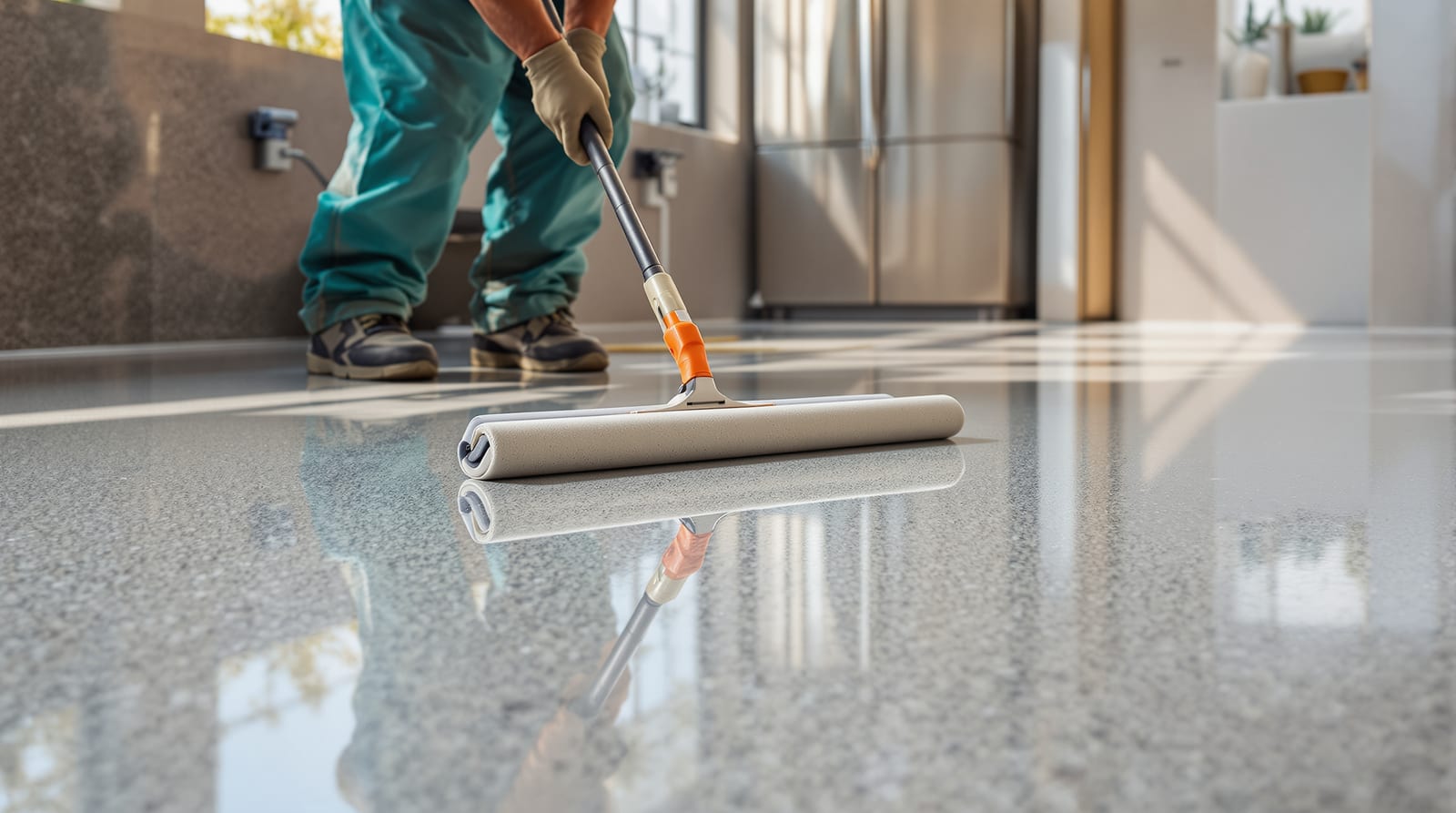
Epoxy Floor Application in India: Substrate Prep, Coats and Curing Step-by-Step
How a resin epoxy floor is actually laid in India — moisture testing and mechanical grinding, crack repair, primer, self-leveling vs broadcast vs coating systems, mixing ratios, pot life, coats and a full 7-day cure.
A good epoxy floor is 80 percent preparation and 20 percent resin. The shiny, seamless finish that survives forklift wheels, hot car tyres and constant mopping is not painted on — it is a chemical system bonded to a sound, bone-dry, mechanically opened concrete slab. Get the substrate wrong and even the most expensive imported resin will blister, peel or chalk within a monsoon. This guide walks through how an epoxy resin floor is actually applied in Indian conditions, from moisture testing to the seven-day cure, so you can specify it, supervise it, or call out a contractor who is cutting corners.
Where an epoxy floor makes sense
Epoxy is a coating and screed system, not a tile. It suits surfaces that need a hard, chemical-resistant, dust-free, joint-free finish: home and basement garages, car porches, utility and wash areas, store rooms, staircases, commercial kitchens, pharma and food units, warehouses, workshops, showrooms and parking decks. It is less suited to living and bedroom areas (it reads cold and industrial, and UV from direct sun yellows standard epoxy — use a PU/aliphatic topcoat outdoors). For a softer cementitious seamless look in habitable rooms, microcement is the better fit — see our guide on microcement flooring in India. For the material economics, finish options and comparison with tiles, read the companion overview on epoxy flooring in India; this guide focuses purely on application.
Step 1: Assess and test the substrate
Epoxy bonds to concrete, not to dirt, laitance, curing compound, old paint or moisture. Before a single drop of resin is opened, the slab must pass three tests.
- Moisture: the slab must read below 4 percent moisture (a calcium chloride or a digital concrete moisture meter on a percentage scale). New concrete must cure a minimum of 28 days; in monsoon or for slabs on grade with no DPM below, test longer and harder. A quick site check is the plastic-sheet test — tape a 1 m square of polythene to the floor overnight; condensation underneath means the slab is still releasing moisture and is not ready.
- Soundness: sound, structurally stable concrete of at least M20 grade, free of hollow or delaminated areas. Tap-test with a hammer; drummy patches must be cut out and re-laid.
- Contamination: no oil, grease, curing membrane or loose laitance. Oil-soaked patches in garages must be degreased and sometimes flame/heat-drawn, because oil migrating up will reject the coating.
For new slabs and deeper substrate logic, our guide on subfloor preparation in India covers flatness, soundness and damp-proofing in detail.
Step 2: Mechanical preparation (the non-negotiable step)
Epoxy needs a mechanical key — an open, slightly rough concrete texture roughly equivalent to medium-grit sandpaper (CSP 2 to 3). Acid-etching alone is no longer accepted good practice for resin floors in India; it leaves salts and an inconsistent profile. Use mechanical methods:
- Diamond grinding with a planetary grinder for homes, garages and most commercial floors — removes laitance, old paint and high spots, opens the pores.
- Shot-blasting for large industrial slabs and heavy-duty broadcast systems — throws steel shot to give an aggressive, uniform profile fast.
- Captive-shot or scarifying for very contaminated or coated floors.
Grind to the perimeter and into corners with a hand/edge grinder, then vacuum thoroughly (industrial HEPA vacuum, not a broom — broom-swept dust contaminates the primer). The slab must be visibly clean and dust-free before priming.
Step 3: Crack and defect repair
Map and treat defects before priming, because every flaw telegraphs through a thin coating:
- Static cracks and joints — chase out with an angle grinder to a V or U groove, vacuum, then fill with an epoxy crack-filler or epoxy mortar (resin + graded silica/quartz sand).
- Spalls, potholes and patches — repair with epoxy mortar or a fast-set patch compound, levelled flush.
- Pinholes and bug-holes — skim with a scratch coat of resin and fine filler.
- Moving / structural joints — do NOT bridge with epoxy. Honour them through the floor and fill with a flexible PU sealant so movement does not crack the resin. The same expansion-joint logic that protects tile floors applies here — see floor expansion joints in India.
Step 4: Primer coat
The primer is a low-viscosity epoxy that soaks into the open concrete, seals porosity, locks down residual dust and creates the bond layer for the body coats. Apply by roller (or squeegee-and-backroll on porous slabs) at roughly 0.2 to 0.3 kg per sq m / coverage about 30 to 50 sq ft per kg depending on porosity. Porous or thirsty slabs may drink a second primer pass. While the primer is still tacky, many systems broadcast a light scatter of quartz sand into it to guarantee a key for the next coat. Let the primer cure to a tack-free state (typically 6 to 12 hours at Indian room temperatures) before bodycoats.
Epoxy floor build-up
Step 5: Choose the system — coating vs self-leveling vs broadcast
Once primed, the body of the floor is built up in one of three ways depending on the duty and the look required.
| System | Typical thickness | How it is laid | Finish & grip | Best for | Indicative ₹/sq ft (applied) |
|---|---|---|---|---|---|
| Roller / coating system | 0.2-0.4 mm (2-3 thin coats) | Roller-applied pigmented epoxy over primer | Smooth gloss, can be slippery when wet | Home garages, store rooms, light-traffic floors | ₹40-90 |
| Self-leveling (self-smoothing) | 1.5-3 mm | Pour, spread with notched squeegee, spike-roll to release air | Glass-smooth, seamless, mirror gloss | Showrooms, clean rooms, premium garages, kitchens | ₹120-300 |
| Broadcast / anti-skid (mortar or quartz) | 3-5 mm+ | Base coat then broadcast quartz/aggregate to refusal, seal with 1-2 topcoats | Textured, high wet grip (R11-R13) | Wet areas, ramps, industrial, commercial kitchens, parking | ₹150-450 |
Rates are indicative for 2026, vary by city, slab condition and brand, and exclude 18 percent GST. Heavy-duty self-leveling and broadcast quartz systems at the top of these ranges use higher resin volumes and more skilled labour. For wet-area grip specifically, pair this with the principles in anti-skid floor treatment in India.
Step 6: Mixing ratios and pot life
Epoxy is a two-part chemical: Part A resin + Part B hardener, supplied at a fixed mix ratio (commonly around 3:1 or 4:1 by weight or 2:1 by volume — always follow the data sheet; do not eyeball it). Discipline here decides the result:
- Measure exactly. Wrong ratios mean the floor never fully cures — it stays tacky and soft. Use the full kit; never split a part-pack by guess.
- Force-mix with a slow-speed drill paddle for 2-3 minutes, scraping the sides and base of the bucket, until uniform and streak-free.
- Double-pot — transfer the mixed resin into a clean second bucket and remix 30 seconds, so unmixed resin clinging to the first bucket wall is not laid down.
- Respect pot life. Once mixed, the clock starts: typical pot life is 20 to 40 minutes and shrinks sharply in summer heat — hot Indian afternoons can halve it, and the resin can flash-cure and smoke in the bucket. Mix only what the crew can lay in time; in summer, work early morning, keep materials shaded, and add silica filler to mortar mixes only per the data sheet.
- Conditions: apply at roughly 15-35 degrees C, ambient relative humidity below about 75-80 percent, and substrate temperature at least 3 degrees C above dew point. High humidity during cure causes amine blush — a greasy, hazy film that must be washed off before the next coat. This is why epoxy laid in peak monsoon is risky without a dehumidified, sealed site.
Step 7: Number of coats and the cure
A typical robust system is primer + one or two body/self-leveling coats + one or two topcoats — three to five passes in all, each laid only after the previous has cured tack-free (usually overnight). Re-coat windows matter: coat too soon and you trap solvent and softness; coat too late (after full cure) and you must abrade for adhesion. Cure timeline at normal Indian temperatures:
| Milestone | Indicative time | What you can do |
|---|---|---|
| Tack-free | 6-12 hours | Recoat next layer |
| Light foot traffic | 24 hours | Walk carefully, no dragging |
| Full chemical / mechanical cure | ~7 days | Vehicles, heavy loads, water/chemical exposure, washing |
Do not park a car, place racking or wash the floor before the 7-day full cure — early loading prints tyre marks and early water causes whitening. Cooler hill-station sites cure slower; budget extra time.
Common application failures (and how to avoid them)
- Peeling / delamination — laitance not ground off, or slab over 4 percent moisture. Always mechanically prep and moisture-test.
- Blisters / osmotic bubbles — moisture vapour from below with no DPM. Use a moisture-tolerant epoxy DPM primer on slabs on grade.
- Tacky, soft floor that never hardens — wrong mix ratio or under-mixing. Measure and double-pot.
- Roller marks, pinholes, orange-peel — body coat applied too thick or not spike-rolled; self-leveling not de-aerated.
- Hazy greasy film between coats — amine blush from humidity; wash and abrade before recoating.
- Yellowing — standard epoxy in direct sun; specify an aliphatic PU/UV topcoat for outdoor or skylit areas.
- Slippery when wet — smooth coating in a wet zone; switch to a broadcast anti-skid or aluminium-oxide topcoat.
Frequently asked questions
How long before I can park a car or use the floor?
Light foot traffic is usually fine after 24 hours, but wait the full seven-day cure before parking vehicles, placing heavy racking, exposing the floor to chemicals or washing it. Early loading leaves permanent tyre prints and early water causes whitening. Cooler climates cure slower, so allow extra time.
Can epoxy be applied directly over old tiles or marble?
It can, but only after heavy mechanical abrasion (diamond grinding) to kill the gloss and create a key, plus a suitable bonding primer; hollow or loose tiles must be fixed first. Bonding over a polished, intact tile floor is risky — in most cases grinding the tile or laying a self-leveling base is more reliable than coating glazed tile.
Why does my epoxy floor stay tacky and never harden?
Almost always an incorrect Part A to Part B mix ratio or inadequate mixing, sometimes compounded by laying below the minimum temperature or onto a damp slab. Epoxy cures by chemical reaction, not by drying, so the ratio is not negotiable. A soft, uncured floor usually has to be scraped off and redone.
Self-leveling or broadcast — which should I choose?
Choose self-leveling for a smooth, seamless, premium look in showrooms, clean rooms and dry premium garages. Choose a broadcast/anti-skid quartz system wherever the floor gets wet or sloped — wet areas, ramps, commercial kitchens and parking — because the embedded aggregate gives a high wet R-rating that a smooth coat cannot.
Is epoxy a good choice in coastal or monsoon-heavy cities?
Epoxy itself is chemical- and salt-resistant and excellent for utility and garage floors in coastal homes, but application must avoid high-humidity windows (amine blush, slow cure) and the slab must be genuinely dry with a working DPM. In flood-prone or perpetually damp slabs, a moisture-tolerant DPM primer is essential, and a textured anti-skid finish is safer than gloss.
Export this guide
Related Guides — Deep-dive reading
Industrial Flooring in India: Floor Hardeners, VDF, Epoxy & PU Systems for Factories, Warehouses & Parking — Method, Flatness & Cost
Industrial flooring is the family of heavy-duty floor systems built for factories, warehouses, godowns, workshops, parking and logistics — dry-shake floor hardeners, vacuum-dewatered concrete, granolithic, epoxy and PU toppings, and polished concrete, all rated for forklift traffic, point loads, abrasion, chemicals and dust control at roughly ₹80–400 per sq ft. Here is how to choose the right system by use, with the joints, curing, flatness and cost detail.
Flooring & SurfacesSubfloor Preparation in India: Get the Base Right Before Any Floor
Why the slab below decides whether your tiles go hollow or your wood cups — assessing, cleaning, repairing, leveling, moisture-testing, priming, screeding and laying over old tiles.
Flooring & SurfacesEpoxy Grout vs Cement Grout for Tiles in India: Which to Specify (2026)
A plain-English guide to tile grouts for Indian homes: what grout does, how cementitious grout compares with epoxy grout on cost, stain and water resistance, hygiene and durability, and exactly where each one belongs - kitchens, bathrooms, pools, dry rooms and more.
Building MaterialsRelated Tools — Try Free
Window Material Comparison Tool
Compare uPVC, aluminium, wood, steel and composite windows on cost, life, upkeep and insulation.
CompareFull-Room BOQ — Living, Bedroom, Kitchen, Bath
Room-wise BOQ across living, bedrooms, kitchen, utility, and bathrooms with line-item pricing.
Full-Room BOQMaterial Compare — Side by Side
Compare materials side-by-side: granite vs quartz vs marble, laminate vs acrylic vs PU, and more.
Comparison