
Surge Protection for CCTV in India (2026): Stopping the Spike That Kills Cameras
A plain-language guide to why voltage surges from lightning, grid switching and generators quietly destroy CCTV, NVRs and PoE switches in India, and the layered protection, on power and on data lines, that keeps a system alive through the monsoon.
A security system can survive years of dust, heat and daily use and then die in a single second. One nearby lightning strike, one rough switching event on the grid, one moment when a generator cuts in, and a spike of voltage races down the wires into your cameras, your recorder and your switch. People find it the morning after a storm: the app is dark, the NVR will not boot, and half the cameras are simply gone. Nothing was hit directly. The damage came in through the wires, invisibly, at the speed of electricity.
This guide is about surge protection for CCTV: what a surge actually is, why security gear is unusually exposed to it in India, and the layered defence that keeps a system alive through years of monsoons and grid swings. It is written for a homeowner or a resident welfare association member who wants to understand the problem well enough to specify it properly and to ask an electrician the right questions, not to wire high-energy protection themselves. This is education, not an electrical design or a code ruling.
Scope and how to read this. This is practical literacy about protecting security systems from electrical surges, not electrical design, an installation manual, or authoritative code. What is required and how it is sized are set by the relevant standards and by a qualified professional, and requirements and good practice vary by location and change over time. Always confirm the current position and have any high-energy or earthing work designed and installed by a licensed electrician or consultant before you act.
What a surge actually is, and why it kills silently
The electricity in your walls is meant to sit at a steady household voltage. A surge, also called a transient or a spike, is a sudden, very short jump far above that level, over in a fraction of a second. Your eyes never see it and a normal meter never shows it, but the delicate electronics inside a camera or a recorder feel it as a hammer blow. Sensitive circuits are designed for a gentle, steady supply; a spike many times higher punches straight through them.
The damage is silent because it is cumulative as well as catastrophic. A single large surge can destroy a device outright. But smaller spikes, the kind Indian grids produce many times a week, chip away at components over months until a device that "just stopped working" finally gives up. This is why a system can seem fine and then fail for no visible reason: the wear was happening all along, out of sight.
Where surges come from in India
Three sources matter most here, and all three are common:
- Lightning, direct and nearby. A direct strike is rare and devastating, but you do not need one. A strike hundreds of metres away induces a surge in any long run of cable, and it couples into both power lines and data or antenna lines. In a monsoon country with long outdoor cable runs, this is the classic camera-killer.
- Grid switching and fluctuation. The supply itself is restless. When the utility switches loads, when power returns after a cut, or when a large motor nearby starts and stops, the voltage jumps. Frequent outages and restorations, normal in much of India, mean frequent switching transients.
- Generators and transformers. The moment a generator or an inverter takes over, or a local transformer is switched, is an electrically rough one. The changeover can throw a spike down the line into whatever is connected, including your NVR sitting quietly in a cupboard.
Why CCTV is unusually exposed
Security systems are more vulnerable to surges than most home electronics, for reasons built into how they are installed.
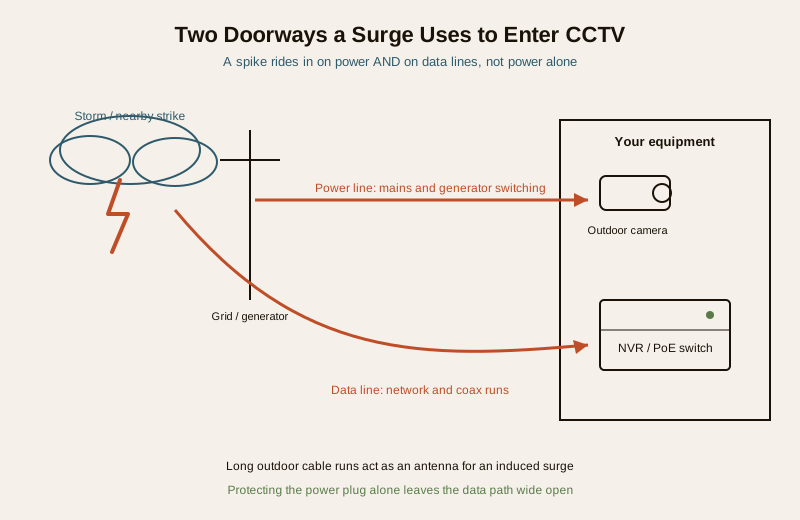
They live outdoors and reach across the building. An outdoor camera sits on an exposed wall, often the highest point on a boundary, connected by a long cable back to a recorder indoors. That long conductor is an excellent antenna for an induced surge, and the outdoor end is closest to the weather. The more cameras and the longer the runs, the larger the net you have cast to catch a passing spike.
They connect on two fronts at once, and this is the point people miss. A surge does not only travel on the power wire. It couples just as readily onto the data line, the network cable carrying video, or the coax on an older analogue system, and on Power over Ethernet the same cable carries both power and data. Protecting only the mains plug leaves the data path wide open, and a spike that comes in on the network cable can wipe out a PoE switch and every camera hanging off it. Both conductors matter.
And they share a fate. Cameras, switch and recorder are all wired together, so a surge that enters at one exposed camera can travel down the shared cabling and take the recorder and the other cameras with it. This is why a single storm so often kills not one camera but the whole system at once. The interconnection that makes CCTV useful is also what lets one spike become a total loss.
The layers of protection
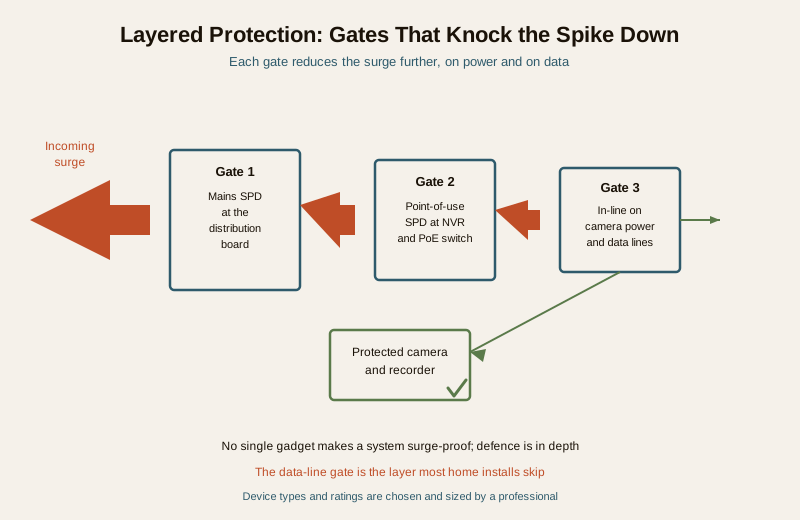
There is no single gadget that makes a system surge-proof. Real protection is layered, like a series of gates that each knock the spike down further before it reaches anything delicate. The idea is defence in depth: catch the big energy at the boundary, then progressively clean up what gets through, on every path into the equipment.
Layer one, at the incoming mains. A surge protective device, or SPD, installed in the main electrical distribution board by an electrician is the first and biggest gate. It clamps the large surges arriving from outside on the power supply before they spread through the building's wiring. This is the foundation. Sizing, type and placement of a mains SPD are an electrician's job, matched to the installation and verified against current standards, not something to guess at.
Layer two, point-of-use at the equipment. The board-level SPD does not catch everything, and surges can also be generated inside the building. A second, smaller stage of protection right where the NVR, DVR and PoE switch plug in cleans up what the first gate let through and stops locally generated spikes. This is the protected power strip or point-of-use SPD feeding your recording rack.
Layer three, in-line on the camera and data lines. This is the layer most home installs skip, and the one that saves the recorder. In-line surge protectors, small devices fitted on the actual signal path, protect the network or coax lines and the camera power, especially at the outdoor camera end and where cables enter the building. Because the surge rides the data line too, protecting the power path alone is only half a defence. On a serious install, both conductors on the exposed runs get protected.
Protection only works if the earth does
Here is the part that is easy to buy your way past and impossible to skip. Every surge protective device works by shunting the surge energy safely away to earth. If there is no good, low-resistance earthing to send that energy into, the SPD has nowhere to dump the spike and cannot do its job, however expensive it is. Surge protection and earthing are not two separate purchases; they are one system. Good earthing is the ground the whole defence stands on. This is important enough that it has its own guide: see earthing for CCTV and security equipment for what proper earthing involves and why it must be verified by a professional.
Surge protection also sits alongside, not instead of, a building's lightning protection. Where direct-strike risk is real, a tall or exposed structure needs a designed lightning protection system to carry a strike safely to earth, and the SPDs then handle the induced transients that get through. The two work together. For outdoor cameras specifically, see lightning protection for outdoor cameras.
The India context: three things to be clear about
Surges here are frequent, not freak events. Between monsoon lightning and a grid that switches, drops and restores often, a system in India meets far more transients than one in a placid supply area. Protection is not paranoia; it is ordinary maintenance of an expensive asset in a demanding environment.
A UPS or stabiliser is not surge protection. This is the most common and most expensive misunderstanding. A stabiliser corrects slow swings in voltage being too high or too low; a UPS keeps the system running through a power cut and smooths the supply. Both are useful and neither is designed to clamp a fast, high-energy transient from a lightning-induced spike. Some units include a basic surge component, but that is not the same as coordinated, layered surge protection on both power and data paths. Do not assume the inverter in the corner is protecting your cameras from a strike. Understand what your backup does and does not do in the CCTV power supply and UPS guide, and treat surge protection as a separate, deliberate layer.
Weatherproofing and surge protection are different problems. A well-sealed outdoor camera keeps water out, but water resistance does nothing about a voltage spike on the cable. A camera can be perfectly weatherproof to its IP rating and still be killed by a surge coming down the wire. You need both.
The big three, plainly. Surge protection is layered, not a single plug. It must be earthed to work at all. And a UPS or stabiliser is not a substitute for it. If any one of those three is missing, the system is exposed, however good the cameras are.
Practical placement, and why SPDs wear out
A few plain-language points about how this lives on a real building.
Protection belongs where the surge enters and where the sensitive gear sits. The heavy gate goes at the incoming supply. In-line protectors go at the exposed ends, at the outdoor camera and where cables cross from outside to inside, because that is where the induced energy is largest. The point-of-use stage sits at the rack with the recorder. The principle is simple: guard the entry points and guard the equipment, on every path.
The single most overlooked fact about surge protective devices is that they are sacrificial. An SPD does its job by taking the hit so your equipment does not, and each hit uses it up. After a big surge, or after a long slow accumulation of small ones, an SPD can be worn out or even destroyed while looking perfectly normal from outside. A dead SPD offers no protection at all, silently. Many devices have a status indicator, a window or light that shows whether the unit is still good, and part of maintaining a system is checking those indicators and replacing spent devices. A surge protector installed once and never looked at again may have stopped protecting anything years ago.
Why my cameras keep dying: a troubleshooting angle
If a system loses cameras or recorders repeatedly, especially after storms or power events, surges are a prime suspect, and the pattern usually gives it away.
- Failures cluster around storms or power cuts. Devices dying the morning after a monsoon night, or just after power returns from an outage, points hard at transients rather than ordinary wear.
- Outdoor cameras and long runs go first. If the units that fail are the exposed outdoor ones on the longest cables, that is the induced-surge signature.
- Multiple devices die together. One storm taking out the NVR and several cameras at once is the shared-cabling fingerprint of a surge, not a coincidence of separate faults.
- It repeats after replacement. Swapping in new cameras that then die too means the cause was never the cameras. Something is delivering the spike, and until protection and earthing are addressed, new hardware will keep feeding the same fault.
When the pattern fits, the fix is not another warranty claim; it is to have the electrical protection and earthing assessed. Repeated unexplained deaths of electronic security gear are, more often than owners expect, an earthing and surge problem wearing a hardware disguise.
The surge protection layers checklist
Run through this when specifying protection or reviewing an existing install with your electrician. It is a literacy checklist, not a design; the actual devices and their ratings are chosen and sized by a professional.
| Layer / question | What it covers | Who handles it |
|---|---|---|
| Mains SPD at the distribution board | The big surges arriving on the incoming power supply | Licensed electrician, sized to the install |
| Point-of-use protection at the rack | What the mains SPD lets through, plus locally generated spikes at the NVR, DVR and PoE switch | Electrician or integrator |
| In-line protection on camera power | Spikes on the power feed to each exposed camera | Integrator, at the camera and entry points |
| In-line protection on data and coax lines | The surge path most installs ignore, on network and coax runs | Integrator, both ends of exposed runs |
| Good, verified earthing | The safe path all SPDs shunt energy into; without it, nothing works | Electrician; earthing must be tested |
| Lightning protection where the risk is real | Carrying a direct or near strike safely to ground | Specialist consultant / electrician |
| SPD status checked and worn units replaced | Keeping the sacrificial devices actually protecting | Whoever maintains the system, on a schedule |
| UPS and stabiliser understood, not mistaken for surge protection | Backup and voltage-swing correction, a separate job | You, when specifying the system |
Who to ask, and when to get a design
Reading this makes you a far better client; it does not make you a surge-protection designer, and it is not meant to. Anything involving the distribution board, high-energy SPDs, or earthing is licensed electrical work with real shock and fire risk, and it must be designed and installed by a qualified professional and verified against current standards.
For a small home system, an experienced security installer working with a competent electrician can fit sensible protection and, crucially, confirm the earthing it depends on. For a larger property, a boundary full of cameras, a shop or an RWA-scale installation, or any site with real lightning exposure, it is worth having a licensed electrical engineer or consultant design coordinated protection across the whole system, mains, equipment and every data line, matched to the specific building. The cost of that design is small next to replacing a recorder and a wall of cameras every stormy season. For how surge protection sits within the wider electrical safety of a security system, see electrical safety for security systems.
Because what is required, and how it is sized, is governed by electrical standards and depends on your exact installation and site, treat everything here as the concepts, not the numbers. Have the specifics confirmed by a professional for your building.
Key takeaways
- Surges kill security gear silently, through the wires. Nearby lightning, grid switching and generator or transformer events send spikes down power and data lines; a single storm can wipe an NVR and every camera without a direct hit.
- CCTV is unusually exposed. Outdoor cameras, long cable runs, connection on both power and data paths, and shared cabling mean one spike can become a total loss.
- Protection is layered, not a single plug. A mains SPD at the board, point-of-use protection at the recorder, and in-line protection on camera power and on the data and coax lines, on both conductors.
- It only works if the earth does. Every SPD shunts surge energy to earth; without good, verified earthing it protects nothing, and it sits alongside lightning protection, not instead of it.
- A UPS or stabiliser is not surge protection, SPDs are sacrificial and must be checked and replaced, and for any serious install, have an electrician or consultant design coordinated protection and verify it for your building.
Where to go next
- Earthing for CCTV and security equipment — the ground the whole surge defence stands on, and why it must be tested.
- Lightning protection for outdoor cameras — the direct-strike side that works alongside surge protection.
- CCTV power supply and UPS — what backup and stabilisation do, and why they are not surge protection.
- Electrical safety for security systems — where surge protection fits in the wider electrical picture.
- CCTV weatherproofing and IP ratings — keeping water out, a separate problem from keeping spikes out.
- The security and fire regulations guide and the regulations hub — how the rules and standards frame safe electrical work.
References
- Bureau of Indian Standards (BIS) and the relevant standards on surge protective devices, earthing and electrical installations — govern what protection is required and how it is sized; verify the current standard and edition, and have any specification confirmed by a licensed professional, via the BIS portal: https://www.services.bis.gov.in/
- Electricity Act and the Central Electricity Authority safety regulations, generally — frame the safe design and installation of electrical protection and earthing; the specifics are set by the regulations and the electrical inspectorate and must be confirmed locally.
- Manufacturer and integrator guidance on surge protective devices for CCTV, on power, network and coax lines — describes point-of-use and in-line protection and the sacrificial nature of SPDs; treat ratings as design choices for a qualified professional, not fixed figures.
This is an educational literacy guide to protecting CCTV and security systems from electrical surges, not electrical design, an installation manual or authoritative code. Surge protective device selection, earthing and lightning protection are life-safety-relevant electrical work whose requirements are set by standards and vary with the installation and change over time; always have them designed, installed and verified by a licensed electrician or consultant for your specific building.
Export this guide
Related Guides — Deep-dive reading
Electrical Safety for Security Systems in India (2026): Powering It Without Peril
A homeowner's guide to the power side of home and RWA security systems, CCTV, alarms, gates, access control and NVRs, done so it protects you instead of quietly becoming a shock or fire hazard. What makes a supply safe, what to insist on, and why the mains work belongs to a licensed electrician.
SecurityLightning Protection for Outdoor Cameras in India (2026): Keeping the Strike Out
Why a pole-mounted or boundary-wall camera is one of the most lightning-exposed devices on your property, and how a homeowner thinks about the two threats, a direct strike and the far more common induced surge, and the coordinated protection, earthing and placement that keep gear alive through an Indian monsoon.
SecurityEarthing for CCTV and Security Equipment in India (2026): The Ground Truth
Why proper earthing quietly keeps your security system safe, alive and clear, what a good earth actually is in plain language, the tell-tale signs of a bad one, and why the earth itself is a job for a licensed electrician, never a do-it-yourself improvisation.
SecurityRelated Tools — Try Free
Security Cabling & PoE Planner
Estimate cable length, drops, PoE power budget, the right switch, conduit and cost for a CCTV/security cabling plan.
Cabling PlannerSecurity Backup Power Calculator
Size a UPS/inverter and battery to keep CCTV, NVR, router and alarm running through a power cut — load, Ah, VA and cost.
Backup PowerCCTV Camera Coverage & Count Calculator
Estimate how many CCTV cameras you need, the NVR channels, storage in TB for your retention period, and an indicative all-in cost with GST.
CCTV Calculator