
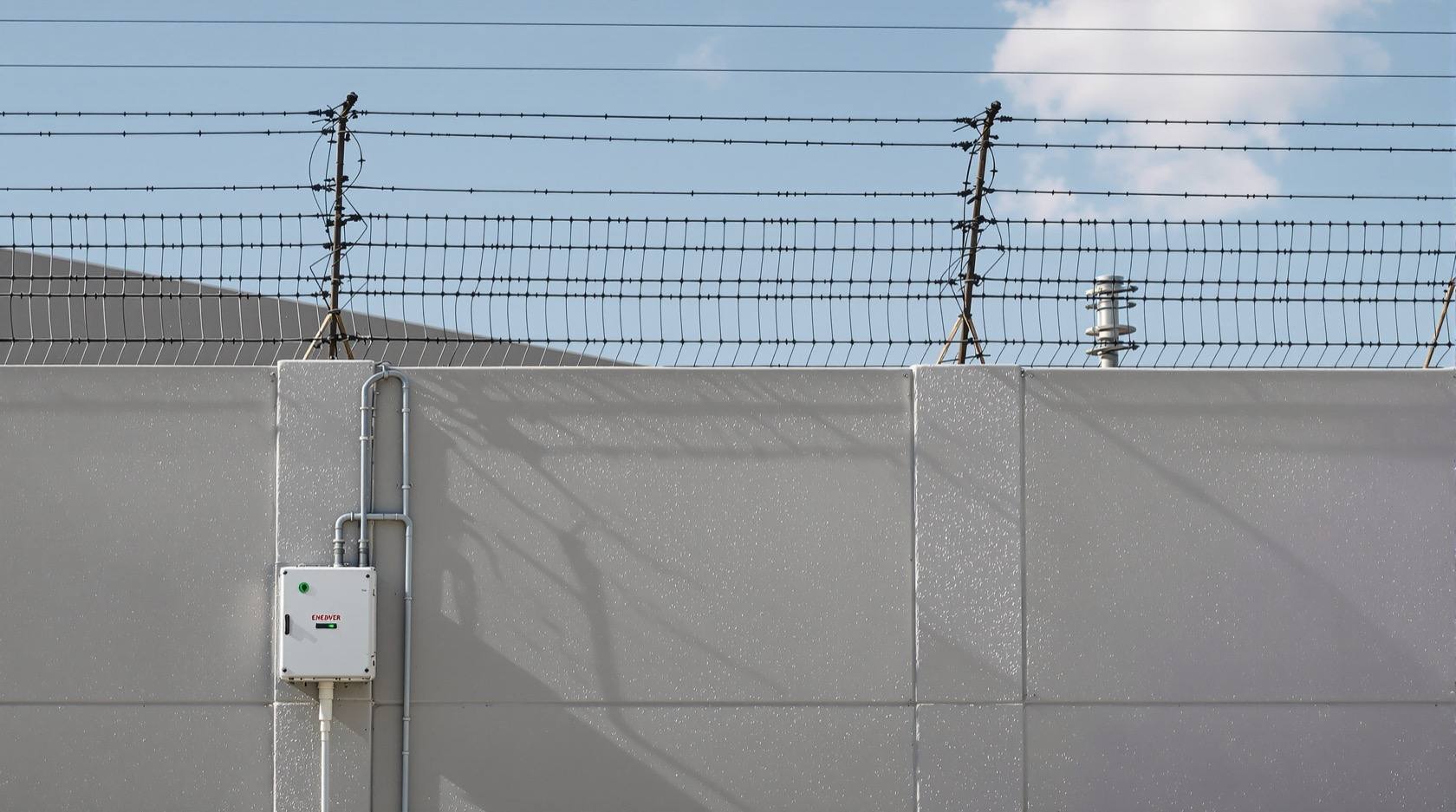
Electric Fence Cost in India (2026): Energizer, Wire, Posts and Install Prices
What a security electric fence really costs in India, honestly: priced by the running metre and the energizer, split into capex (energizer, wire, posts, earthing, signage, install) and the very low opex, with wide indicative 2026 bands and a plain safety-and-legality warning.
A security electric fence is priced unlike almost anything else on a home-security quote, because it is sold two ways at once: by the running metre of boundary you want to protect, and by the energizer — the controller box that sends the pulse down the wires. Ask two installers to price the same compound and the metre-rate may look similar, yet the totals diverge, because one has sized a small energizer for a short wall-top run and the other has specified a bigger unit split into several independently-monitored zones. Neither is wrong; the honest answer is a set of wide bands, not a single figure, and those bands move with perimeter length, the number of zones, and whether the fence sits on top of an existing wall or stands on its own posts.
This guide breaks the electric fence cost into the parts that actually appear on the bill: the energizer or controller unit that is the heart of the system, the wires and insulators, the posts, the earthing system, the mandatory warning signage, an alarm or integration output, and specialist installation. Every figure here is an indicative 2026 band, GST extra unless noted, and every one varies by city, brand, terrain and installer. It sits within Studio Matrx's home-security cost pillar and the wider perimeter security cost picture — an electric fence is one perimeter deterrent among several, not the whole boundary.
Scope & safety. This is a budgeting and specifying guide, not a fitting manual, and it is not legal advice. Every price here is an indicative 2026 band that varies by perimeter length, zones, brand, terrain and installer — treat it as a way to sanity-check a quote, never a fixed rate. A security electric fence is a non-lethal, pulsed-shock deterrent, not a lethal live-mains fence — the latter is illegal, deadly and never an option. A compliant system is properly earthed, clearly signed, kept within safe pulse limits and installed by a specialist. Get at least three written, itemised quotes, insist on a compliant certified energizer and warning signage, and separate one-time capex from the small ongoing opex before you decide.
First, the safety and legality line you do not cross
Before any number, one distinction governs everything. There are two completely different things people loosely call an "electric fence", and only one of them is a security product.
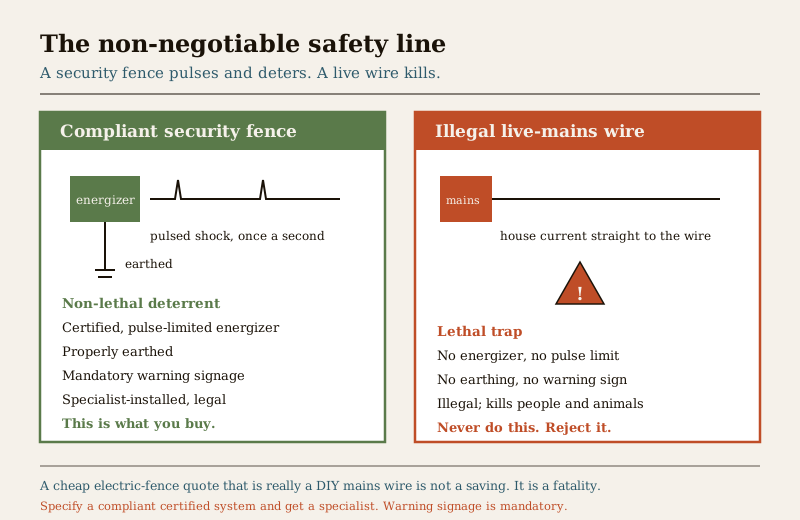
- A compliant security electric fence carries a pulsed shock: a certified energizer sends a brief, high-voltage, very-low-energy pulse down the wires roughly once a second. It is designed to be a startling, painful, memorable deterrent — and to be non-lethal. The pulse energy is limited, the system is earthed, and it is fitted by a specialist to a standard.
- A live mains-hooked wire — someone running house current straight to a fence — is not a security system. It is a lethal trap. It is illegal, it kills people and animals, and it has killed the very householders who rigged it. It is never, under any circumstances, what this guide is pricing.
Everything below assumes the first: a certified, properly-earthed, clearly-signed, pulse-limited system installed by a specialist. If a "cheap electric fence" quote is quietly the second thing — a DIY wire off the mains — it is not a saving, it is a fatality waiting to happen. Reject it outright. Warning signage is mandatory on a compliant fence for exactly this reason: everyone approaching the boundary must know the wire bites. Specify a compliant certified system and get a specialist; that is the whole stance of this guide.
Where the money goes: the bill of materials
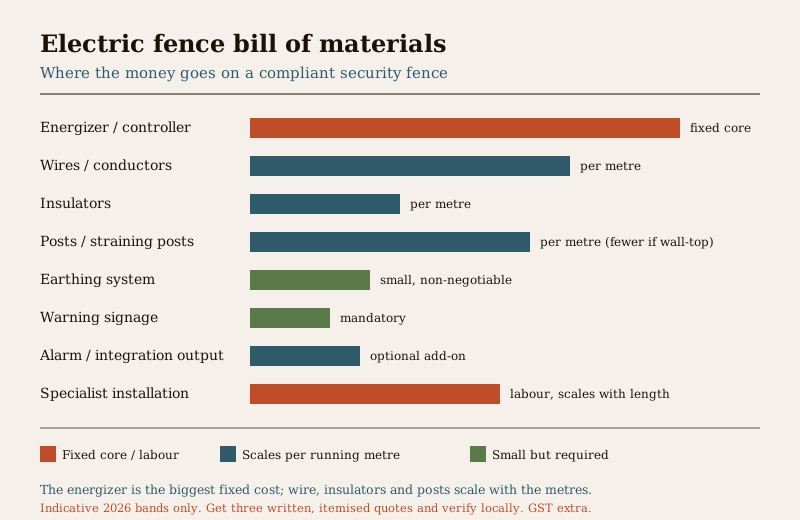
An electric fence quote is really seven line items. Two of them are a roughly fixed core that you pay whether your boundary is short or long; the rest scale with the length of the run.
| Component | What it is | How it scales | Share of a typical job |
|---|---|---|---|
| Energizer / controller | The heart: generates the pulse, sized to total wire length and split by zone; a monitored controller adds alarm logic | Fixed core, steps up with total length and zones | Large fixed chunk |
| Wires / conductors | The live and earth conductors strung along the boundary, usually several parallel lines | Per metre, multiplied by number of lines | Scales with length |
| Insulators | Isolate each wire from posts and wall | Per post, per line | Scales with length |
| Posts / straining posts | Carry the wires; standalone fences need many, wall-top runs need short brackets | Per metre (fewer for wall-top) | Scales with length |
| Earthing system | Earth rods and earth wire — the safety backbone that makes the shock work and stay safe | Semi-fixed, more for long/dry-soil runs | Small but non-negotiable |
| Warning signage | Mandatory yellow warning signs at intervals along the fence | Per sign, at set intervals | Small, required |
| Alarm / integration output | Wiring the fence alarm to a siren, keypad or your home-security panel and app | Optional add-on | Small to moderate |
| Specialist installation | Survey, mounting, tensioning, earthing, commissioning and testing the pulse | Labour, scales with length and terrain | Moderate |
The one that surprises people is the energizer. It is the single biggest fixed cost, and it is sized to the job — a small unit for a short wall-top run, a larger multi-zone controller for a long boundary you want split into separately-monitored sections. Under-size it and the fence under-performs on a long run; over-size it and you have paid for capacity you never use. This is exactly why the number of zones matters: each independently-monitored zone tells you which stretch of boundary was hit, but it also adds controller capacity and wiring.
Capex: the one-time build cost
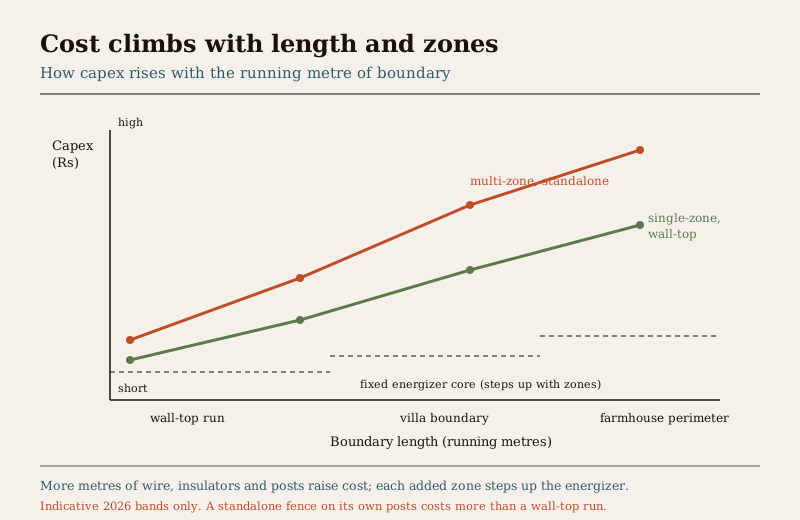
The build cost is best thought of two ways — a per-metre band for the run, plus the energizer sized on top — and then sanity-checked against a whole-perimeter band for a typical home.
The per-metre band
As a wide, honest 2026 band, a compliant multi-line security electric fence — wire, insulators, posts or wall-top brackets and the labour to string and tension it — commonly lands in the region of roughly Rs 250 to Rs 700 per running metre, before the energizer. The spread is real and driven by:
- Wall-top mount versus standalone fence. Sitting the fence on top of an existing compound wall is the cheaper case — short brackets, no ground posts, less material. A standalone fence on its own posts, or a taller multi-line run, sits at the upper end because it needs full posts, more wire lines and more labour.
- Number of wire lines. Two or three lines cost far less per metre than an eight- or ten-line high-security curtain.
- Terrain and access. A straight, level, easily-reached wall is cheap to fit; a sloping, cornered or overgrown boundary costs more in labour.
The energizer, sized on top
On top of the per-metre run sits the energizer as a largely fixed cost. A small single-zone energizer for a modest wall-top run is the entry case; a multi-zone monitored controller for a long boundary is several times that. As a rough 2026 band the energizer and its controller commonly add somewhere in the region of Rs 8,000 to Rs 60,000+ depending on capacity, the number of zones and whether it is a plain energizer or a monitored, alarm-integrated controller.
The whole-perimeter sanity check
Put together, an indicative all-in capex band for a compliant, signed, earthed and commissioned security electric fence looks roughly like this. These are wide bands to be checked against three quotes, not a rate card.
| Property | Typical boundary | Mount | Indicative all-in capex (2026, GST extra) |
|---|---|---|---|
| Small urban plot / villa | ~40 to 80 m, wall-top, 1 zone | On existing wall | ~Rs 25,000 to Rs 80,000 |
| Larger villa / bungalow | ~80 to 150 m, wall-top, 1 to 2 zones | On existing wall | ~Rs 60,000 to Rs 1,50,000 |
| Farmhouse / large plot | ~200 to 500 m, standalone or wall-top, multi-zone | Mixed / standalone | ~Rs 1,50,000 to Rs 5,00,000+ |
The driver behind the whole table is the two that push you up any band: perimeter length (more metres of wire, insulators and posts) and number of zones (more controller capacity and alarm wiring). A farmhouse is the steepest jump not only because it is long, but because it is often a standalone fence on open ground rather than a neat wall-top run.
Opex: the running cost is genuinely low
Here is the good news that sets an electric fence apart from a monitored alarm or a guardhouse. Its ongoing cost is small.
| Running item | What it is | Indicative cost (2026) | Notes |
|---|---|---|---|
| Electricity | The pulse draws very little power | Negligible — tens of rupees a month at most | The energizer sips power; this is not where the cost lives |
| Battery / backup | Backup battery so the fence stays live through power cuts | Battery replacement every few years, a few thousand rupees | Essential in India's load-shedding — a fence that dies with the power is no deterrent |
| Maintenance / AMC | Periodic check of tension, insulators, earthing and pulse | A modest yearly service, often bundled the first year | Keeps the shock and the alarm honest |
| Vegetation clearing | Keeping plants, creepers and branches off the wires | Your time, or a gardener's | The single most important upkeep — see below |
The line that actually matters here is vegetation clearing. A leaf, a creeper or a branch touching the wires shorts the fence: it drains the pulse and can trigger endless false alarms, and a fence that cries wolf gets switched off — which is how an expensive install quietly stops protecting anything. Budget the upkeep as keeping the boundary strip clear, not as a big rupee line. Electricity, by contrast, is a rounding error: a certified energizer draws so little that the running electricity bill is one of the smallest opex lines in the whole of home security.
Where an electric fence is worth it, and where it is not
Cost only makes sense against value, and this is a product with a very specific sweet spot.
- Excellent value for villas, farmhouses and large plots. A long, quiet, hard-to-watch boundary is exactly what an electric fence is for. It is an outstanding early-warning deterrent: it announces itself, it hurts, it alarms, and it turns an easy climb-over into a decision most intruders will not make. Paired with good security lighting and the rest of a layered perimeter, it is a strong spend on a big boundary.
- Overkill for a small urban flat. For an apartment, or a small house with a short, overlooked boundary in a busy street, an electric fence is usually more system than the risk warrants — the money is better spent on the door, an alarm and a camera. Right-size to the real threat rather than fencing a boundary that neighbours already watch.
- Never the only layer. An electric fence deters and warns at the line; it does not replace a locked door, an alarm or a response. It is one layer in a plan, which is why it belongs inside a security cost-planning exercise rather than bought in isolation.
Reading an electric-fence quote honestly
When you compare quotes, make them comparable first, and use the safety line above as your filter.
- Confirm it is a compliant, certified, pulsed energizer — ask for the make and that it is a proper security energizer, not a mystery box wired to the mains. This is the non-negotiable.
- Ask for energizer, wire/insulators, posts, earthing, signage, alarm output and installation as separate lines, plus the perimeter length in metres and the number of wire lines and zones.
- Confirm earthing and warning signage are included and priced — a quote that omits either is not a compliant quote.
- Check the backup battery is included and sized for your typical power cut.
- Ask what is recurring: the maintenance/AMC terms, expected battery-replacement cycle, and who keeps the boundary strip clear of vegetation.
- Remember GST applies to both equipment and installation; a reputable installer shows it on the invoice.
Three written, itemised quotes will tell you far more than any single headline metre-rate. For the wider boundary picture this sits in, start from the perimeter security cost guide and the perimeter hub; for how it fits a whole-home budget, the home-security cost pillar and the security cost sub-hub.
Key takeaways
- A security electric fence is priced two ways at once — by the running metre and by the energizer — so the honest answer is a wide band, not one figure; the biggest drivers are perimeter length, number of zones, and wall-top versus standalone.
- The energizer is the largest fixed core cost, sized to total wire length and zones; wire, insulators and posts scale with the metres; earthing and mandatory warning signage are small but non-negotiable.
- Capex is real, opex is genuinely low — the electricity is negligible; the running budget is mostly backup-battery replacement, a modest AMC, and keeping vegetation off the wires so it does not short or false-alarm.
- The safety line is absolute: a compliant electric fence is a non-lethal, pulsed, earthed, signed, specialist-installed deterrent; a live mains-hooked wire is illegal and lethal and is never what you are buying. Specify a certified system and reject any cheap quote that is really a DIY wire.
- Value-honest: an excellent early-warning deterrent for villas, farmhouses and large plots; usually overkill for a small urban flat; and never the only layer. Get three itemised quotes, verify prices locally, and remember GST applies.
References
- Manufacturer specifications and datasheets — verify that any energizer is a certified security energizer with limited pulse energy, and confirm capacity, zone count, earthing requirement and backup-battery support on the maker's own datasheet before ordering; prices quoted here are indicative 2026 bands only, not manufacturer or installer rates.
- Bureau of Indian Standards and the National Building Code of India (SP 7) for the electrical, earthing and installation aspects of a fixed perimeter system; verify the current edition and any applicable standard via the BIS catalogue before relying on it: https://www.services.bis.gov.in/
- General product safety and local law — a security electric fence must be a non-lethal, pulse-limited, earthed and clearly-signed system installed by a specialist; a live mains-connected fence is unlawful and deadly. This guide does not give legal advice; confirm the current legal and signage requirements with a qualified specialist and local authority before installing.
This is an educational budgeting overview, not legal, electrical or financial advice. All prices are indicative 2026 bands that vary by perimeter length, zones, terrain, brand and installer — get a written, itemised quote and verify locally. Earthing, mains isolation and commissioning are qualified specialist tasks; engage a certified installer, insist on a compliant non-lethal energizer and mandatory warning signage, and verify any standard's current status via the BIS catalogue before relying on it.
Export this guide
Related Guides — Deep-dive reading
Wireless CCTV Cost in India (2026): Cheap to Buy, Read the Running Costs First
What Wi-Fi and wire-free CCTV really costs an Indian home — a low, DIY-friendly install price that hides a subscription, battery and reliability bill. An honest, capex-versus-opex look at where the money actually goes over three to five years, with indicative bands and the drivers that move them.
SecurityFire Alarm System Cost in India (2026): What a Code-Compliant System Really Costs
An honest, building-scale look at what a fire alarm SYSTEM costs in India — the control panel, detectors, manual call points, sounders, wiring and battery backup — and how conventional versus addressable architecture, the number of zones, floors and occupancy type move the total, always as indicative bands to price against three itemised quotes and never below the code minimum.
SecurityPerimeter Security Cost in India (2026): Priced by the Metre and by the Layer
What a boundary really costs to secure — priced by the running metre of line and by the layers you add (wall or fence, anti-climb topping, detection, lighting, gates and monitoring), with the two big cost drivers, capex versus opex, and how to right-size the spend to the real threat.
SecurityRelated Tools — Try Free
Apartment vs Villa Interior Planning Guide
Compare ceiling height, structural flexibility, lighting, storage, and services between apartments and villas.
Planning GuideElectrical Safety & Load Audit
Home electrical audit — 10 categories, 65+ checkpoints across earthing, RCCB, MCB, wiring, switchboards, appliance circuits, DG/inverter backup.
Safety AuditStamp Duty Calculator — All Indian States
Stamp duty + registration charges for all 28 states and 8 UTs — gender concessions, urban/rural variants, metro cess built in.
Stamp Duty